
LEGO Technic: The Toy That Teaches You More About Cars Than Your Mechanic
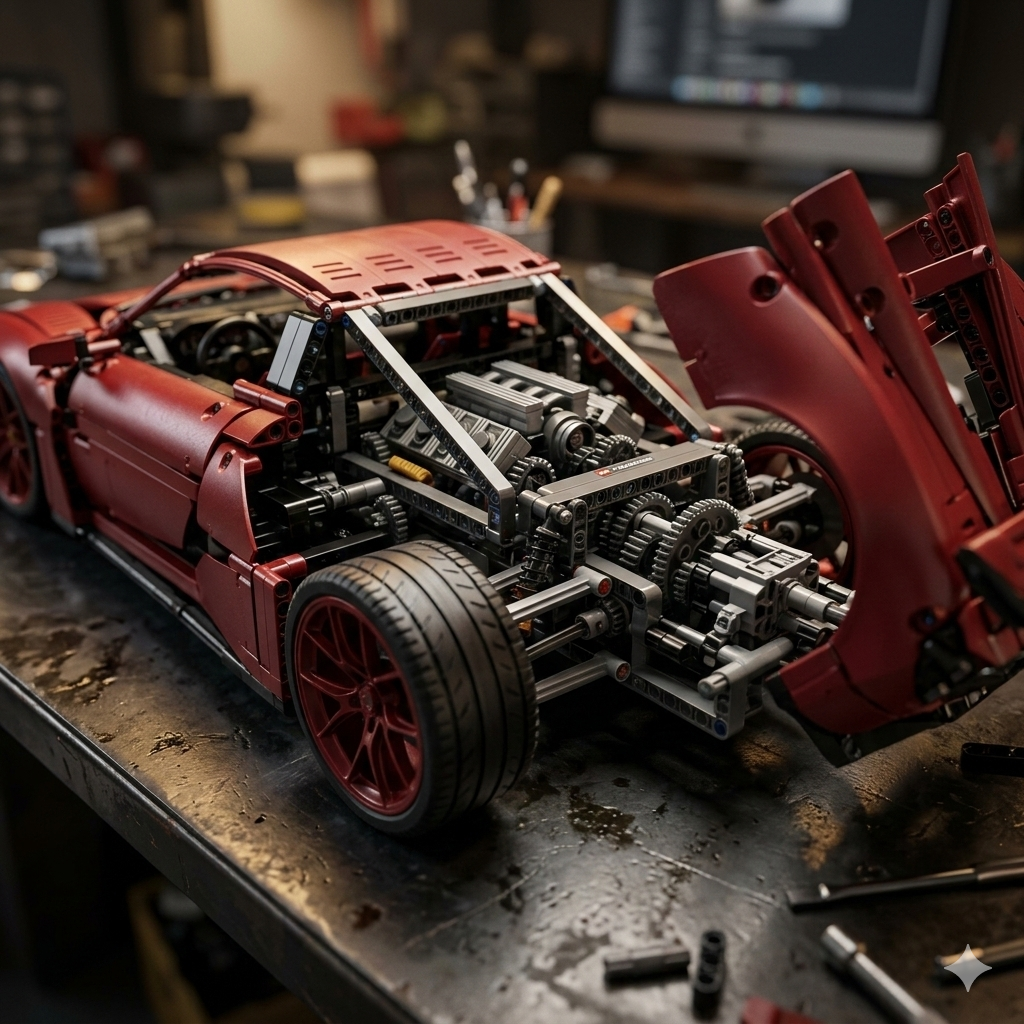
There’s a test I like to run on people who claim to know about cars. I don’t ask them about horsepower figures or quarter-mile times. I ask them what a differential does. Or how a sequential gearbox works. Or why independent suspension matters.
Most can’t answer. But I know a group of people who can: anyone who’s built a LEGO Technic supercar.
That’s not a joke. Since 1977, LEGO’s Technic line has been quietly producing the most effective mechanical engineering education program ever created — disguised as a toy. And since 2016, their “Ultimate Car Series” has turned 1:8 scale replicas of Porsche, Bugatti, Lamborghini, Ferrari, and McLaren supercars into working mechanical models that you build with your own hands.
Let me tell you why this matters more than you think.
From Expert Builder to Mechanical Revolution
LEGO Technic launched in 1977 under the name “Expert Builder” (or “Technical Sets” depending on the market). The concept was elegantly subversive: take a children’s construction toy and embed actual mechanical engineering principles into it.
Standard LEGO bricks let you build shapes. Technic pieces let you build functions. The difference is the same as between a photograph of an engine and an engine that actually runs.
The system introduced components that had never existed in a toy before: beams with holes for axles to pass through, gears of varying sizes for power transmission and speed ratios, universal joints for transferring motion at angles, and differential gears that replicate real vehicle drive mechanisms.
The flagship set was the 853 Auto Chassis, designed by Jan Ryaa and Erik Bach. A naked car chassis featuring a four-cylinder inline engine with moving pistons, a two-speed transmission, steering controlled by a wheel, and adjustable seats. In 1977. For a toy.
The line was officially renamed “LEGO Technic” in 1982 and has evolved continuously since. Each decade brought innovations mirroring real engineering advances: pneumatic systems with air pumps and cylinders in 1985. Studless beams enabling sleeker aerodynamic shapes in the 1990s. Power Functions electric motors with infrared control in 2007. And in 2018, the Powered Up system (branded CONTROL+ for Technic sets) with Bluetooth motor control via smartphone app.
The Ultimate Car Series: Where LEGO Gets Serious
In 2016, LEGO Technic crossed a threshold. It stopped making “car models” and started making engineering replicas.
The first entry in what would become the “Ultimate Car Series” was the 42056 Porsche 911 GT3 RS. At 2,704 pieces and 1:8 scale, this was a statement piece. Working gearbox. Flat-six engine with moving pistons. Independent suspension. Functional steering. Premium packaging with a collector’s booklet featuring the car’s history and designer interviews.
Two years later came the 42083 Bugatti Chiron: 3,599 pieces. A W16 engine with moving pistons — the most complex Technic engine built at that point. Eight-speed gearbox with paddle shifters. An active rear spoiler toggled by a “speed key.” Even a Bugatti overnight bag built from Technic pieces inside the box.
The 42115 Lamborghini Sián FKP 37 followed in 2020 with 3,696 pieces, signature scissor doors, a transparent engine cover revealing the V12, and gold-lacquered wheels. Many collectors consider it the most visually stunning of the five.
The 42143 Ferrari Daytona SP3 raised the bar in 2022 with 3,778 pieces — the highest in the series. V12 engine, eight-speed sequential gearbox with paddle shifter, butterfly doors, and every decorative element printed rather than stickered. A limited-edition coffee table book titled “The Sense of Perfection” accompanied the launch.
And in 2024, the 42172 McLaren P1 completed the quintet with improved butterfly doors, redesigned suspension, and what reviewers call the best gearbox in the series.
Each set is developed in direct collaboration with the actual manufacturer. LEGO engineers work alongside teams from Porsche, Bugatti, Lamborghini, Ferrari, and McLaren to ensure both form and function are as faithful as possible.
The Full-Size LEGO Bugatti Chiron: When the Toy Became Real
In August 2018, LEGO did something nobody thought possible.
They built a full-size, drivable Bugatti Chiron using exclusively LEGO Technic pieces. Over one million of them. No glue.
The project originated within the LEGO Technic design team in Billund, Denmark, led by designer Aurelien Rouffiange. After completing the 1:8 scale Chiron, the team asked: what would be the ultimate challenge for the Technic building system? The answer was a real-size car that could move under its own power.
Construction took place at LEGO’s facility in Kladno, Czech Republic, by a team of 16 specialists over 13,438 hours. The car used 339 different types of Technic pieces, including 58 custom elements created specifically for the build.
Propulsion came from 2,304 LEGO Power Functions L-Motors arranged in 24 packs of 96 motors each, driving through 4,032 Technic gear wheels and 2,016 cross axles connected to a steel chain that turned the wheels. Total theoretical output: 5.3 horsepower. Estimated torque: 92 Nm. Weight: 1,500 kilograms. Top speed: just over 20 km/h — roughly 12 mph.
It’s not a real Chiron with its 1,500 horsepower and 261 mph top speed. But it’s a functional car made entirely of plastic that drives, brakes, has working lights, a movable rear spoiler, a Technic-built speedometer, and a detailed interior with seats, dashboard, and steering wheel.
Andy Wallace, Bugatti’s official test driver with multiple wins at the 24 Hours of Le Mans and Daytona, drove it at Bugatti’s test track in Germany. His verdict: driving it “felt a lot faster” than 12 mph.
Real Engineering Inside Every Box
What sets LEGO Technic apart from any other car replica isn’t the exterior — it’s the internals.
Every Ultimate Car set contains a working gearbox with actual gears transmitting motion. The engines have pistons that move when you push the car. The suspensions compress and extend. The steering turns the wheels. The differentials distribute motion between axles.
These aren’t simulations. They’re functional mechanisms demonstrating the same engineering principles that operate in the real car, at a different scale.
The Technic gear system includes 8, 16, 24, and 40-tooth spur gears; 12, 20, 28, and 36-tooth double bevel gears; plus clutch gears and friction gears that slip at a set torque threshold — exactly like a real torque limiter. The sequential gearboxes in the Ultimate Car sets use paddle shifters with mechanical detents. Reviewers have compared the Ferrari Daytona SP3’s gearbox to watchmaking precision.
Beyond Supercars: The Broader Technic Universe
The Ultimate Car Series dominates headlines, but LEGO Technic extends far beyond five premium sets. The automotive section alone spans dozens of active sets across multiple sub-themes and price points.
Speed Champions offers smaller-scale replicas of iconic cars — from the Nissan Skyline GT-R R34 of Fast & Furious fame to the Porsche 911 Turbo 3.0. These sets typically run between 200 and 600 pieces, making them accessible entry points for younger builders or adults who want a weekend project rather than a week-long commitment. Creator Expert set 10295 offers a two-in-one Porsche 911 where you choose between building a Turbo or a Targa — a clever nod to the eternal debate among Porsche enthusiasts about which configuration is the definitive 911.
At the other extreme, the 42146 Liebherr LR 13000 Crawler Crane is among the largest LEGO sets ever produced, controllable via smartphone app. And sets like the Jeep Wrangler 42122 — with working suspension that flexes like the real thing — the Ford Mustang Shelby GT500 with its augmented reality features, and the Mercedes-Benz Arocs 3245 with pneumatic functions demonstrate the system’s extraordinary range.
The MOC (My Own Creation) community is where Technic gets truly wild. Independent builders worldwide create replicas of cars LEGO would never produce officially — Lancia Delta Integrale, Audi Quattro, Toyota AE86, BMW E30 M3, and dozens more. The community shares building instructions online, often for free, creating a parallel ecosystem of automotive replicas that caters to niche tastes no corporate product line could serve.
Some MOC builders go further still. Third-party companies like ZENE Bricks produce RC conversion kits that transform static Technic models into remote-controlled machines. Motorized Technic Porsches have been clocked at over 60 km/h — with plastic bodies. There’s an entire subculture of Technic racing where builders optimize gear ratios, motor configurations, and weight distribution to extract maximum performance from a handful of plastic parts and tiny electric motors. It’s Formula 1 engineering principles applied to toys, and the crossover between real automotive engineering and Technic optimization is closer than most people realize.
Pricing and the Investment Angle
The Ultimate Car Series commands premium pricing. The Porsche GT3 RS launched at around $300. The Bugatti Chiron at roughly $370. The Lamborghini Sián and Ferrari Daytona SP3 between $380 and $450. The McLaren P1 debuted at approximately $450.
Here’s where it gets interesting for collectors: retired sets appreciate. The Porsche 911 GT3 RS (42056), discontinued in 2020, commands significantly above retail on the secondary market. The Bugatti Chiron (42083), also retired, follows a similar trajectory.
Sealed, unopened LEGO Technic sets have become a legitimate alternative collectible investment, with the Ultimate Car Series and premium licensed editions showing predictable appreciation curves.
What LEGO Technic Actually Teaches About Cars
This is what connects LEGO Technic to the core mission of Not Enough Cylinders.
When you build a Technic supercar, you understand things a spec sheet can never convey. You understand why more cylinders means smoother power delivery — because you see the pistons alternating. You understand what a differential does — because you build one with your hands. You understand why independent suspension outperforms a solid axle — because you feel the difference pushing the model across a table.
LEGO knows this. Technic has been adopted into school and university curricula as a teaching tool for mechanical engineering principles. Generations of industrial engineers, designers, and architects cite LEGO Technic as their first inspiration.
Interlinking NEC
If Technic replicas left you wanting the real thing, check out our deep dives on the Porsche 911, the Lamborghini Aventador, Ferrari’s history, and the Bugatti story. For another perspective on automotive culture in miniature, read our piece on Hot Wheels.
The Hot Take: Building a LEGO Technic Bugatti Teaches You More About Cars Than Owning One
I’ll stand by this claim.
Someone who builds the LEGO Technic Bugatti Chiron — all 3,599 pieces — understands more about how a real car works than 90% of people who buy a car every year.
They’ve assembled an eight-speed gearbox with their own hands. They’ve watched gears transfer power from engine to wheels. They’ve felt suspension absorb irregularities. They’ve verified that a differential allows two wheels to rotate at different speeds in a corner.
A spec sheet tells you a car has “independent McPherson suspension.” LEGO Technic shows you what that actually means. With your hands, not with marketing copy on a screen.
The automotive industry spends billions on marketing to explain why their cars are special. LEGO achieves the same thing with an instruction manual and a bag of plastic parts.
Am I exaggerating? Maybe. Build one and tell me I’m wrong.
Comments are open.