
Life Is a Gift — The Story of María de Villota, the Spanish Woman Who Broke Every Barrier in Motorsport and Paid With Her Life
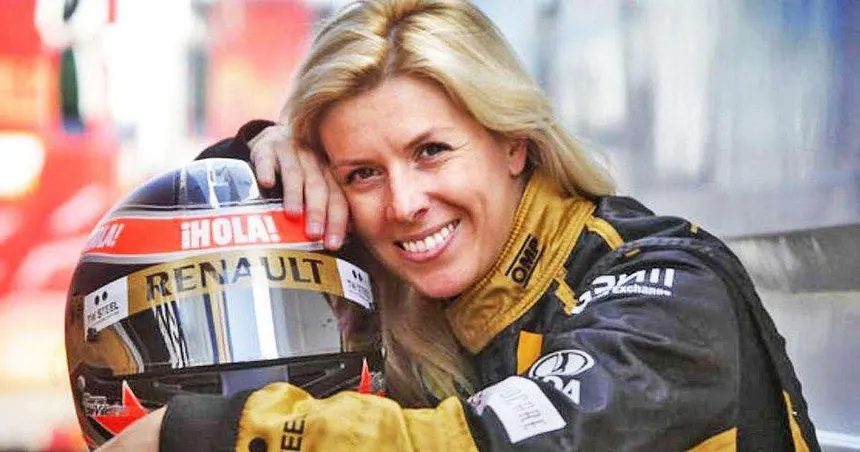
There are stories that aren’t told to fill a feed. They’re told because if they’re not told, we deserve them a little less.
María de Villota Comba. Madrid, Spain. January 13, 1979. Daughter of Emilio de Villota, one of the first Spaniards to race in a Formula 1 Grand Prix and founder of the first racing school in Spain and Portugal.
At 16, she sat in a kart for the first time. She won her first race. And she didn’t stop for 17 years.
Her father used to wake her up before dawn to go running through the fields. She hated it. But she went. She always went. He’d tell her: “Do you want to be a racing driver or not? If you’re not willing to put in the work, you don’t want it badly enough.” And María would get up cursing, but she went.
What followed wasn’t a fairy tale. It was a 17-year racing career, category by category, result by result, against a system that didn’t open a single door she didn’t have to kick down herself.
1996–2000: Karting
Debut at the Havana Grand Prix. First race, first win. Four years competing in Spanish karting while continuing her education. At 20, she was selected from a pool of 2,500 drivers for the MoviStar Racing Formula program — Spain’s official pathway into single-seater racing. She’d actually been placed as an alternate. When one of the selected drivers couldn’t make it, María stepped in. She never gave the seat back.
2000–2001: Formula Toyota Castrol 1300
Her debut in single-seaters came with Team MoviStar in the Formula Toyota Castrol 1300 — the Spanish Formula Junior Championship. First season was a learning year. In 2001, the results came: victories at Albacete and Valencia, runner-up in the Spanish championship, only beaten by her own teammate Juan Antonio del Pino. At 22, María became the only woman ever to finish runner-up in a Spanish national single-seater championship. A record that still stands.
2002–2005: Spanish Formula 3 Championship
The step up to F3 was brutal. In 2002, she raced with Meycom, finishing all 13 races inside the points — pure consistency. In 2003, she signed with GTA Motor Competición, the team owned by Domingo Ochoa. Yes, that Domingo Ochoa. The same Valencian who started as an apprentice mechanic at 13 in a small workshop in Torrent, spent seven years at the Ferrari dealership in Valencia, founded his own racing team at 29, and would go on to create the GTA Spano — Spain’s only hypercar.
Through Domingo’s racing operation passed Marc Gené, Jaime Alguersuari, Roberto Merhi, Carmen Jordá, Matthias Lauda. And María de Villota.
For American readers who may not recognize all those names: Gené raced in F1 for Minardi and became Ferrari’s test driver. Alguersuari became the youngest F1 driver in history at the time when he debuted for Toro Rosso at 19. Merhi raced in F1 for Manor. Lauda is the son of three-time world champion Niki Lauda. That was the caliber of talent flowing through Domingo Ochoa’s team in a factory in Valencia.
The F3 results weren’t there — thirteenth with GTA in 2003, similar outcome with Racing Engineering in 2004. Spanish F3 was hostile territory. María knew it. She admitted it without excuses. But she didn’t quit. She changed strategy.
2005: 24 Hours of Daytona
First Spanish woman to race in the 24 Hours of Daytona. GT Class with a Ferrari Modena for the Baron Team. Ninth position. At 26, María already had international endurance experience on one of the most iconic circuits in American motorsport — the same Daytona that hosts the Rolex 24 every January. She raced there. On the banking. In a Ferrari.
2005–2006: Ferrari Challenge
She competed in the Ferrari European Challenge with the Baron Team. At the Ferrari World Finals in Mugello, Italy, she took pole position. The first woman to achieve that in the history of the championship.
2006–2007: WTCC and ADAC
In 2006 and 2007, she was an official Chevrolet works driver in the World Touring Car Championship (WTCC). The first woman to compete in the history of the championship. She raced in the Race of Spain rounds driving a Chevrolet Lacetti for Maurer Motorsport.
Simultaneously, in 2007, she competed in the German Touring Car Championship ADAC Procar with Chevrolet. She finished third overall. And here, María spoke candidly about what it meant to be a woman in that environment: “The year I felt the most rejection without a doubt was when I raced the German Touring Car Championship.”
She didn’t brag about it. She didn’t complain. She stated a fact. And kept driving.
2008: Euroseries 3000 and DTM Test
Back to single-seaters. She competed in the Formula 3000 Euroseries with Emilio de Villota Motorsport. Best result: seventh position at Spa-Francorchamps — the same legendary Belgian circuit that hosts the F1 Belgian Grand Prix. That same year she completed a test with Audi in DTM and another evaluation for the Superleague Formula.
2009–2011: Superleague Formula
Three seasons as official driver for Atlético de Madrid. First woman in the history of the Superleague Formula. Fourth place at Nürburgring in 2010 as her best result. She raced against professional drivers in spec single-seaters on circuits like Jarama, Nürburgring, Brands Hatch, and Estoril.
2011: The Leap to Formula 1
August 2011. Paul Ricard Circuit, southern France. Lotus Renault GP confirmed that María de Villota had completed a test at the wheel of a Renault R29. Three hundred kilometers. She broke a 25-year gap without any female representation behind the wheel of a Formula 1 car.
Weeks later, María drove a Renault R30 in an exhibition run at the final round of the World Series by Renault at the Circuit de Catalunya in Barcelona.
This wasn’t a PR stunt. This was a driver with 15 years of competition under her belt, 11 different categories on her résumé, experience in single-seaters, touring cars, GT, endurance, and three seasons in the Superleague preparing her for the final step.
2012: Marussia F1 Team
March 7, 2012. Marussia F1 Team announced María de Villota as their test driver. Her debut as a development driver took place at the Australian Grand Prix in Melbourne. She lacked the Super License needed to race in a Grand Prix, but her first official test was scheduled for the Young Driver Test at Yas Marina at the end of the season.
María said it at her presentation: “I’m going to prove that they made the right choice picking me as a driver, and as a woman. I’m going to keep fighting because my ambition is to race.”
She passed her medical and physical examination at McLaren. Fully fit.
July 3, 2012. Duxford Aerodrome, Cambridgeshire, England.
Approximately 9:30 in the morning. María got into the Marussia MR-01 for the first time for a straight-line aerodynamic test. She completed the initial runs without incident.
On her return to the service area after one of the runs, the car didn’t stop. A truck parked at the edge of the track had its rear ramp deployed at mid-height. Exactly at the height of the driver’s head.
The impact speed was relatively low — between 30 and 40 mph according to a BBC journalist who witnessed the accident. But the ramp struck directly against her helmet.
It took an hour to extract her from the car. She was airlifted to Addenbrooke’s Hospital in Cambridge with life-threatening cranial and facial injuries.
The diagnosis:
Five plates in her skull. Loss of her right eye. Complete loss of her sense of smell. 104 stitches in her face. Three craniotomies. Over 30 hours in the operating room. Five days in a coma.
Years later, a report by the British Health and Safety Executive revealed that Marussia never explained to María how to stop the car in the pits, nor informed her about the car’s gear engagement and anti-stall system. The team had initially stated the car had no fault whatsoever. They questioned María’s driving.
In 2017, the De Villota family and the team reached an agreement that exonerated María from all responsibility as the direct cause of the accident. The family pointed to the position of the truck, the difficulties in controlling the car, the lack of logistical and technical information, and the absence of basic safety protocols.
But María was no longer there to hear it.
After the Accident
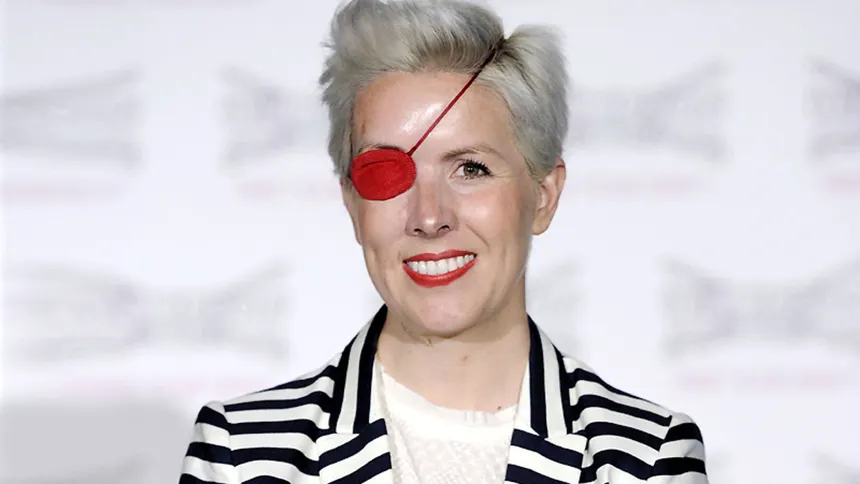
María never raced again. She’d lost depth perception. The 17-year dream had shattered against the ramp of a truck.
But she didn’t break.
She became a member of the FIA Drivers’ Commission, alongside Nigel Mansell, Sébastien Loeb, and Emerson Fittipaldi. Ambassador for the FIA Women in Motorsport Commission. Member of the Board of Directors of the Royal Spanish Automobile Federation. Ambassador against Gender Violence. Ambassador for International Women’s Day for the Community of Madrid. Patron of the Ana Carolina Díez Mahou Foundation, dedicated to children with neuromuscular and mitochondrial diseases. Motorsport analyst for Spain’s Antena 3 television alongside Antonio Lobato during F1 broadcasts, delivering road safety lessons. Public speaker.
She held a degree in Physical Activity and Sport Sciences. She ran the Emilio de Villota Racing School, where she trained young talent. Among them, a karting kid named Carlos Sainz Jr., whom María instructed in his first steps in single-seaters. Sainz would go on to win races in Formula 1 with Ferrari.
On July 28, 2013, she married Rodrigo García Millán in Seville.
She wrote a book. She titled it “La vida es un regalo” — “Life Is a Gift.” Presentation scheduled for Monday, October 14, 2013, in Madrid.
October 11, 2013. Hotel Sevilla Congresos.
María was in Seville to speak at the Fundación Lo Que De Verdad Importa congress, an event for young university students where speakers share life-changing experiences.
The night before, she told her manager she had a terrible headache.
At 7:23 in the morning, emergency services received the call. María was found on the floor of her hotel room. Paramedics tried to resuscitate her. They couldn’t.
María de Villota had died in her sleep. She was 34 years old. She’d been married for three months. Her book was due to launch three days later.
The autopsy confirmed a cardiac arrest. A forensic doctor subsequently determined that her death was a direct consequence of the neurological injuries sustained in the Duxford accident, fifteen months earlier.
Her family issued a statement: “María has left us. She had to go to heaven like all angels. We thank God for the extra year and a half He let her stay with us.”
That weekend, at Suzuka, a minute of silence was held before the Japanese Grand Prix. Fernando Alonso, María’s friend, couldn’t believe the news.
On October 29, 2013, she was posthumously awarded the Gold Medal of the Royal Order of Sporting Merit — Spain’s highest honor in sports.
Legacy
The final turn at the Jarama Circuit — the one that leads onto the pit straight — has been called Curva María de Villota since July 5, 2017.
Every Christmas Eve, a charity 10K and 5K race takes place at Jarama in her name.
The Legado María de Villota, founded in 2014, keeps alive the First Star Program for children with neuromuscular diseases, the María de Villota Homes, the San Ramón Nonato Community Kitchen in Vallecas, Madrid, and the Fórmula 1 Kilo food drive initiative.
Carlos Sainz Jr. has carried María’s star on his helmet since his Formula 1 debut. He’s been an Ambassador of her Legacy since 2016. Pedro de la Rosa and Marc Gené are also ambassadors.
The Barcelona Speed Festival, host venue for the GT World Challenge Europe finals, is held every year under the name Legado María de Villota.
Schools, parks, sports centers, and public buildings across Spain carry her name.
María is still there.
And Now Comes What I Really Want to Say.
María de Villota competed for 17 years across karting, Formula Toyota, Formula 3, Ferrari Challenge, WTCC, ADAC Procar, Euroseries 3000, the 24 Hours of Daytona, Superleague Formula, and Formula 1. Eleven different categories. Spanish championship runner-up. Third in Germany. Pole at Mugello. Ninth at Daytona. First woman in four different championships.
She wasn’t “a woman who tried to compete in a man’s world.”
She was a racing driver. No qualifiers. No asterisks. No quotas.
She said it herself: “What happens in my world is that women have to constantly prove their worth. But when they do, it surprises people so much that it hooks them even more.”
María didn’t ask for the bar to be lowered. She asked to be allowed to compete. And when they let her, she showed every single one of them what she was made of.
María de Villota titled her book “Life Is a Gift.”
She wrote it after losing an eye, her sense of smell, the career that was her entire life, and the ability to ever again do the only thing she’d wanted to do since she was 16.
And still, she chose that title.
Not out of naivety. But because after looking in the mirror with a shattered face and half her field of vision gone, she understood something that most people don’t understand even with both eyes intact:
That every day you open your eyes is a gift you haven’t earned.
María never got to present that book. She left the same night she was supposed to tell her story to the world. At peace, asleep, with a three-month-old wedding ring on her finger and a manuscript that said exactly what she felt.
If you’re reading this and you’ve ever felt like the world won’t make room for you. That they won’t let you in. That you can’t. That the road was built for someone else.
Think about a girl from Madrid who decided at 16 that she was going to drive a Formula 1 car.
Who fought for 17 years against a system that didn’t want her inside.
Who competed in 11 categories, in 5 countries, against men who didn’t spare her a single sideways look.
Who, when she finally made it, had the dream and half her face ripped away by a poorly placed truck.
Who got back up.
Who chose to live.
Who wrote that life is a gift.
And who left in her sleep, in Seville, with the book finished and her smile intact.
If this story doesn’t move something inside you, check that you’re still feeling.
Pingback: The Spanish Phoenix: Domingo Ochoa and the GTA Spano Story