
Mercedes-Benz 190E 2.5-16 Evolution II: The Sedan That Taught Mercedes How to Fight Dirty
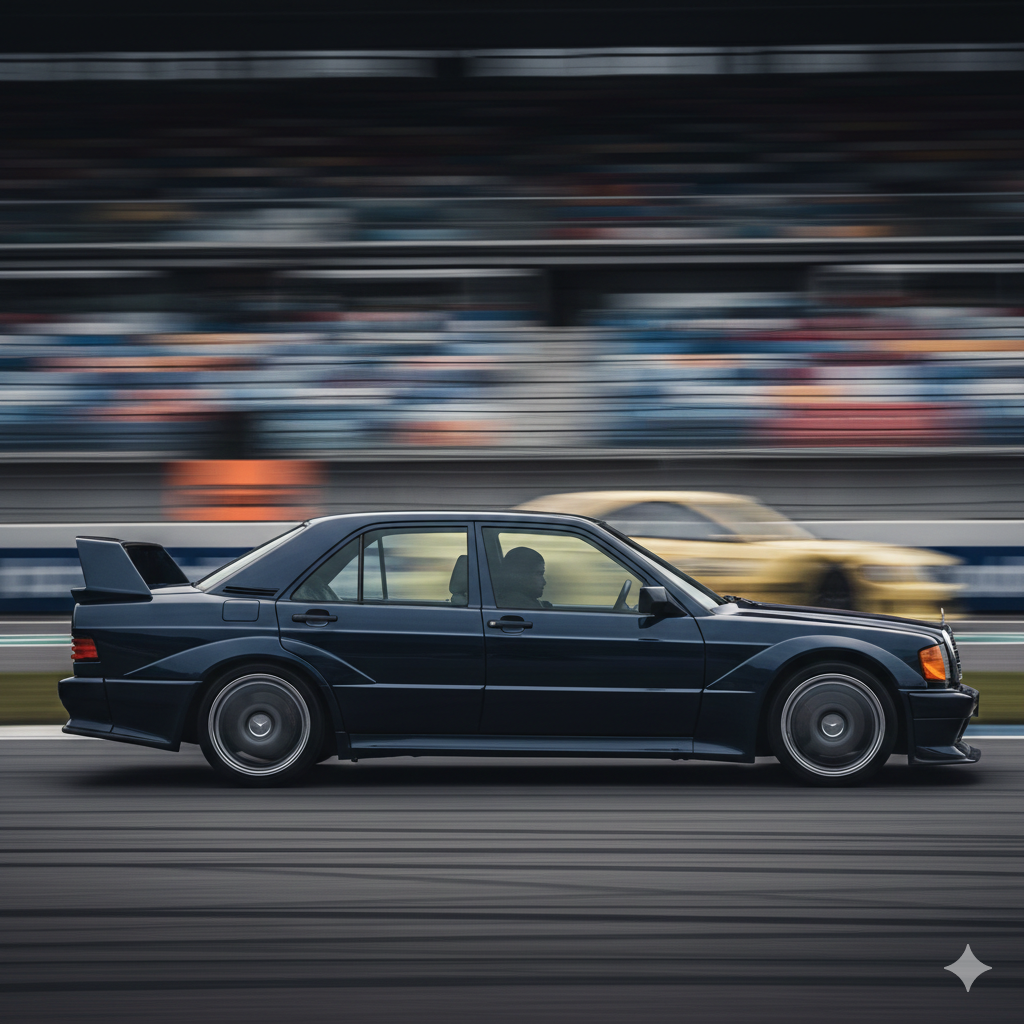
502 Units. One Giant Wing. And the Birth of a Racing Legend.
Before AMG badges were standard options. Before every Mercedes sedan could be ordered with 500+ horsepower. Before the very concept of a “sporty Mercedes” was anything other than an oxymoron — there was a compact sedan from Stuttgart with a Cosworth engine, a rear wing borrowed from a touring car, and an attitude problem the size of Bavaria.
The Mercedes-Benz 190E 2.5-16 Evolution II — the Evo II — is the car that single-handedly changed how the world perceived Mercedes-Benz. It transformed the brand from builder of dignified business sedans into a legitimate racing powerhouse. And in doing so, it laid the foundation for everything AMG would become.
This is the story of a car that was never supposed to be subtle. And succeeded spectacularly.
Context: The War of the Touring Cars
To understand the Evo II, you need to understand the battlefield it was built for.
The late 1980s German Touring Car Championship — the Deutsche Tourenwagen Meisterschaft (DTM) — was the most brutal, most competitive, and most politically charged racing series in Europe. BMW had its E30 M3, a car purpose-built for racing supremacy. Ford deployed the Sierra Cosworth, an Anglo-German missile with turbocharged aggression. Audi brought the V8 quattro and its unfair advantage of all-wheel drive. Opel had Cosworth-tuned machinery of its own.
Mercedes? Mercedes had the 190 — a small, dignified sedan that your insurance broker drove to work.
The idea of racing it was, to many observers, absurd. But Mercedes had a plan, a British engineering firm called Cosworth, and an absolute refusal to lose.
The Lineage: From Rally Dream to Racing Reality
Phase 1: The 190E 2.3-16 (1984)
The story begins not on a racetrack but on a rally stage. In the late 1970s, Mercedes had competed in rallying with the big V8-powered SLC coupés. When they wanted to take the new compact 190 into rallying, they commissioned Cosworth to develop a 320 hp engine for the project.
Then Audi launched the Quattro. With its turbocharged engine and all-wheel drive, it made the rear-wheel-drive 190 project instantly obsolete for rallying. But Mercedes now had an exceptional engine and nowhere to put it.
The solution: DTM.
The road-legal 190E 2.3-16 debuted at the 1983 Frankfurt Motor Show, carrying a Cosworth-developed 16-valve DOHC cylinder head on Mercedes’ 2.3-liter four-cylinder block. Power output was 183 hp in European trim — modest by today’s standards but significant for a compact sedan in 1984.
Before its official launch, three nearly stock cars had averaged 247 km/h over a 50,000 km endurance test at Nardo, setting twelve international records. The car had proven its durability. Now it needed to prove its speed.
The legendary Nürburgring race of 1984: Mercedes organized a one-make promotional race on the new Nürburgring GP circuit. The entry list reads like a Hall of Fame: Ayrton Senna, Niki Lauda, Alain Prost, Keke Rosberg, Jack Brabham, John Surtees, Jody Scheckter, Denny Hulme. Senna won, in the rain, because of course he did. It was one of the most star-studded single-make races in history, and it put the 190E 2.3-16 on the global map.
Phase 2: The 190E 2.5-16 (1988)
By 1987, BMW had entered the DTM with full factory support behind the M3, and the 2.3-liter Cosworth engine was no longer competitive. Mercedes responded with a displacement increase to 2.5 liters and 195 hp for the road car, with significantly more in racing trim.
Phase 3: Evolution I (1989)
DTM regulations required homologation — manufacturers had to build a minimum number of road cars incorporating the race-specification components. The Evo I appeared in 1989: 502 units with larger brakes, 16-inch wheels, wider fender flares, a more aggressive rear wing, and quickened steering. Power remained at around 195 hp, but an optional AMG PowerPack could boost it to 232 hp.
It was faster, but still not enough. The BMWs and Audis were relentless.
Phase 4: Evolution II (1990) — The One That Changed Everything
Mercedes needed more. Much more.
The Evolution II: Engineering Meets Aerodynamics
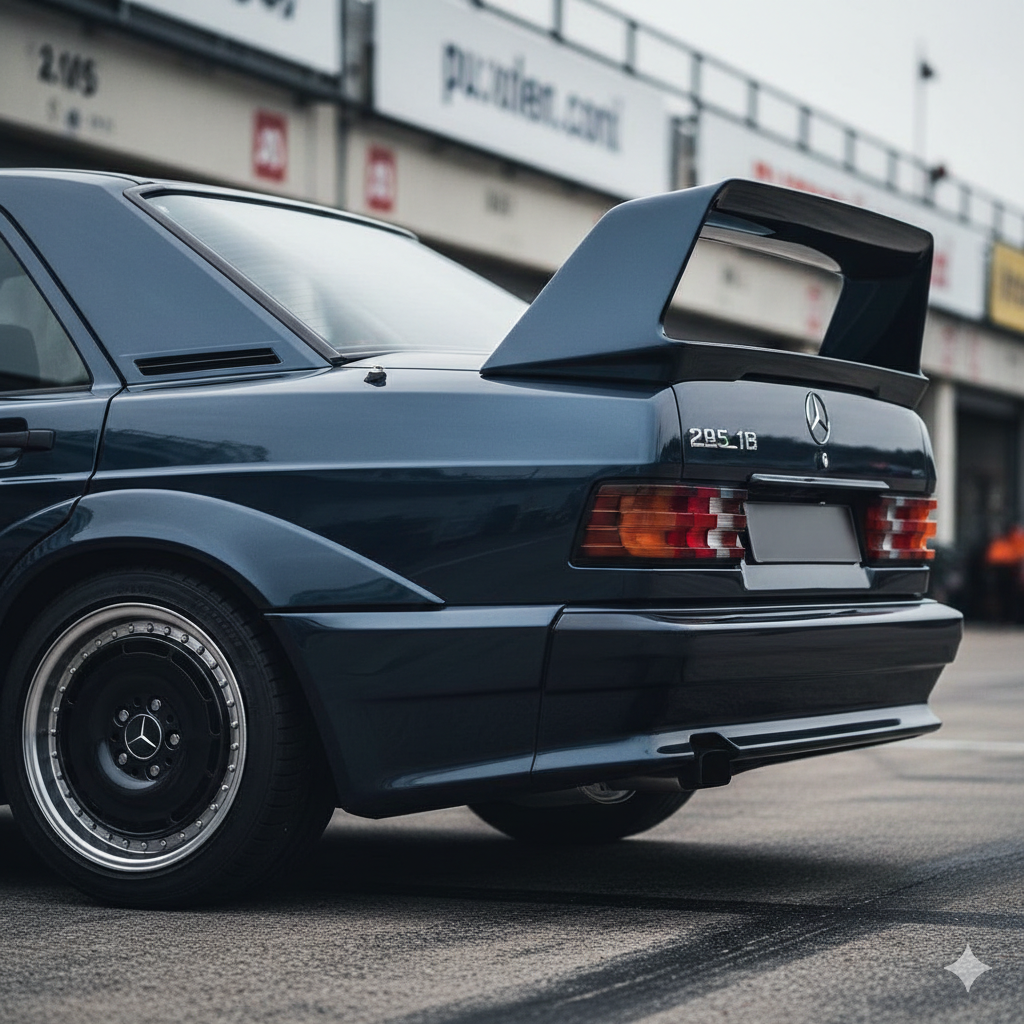
To create the Evo II, Mercedes brought in Professor Richard Eppler from the University of Stuttgart — not a car designer, but an aerodynamics expert who specialized in wing profiles. His mandate: make the 190E generate as much downforce as physically possible within the confines of a touring car silhouette.
The result was — and remains — one of the most visually dramatic production sedans ever created.
The Bodywork
The Evo II’s defining feature is immediately obvious: a massive, adjustable rear wing that looks like it was grafted from a Group C prototype onto a family sedan. It’s not subtle. It’s not trying to be. Combined with teardrop-shaped fender flares that are significantly wider than the Evo I, a deeper front splitter, and extended side skirts, the aerodynamic package transforms the 190’s silhouette from conservative to confrontational.
Every panel modification was driven by wind tunnel data, not aesthetics. The fender flares aren’t just wider — they’re shaped to manage airflow around the wheels. The rear wing’s angle was calculated to provide optimal downforce at DTM racing speeds. The front bumper’s lower edge directs air under the car to reduce lift.
It looks aggressive because aerodynamics at racing speeds is aggressive. Form followed function, and function demanded a car that looked like it wanted to fight you.
The Engine
Under the hood sat the familiar 2.5-liter Cosworth-developed inline-four, but with meaningful revisions: higher compression ratio, altered valve lift and timing, modified intake tract, and a reworked exhaust system. The result was 232 hp at a screaming 7,200 rpm, with a redline of approximately 7,800 rpm — extraordinary for a Mercedes production car of any era.
The engine retained its dog-leg five-speed Getrag manual gearbox, where first gear is positioned to the left and rearward, allowing faster sequential shifts between second, third, fourth, and fifth during racing. It’s an old racing trick: you rarely need first gear on a circuit, so it’s moved out of the natural shift pattern to prevent accidental downshifts.
The Chassis
Larger brakes, stiffer suspension, 17-inch wheels (massive for 1990), and — perhaps the most technologically advanced feature — a hydro-pneumatic self-leveling suspension with three adjustable ride heights. A knob on the dashboard allowed the driver to raise or lower the car depending on road conditions. This technology, common in modern supercars, was cutting-edge in 1990.
The Details
All 502 Evo IIs were finished in a single color: Blue-Black Metallic (199), with the exception of two silver units. The interior remained distinctly Mercedes — wood trim, leather seats — creating a fascinating contrast with the exterior’s racing intent. It was a car that looked like a DTM weapon from the outside and a Stuttgart executive’s daily driver from the inside.
The Racing Legacy: DTM Glory
The Evo II made its DTM competition debut at the Nürburgring in June 1990, with AMG-prepared cars for drivers Kurt Thiim and Klaus Ludwig. The first outing was disappointing — neither driver finished Race 1.
But the 1990 season was a development year. The real payoff came in 1991, when Mercedes won the DTM Manufacturers’ Championship and AMG was crowned Team Champion, with Evo II pilot Klaus Ludwig narrowly losing the Drivers’ title to Audi’s Frank Biela.
The dominant year was 1992. AMG’s Evo IIs won 16 out of 24 races. Klaus Ludwig clinched the Drivers’ Championship, and Mercedes swept the top three positions in the final standings. It was total domination — the kind of season that ends arguments permanently.
The irony: by the time the Evo II achieved its ultimate DTM triumph, the road car had already been out of production for over a year. Only 502 were ever made. The car that won the championship was a ghost — a weapon from the past that refused to lose.
The Numbers
| Specification | Detail |
|---|---|
| Engine | 2.5L inline-4, DOHC 16V (Cosworth) |
| Power | 232 hp @ 7,200 rpm |
| Torque | 245 Nm @ 5,000 rpm |
| Redline | ~7,800 rpm |
| Transmission | 5-speed Getrag manual (dog-leg pattern) |
| Weight | ~1,340 kg |
| 0–100 km/h | ~7.1 seconds |
| Top speed | 250 km/h (electronically limited) |
| Production | 502 units |
| Colors | Blue-Black Metallic (500), Silver (2) |
| Year | 1990 |
| Original price | ~DM 115,000 (approximately €59,000 at the time) |
The Market Today: From Sedan to Seven Figures
The 190E Evo II has completed one of the most dramatic value appreciation curves in automotive history.
When new, the Evo II cost approximately 115,000 Deutsche Marks — expensive for a compact sedan, but not stratospheric. For years, values remained relatively stable. Then the “youngtimer” boom hit, and the Evo II’s combination of DTM heritage, extreme rarity (502 units), and that unforgettable silhouette turned it into one of the most sought-after Mercedes collectibles in existence.
Current auction data tells the story: average transaction prices for Evo IIs over the past five years sit around $296,000, with exceptional examples pushing significantly higher. The trajectory shows a consistent upward trend, with three-year appreciation of nearly 10%.
For context: the more common 190E 2.3-16 — the “base” Cosworth model — trades around $50,000 in excellent condition. The Evo II commands six times that price. Rarity, racing provenance, and that wing make all the difference.
Why the Evo II Matters
The 190E 2.5-16 Evolution II isn’t just a fast sedan from the early 1990s. It’s a turning point — the moment Mercedes-Benz stopped being purely dignified and started being dangerous.
Without the Evo II, there is no AMG as we know it today. The car demonstrated that Mercedes could compete — and win — in the most demanding touring car championship in the world. It proved that the three-pointed star could coexist with racing aggression. It showed a generation of engineers and enthusiasts that performance and the Mercedes badge were not mutually exclusive.
Every AMG model that followed — from the Hammer to the C63 to the Black Series to the AMG One — carries DNA that traces directly back to a compact sedan with a Cosworth four-cylinder and a wing that looked like it was designed by a professor who didn’t care about your feelings.
Because it was.
502 units. One wing. One championship. And the birth of an empire.