
Mercedes-Benz CLK GTR: The Race Car That Was Forced to Become a Road Car
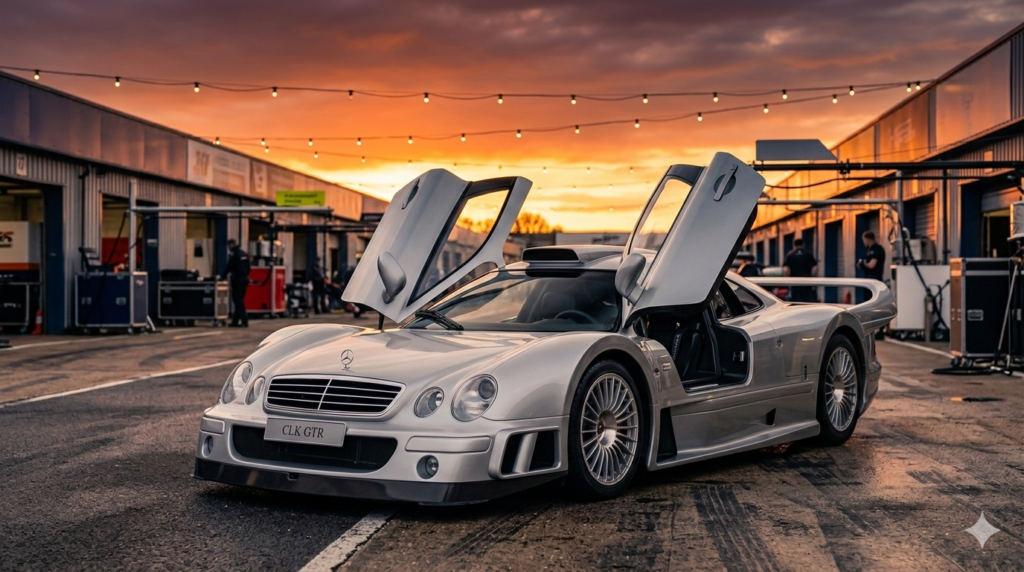
128 Days from Blank Paper to Race Winner. 25 Road Cars. $1.5 Million Each. And a McLaren F1 They Bought in Secret.
There are road cars that get turned into race cars. And then, very rarely, there are race cars that get turned into road cars because the rules said you had to.
The Mercedes-Benz CLK GTR is the most extreme example of the latter. A purpose-built prototype racer, designed to annihilate the McLaren F1 GTR and Porsche 911 GT1 in FIA GT Championship endurance racing, that was forced to spawn 25 road-legal versions to satisfy homologation regulations.
The result: a carbon-fiber monocoque hypercar with a 6.9-liter V12, butterfly doors, a sequential racing gearbox, and the driving manners of a Le Mans prototype that happened to have air conditioning and a stereo.
When it was introduced in 1998, the CLK GTR Straßenversion was the most expensive production car in the world according to the Guinness Book of World Records. And it was also, by any reasonable standard, one of the most insane.
The Background: GT1 and the Arms Race
In the mid-1990s, the FIA GT Championship became the arena where the world’s most prestigious manufacturers fought for supremacy. The category was GT1 — a class that theoretically required cars to be based on production models but, in practice, allowed manufacturers to build race cars first and production cars second.
The dominant force was the McLaren F1 GTR — the racing version of Gordon Murray’s legendary three-seat supercar. The F1 GTR had won Le Mans in 1995 and was crushing the GT1 competition. McLaren had the advantage of actually starting with a road car and converting it for racing, meaning their 25-car homologation requirement was easily met.
Porsche saw the opportunity and built the 911 GT1 — a car that looked vaguely like a 911 from the front but was actually a modified 962 race car chassis underneath. The homologation requirement was treated as an afterthought: Porsche built exactly the minimum required number of road cars.
Mercedes wanted in. And they were going to do it the same way as Porsche — racing car first, road car as a regulatory obligation.
The Development: 128 Days of Madness
Mercedes tasked AMG and its racing partner HWA (Hans Werner Aufrecht’s racing division) with creating a GT1 contender from scratch.
The timeline was absurd: 128 days from a blank sheet of paper to a completed racing car. Less than four months to design, engineer, build, and test a car that would compete against the most sophisticated racing machines in the world.
Here’s the part Mercedes doesn’t like to publicize: to accelerate development, they secretly purchased a second-hand McLaren F1 GTR from privateer team Larbre Compétition. They stripped out the BMW V12, installed one of their own engines, fitted new bodywork, and used it as a development mule at the Jarama circuit in Spain. Driver Bernd Schneider crashed it during testing. The car was later restored to original McLaren specification and returned to its owner.
How much Mercedes borrowed from studying the McLaren is debated. What’s undeniable is that the CLK GTR that emerged from those 128 days was a formidable machine that immediately dominated its competition.
The Race Car: Championship Domination
The racing CLK GTR was built around a carbon-fiber and aluminum honeycomb monocoque — full racing technology, not adapted road car structure. The engine was Mercedes’ proven M120 6.0-liter V12, originally from the S-Class and SL range, but extensively modified with titanium connecting rods and a higher compression ratio to produce 592 hp.
Power went to the rear wheels through a six-speed sequential racing gearbox. The suspension used double wishbones with pull-rod coil springs at both ends — pure racing specification. Braking came from six-piston calipers with massive carbon-composite rotors.
The bodywork shared virtually nothing with the production CLK. Only the headlights, taillights, and grille were taken from the road car — enough for a passing family resemblance and nothing more. Everything else — the carbon body, the butterfly doors, the roof-mounted air scoops, the massive rear wing — was bespoke racing equipment.
1997 Season Results
The CLK GTR won 6 of 11 races in the FIA GT Championship, securing both the Drivers’ Championship and the Teams’ Championship in its debut year. It was an overwhelming success that validated the entire program.
1998 Season
Mercedes continued with an evolved version and again won both championships, making it back-to-back titles. The CLK GTR was then retired from GT racing and replaced by the CLK LM for Le Mans, and subsequently the ill-fated CLR — the car that tragically became airborne at Le Mans 1999, ending Mercedes’ prototype racing program for years.
The Road Car: Straßenversion
With two championships secured, Mercedes now had to fulfill the homologation requirement: 25 road-legal CLK GTRs had to be built.
The road car — officially the CLK GTR Straßenversion (“Street Version”) — was assembled at Affalterbach by AMG and HWA between late 1998 and mid-1999. And in a twist that defied expectations, the road car was actually more powerful than the race car.
The Engine
The M120 V12 was stroked by Ilmor from 6.0 to 6,898 cc (6.9 liters), producing:
| Specification | Detail |
|---|---|
| Engine | M120-based 6.9L V12 naturally aspirated (built by Ilmor) |
| Power | 622 hp @ 6,500 rpm |
| Torque | 731 Nm @ 5,250 rpm |
| Transmission | 6-speed sequential manual |
| 0–100 km/h | 3.8 seconds |
| Top speed | 320+ km/h (claimed) |
| Weight | 1,470 kg (road version, +465 kg over race car) |
| Brakes | 6-piston calipers, 380mm carbon-composite front / 335mm rear |
| Wheels | 18-inch center-locking; 295/35 front, 345/35 rear |
The extra displacement and tuning gave the road car 30 hp more than the race version — a rare situation where the road-going homologation car outperformed its racing counterpart in raw power.
The Interior
The road car received concessions to usability that the race car didn’t need: air conditioning, a CD audio system, electric windows, electric mirrors, soundproofing, and the option of leather, Alcantara, or even tartan seat upholstery. Four-point racing harnesses were standard.
The driving position was offset slightly to the left, and the passenger sat noticeably further back — a consequence of the carbon monocoque’s racing origins. Luggage was stored in bins under each door. The fire suppression system from the race car was retained, with the activation switch conveniently located on the driver’s door.
Despite these additions, weight rose significantly from the race car’s 1,005 kg to the road car’s 1,470 kg. The extra 465 kg came from soundproofing, comfort equipment, and the heavier road-legal exhaust system.
The Variants
CLK GTR Coupé
20 production coupés were built (numbered 01/25 to 20/25), plus two prototypes. The standard body with fixed roof, integrated rear wing, and the full carbon-fiber bodywork.
CLK GTR Roadster
6 roadsters were produced (numbered 21/25 to 25/25, plus a sixth unnumbered example). The roadster featured an open top, rollover hoops behind each headrest, a new engine cover, and a twin-pylon rear spoiler similar to the race car’s wing. Weight increased by 105 kg over the coupé.
Five of the six roadsters were completed in 2006 — years after the coupés — making them among the last CLK GTRs built.
CLK GTR SuperSport
Two coupés left the factory in “SuperSport” specification, with additional performance modifications. These are the rarest of the rare.
Right-Hand Drive
Two cars — one coupé and one roadster — were built in right-hand drive configuration for the Sultan of Brunei, one of the world’s most prolific automotive collectors.
The Driving Experience
Former racing driver and journalist Paul Frère test drove the CLK GTR around Hockenheim for Road & Track magazine. His assessment was revealing: he praised the car’s tractability and the effort Mercedes had made to civilize a racing machine, but noted the cramped cockpit, the difficulty of driving in city conditions (the sequential gearbox was non-synchronous), and the sheer amount of torque available from low rpm that demanded constant respect.
The CLK GTR was not a car designed for enjoyment. It was a race car with number plates — and driving it on public roads was an exercise in managing a machine that fundamentally wanted to be on a circuit. The seating position, the sequential gearbox, the aggressive brake feel, the enormous width on narrow European streets — everything about the road experience reminded you that this car’s primary purpose was winning championships.
Frère’s verdict: a “real work of art.” With the caveat that the art was meant to be experienced at 280 km/h on a racetrack, not at 50 km/h in Stuttgart traffic.
The Market: Stratospheric
At launch, the CLK GTR cost approximately $1.5 million — making it the most expensive production car in the world. Every car was spoken for before production began.
Today, CLK GTRs rarely appear at auction, but when they do, prices are extraordinary:
- Coupés: $5–10 million range at recent auctions
- Roadsters: Potentially higher due to extreme rarity (only 6 exist)
- SuperSport: No public sales data — effectively priceless
The CLK GTR occupies a unique space in the collector market: it’s a genuine championship-winning race car that happens to be road legal, built by one of the world’s most prestigious manufacturers, in numbers so small that most car enthusiasts will never see one in person.
Why the CLK GTR Matters
The CLK GTR represents the last gasp of the GT1 era — a brief, glorious period in motorsport when manufacturers built race cars first and worried about road legality second. The FIA shut down the GT1 category after 1998, largely because the cars had become too extreme, too expensive, and too far removed from anything resembling a production vehicle.
The CLK GTR also represents Mercedes’ most ambitious competitive statement of the 1990s: a car developed in 128 days that won back-to-back championships against Porsche and McLaren. It proved that Mercedes-AMG could compete at the highest level of sports car racing, not just in touring cars.
And its road-legal version proved something else: that with enough engineering ambition and a complete disregard for practicality, a full-size V12 race car could be made to idle in traffic, play CDs through its stereo, and cool its occupants with air conditioning — while remaining capable of 320+ km/h when the road opened up.
128 days. 25 road cars. Two championships. One legend.