
Mercedes-Benz R107 SL: Eighteen Years, 237,287 Cars, and the Roadster That Defined American Luxury
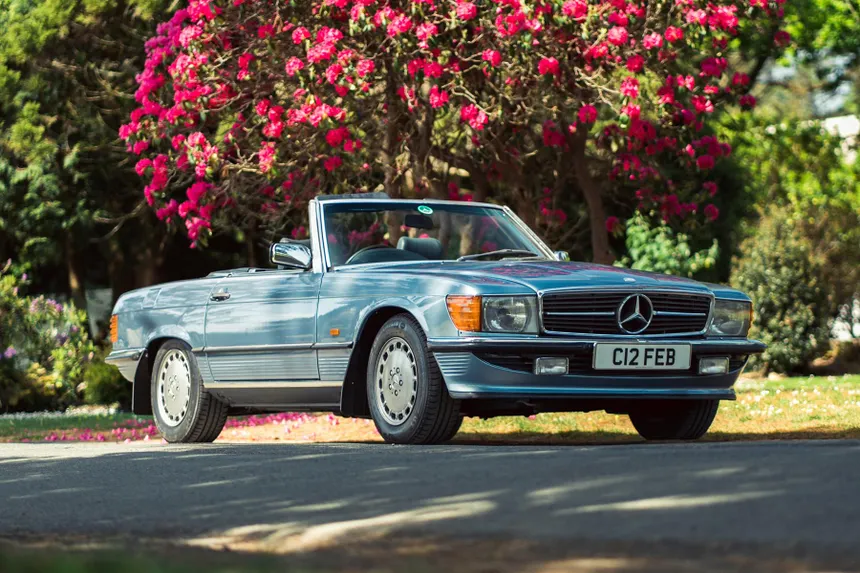
The Car That Was Too Americanized for Germany and Too German for America — And Conquered Both
When the Mercedes-Benz R107 SL debuted at the 1971 Geneva Motor Show, the German automotive press was not kind. They called it a tank. They called it too Americanized. They said it had lost the sporting purity of the W113 Pagoda it replaced. It was heavier, softer, and more focused on comfort than any SL before it.
The critics were right about one thing: the R107 was designed with the American market firmly in mind. And that turned out to be the smartest decision Mercedes-Benz made in the 1970s.
Over the next eighteen years — a production run so long it remains the second-longest in Mercedes history, behind only the G-Class — the R107 would sell 237,287 units. Two-thirds of them went to the United States. It became the definitive personal luxury car of an entire generation, the car parked in the driveways of doctors, lawyers, executives, and old money from Greenwich to Beverly Hills. It was the car that taught America what Mercedes-Benz meant.
And today, it’s one of the most compelling entry points into classic Mercedes ownership that still exists.
The Origins: Replacing the Irreplaceable
Replacing the W113 Pagoda was an almost impossible task. The Pagoda — with its distinctive concave hardtop designed by Paul Bracq — had become an icon of 1960s design elegance. It was light, beautiful, and possessed a delicacy that made it feel special every time you looked at it.
The R107 was none of those things. It was broader, heavier, and unambiguously muscular where the Pagoda had been graceful. Under the direction of designer Friedrich Geiger and chief engineer Rudolf Uhlenhaut’s successor Hans Scherenberg, the R107 was engineered to meet a new reality: tightening safety regulations, increasingly strict emissions requirements, and the growing importance of the American market, which demanded comfort, luxury accessories, and V8 power.
The development team took the chassis components of the midsize W114 sedan and mated them to the M116 and M117 V8 engines from the W108/W109 S-Class. The result was a platform that prioritized structural rigidity, crash protection, and long-distance touring comfort over raw sporting agility. Mercedes called the development car the “Panzerwagen” — the tank — and the name stuck internally throughout development.
The body design didn’t change materially from its 1971 introduction until the end of production in 1989. That visual consistency — combined with periodic mechanical updates — meant the R107 aged gracefully rather than becoming dated. By the time it was finally replaced by the R129, the design looked classic rather than old.
The American Love Affair: Two-Thirds of Production
The R107’s relationship with America wasn’t an afterthought — it was the primary commercial strategy. North America absorbed approximately 156,000 of the 237,287 units produced, making it overwhelmingly the car’s largest market.
Mercedes understood something profound about the American luxury car buyer of the 1970s and 1980s: they wanted a European car that felt distinctly different from a Cadillac or Lincoln, but they didn’t want the compromises of a raw European sports car. They wanted comfort. They wanted prestige. They wanted a car that started every morning without drama, cruised effortlessly at highway speeds, and looked elegant parked outside a country club.
The R107 delivered all of this. It was the personal luxury car redefined through German engineering — comfortable but not wallowing, powerful but not crude, luxurious but never ostentatious.
The US Market Models
The American market received its own specific lineup, shaped by emissions regulations and market preferences:
| Model | Years | Engine | Power (US spec) |
|---|---|---|---|
| 350SL (badged) | 1972 | 4.5L V8 (M117) | 230 hp SAE |
| 450SL | 1973–1980 | 4.5L V8 (M117) | 190–230 hp SAE |
| 380SL | 1981–1985 | 3.8L V8 (M116) | 155 hp SAE |
| 560SL | 1986–1989 | 5.6L V8 (M117) | 227 hp SAE |
There’s an important detail here that many enthusiasts don’t know: the first US-market R107s were badged “350SL” despite actually having a 4.5-liter V8. The 350SL badge was a deliberate deception designed to avoid alerting the German market that Americans were getting a larger engine before them. When the car was officially launched in Europe in 1973, the US cars were re-badged “450SL.”
The 380SL era (1981-1985) represents the low point in R107 performance — emissions regulations had strangled the 3.8-liter V8 down to just 155 horsepower, making these the slowest R107s produced. However, they remain mechanically sound cars and their lower performance actually makes them cheaper to buy today.
The 560SL (1986-1989) was exclusive to the US, Japanese, and Australian markets. With 227 horsepower from a 5.6-liter V8, it was the most powerful US-market R107 and represented the model at its most refined. The 560SL is generally considered the most desirable US-market variant.
Paradoxically, the fastest R107 ever produced — the European-spec 500SL with 240 horsepower — was never officially sold in America. Any 500SLs found in the US are grey market imports.
The European Perspective: What America Didn’t Get
European buyers had access to a different range that included engines America never saw:
| Model | Years | Engine | Power (Euro spec) |
|---|---|---|---|
| 280SL | 1974–1985 | 2.8L I6 (M110) | 185 hp DIN |
| 300SL | 1985–1989 | 3.0L I6 (M103) | 188 hp DIN |
| 350SL | 1971–1980 | 3.5L V8 (M116) | 200 hp DIN |
| 380SL | 1980–1985 | 3.8L V8 (M116) | 218 hp DIN |
| 420SL | 1985–1989 | 4.2L V8 (M116) | 218 hp DIN |
| 500SL | 1980–1989 | 5.0L V8 (M117) | 240 hp DIN |
The inline-six models — 280SL and 300SL — were never exported to North America and represent an entirely different character of R107. Lighter over the front axle and with the inherent smoothness of a straight-six, they offered a more balanced, more European driving experience compared to the V8-heavy US lineup.
The 500SL was the jewel of the European range. Without American emissions equipment, the 5.0-liter V8 produced 240 horsepower and could reach 225 km/h (140 mph). Mercedes published a 0-60 time of 7.4 seconds — quick for a luxury roadster in the early 1980s.
The SLC: The Forgotten Coupé
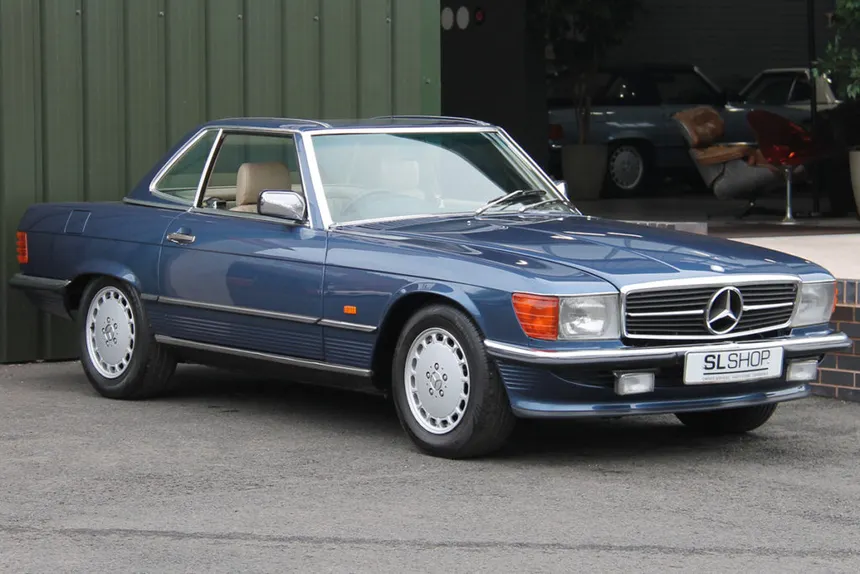
The R107 had a sister: the C107 SLC — a fixed-roof coupé built on a wheelbase stretched by 360mm (14.2 inches). The SLC was the first and only time Mercedes based their S-Class coupé on a stretched SL roadster platform rather than on the full-size sedan.
The SLC was produced from 1971 to 1981, with 62,888 units built. It offered a genuine back seat and a more practical fixed-roof package while sharing the SL’s mechanical DNA. The most collectible version is the 450 SLC 5.0 (1978) — the first Mercedes to use the new aluminum 5.0-liter V8 and the first to feature aluminum hood and trunk lid for weight savings. It was developed specifically for long-distance rally events and proved its toughness in the grueling Bandama Rally in Africa.
Today, SLC prices remain significantly lower than their SL counterparts — making them a genuine hidden gem for collectors who value driving dynamics over open-air motoring.
Innovation Through Longevity
Despite its 18-year production run, the R107 wasn’t static. Mercedes continuously updated the car with technologies that often appeared on the SL before filtering down to the rest of the range:
1980: Anti-lock brakes (ABS) became available — making the R107 one of the earliest production cars to offer this safety feature. The hardtop, previously optional, became standard equipment on all SLs.
1982: A driver’s airbag became an option — the R107 was among the very first cars in the world to offer this. Combined with seatbelt pre-tensioners, it established safety features that wouldn’t become mandatory for another decade.
1985: Major facelift with revised front suspension, front spoiler, aluminum-rim wheels, and a completely restructured engine range. All versions received closed-loop catalytic converters. The legendary 560SL was introduced for the US market.
1986-1989: Final evolution with Bosch KE-Jetronic fuel injection, offering improved efficiency and throttle response. These late cars represent the R107 at its most refined, with every lesson from 15 years of production baked in.
The End: Signal Red and a Museum
The final R107 rolled off the Sindelfingen production line on August 4, 1989. It was a 500SL painted in Signal Red — a fitting final statement for a car that had defined personal luxury for nearly two decades. That car now resides in the Mercedes-Benz Museum in Stuttgart.
The R129 SL had already been presented at the Geneva Motor Show months earlier, in March 1989. The transition was smooth, but the two cars couldn’t have been more different in philosophy. Where the R107 was conservative, comfortable, and evolutionary, the R129 was technologically ambitious, packed with innovations like automatic roll bars and an unprecedented investment budget.
The irony is that Mercedes delayed the R129’s introduction partly because R107s were still selling well. After 18 years, the market still hadn’t tired of the car.
The Driving Experience: Panzerwagen Charm
Driving an R107 today is an exercise in understanding a different philosophy of what a sports car should be. It is not fast by modern standards — even the quickest 560SL needs 7.3 seconds to reach 60 mph, and the emissions-strangled 380SL takes a leisurely 10.6 seconds.
But speed was never the point. The R107 was designed to be a comfortable, refined grand tourer that happened to have a folding roof. The V8 is smooth and unstressed at highway cruising speeds. The automatic transmission shifts with Mercedes precision. The ride absorbs bumps with a suppleness that modern sports cars have sacrificed for handling sharpness.
The steering is heavy and communicative through a thin-rimmed wheel. The brakes require firm progressive pressure. Everything about the R107 requires the driver to participate deliberately — there’s no electric assistance filtering out the road feel, no computerized stability control correcting your inputs. It’s you, the car, and the road, connected through beautifully engineered mechanical systems.
Body roll in corners is significant — this is not a car for attacking mountain passes. But cruise through the canyons of Malibu at seven-tenths, top down, V8 burbling through the exhaust, and the R107 makes more sense than any modern car at any price.
Market Values: The Window Is Open
R107 values have been climbing steadily across all variants, but remain accessible compared to the Pagoda (which has priced out most enthusiasts) and are still reasonable compared to many European classics of the same era:
| Model | Condition 3 (Good) | Condition 2 (Excellent) |
|---|---|---|
| 380SL (1981-85) | $11,000–$12,000 | $25,000–$26,000 |
| 450SL | $13,000 | $37,200 |
| 350SL (1972) | $15,400 | $40,800 |
| 560SL (1986-89) | $18,000–$22,000 | $45,000–$51,200 |
| 500SL (Euro) | $20,000–$30,000 | $50,000–$75,000 |
| 450 SLC 5.0 | Rare — $30,000+ | $60,000+ |
The average sale price across all R107 variants sits around $24,000 according to Classic.com tracking data. All Mercedes SLs in the Hagerty Price Guide have appreciated an average of 15% over the past five years.
The 560SL is the sweet spot for American buyers: the most refined mechanical package, the best performance of any US-market R107, and values that are climbing but haven’t yet reached the stratosphere. A clean, well-documented 560SL for $30,000-$45,000 is one of the best propositions in the classic car market today.
Why It Matters
The R107 matters because it redefined what a luxury roadster could be — not a compromise between sportiness and comfort, but a deliberate, unapologetic commitment to civilized grand touring. It taught an entire generation of American buyers what Mercedes-Benz stood for. And it did it so well that Mercedes couldn’t bring themselves to replace it for eighteen years.
237,287 cars. Eighteen years. Two-thirds to America. And a design that still looks right today, half a century after it first rolled out of Sindelfingen.
That’s the R107. Not the fastest. Not the lightest. Not the most exciting. But possibly the most perfectly realized luxury roadster ever built.
Pingback: Mercedes SL 500 R129: The Last No-Compromise Mercedes Roadster