
Mercedes-Benz SL 500 (R129): The Last SL Built Without Compromise
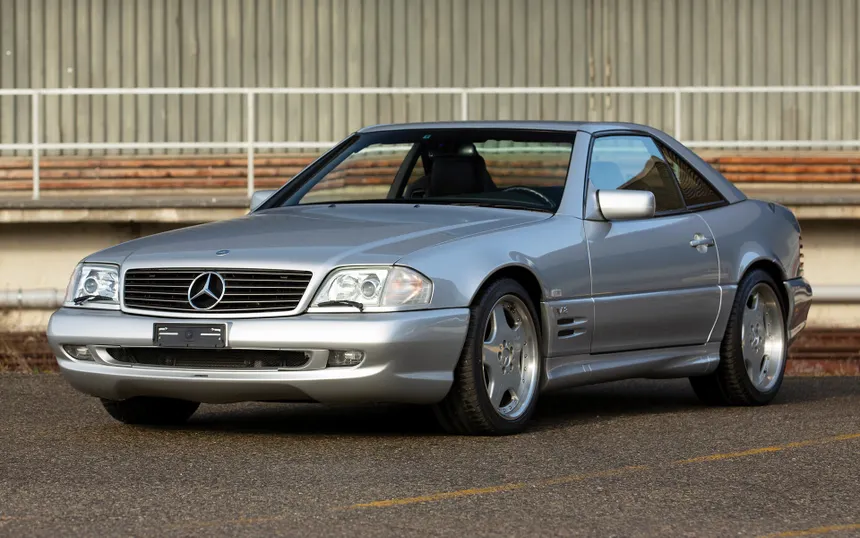
When Mercedes-Benz Still Didn’t Know the Meaning of “Cost Optimization”
There’s a phrase that gets thrown around a lot when car enthusiasts talk about the golden age of Mercedes-Benz: “cost-plus engineering.” It means the engineers built the best car they could, and then the accountants figured out how much to charge for it. Not the other way around.
The Mercedes-Benz SL 500 (R129) is the purest expression of that philosophy in roadster form. Produced from 1989 to 2001 — a twelve-year run that spanned the entire decade of the 1990s — the R129 was the last SL developed before corporate synergy, platform sharing, and shareholder pressure began to erode what “Mercedes-Benz” meant in the minds of those who valued engineering above everything.
It was overbuilt, over-engineered, and overweight. It was also magnificent.
The Birth: Geneva, 1989
When Mercedes-Benz unveiled the R129 at the 1989 Geneva Motor Show, it had an impossible task: replace the R107, a car that had been in production for eighteen years and had become one of the most recognizable luxury roadsters on the planet.
The R107 was a classic in every sense — chrome-heavy, elegant, timelessly styled. Mercedes knew they couldn’t simply update it. They had to leapfrog it. And that’s exactly what they did.
The R129 arrived with a level of technology that was borderline science fiction for a convertible in 1989:
- Automatic folding soft top that opened and closed in 30 seconds at the push of a button — a first for Mercedes
- Automatic roll bar that deployed in 0.3 seconds if the car’s sensors detected an impending rollover
- Integrated wind deflector that reduced cabin turbulence with the top down — Mercedes invented this concept, and every convertible since has copied it
- ABS as standard across the entire range
- Multi-link independent rear suspension derived from the W124 platform
The response was immediate and overwhelming. Mercedes had planned annual production capacity of 20,000 units. Waiting lists stretched to several years. The car won the International Car Design Award barely a year after launch.
The Engine: M119 — Mercedes’ V8 Masterpiece
The heart of the SL 500 was the M119 — a 5.0-liter, DOHC, 32-valve V8 that remains one of the finest engines Mercedes has ever produced.
| Specification | Detail |
|---|---|
| Engine | M119 5.0L V8 DOHC 32V (early) / M113 5.0L V8 SOHC 24V (post-1998) |
| Power (M119) | 326 hp @ 5,500 rpm |
| Torque (M119) | 480 Nm @ 3,900 rpm |
| Power (M113) | 306 hp @ 5,600 rpm |
| Transmission | 4-speed automatic (early) / 5-speed automatic (later) |
| 0–100 km/h | 6.2 seconds |
| Top speed | 250 km/h (electronically limited) |
| Weight | ~1,770 kg |
| Drive | Rear-wheel drive |
The M119 was the same engine that powered the 500E sedan and the legendary SL 600’s smaller sibling. It was smooth, powerful, and — crucially — built to last. These engines routinely exceed 300,000 km with proper maintenance, a durability figure that modern turbocharged units can only dream about.
For the 1999 model year facelift, Mercedes replaced the M119 with the newer M113 — a simpler SOHC design with three valves per cylinder. It was slightly less powerful (306 hp vs. 326 hp) but more efficient and refined. Enthusiasts generally prefer the earlier M119 for its character and the sense that it was built without regard for production cost.
The Lineup: From Six Cylinders to Twelve
The SL 500 was the sweet spot of the R129 range, but it was far from the only option:
- 300 SL / SL 280 / SL 320 — Inline-six models for those who prioritized refinement over power
- SL 500 — The V8 that outsold everything else. The people’s champion of the R129
- SL 600 — 6.0-liter V12, 394 hp. Grand touring in its most absolute form. Only 38 were delivered to Australia
- SL 55 AMG — 5.4L V8, 349 hp. Naturally aspirated. Just 65 units in R129 form
- SL 60 AMG — 6.0L V8, 381 hp. Pre-merger AMG. Incredibly rare
- SL 70 AMG — 7.0L V12. The stuff of legends
- SL 73 AMG — 7.3L V12, 525 hp. The engine that would later power the Pagani Zonda
That last one bears repeating: the most extreme version of the R129 SL carried an engine so extraordinary that Horacio Pagani chose it as the heart of his hypercar. If that doesn’t tell you something about the engineering depth of this platform, nothing will.
The Design: Bruno Sacco’s Masterclass
Designed under the direction of Bruno Sacco, Mercedes’ legendary head of design, the R129 represented a dramatic departure from the chrome-laden R107. The new SL was aerodynamically optimized, with clean lines, flush glass, and an understated aggression that looked modern without being trendy.
The genius of Sacco’s design is its timelessness. An R129 parked next to modern traffic today doesn’t look dated — it looks classic. The proportions are perfect: a long hood suggesting serious machinery underneath, a compact cabin for two, and a short rear deck that keeps the visual weight forward.
Three decades later, the R129’s design language has aged better than most cars from the same era. It’s the automotive equivalent of a well-tailored suit — it doesn’t follow fashion because it doesn’t need to.
The Cultural Moment
The R129 arrived at the perfect intersection of culture and technology. The early 1990s was the era of unabashed luxury, and the SL 500 became its four-wheeled symbol.
Princess Diana famously sold her Jaguar XJS to lease a metallic-red 500 SL in 1991, becoming the first member of the British royal family to drive a foreign car. The media storm that followed — questioning whether a royal should drive a German car — only cemented the R129’s status as the car that transcended national boundaries.
In Hollywood, on the Côte d’Azur, along the Pacific Coast Highway — the R129 SL was the car you drove when you had arrived. Not because it was flashy, but precisely because it wasn’t. It communicated success through engineering quality rather than ostentation. You didn’t need a massive badge or an exotic silhouette. You needed a three-pointed star and the quiet authority of a V8 that could cruise at 200 km/h without raising its voice.
The Generations: A Spotter’s Guide
The R129’s twelve-year run can be divided into three distinct phases:
Early Cars (1990–1995) — The Purists’ Choice
Original M119 V8, square-ribbed taillights, three-slot front wing vents, mechanical odometer. These are the cars that represent the R129 in its most authentic form. The analog instruments, the solid feel of every switch, the sense that absolutely nothing was compromised — this is peak cost-plus Mercedes engineering.
Mid-Year Cars (1996–1998) — The Refined Era
Updated wing vents (two rounded slots instead of three), electronic odometer, dual-zone climate control, upgraded Bose audio. The Panorama tinted-glass hardtop became optional. The engines remained unchanged, but the overall experience became slightly more modern.
Late Cars (1999–2002) — The Modern Classics
New M113 V8, curved taillights replacing the classic square units, body-color door handles, 17-inch wheels as standard, fiber-optic audio connections, one-touch engine start. These are the most reliable and the most comfortable, but purists sometimes feel they traded character for refinement.
Special Editions
Mercedes offered numerous special editions throughout the R129’s life:
- Mille Miglia Edition (1995) — Brilliant Silver, red/black leather, carbon fiber trim. Commemorating Stirling Moss’s 1955 Mille Miglia victory. Only 40 built despite plans for 600
- 40th Anniversary Edition (1997) — Celebrating the original 300SL roadster
- Designo Editions (2000–2001) — Black Diamond and Slate Blue, featuring unique color and trim combinations
- Silver Arrow (2002) — The farewell edition. Special metallic silver paint, two-tone interior, BBS wheels. 1,550 units for the US (1,450 SL 500, 100 SL 600)
- Formula One Edition (2001) — Just 20 units celebrating Mercedes’ return to F1
The Market Today
Total R129 production reached 204,940 units over twelve years, with the SL 500 accounting for the vast majority. For years, depreciation hit these cars hard — six-figure luxury cars becoming $10,000–$35,000 used buys.
But the tide is turning. According to Hagerty, R129 values have shown increases of 19–31% in recent years, though they still trail the iconic R107 560SL in the collector hierarchy. The early M119-equipped cars and the special editions are leading the appreciation curve, while late-model SL 500s remain accessible entry points into R129 ownership.
The sweet spot for buyers right now? A well-maintained 1995–1998 SL 500 with the M119 engine, reasonable mileage, and full service history. It’s the best V8 roadster you can buy for the money, and the market is beginning to recognize that.
Why the R129 SL 500 Matters
The R129 was the last Mercedes-Benz SL built under the philosophy that cost was secondary to engineering excellence. The subsequent R230, while competent, introduced ABC suspension that was brilliantly innovative but financially devastating to maintain. The R231 after it was comfortable but anonymous. The current R232 is a completely different kind of car — more GT than roadster.
The R129 SL 500 represents the endpoint of a lineage that stretches back to the original 300SL Gullwing. It carries the DNA of that car — the mechanical purity, the over-engineering, the sense that every component exists because an engineer believed it was the right solution, not because an accountant approved it.
In thirty years, when people look back at the great Mercedes roadsters, the R129 will occupy the same revered position that the R107 holds today. The only difference is that right now, you can still buy one for less than the price of a moderately equipped new SUV.
That window won’t stay open forever.
Pingback: Mercedes-Benz R107 SL: Complete History of the 18-Year Icon That Conquered America