
Mitsubishi Lancer Evolution: The War Machine that Became a Cult Icon.
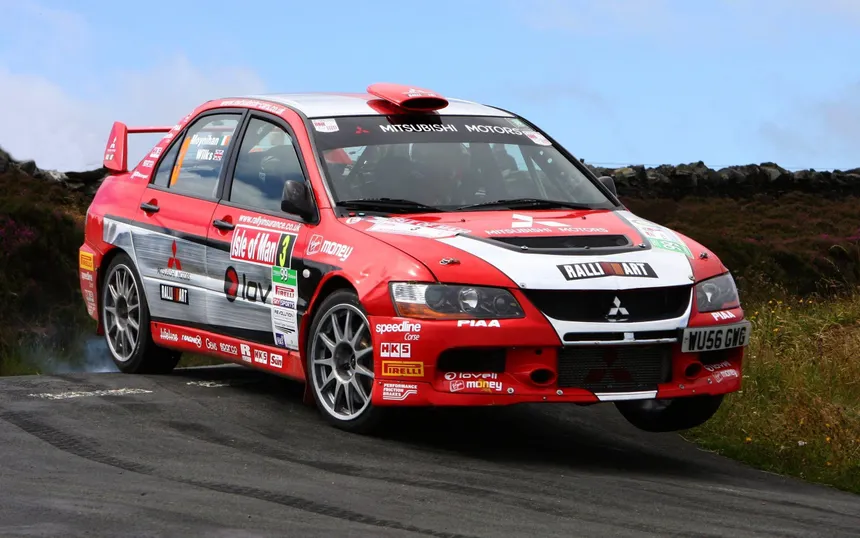
Mitsubishi Lancer Evolution: From Rally Homologation Tool to Cult Legend. The Full Evo Story.
Some cars are born for the market. Some cars are born for competition. And some cars are born for competition, end up being sold to the public, and somehow conquer both worlds with an intensity nobody predicted.
The Mitsubishi Lancer Evolution is all three at once.
When Mitsubishi introduced the first Lancer Evolution in 1992, they weren’t trying to create an icon. They were doing it because WRC homologation rules required any competition car to have a road-going version sold to the public in a minimum number of units. The Evo was, at its purest origin, a bureaucratic formality.
Three decades, ten generations, and a global legion of fans later, that bureaucratic formality has become one of the most beloved and respected cars in Japanese performance car history.
Few stories in the industry are so improbable.
The Origin: The Need for a Homologation Weapon
The 1992 WRC operated under Group A regulations: cars with a solid production base, stricter homologation requirements than the wild Group B that preceded them. To homologate a Group A car, the manufacturer needed to produce at least 2,500 road-going units in 12 months.
Mitsubishi wanted to compete seriously in the WRC. The decision: use the Lancer, a completely anonymous mass-market compact saloon, as the base. They fitted the turbocharged 4G63 engine, added four-wheel drive with an Active Center Differential, and called the result “Lancer Evolution.”
The EVO I arrived in 1992. 250 hp, approximately 1,100 kg, four-wheel drive developed specifically for rally. A missile disguised as a family saloon.
In Japan, it sold out in minutes. Not metaphorically: the 2,500 homologation units were exhausted so quickly that Mitsubishi had to reassess whether they’d misjudged the demand.
They had misjudged the demand.
The 4G63: The Engine That Defined an Era
The heart of the Evo and one of the main reasons for its legacy is the 4G63 — a two-liter inline-four with aluminum head, twin cam, and a turbocharger that in competition specification could push power to figures that would be respectable today and were simply scandalous in the 1990s.
What made the 4G63 special wasn’t just its power. It was its tuning potential. The block tolerated aggressive modifications, the management system responded well to remapping, internal components withstood power figures well above factory spec without requiring major rebuilds.
For the tuning community, growing exponentially in the 90s partly thanks to JDM culture and video games like Gran Turismo, the 4G63 was the dream engine. Take a stock Evo with 250-280 hp, invest in a turbo upgrade, intercooler, ECU remap, and within weeks you have 400 hp. On a reasonable budget, 500 hp. And the car remains daily-driveable.
That democratized access to supercar-level performance. An amateur mechanic with knowledge and tools could transform an Evo into something that embarrassed Ferraris costing ten times more. That narrative was fuel for the cult.
Tommi Mäkinen and the WRC Golden Years
In the WRC, the Evo found its fullest expression with Tommi Mäkinen behind the wheel. The Finn, nicknamed “the wood man” for his ability to maintain pace in snow and mud where others got lost, won four consecutive world championships between 1996 and 1999 — all with versions of the Lancer Evolution.
Four consecutive championships with the same driver and the same base car. Against Subaru and the Impreza as the main rival, against Carlos Sainz in Ford, with Toyota rebuilding after their 1995 scandal, it was an extraordinary run.
Mäkinen and the Evo had a symbiotic relationship rarely seen in motorsport. The Finn’s driving style was highly specific — attacking stages with an aggression that in less talented drivers would have meant constant off-road excursions, but in him generated times that rivals couldn’t match. The Evo, with its active four-wheel drive and weight balance, gave him the perfect platform for that style.
The Subaru Wars: The Perfect Rivalry
A fundamental part of the Evo’s legacy is inseparable from its rivalry with the Subaru Impreza WRX. The two cars competed for years in the WRC, shared the same price and performance profile in the market, and divided Japanese performance car fans into two camps with the clarity and passion of a football derby.
Impreza or Evo. Subaru or Mitsubishi. Flat-four or inline-four. The debate never had a definitive answer because both cars were extraordinary in slightly different ways.
The Impreza was more forgiving, more confidence-inspiring at the limit, with the boxer’s unmistakable sound and a solidity the Evo didn’t always match in less experienced hands. The Evo was sharper, more aggressive, more capable of surprising with its agility but also more demanding to truly exploit.
This rivalry elevated both cars. Direct competition forced Mitsubishi and Subaru to innovate with every generation. Without the Impreza, the Evo probably wouldn’t have reached the technical level it achieved. And vice versa.
The End of the Evo and What It Means
The end of the Lancer Evolution in 2016 felt to the JDM and performance car community like more than the discontinuation of a model. It felt like the end of a philosophy.
Mitsubishi reoriented its lineup toward SUVs and electric vehicles. A commercially understandable decision in a changing market. But the consequence was that one of the most influential performance cars of the past three decades ceased to exist with no successor.
There’s no Evo in Mitsubishi’s current catalog. In a world where Hyundai has the i30 N, Honda has the Civic Type R, and Volkswagen maintains the Golf R, the Evo’s absence is a notable gap.
What the Evo represented goes beyond technical specifications: it was proof that an accessible car, based on an anonymous saloon, could be developed to a level of real-world competence that few supercars could match. An argument for humble engineering and technical ambition over exclusivity and price.
That argument remains valid. And its absence from the market is, for those of us who understand it, a small cultural loss that no amount of SUV sales numbers can compensate.
The Evo was a happy accident that nobody planned to turn into an icon.
Which, paradoxically, is exactly what makes it more iconic.
Pingback: Subaru Impreza 22B STi: History, Specs & Legacy