
The PCV Valve: The €80 Part That Kills €10,000 Engines
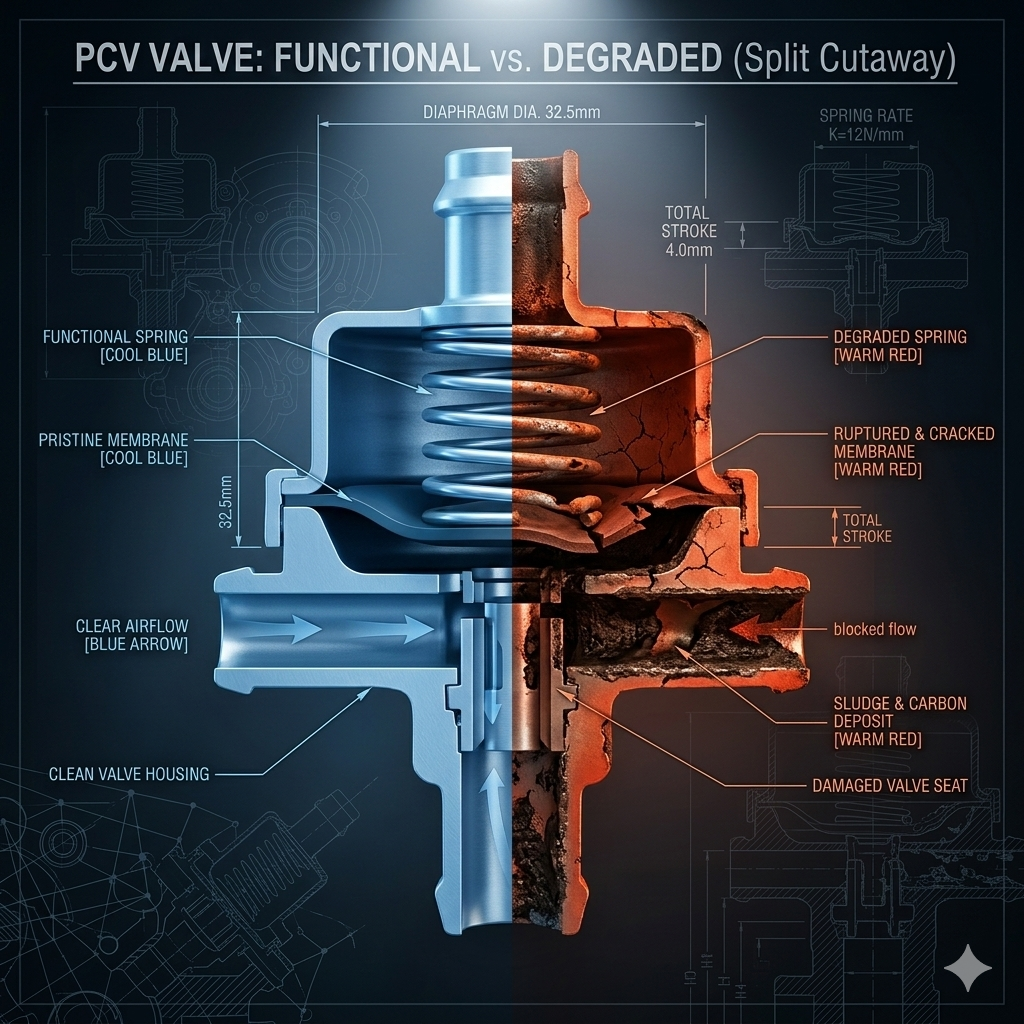
Some car components have the decency to warn you before they fail like EGR, DPF or the Dual Mass Flywheel. They make noise, throw a warning light, lose power in ways you can actually feel.
Then there’s the PCV valve.
A component that costs between €70 and €200 depending on whether you go OEM or aftermarket. A plastic housing with a rubber diaphragm that regulates crankcase gases. Something most car owners have never heard of, let alone thought about.
Until it fails.
And when it fails, there’s no specific warning light. No obvious noise. No diagnostic code that says “PCV valve failure.” It just starts destroying your engine from the inside while you drive on, completely unaware.
What the PCV Valve Actually Does
PCV stands for Positive Crankcase Ventilation.
During normal engine operation, a small amount of combustion gases slip past the piston rings and enter the crankcase. This happens in every internal combustion engine ever made, no exceptions. These gases are called “blow-by” and they contain moisture, unburned fuel, soot, and partial combustion byproducts.
If these gases stay in the crankcase, they contaminate the oil, build internal pressure, accelerate oil oxidation, and cause premature wear on every internal component. The crankcase needs to breathe, but in a controlled manner.
The solution, engineered back in the 1960s: extract these gases and route them back into the intake manifold to be burned again in the combustion chamber. Two birds with one stone: reduced emissions and a clean crankcase.
The PCV valve regulates this flow. It acts as a one-way valve with negative pressure control. Under normal operating conditions, it allows crankcase gases to flow into the intake manifold using the vacuum generated by the engine. Under high vacuum conditions, like during deceleration with a closed throttle, the valve limits flow to prevent excessive vacuum from sucking oil out of the crankcase and into the intake.
It’s an elegant system in its simplicity. A delicate balance of pressures that operates thousands of times per minute throughout the engine’s life.
When the valve is working properly.
The Problem: Inadequate Materials and Calculated Failure
This is where things get uncomfortable for manufacturers.
Early PCV valves were robust components. Machined metal, calibrated steel springs, membranes made from durable materials. Designed to last the entire service life of the vehicle without intervention.
Modern PCV valves, especially those in turbocharged direct-injection engines, tell a completely different story. Engineering plastic housings that degrade with heat. Synthetic rubber diaphragms that harden and crack. Thin wire springs that lose tension. Complex geometries that accumulate carbonized oil residue.
Operating conditions are brutal. Temperatures cycling between ambient and over 100 degrees Celsius. Constant exposure to oil vapors and corrosive gases. Continuous cycles of pressure and vacuum. Thousands of actuations for every hour of engine operation.
The result is predictable and documented: typical service life between 95,000 and 130,000 kilometers in most modern applications. For a component that, with proper materials, should function trouble-free for 300,000 kilometers or more.
Is this engineering incompetence? No. The same manufacturers produce higher-quality valves for industrial and motorsport applications. They know exactly which materials hold up and which don’t.
It’s an economic decision. A metal component with a high-temperature silicone membrane would cost between €20 and €40 more per unit. Across production runs of millions of engines annually, those euros represent tens of millions in profit margin.
Warranty costs are calculated. Post-warranty repair costs are absorbed by the customer. The equation works out on the manufacturer’s balance sheet.
Diagnostic Hell: Symptoms That Point Everywhere Except the PCV
The PCV valve can fail in two fundamental ways: stuck permanently open or stuck permanently closed. Each failure mode produces different symptoms, and none of them obviously point to the culprit.
Valve Stuck Open
When the diaphragm ruptures or the mechanism jams in the open position, the system loses its ability to regulate flow. The result is massive unmetered air entry past the MAF sensor, creating a significant vacuum leak.
Typical symptoms include unstable idle fluctuating between 500 and 1000 RPM, lean mixture with possible cold misfires, error codes related to lean mixture or slow lambda sensor response, increased fuel consumption, and in advanced cases, a check engine light with generic codes that point to nothing specific.
A mechanic without specific experience will start hunting for vacuum leaks in hoses, intake manifold gaskets, poorly sealed injectors. They’ll replace lambda sensors. Clean the throttle body. They can spend hours and hundreds of euros without finding the cause.
Valve Stuck Closed
When the valve blocks closed, crankcase gases have no exit. Internal pressure builds progressively with each combustion cycle until it finds an alternative path.
Symptoms are different but equally confusing: oil leaks from crankshaft and camshaft seals, oil expelled toward the air filter through the emergency breather, blue smoke on acceleration from oil finding its way into combustion, dramatically accelerated oil degradation requiring shorter change intervals, and in extreme cases, seals literally blown out by pressure.
The typical diagnosis will be “excessive engine wear” or “seals needing replacement.” The mechanic will change the seals for €300 to €400 in labor. And in a few months, they’ll fail again because the root cause remains untouched.
The Modern Diagnostic Trap
OBD-II diagnostic systems don’t have a specific code for “PCV valve failure” in most vehicles. The codes that appear are secondary symptoms: P0171 lean mixture, P0300 random misfires, P0420 catalyst efficiency.
A technician unfamiliar with the specific engine’s PCV system can spend days chasing ghosts while the engine continues to degrade.
Documented Cases: The Real Price of Failure
The VAG Group EA888: A Case Study in Systematic Failure
Volkswagen, Audi, Seat, and Skoda’s EA888 engines are technically brilliant. High specific output, contained consumption, excellent response. They’re also a perfect example of problematic PCV design.
In these engines, the PCV valve isn’t an independent component. It’s integrated into the valve cover along with the oil separator. A compact, elegant design that reduces the number of components and connections. It also means that when the internal diaphragm fails, repair requires replacing the entire valve cover assembly, a component costing between €400 and €600 in OEM parts plus labor.
But the part cost is the least of the problems. When the EA888 diaphragm fails in the open position, it can create suction so intense that it draws oil directly into the intake. This oil carbonizes on the intake valves, a problem already critical in direct-injection engines where fuel doesn’t wash the valves like it does with port injection.
The result is extreme carbonization. Intake valves with deposits that restrict airflow, cause misfires, power loss, and elevated consumption. Valve cleaning via walnut blasting costs between €400 and €900 depending on the shop. In extreme cases, it requires cylinder head removal.
I’ve documented cases of EA888 engines with less than 130,000 kilometers that needed complete carbon cleaning, valve cover replacement, and in one particularly unfortunate case, a new turbocharger because excess oil in the intake ended up passing through the turbo and carbonizing on the compressor wheel.
Total repair cost: over €4,000. Root cause: an €80 rubber diaphragm that cracked.
The Problem Isn’t Exclusive to VAG
PSA’s 1.6 THP Prince engines have their own version of the problem. BMW’s N20 and N26 as well. Ford’s EcoBoost engines, Mazda’s Skyactiv, Honda’s turbo VTEC. Virtually any turbocharged direct-injection engine from the last decade has a PCV system that fails prematurely.
The difference lies in how integrated the system is and how much the repair costs when it fails. In some cases it’s an independent valve costing €40 and 20 minutes of work. In others it’s an integrated module costing €400 that requires removing half the engine to access.
The Solution Nobody Tells You About
The aftermarket parts industry has identified the problem and offered solutions. Higher-quality replacement PCV valves exist, manufactured with superior materials to the originals.
High-temperature silicone membranes instead of standard synthetic rubber. Machined aluminum housings instead of engineering plastic. Calibrated stainless steel springs. Optimized geometries to reduce residue accumulation.
These components cost between €120 and €250 depending on application. More than basic aftermarket parts, but comparable or even less than OEM.
But they’re designed to last. Manufacturers like Dorman, URO Parts, CRP, Vaico, and various brand specialists offer alternatives with documented quality. Typical warranties are 2 to 5 years or 100,000 kilometers, far superior to original components.
The problem is visibility. Official dealers only install original replacement parts, often the same deficient quality that caused the failure. Independent shops usually opt for the lowest price, which frequently means another part of equivalent quality to the original. And owners don’t know alternatives exist because nobody has any incentive to tell them.
Preventive Maintenance Strategy
After years observing these failures and their consequences, my recommendation for any turbocharged direct-injection engine owner is clear:
Know Your System
Before you have a problem, research how your specific engine’s PCV system works. Is it an accessible independent valve? Is it integrated into the valve cover? Does it require special tools for removal? Knowing this lets you evaluate shop quotes and detect when someone’s trying to overcharge you.
Inspection Every 80,000 Kilometers
At the 80,000-kilometer service, specifically request that they check the PCV valve and oil separator condition. If they’re accessible, it’s minutes of work any competent shop can do. Look for cracks in membranes, hardness in rubber components, excessive residue accumulation.
Preventive Replacement Every 120,000 Kilometers
Don’t wait for it to fail. The cost of preventive PCV valve replacement, even using superior quality components, is insignificant compared to the potential damage from an undetected failure. Treat it as scheduled maintenance, just like timing belt replacement.
Oil Quality and Interval Compliance
Higher-quality oil better resists degradation and produces fewer residues that contaminate the PCV system. Oils exceeding manufacturer specifications with margin, like a quality 5W-30 when the manufacturer only requires minimum spec, help keep the system clean longer.
Respect change intervals. The extended 30,000-kilometer intervals some manufacturers specify are optimistic at best. A change every 15,000 kilometers or once per year keeps oil in optimal condition.
Avoid Repeated Short Trips
Short urban trips where the engine never reaches optimal operating temperature are the worst-case scenario for the PCV system. Moisture doesn’t evaporate, residues don’t burn off, oil contamination accelerates. If your typical use involves short trips, consider more frequent oil change intervals.
The Uncomfortable Question: Design or Decision?
I’m not one who sees corporate conspiracy around every corner. Automotive engineering is complex, compromises are inevitable, mistakes happen even in competent organizations.
But when you observe a systematic pattern, the explanation stops being error and starts being decision.
A critical component for engine longevity, systematically manufactured with materials that can’t withstand expected operating conditions, with higher-quality alternatives perfectly available at marginally higher cost. A failure that doesn’t generate specific diagnostic codes, that mimics symptoms of other more expensive problems, that frequently manifests just after the warranty period.
Is it deliberate planned obsolescence? Is it cost optimization without consideration of long-term consequences? Is it pressure from finance departments on engineering departments? Is it lack of durability testing beyond the warranty period?
Probably a bit of everything. The result for the owner is the same: an engine that fails prematurely due to a component that should last the vehicle’s entire life. Thousands of euros in repairs that could have been avoided with a few more euros on the production line.
The Real Cost of Corner-Cutting Engineering
€80 in inferior-quality components on the production line.
Between €500 and €5,000 in repairs for the owner when the component fails.
That’s the equation of the modern PCV valve. A perfect example of how contemporary engineering has stopped designing for durability and started designing for immediate profit margin.
Every gram of material saved, every cent cut in component selection, adds cents to profit per unit sold. Multiplied by millions of vehicles, that’s millions of euros on annual balance sheets.
And subtracts years of life from millions of engines. Generates millions in repair costs absorbed by owners. Sends vehicles to the scrapyard prematurely that could have run for decades longer.
Next time you hear an automotive executive talk about sustainability and circular economy, remember the PCV valve. Remember the €80 component designed to fail.
Have you had PCV valve problems with your car? Been diagnosed with oil consumption or leaks without finding the cause? Tell me about it in the comments.
Pingback: Motor Oil: Technical Guide to Choosing Right