Pegaso Z-102: The Story of the Spanish Supercar That Was the Fastest in the World
Not Enough Cylinders — Unfiltered Automotive Opinion
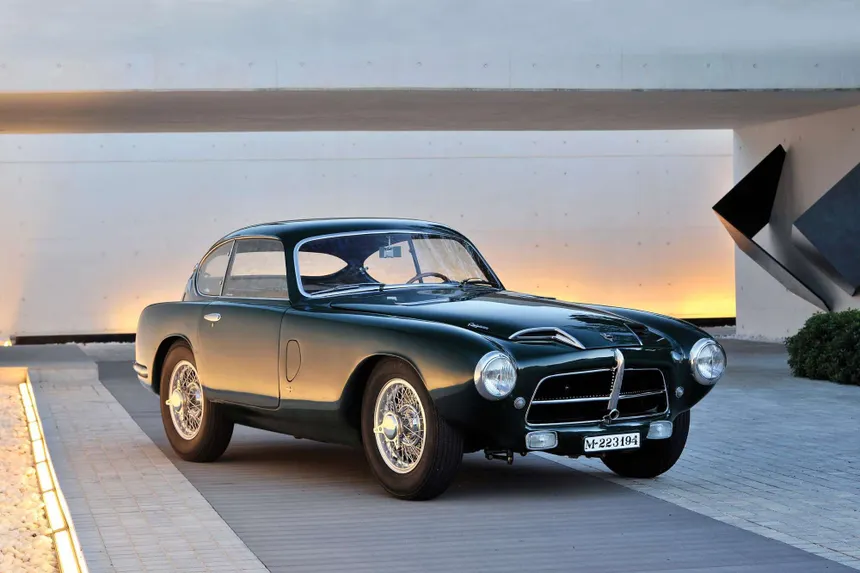
There are cars that define eras. Others defy logic. The Pegaso Z-102 did both. Born in post-war Barcelona, in a factory meant to build trucks and buses, this Spanish V8 had the audacity to challenge Ferrari, Jaguar, and Maserati on their own turf. And it didn’t just show up: in September 1953, it snatched the world speed record away from them. A car made in Spain. In the ’50s. With Franco in power and the country rebuilding from a civil war. If that isn’t a story worth telling, I don’t know what is.
The Context: A Spain in Need of a Symbol
To understand the Pegaso Z-102, you have to understand Spain in 1950. The country was internationally isolated, the economy was at subsistence levels, and the automotive industry practically didn’t exist. The National Institute of Industry (INI), created in 1941, had founded ENASA (National Truck Company) in 1946 to manufacture industrial vehicles. The factory was located in the former Hispano-Suiza facilities in Barcelona, in the La Sagrera neighborhood. There, where some of the most exclusive pre-war luxury cars had once been built, they were now cranking out trucks and buses.
But within ENASA existed the CETA (Center for Technical Automotive Studies), a department with a special mission: to develop high-level proprietary technology. And at the helm of CETA, Spain was fortunate to have one of the most brilliant engineers of his time.
Wifredo Ricart: The Genius Behind the Winged Horse
Wifredo Ricart Medina was no ordinary engineer. Before arriving at ENASA, he had worked at Alfa Romeo during the ’30s, where he rose to become the Director of Design and Experimental Services and head of racing. In Italy, Ricart had led top-tier technical teams and crossed paths professionally with a man named Enzo Ferrari, who at the time worked as the head of Scuderia Ferrari within Alfa Romeo. The relationship between the two was, to put it mildly, tense. Ferrari felt Ricart had taken a position he didn’t deserve. Ricart, for his part, considered Ferrari a good sports manager but no engineer.
When WWII ended, Ricart received an offer from Studebaker in the United States, but he chose to return to Spain. He brought with him two dozen engineers who had worked with him at Alfa Romeo and a clear vision: to prove that Spain could build a world-class automobile. The result of that vision would be the Pegaso Z-102.
Technical Specifications: Engineering Without Compromise
The Z-102 wasn’t just a fast car with a big engine. It was a comprehensive piece of engineering where every component was designed and manufactured in-house—something even Ferrari wasn’t doing at the time.
The Engine: A V8 Ahead of Its Time
The heart of the Z-102 was a 90° light aluminum alloy V8, featuring four overhead camshafts (DOHC), 32 valves, and hemispherical combustion chambers. The camshafts were driven by gear cascades—a much more precise and reliable solution than chains. It featured a dry-sump lubrication system, typical of race cars but rarely seen in street vehicles. And a detail that is still impressive today: the exhaust valves were cooled by liquid sodium, a technology inherited directly from military aviation.
Three displacements were offered: 2.5L, 2.8L, and 3.2L. Fueling could be handled by one, two, or even four inverted twin-choke Weber carburetors, or an optional Roots supercharger. Power outputs ranged from 175 HP in the base version to 360 HP in the supercharged 3.2L version. For context, a Ferrari 250 Europa from the same era produced around 200 HP.
Chassis, Transmission, and Suspension
The chassis was a pressed, folded, and welded steel platform, extraordinarily rigid for its time. The transmission was a non-synchronized, straight-cut five-speed gearbox mounted in a transaxle configuration with the differential at the rear axle. This setup significantly improved weight distribution. The engine was placed slightly behind the front axle for the same reason.
The front suspension was independent with double wishbones, while the rear used a De Dion axle with transverse torsion bars—a technical solution that combined the rigidity of a live axle with the stability of independent suspension. The recognized weak point of the package was the drum brakes, which suffered from overheating, especially in competition.
Technical Spec Sheet Summary
| Parameter | Specification |
| Production | 1951 – 1958 |
| Units Manufactured | ~86 (no two are alike) |
| Engine | Aluminum V8, DOHC, 32v, Dry Sump |
| Displacements | 2.5L / 2.8L / 3.2L |
| Power | 175 HP – 360 HP (with supercharger) |
| Fueling | 1–4 inverted Webers or Roots blower |
| Transmission | 5-speed, transaxle, non-synchro |
| Top Speed | 151 mph (243 km/h) (supercharged version) |
| Coachbuilders | ENASA, Touring, Saoutchik, Serra |
The Coachwork: Where Art Met Engineering
As was common at the time, the manufacturer provided the chassis and mechanicals, and customers could choose a coachbuilder. This makes almost every Pegaso Z-102 a unique piece.
- ENASA (22 units): The first units were bodied in the La Sagrera factory itself. This includes the spectacular Berlinetta Cúpula, also known as the “Tea Rose,” featuring one of the most unique body designs in automotive history.
- Touring Superleggera (~41 units): The Milanese house was the primary coachbuilder. Notable is the Z-102 Thrill, nicknamed “the ears” by factory mechanics due to its side fins, which even included seatbelts—unheard of in 1953.
- Saoutchik (~18 units): The French firm created opulent, baroque versions. The most famous was commissioned by Baron Thyssen-Bornemisza for his wife: a Z-102 with real leopard skin upholstery and gold-plated controls. It won the Grand Prix d’Elegance at Enghien-les-Bains in 1953.
- Pedro Serra (5 units): The Barcelona coachbuilder entered the story by chance after a driver wrecked his Pegaso and asked Serra for a new body. The result was so impressive that Ricart commissioned more work from him, fulfilling the dream of a purely Spanish high-end sports car.
In Competition: Glory, Blood, and a World Record
Monaco and Le Mans: Ambition vs. Reality
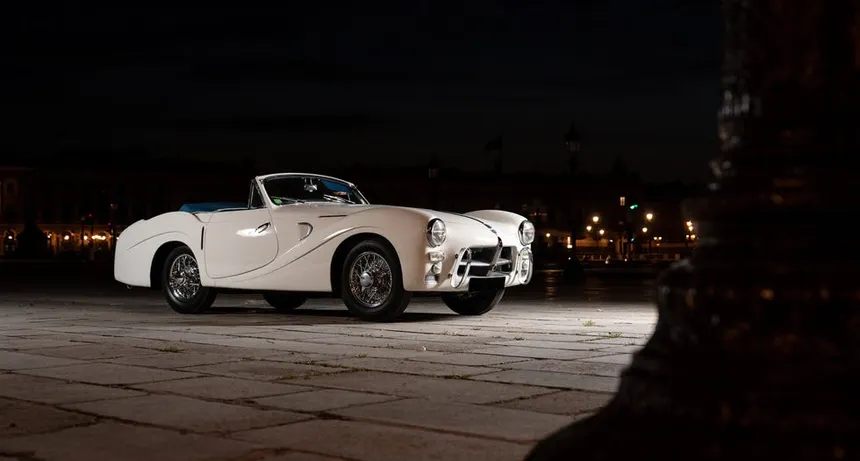
ENASA entered two Z-102s in the 1952 Monaco Grand Prix (run for sports cars that year). In 1953, Pegaso sent three units to the 24 Hours of Le Mans. However, pre-race tests revealed plug issues and critical brake overheating. During the race, Juan Jover misjudged his entry speed into the corner after the Dunlop bridge and crashed his Spider into the barriers at over 125 mph. He suffered severe leg injuries, and a shocked Pegaso withdrew the remaining cars. They would never return to Le Mans.
Jabbeke: The Day Spain Was the Fastest in the World
The Le Mans failure triggered a change in strategy: if Pegaso couldn’t prove reliability in endurance, it would prove pure speed. On September 25, 1953, on the Jabbeke straight in Belgium, a supercharged Z-102 Touring BS/2.8 driven by Celso Fernández broke four official R.A.C.B. records. Most importantly, it clocked an average of 151.04 mph (243.079 km/h) on the flying kilometer, snatching the record from the Jaguar XK120. The Pegaso Z-102 became the fastest production car in the world.
10 Trivia Facts You Probably Didn’t Know
- The Shah of Iran owned one. It was allegedly a gift from the Spanish government during trade negotiations.
- No two are alike. Between engine variations, coachbuilders, and colors, every unit is unique.
- It cost as much as six SEAT 600s. It was a car for a tiny elite in a developing country.
- The valves were liquid sodium-cooled. Technology straight from aircraft engines.
- Enzo Ferrari hated Ricart. Their rivalry at Alfa Romeo was legendary; some say Ricart built the Pegaso just to prove he could outdo Ferrari.
- They destroyed the blueprints. When ENASA killed the project, they destroyed the plans and tooling, believing the car never paid for itself.
- The leopard skin was real. Baron Thyssen’s car didn’t use imitation; it was genuine leopard.
- 77 out of 86 were sold in Spain. Despite being aimed at international prestige, only 9 crossed the border.
- 45 were still running in 2010. 17 units have been confirmed destroyed over the decades.
- It earned 18 first-place finishes. Between 1953 and 1957 in hill climbs and speed trials.
The Sad End and Eternal Legacy
The Z-102 died the way misunderstood geniuses do: too soon and without a sound. The car, built without cutting corners in a country that could barely afford luxury, was never economically viable. ENASA tried a simplified version, the Z-103, but only 3 were built. The last Pegaso sports car left the factory in 1958.
British journalist J. K. Setright wrote that the Z-102 was, in concept, everything the Ferrari could have been, but its failure was a victim of circumstances rather than any innate flaw. Today, a Z-102 in good condition can exceed one million dollars at auction. It is one of the most coveted pieces in global collecting.
The Pegaso Z-102 wasn’t a commercial success. It didn’t win Le Mans. But it proved that a group of engineers in a truck factory in post-war Barcelona could create a car that humbled Jaguar in speed, rivaled Ferrari in sophistication, and surpassed Maserati in exclusivity. The winged horse flew high—perhaps too high for the Spain of the ’50s. But its flight was absolutely glorious.
— Not Enough Cylinders
Pingback: Hispano-Suiza: Europe's kings chose this over the Rolls-Royce