
Peugeot 405 T16: The Monster That Turned Pikes Peak Into a World Legend
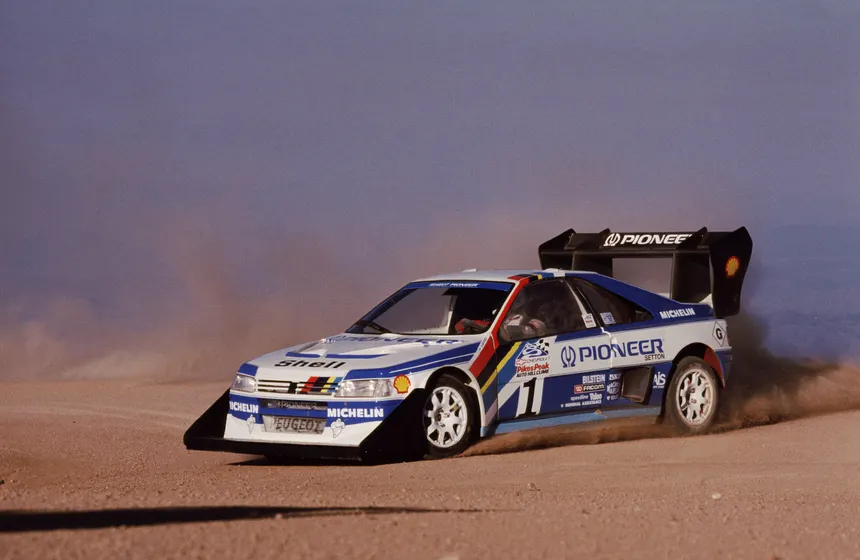
There Are Races. There Are Records. And Then There Are Moments That Change the History of a Sport Forever.
On July 4, 1988, on a Colorado mountain covered in gravel and dust, a Finn named Ari Vatanen steered a 600 CV Peugeot into the first corner and for ten minutes and forty-seven seconds did something no one had ever witnessed in quite that way: he drove as if the mountain belonged to him.
He didn’t just win a race. He didn’t just break a record. Vatanen and the Peugeot 405 T16 created one of the most powerful images motorsport has ever produced. And they did it on gravel. Without guardrails. With the void just centimeters away.
If you’ve never seen “Climb Dance”, you have homework after reading this.
The Context: Peugeot Needed Revenge
To understand why the 405 T16 exists, you need to understand the wounded pride of a French brand with Group B all over its hands.
Peugeot had arrived at Pikes Peak in 1987 with the 205 T16 — the same car that had dominated rallying before Group B was banned. Their driver was Bruno Saby. The result was a clear defeat against Walter Röhrl’s Audi Sport Quattro, which won that year with authority.
Jean Todt, Peugeot’s Motorsport Director — the same Jean Todt who would later manage Schumacher’s Ferrari victories and then preside over the FIA — was not a man who accepted defeat quietly. So between late 1987 and early 1988, he ordered a new machine to be built. One designed specifically for Pikes Peak. One that wouldn’t fail.
The problem was clear: the 205 T16 had too short a wheelbase for Pikes Peak’s long high-speed corners. You could stretch it to a point, but it wasn’t enough. They needed another car.
The solution was the Peugeot 405 T16.
The Car: Engineering at the Edge of Absurdity
The 405 T16 shares practically nothing with the Peugeot 405 your neighbor drove to work in 1988. They share the name and a carbon-kevlar body that vaguely resembles the road car. The rest is science fiction for the era.
The Technical Foundation:
The starting point was the Grand Raid version of the 205 T16, the car Peugeot had developed for the Paris-Dakar. They extended the chassis 30 centimeters between the engine and the cockpit, going from a 100-inch wheelbase to 113.7 inches. This not only gave more stability in Pikes Peak’s long corners but also allowed for larger fuel tanks — critical for a 20-kilometer continuous climb.
The final structure was fully tubular. On top, a carbon-kevlar body mimicking the shapes of the road 405 but sharing not a single panel with it. The car’s weight without equipment was around 880 kilograms. Under a tonne for what was inside.
The Engine: The XU9T
The engine was an evolution of the Group B T16 powerplant, but with the Group B displacement restrictions lifted. Peugeot used that freedom to increase displacement to 1,905 cc, fit a variable geometry turbo, and add variable valve timing on both camshafts. The result was over 600 CV reaching all four wheels.
For context: the Ferrari F40, the most extreme supercar Ferrari sold to the public at that moment, had 478 CV. The Peugeot produced 120 more horsepower than that and weighed under 900 kilograms.
The power-to-weight ratio was under 1.5 kg per CV. Outrageous for 1988. Outrageous today as well.
Four-Wheel Drive and Four-Wheel Steering
The 405 T16 had permanent four-wheel drive with an electronically adjustable center differential, inherited directly from the 205 T16. Nothing new there for anyone familiar with Group B cars.
What was new — radically new — was the four-wheel steering. Never before had a rally or hillclimb car incorporated this technology. The rear wheels could turn independently to improve maneuverability in tight corners and stability in high-speed bends. It was aerospace technology applied to a dirt racing car.
The Aerodynamics: More Than Any F1 Car of the Era
The 405 T16 carried a massive rear wing designed specifically for Pikes Peak. There’s no other way to describe it than “absurdly large.” And it wasn’t just aesthetics: the car generated more aerodynamic downforce than any Formula 1 of the period. On a gravel track without asphalt, where mechanical grip is dramatically reduced, aerodynamic downforce was literally what kept the car on the mountain.
The construction budget for the 405 T16 exceeded one million dollars in 1988 money. For a car that was going to do one race. That tells you everything you need to know about how seriously Peugeot took Pikes Peak.
The Driver: Ari Vatanen, The Man Who Needed Redemption
Ari Pieti Uolevi Vatanen was born on April 27, 1952 in Tuupovaara, in eastern Finland.
Vatanen is the 1981 World Rally Champion, in a Ford Escort RS1800, and to this day remains the only privateer driver — not belonging to an official factory team — to have won the world title until 2017. He won the Dakar four times (1987, 1989, 1990, and 1991). In total, 10 WRC victories across 101 starts.
But between those cold statistics is a story of suffering that explains much of what happened at Pikes Peak in 1988.
In 1985, Vatanen was on course to win his second world championship with Peugeot when his car rolled at nearly 200 km/h on the Rally Argentina. The accident was devastating. Vatanen spent weeks in hospital with serious injuries. Recovery lasted 18 months. Many thought he’d never race again.
He came back. And he came back hungrier.
In 1987 he won the Dakar with Peugeot. In 1988, Jean Todt called him for Pikes Peak with a specific mission: win and break the record. Vatanen didn’t need much convincing.
The Climb: Ten Minutes That Lasted Forever
On July 4, 1988, Pikes Peak was still a gravel race. No asphalt. No guardrails. Spectators literally sitting at the corners on the edge of cliffs. It was another world.
Vatanen set off from 2,862 meters of altitude with the 405 T16 primed. Jean Todt was in the paddock. The Peugeot team had prepared the car for weeks. There was no margin for error.
What happened over the next 10 minutes and 47 seconds (10:47.77 is the official time) is something words can’t fully describe. Vatanen attacked the mountain with a controlled violence that seemed almost supernatural. One hand on the wheel while the other constantly worked the clutch to maintain turbo pressure — he explained it himself years later: if he’d changed to a lower gear, all four wheels would have spun together. The car danced on the gravel with a fluidity that seemed impossible for something of that size and power.
He crossed the finish line at the summit, at 4,302 meters of altitude, with the outright course record in his pocket.
But the race itself is not what made that day immortal.
Climb Dance: When Motorsport Became Art
Jean Louis Mourey was a film director who was at Pikes Peak that day with a small crew and cameras fitted to the car, in helicopters, and at trackside. The original goal, according to Vatanen himself, was basically a testing video for Peugeot. A record of the climb.
What came from that footage was something else entirely.
“Climb Dance” is a 5 minute and 14 second short film that compresses Vatanen’s 10:47 climb into something that feels like a piece of cinematic art. The editing. The camera angles. The sound of the 405 T16’s turbo. The helicopter shots showing the void beneath the car. And above all, that iconic moment when Vatanen, attacking a corner at maximum speed, raises his arm to shield his eyes from the sun blinding him as it appears above a ridge.
That image — driver with one hand on the wheel, the other shielding against the sun, the car touching the limit of the precipice — became one of the most reproduced photographs in 20th-century motorsport.
The film won five international awards. Not in motorsport film categories. At general film festivals. It was recognized as a relevant audiovisual work beyond the world of motorsport.
In 2013, Peugeot commissioned a remastered HD version to celebrate their return to Pikes Peak with Sébastien Loeb. The original was 25 years old and remained just as striking.
Vatanen has said in interviews that people stop him in the street even today to ask him to recreate the arm gesture. To take a photo. To tell him they’ve watched Climb Dance a hundred times and still watch it again.
That’s what real art does: it doesn’t age.
The Debate Nobody Wants to Have: Was It the Greatest Climb in History?
Here comes the uncomfortable question — the one that divides real motorsport fans.
Loeb in 2013 broke 8:14 with 875 CV and asphalt. Dumas in 2018 broke 8 minutes in an electric car. Those times make Vatanen’s 10:47 look, on paper, prehistoric.
But there’s something the numbers don’t tell you.
Vatanen climbed on gravel. No asphalt. With all 156 corners of Pikes Peak covered in dust and loose stone, where a half-meter error could literally send you off the edge. With a car that was technologically revolutionary but had none of the electronic driver aids modern cars take for granted. No ABS. No traction control. No ESP. Just mechanics, tires, and the instinct of a driver who had survived an accident that would have ended anyone else’s career.
Loeb and Dumas are great drivers. Enormous talents. But they ran on asphalt, with decades more technological development, with electronic systems protecting them from their own mistakes.
Vatanen had no safety net of any kind. Not on the track, not in the car.
Was it the best climb technically speaking? No. Not in terms of time.
Was it the most impressive in human terms? That’s a different debate. And one worth having.
The Legacy: How a Car and Five Minutes of Film Changed Motorsport
Without the 405 T16 and without Climb Dance, Pikes Peak would be an important but regional race today. Known in the United States, followed by hillclimb enthusiasts, but not the global phenomenon it is.
What Vatanen did in 1988 was give the event a cinematic dimension that no other race had. After Climb Dance, European manufacturers started looking at Pikes Peak differently. Fans from around the world started following it. Mainstream media paid attention.
Loeb went to Pikes Peak in 2013 because he wanted the mountain where Vatanen had been immortal. Volkswagen built the ID.R with the ambition to break the record of a race that Climb Dance had put on the world map.
All the media and cultural weight Pikes Peak carries today owes an enormous debt to that July day in 1988, to that blond-haired Finn and that grotesquely-winged Peugeot climbing a dust mountain faster than anyone before.
Verified Technical Sheet: Peugeot 405 T16 Pikes Peak (1988)
| Data | Value |
|---|---|
| Engine | 4-cylinder inline, 1,905 cc, variable geometry turbo |
| Power | Over 600 CV |
| Weight | ~880 kg (unequipped) |
| Drivetrain | Permanent 4WD, electronic center differential |
| Steering | Four-wheel steering (pioneering in rally/hillclimb) |
| Body | Carbon-kevlar |
| Construction budget | Over $1 million (1988) |
| Pikes Peak 1988 time | 10:47.77 (outright record) |
| Driver | Ari Vatanen |
| Film | “Climb Dance,” dir. Jean Louis Mourey, 5:14 min, 5 international awards |
Next episode: Suzuki Escudo Pikes Peak — The twin-engine monster that made Tajima a legend and Gran Turismo its best advertisement.