
SAAB 900 Turbo: The Car That Deserved to Win, and the Autopsy of Who Killed SAAB
By Not Enough Cylinders
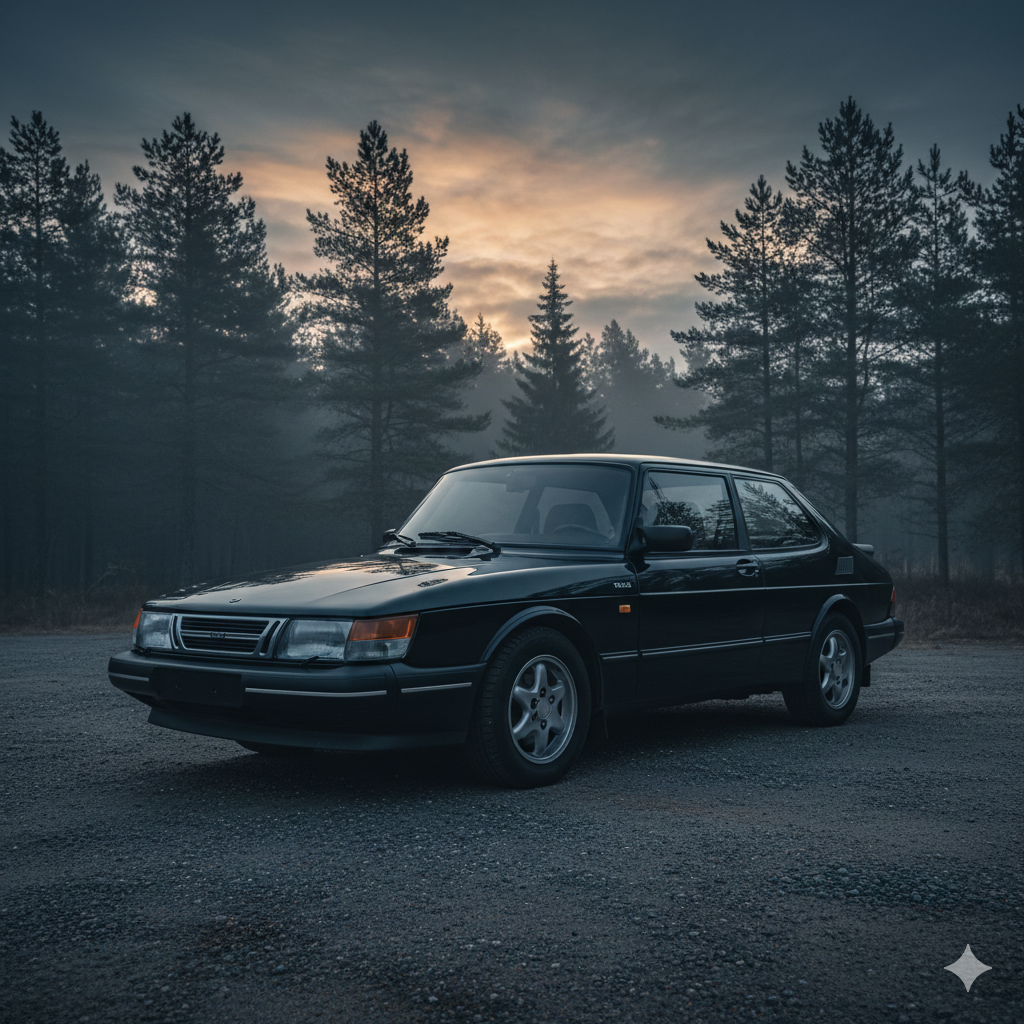
Let me tell you something German car fans don’t want to hear: the SAAB 900 Turbo was a better car than almost everything its European competition was building in the 1980s. Better designed. Safer. More technically ingenious. With more personality per square centimetre than a BMW of the same era.
And yet, SAAB doesn’t exist anymore.
This is the autopsy. No anaesthetic.
First, the Car. Because You Need to Understand What Was Lost.
The SAAB 900 appeared in 1978. But the real story starts earlier, with the 99 Turbo of 1977: the first mass-production turbocharged passenger car in Europe. Not BMW. Not Mercedes. Not Audi. SAAB.
When the 900 arrived, it carried all that heritage and amplified it.
The first-generation 900 Turbo wasn’t a normal car. It was proof that a relatively small company, in a cold country with four million inhabitants, could build cars that redefined what was expected from a European saloon.
The engine: installed backwards, because SAAB did what it wanted
The 900’s straight-four was mounted with the camshaft facing rearward and the gearbox below the engine, sharing the same sump. It was an engineering solution that shortened the front overhang and improved weight distribution. Nobody else did it this way. SAAB did it because it was the better solution, not because it was conventional.
The Turbo added a Garrett AiResearch to that block. In 1978. With an intercooler standard on later versions. SAAB’s engineers were playing in a different dimension.
The design: real aerodynamics before it became marketing
The 900’s bodywork was the result of serious wind tunnel work, not styling for styling’s sake. The Cd of 0.34 was excellent for the era. The large wraparound windscreen — which gave that characteristic fishbowl feeling from inside — wasn’t a whim, but part of a structural solution that improved visibility and cell rigidity.
The safety: SAAB vs the world
This is where SAAB embarrassed most of its competition. The company came from building fighter jets. The mindset was completely different: the vehicle must protect its occupants under any circumstances.
The 900 had an especially rigid passenger cell, programmed deformation zones front and rear before regulations required them, and a driving position derived directly from cockpit ergonomics. The ignition key was between the seats, not on the steering column, to reduce knee injury risk in a frontal impact. Details like that.
The driving: the turbo that refined the concept
Turbo lag was a reality every manufacturer lived with in the 1980s. But SAAB worked harder than anyone to smooth it out. The result was a car that between 3,000 and 5,000rpm had a thrust difficult to find in direct competition. It wasn’t the fastest in a straight line. It was the most satisfying to drive hard.
The 175hp 900 Turbo of 1984 went 0-100 in 8.5 seconds. That doesn’t sound impressive today. In 1984, with that level of equipment, that weight, and that safety, it was a very serious number.
The Swedish Rival: Volvo 240 and the War That Wasn’t Really a War
Before talking about how SAAB died, we need to establish the full Swedish context. Because in the eighties, if you were a European with money, taste, and a desire for something different, the choice was between two brands from the same country and completely different worlds.
Volvo 240 was conservatism elevated to a masterpiece. Solid as a bunker. Boring as reading legal notices. But it lasted forever and everyone knew it.
SAAB 900 was the opposite: innovation, bold design, aviation technology applied to civilian motoring. The car for someone with their own opinions about the world who wanted their car to reflect them.
They didn’t compete directly because they appealed to different buyers. The 240 was bought by the general practitioner. The 900 was bought by the architect who designed houses clients first hated and then copied.
But there was one crucial difference: Volvo understood before SAAB that to survive in the modern market you needed scale. And that difference was decisive.
The Autopsy: Five Knives in SAAB’s Heart
Knife 1: The Scale They Never Had
SAAB never built enough cars. In their best years they produced around 100,000 units annually. BMW produced over a million. Mercedes more. Even Volvo — their compatriot — produced double or triple.
That meant every technological innovation, every safety investment, every engine development had to be amortised across fewer cars. The cost per unit was structurally higher. The margin was structurally thinner.
You could survive like that in the seventies. In the nineties, with an accelerating global market, it was a death sentence.
Knife 2: General Motors, the Worst Adoption in Automotive History
In 1989, General Motors acquired 50% of SAAB Automobile. In 2000 they bought the rest.
It sounds like salvation. It was the opposite.
GM in the nineties was a company with serious structural problems trying to solve them by selling massive volumes of mediocre cars. The philosophy was opposite to SAAB in every dimension: where SAAB invested in proprietary engineering, GM wanted shared platforms; where SAAB sought differentiation, GM sought economies of scale; where SAAB nurtured brand identity, GM managed brands like commodities.
The result was a series of decisions that progressively hollowed SAAB out of what made it SAAB.
The second-generation 9-3 of 2002 shared its platform with the Opel Vectra. Think about that. The most advanced car of a brand that came from building supersonic fighters, sharing a platform with an Opel Vectra. Not because it was a bad platform. But because it was the signal that GM didn’t understand — or didn’t care — what SAAB was.
The 9-7X was the definitive catastrophe: an SUV based on the Chevrolet TrailBlazer with a SAAB badge bolted on. A three-tonne American SUV with the gauges in the centre tunnel and pretensions of Nordic premium. SAAB buyers looked at it and recognised nothing. American SUV buyers preferred the original Chevrolet, which was cheaper.
The 9-7X was a car nobody wanted, sold by a brand nobody understood anymore, built by a company that had no idea why its original customers were buying SAABs.
Knife 3: The Investments GM Didn’t Make
During the years of GM ownership, SAAB needed to renew its lineup with proprietary technology. The BioPower four-cylinders with ethanol were brilliant but insufficient. Missing were investments in new platforms, competitive diesel engines (which SAAB didn’t have in quality until very late), and credible SUVs for the European market.
GM directed those investments to its other brands. SAAB received scraps and the instruction to survive on them.
An engineer who worked at Trollhättan during that period described it this way: “They asked us to develop the cars of the future with the budget of the past.”
Knife 4: The 2008 Crisis and the Perfect Timing to Die
When the global financial crisis hit, GM was on the verge of bankruptcy. The American government intervened. GM had to shed assets.
SAAB was one of those assets.
There were rescue attempts. Koenigsegg — the Swedish hypercar manufacturer we’ll cover in another article in this series — even negotiated a purchase. Swedish businessman Victor Muller through Spyker Cars eventually completed one in 2010.
But it was too late. The brand was exhausted. Dealers had lost confidence. Buyers had migrated to Audi, BMW, and Lexus. The supply chain was at its limit.
SAAB Automobile declared bankruptcy in December 2011. The Trollhättan plant closed. 3,400 direct workers made redundant. Decades of aeronautical engineering applied to civilian cars, finished.
Knife 5: The Identity That Was Diluted Drop by Drop
Perhaps the deepest knife wasn’t any of the above. It was the progressive loss of what made SAAB unique.
The 99 Turbo was a radical car. The 900 Turbo was a radical car. The 9000 still had character. The first 9-3 (based on the Opel Vectra F platform) was already starting to lose it. The second 9-3 had lost it almost entirely. The second-generation 9-5 — which arrived in 2010, when the company was already dying — was a good car that anyone could have built.
SAAB customers weren’t buying cars. They were buying the feeling that there were engineers behind the product who had refused to do the conventional thing. When that disappeared, there was no reason to keep paying the premium.
Those Who Went to BMW and Audi: The Great Exodus
The market of buyers who chose SAAB didn’t disappear when SAAB died. They were still there. They had money. They had taste. And they found other places to go.
BMW absorbed them with the 3 Series and 5 Series. Audi with the A4 and A6. Lexus with the IS and GS for those who wanted comfort above all.
The niche of “premium European car with its own personality and non-German origin” was orphaned for years. Until Volvo, paradoxically, partially reclaimed it with their current models: differentiated Scandinavian design, safety as a banner, alternative to the Germans.
The irony is that Volvo survived by becoming, in some sense, what SAAB aspired to be: a premium brand with its own personality as an alternative to the German oligopoly.
Could SAAB Have Survived?
The question enthusiasts have been asking since 2011.
The honest answer is: with different ownership and different strategic decisions in the nineties, yes. With GM as owner, no.
To survive, SAAB needed what it briefly had under Muller and never managed to consolidate: independence to make product decisions, sufficient capital to renew the lineup, and the confidence that brand identity wasn’t going to keep diluting.
With those conditions, the niche existed and exists. The buyers were and are there. The engineering reputation was still valued.
Without those conditions, the result was what it was.
The Legacy: What Remains
SAAB as an aviation brand — SAAB AB — still exists and builds military aircraft. The Gripen is one of the most advanced fighters in the world. Swedish engineering didn’t die.
Classic era cars — especially the first-generation 900 Turbo and the 9000 Aero — have active collector markets. An original 900 Turbo in good condition can exceed €15,000 without difficulty.
NEVS, a Chinese company, bought SAAB Automobile’s assets in 2012 with the intention of building electric cars. The project advances slowly and without fully convincing anyone. It isn’t SAAB. It’s the SAAB name on a car that has nothing to do with Trollhättan.
There’s something very sad in that. And very revealing about how the automotive world treats brand identity when the real money is somewhere else.
Conclusion: Murder With Premeditation
SAAB didn’t die because it was a bad brand. It died because it was an exceptional brand managed by people who didn’t understand what made it exceptional.
If you had taken the technical DNA of the 900 Turbo, the safety obsession inherited from aviation, the tradition of turbocharged road cars, and combined it with ownership that understood it and funded it correctly… you have a brand that today could be where Volvo is, or higher.
But that’s not what happened.
What happened is that someone who built Chevrolets decided that what made SAAB different was expendable. And once there was nothing different about a SAAB, there was no reason to buy one.
End of autopsy. The patient should never have died.
Did you ever own a SAAB? Which model? Tell us in the comments.
This is the second article in our Swedish universe series: Volvo’s Five-Cylinder Engine | SAAB 9-3 Viggen: The Last Scream Before the Abyss | Why Swedes Design Such Strange Cars | Koenigsegg: The Third Swede Nobody Mentions
Pingback: Why Swedes Design Such Strange Cars: Nordic Philosophy vs German Obsession