
The Small Block Chevy: The Most Produced Engine in History
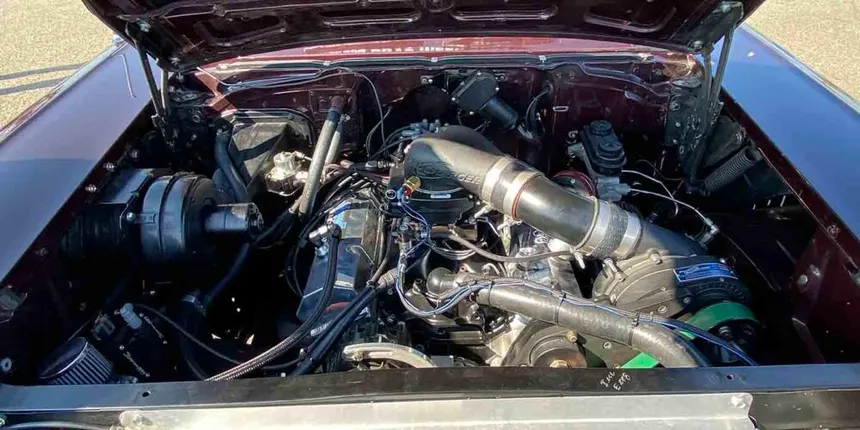
In 1955, Chevrolet introduced an engine nobody knew would last 50 years. A 265 cubic inch V8, compact by the standards of the era, designed by a team led by Ed Cole with the premise that lightness and power didn’t have to be opposing concepts. They called it the Small Block because of its relative size compared to the big blocks of the competition. The name stuck. So did the engine.
Over 100 million units produced. The most cited figure when discussing the Small Block Chevy. A number so large it’s hard to process. For context: that’s more engines than there are people in many countries. For five decades, this engine equipped virtually every imaginable vehicle category, dominated competitions across all disciplines, and became the common language of the American hot rod.
At the Engine’s Syndicate, the Small Block Chevy is not just another entry. It’s the foundation on which much of modern American engine history was built.
Ed Cole and the Obsession With Weight
The story of the Small Block begins with an obsession: build a V8 that weighed less than the giants of the competition without sacrificing power. In the early 1950s, the dominant concept in Detroit was “bigger is better.” Cadillac and Oldsmobile were running enormous, heavy, but powerful V8s. Chrysler was answering with its own massive blocks.
Ed Cole, Chevrolet’s chief engineer, thought differently. Working with a small team and a tight budget, he designed a V8 that in its original 265 cubic inch form weighed nearly 100 lbs less than comparable V8s of the era. The weight reduction wasn’t achieved through magic but through obsessive attention to every component: shorter block deck, integrated main bearing caps that added block stiffness while removing separate hardware, optimized cylinder head design, and exhaust manifolds cast directly into the head.
The engine arrived in the Chevrolet 150/210 and the 1955 Corvette. In the Corvette — the most important American sports car of the era — the difference was immediate and obvious. The Small Block transformed a car that had been born with an uninspiring six-cylinder into a machine that could compete with European sports cars of the period.
The Power Pack, Chevrolet’s first official performance upgrade kit, arrived almost immediately: four-barrel carburetor, more aggressive camshaft, free-flow exhaust. 195 horsepower in 1955. The message was clear: this engine wanted to be modified.
Evolution Through the Decades
The history of the Small Block is inseparable from its constant evolution. It’s not a static engine that survived unchanged for 50 years. It’s a platform that reinvented itself repeatedly while maintaining its fundamental identity.
The 1950s established the foundation. From the original 265 cubic inches, the engine grew to the 283 in 1957 — the first American production V8 to officially achieve one horsepower per cubic inch, accomplished in its Rochester fuel injection version. This was a genuine engineering milestone: Chevrolet had developed a mechanical fuel injection system sophisticated enough to extract that benchmark figure from a production engine, at a time when most performance engines relied entirely on carburetion.
The 1960s brought the 327, probably the most beloved Small Block of its era. With 360 horsepower in the L84 Rochester fuel injection version in the Corvette, the 327 was an engine of exceptional character that combined high power with an unusual smoothness for an American V8. The L84 327 from the 1965 Corvette remains one of the most sought-after engines among collectors.
The 350 arrived in 1967 and became the definitive expression of the SBC. 350 cubic inches, a name that would become so generic it functioned as a synonym for “American V8.” The 350 equipped more vehicles than any other variant, in more applications, over more years. It’s the SBC that more people have touched, repaired, built, and modified than any other. When someone in a junkyard says they found a “Chevy small block,” they almost certainly mean a 350.
The 1970s brought problems: emissions regulations, unleaded gasoline requirements, compression ratio reductions. The mid-1970s SBCs are the least loved of the family, with power outputs that in some cases fell to embarrassing levels. A 1975 Corvette with a 350 making 165 horsepower was a long way from the 375-horsepower L84 of a decade earlier. But the block survived. When the restrictions began to ease and manufacturers learned to work within them, the Small Block came back.
The 1980s and 1990s saw a genuine renaissance. The L98 Tuned Port Injection engine in the C4 Corvette, the LT1 that powered the final C4 iterations and the fourth-generation Camaro, the LT4 in the Grand Sport — GM learned to combine controlled emissions with genuine performance, and the Small Block was the laboratory for those experiments.
In Competition: The Engine That Won Everything
Listing the competitive achievements of the Small Block Chevy would require a separate article. But certain milestones deserve mention.
Drag racing in the 1960s belonged to the SBC across multiple categories. Light, affordable, with a growing aftermarket performance parts ecosystem, the Small Block was the logical choice for any budget-conscious racer who wanted to win. The combination of displacement, weight advantage, and early aftermarket support made it nearly unbeatable in bracket racing and stock classes.
In NASCAR, the Small Block Chevy was the dominant engine architecture from the late 1950s through the 1990s. The 358 cubic inch displacement limit that NASCAR imposed on engines meant the SBC’s architecture — its ability to rev, its proven durability under sustained high-rpm conditions, and its massive base of engineering knowledge — made it the engine of choice for teams that prioritized consistency. It powered more NASCAR championships than any other engine family of its era.
At Le Mans, Corvette carried prepared versions of the SBC to GT-class competition results that defied expectations of what a pushrod V8 could do at the highest level of endurance racing. Before the LS era, the SBC was already demonstrating that American pushrod architecture could be competitive on the world stage.
In amateur and semi-professional road racing across America, the SBC was omnipresent. Easy to source, economical to repair, with replacement parts available at every auto parts store in the country. It was the engine of the working-class racer, the one that made competition accessible to people who didn’t have factory backing.
The Ecosystem: The Real Reason for Dominance
The deepest reason for the Small Block Chevy’s success isn’t in its original design, however good that was. It’s in the ecosystem that design generated.
When an engine spends 50 years in production and sells more than 100 million units, it generates an aftermarket parts and performance industry with no parallel. There are literally thousands of companies — from major equipment manufacturers to small specialist workshops — that built their business around the Small Block Chevy.
High-performance cylinder heads from Edelbrock, AFR, Dart, or World Products. Camshafts from Comp Cams or Crane. Intake manifolds from Holley or Weiand. Exhaust headers from Hooker or Hedman. Forged piston kits from Mahle or CP. The list is endless, and the prices, compared to any European equivalent, are extraordinarily competitive.
A fully rebuilt SBC with quality components, ready to make 400 reliable horsepower in a street vehicle, can be assembled for a cost that would make any BMW or Mercedes M-engine owner weep with joy. That accessibility fundamentally changed who could afford to participate in high-performance automotive culture.
The Tom Wolfe Moment
No discussion of the Small Block’s cultural impact is complete without acknowledging what it represented in the broader narrative of American culture. Tom Wolfe captured it in his 1965 essay “The Last American Hero” — a portrait of Junior Johnson and the world of Southern stock car racing that ran on Small Block Chevys. The engine wasn’t just transportation; it was an expression of working-class ingenuity, of the American capacity to extract performance from limited resources.
That spirit defined the Small Block’s cultural meaning. It was the engine of the self-taught mechanic, the garage builder, the racer who couldn’t afford a team but could afford a 350 and a Saturday afternoon. It democratized performance in a way that no expensive European engine ever could.
The End and the Legacy
In 2003, General Motors announced that the Small Block Chevy would be discontinued to make way for its successor, the LS family. It was the inevitable end of an era. The engine that had begun in 1955 couldn’t remain in production indefinitely, and the LS was objectively superior in virtually every measurable parameter.
But the Small Block’s legacy didn’t die with its production. It died in the way a founder dies: leaving something larger than itself behind. The LS exists because the SBC existed. The philosophy of compact, light, capable, fundamentally sound V8 engineering that Ed Cole established in 1955 is visible in every design decision of the LS family.
The Small Block community is still alive. Millions of units in circulation, decades of accumulated parts in workshops around the world, and a performance aftermarket that remains active decades after production ended. The SBC is not going away any time soon.
In terms of total impact on the American automobile — in production volume, in competition, in popular culture, in the aftermarket industry — the Small Block Chevy has no competition. It’s the most democratic engine in American automotive history: available to everyone, capable of much, and loyal until the end.
Welcome to the Engine’s Syndicate, old friend.
Pingback: Chevrolet Camaro Z28 SS: Complete History of the Ultimate F-Body