
The Toyota 2JZ-GTE: The Legend That Earned Its Throne on Boost
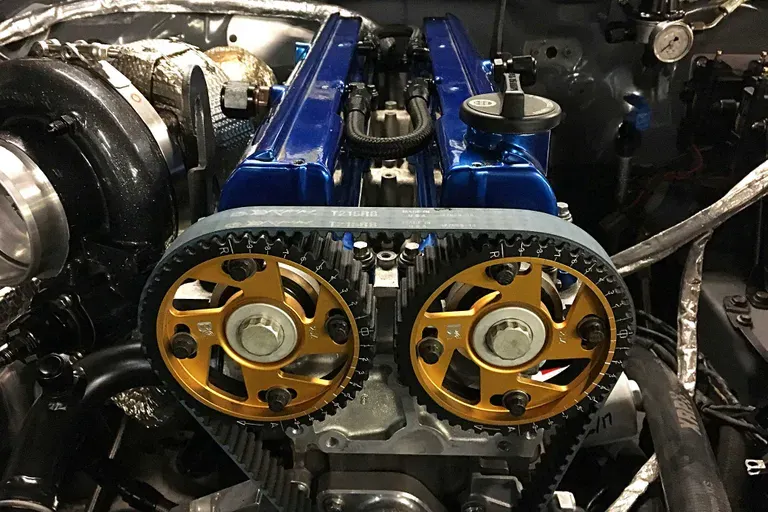
There are good engines. There are reliable engines. There are powerful engines. And then there’s the 2JZ-GTE. The engine that turned the Toyota Supra into an immortal icon, humiliated supercars on workshop budgets, and two decades later remains the absolute reference when discussing tuneable engines. The 2JZ isn’t just an engine. It’s a religion. And like every religion, it has its faithful, its sceptics, and its heresies.
Origins: Toyota Gets Serious About Grand Touring
To understand the 2JZ, you need to understand the context in which it was born. In the early 1990s, Toyota was fighting a quiet war against Nissan and Honda for technological supremacy in Japan’s high-performance market. The Skyline GT-R dominated the conversation, the NSX had proved Japan could build a supercar, and Toyota needed a decisive response.
That response was the fourth-generation Supra, the A80, presented in 1993. And its heart was the 2JZ-GTE: a 3.0-litre inline-six with sequential twin turbochargers that Toyota had designed from scratch with a clear premise. Being fast wasn’t enough. It had to be indestructible.
The JZ engine family succeeded the revered M family, and Toyota applied everything learned from the 7M-GTE in the previous Supra, a powerful engine but one with known weaknesses in its head gasket and block strength. With the 2JZ, Toyota didn’t just correct those problems. They eliminated them with almost absurd over-engineering.
Anatomy of a Monster
The 2JZ-GTE displaces 2,997 cc with an 86 mm bore and 86 mm stroke, a perfect square ratio offering optimal balance between torque and rev capability. But what makes the 2JZ special isn’t its dimensions. It’s how it’s built.
The block is closed-deck cast iron, the most robust configuration possible for an engine block. The walls between cylinders are thick and fully supported, eliminating flex under extreme combustion pressures. This design is what allows the 2JZ to withstand boost pressures that would destroy any conventional block.
The crankshaft is a forged steel piece with seven main bearings, providing exceptional torsional rigidity. The connecting rods are forged and the pistons are designed with thermal clearances anticipating the extreme temperatures of forced induction. The entire rotating assembly of the 2JZ appears designed not for the 280 hp Toyota officially declared, but for the 800 or 1,000 hp that the tuning community would prove it capable of withstanding.
The aluminum cylinder head with dual overhead camshafts (DOHC) and four valves per cylinder incorporates intake and exhaust ports designed for high flow. The toothed belt timing system, while requiring periodic maintenance unlike BMW’s chains, is a reliable component when replaced at recommended intervals.
The factory sequential turbo system used two turbochargers: a small one for immediate low-rpm response and a larger one for top-end thrust. This system, while ingenious, was precisely the first thing the tuning community removed, replacing it with a single large turbo capable of feeding power levels far exceeding stock.
The Most Dishonest 280 HP in History
Here we arrive at one of the great anecdotes in Japanese automotive history. The 2JZ-GTE was officially presented with 280 hp, the magic figure all Japanese manufacturers respected as a gentleman’s agreement to avoid triggering stricter government power regulations.
Nobody believed those 280 hp. Toyota didn’t even try particularly hard to make the lie convincing. Independent dyno measurements placed the real power of the stock 2JZ-GTE between 320 and 330 hp, and torque exceeded 440 Nm. These figures, already above the declared output, made the Supra a significantly faster car than the official specifications suggested.
This power understatement, combined with the engine’s structural over-engineering, created a perfect storm for tuning. Supra owners quickly discovered that their engine was not only more powerful than the spec sheet claimed, but also had room for improvement that seemed limitless.
Tuning Potential: Where the Legend Is Born
If there’s one thing that defines the 2JZ above all other characteristics, it’s its near-supernatural ability to absorb power. The closed-deck cast iron block, forged crankshaft, and oversized rotating assembly create a foundation that accepts boost pressure levels defying logic.
With stock internal components, a 2JZ-GTE with an appropriately sized single turbo, uprated injectors, higher-capacity fuel pump, and standalone engine management can produce between 600 and 700 hp reliably. These numbers, which would be the absolute limit for most production engines, are merely the starting point for serious 2JZ builders.
With forged internals — pistons, connecting rods, and a billet crankshaft — the 2JZ enters four-figure territory. Builds producing 1,000 hp are common in the Japanese and American tuning scenes. The most extreme records exceed 2,000 hp, although at those power levels, engine reliability and service life are measured in drag strip passes rather than road kilometres.
What makes the 2JZ truly extraordinary isn’t just that it can reach those figures, but the infrastructure that exists around the engine. Decades of development by tuners worldwide have created an ecosystem of components, knowledge, and solutions that has no equal. Turbochargers, exhaust manifolds, injection systems, engine management, block reinforcement kits: everything you could need to build a 2JZ at any power level already exists, is proven, and is available.
The Supra Factor: Hollywood, the Internet, and JDM Culture
It would be dishonest to discuss the 2JZ without acknowledging the role the Toyota Supra and popular culture played in building its legend. The release of The Fast and the Furious in 2001 catapulted the Supra and its engine to a level of fame that no marketing campaign could have achieved. The scene where Brian O’Conner’s Supra launches and passes a Ferrari is one of the most iconic moments in automotive cinema, burning into collective memory the image of the Supra as a Giant Killer capable of humiliating any supercar.
But it would be equally dishonest to attribute all the 2JZ’s fame to Hollywood. Before Vin Diesel and Paul Walker put the Supra on screen, the tuning community already knew the engine’s capabilities perfectly. The internet forums of the late 1990s, specialist magazines like Sport Compact Car and Option, and drag racing videos circulating on VHS had already established the 2JZ’s reputation as the most modifiable engine on the planet.
What Hollywood did was amplify a reality that already existed. The 2JZ didn’t become famous because of a film. It became famous because it was genuinely extraordinary, and the film simply told the world.
The 2JZ-GE: The Naturally Aspirated Sibling
Not all the 2JZ’s legacy revolves around the turbo version. The 2JZ-GE, the naturally aspirated variant, also deserves recognition. With 220 hp in stock form, the 2JZ-GE offered the same smoothness, the same reliability, and the same oversized architecture as its turbocharged brother, but in a more accessible package.
The 2JZ-GE powered a variety of Toyota and Lexus models, including the non-turbo Supra, the Lexus IS300, GS300, and SC300. In many of these applications, the engine demonstrated exceptional longevity, with examples routinely exceeding 400,000 kilometres without major issues.
For tuning builders, the 2JZ-GE represented an economical base for turbo projects. Converting the 2JZ-GE to forced induction required reinforcement of certain internal components, as the GE’s pistons and connecting rods aren’t as overbuilt as the GTE’s, but the closed-deck cast iron block is identical in both versions, providing the same structural foundation.
Reliability: Kilometres Without Drama
Beyond extreme tuning, the 2JZ is an engine that in stock configuration offers outstanding reliability. Maintenance is straightforward and well documented: regular oil changes, timing belt replacement at recommended intervals, and attention to the cooling system are practically all the engine needs to run for decades without issues.
Known weak points are minor. Ignition coils can fail over time and the sequential injection system can develop problems in high-mileage cars. The factory sequential turbo system, with its complexity of vacuum lines and actuators, is probably the most problematic component of the package, which ironically reinforces the common practice of replacing it with a simpler and more powerful single turbo setup.
The block and internal components, however, are virtually immune to normal wear. With proper maintenance, the 2JZ’s rotating assembly can last indefinitely, which explains why it’s common to find engines with hundreds of thousands of kilometres still running with first-day precision.
The Current Market: Gold Prices
The flipside of legend is price. The 2JZ market has experienced a price escalation faithfully reflecting its iconic status. A Toyota Supra A80 with 2JZ-GTE in good condition can easily exceed 80,000-100,000 euros in today’s market, with exceptional examples reaching significantly higher figures.
Even standalone engines, without a car, command prices that would have seemed absurd a decade ago. A complete 2JZ-GTE can cost between 5,000 and 10,000 euros depending on condition and mileage, a price reflecting the insatiable demand from the tuning community.
This situation has made alternatives like the BMW M50B25 or Nissan RB26 gain appeal for builders on tighter budgets. But for many, the 2JZ remains the standard against which everything else is measured.
The Debate: Is It Really the Greatest Engine of All Time?
And here is where religion meets reality. The 2JZ is, without dispute, one of the most extraordinary engines ever manufactured. But is it the best? Is it the most modifiable? Or is it simply the one with the best marketing?
RB26DETT defenders argue that the Skyline GT-R’s engine is equally capable and more exciting in stock configuration. BMW M50 fans point out that their engine does the same with half a litre less displacement. Chevrolet LS purists claim the American pushrod V8 offers more power per euro invested. And Honda K20 supporters maintain their four-cylinder achieves specific power figures that put the 2JZ to shame.
All have valid arguments. The RB26 has a character the 2JZ can’t match. The LS is cheaper to build. The K20 is a masterpiece of volumetric efficiency. The M50 proves Europe knew how to build indestructible engines long before Hollywood discovered the Supra.
But none of them offer the complete combination the 2JZ provides: a virtually indestructible block, an unmatched parts ecosystem, a global knowledge community, and a learning curve that allows you to go from 300 hp to 2,000 hp using the same foundation.
The 2JZ is king because nobody else offers all of that together. Not because it’s perfect, but because its complete package has no equivalent.
Does it deserve the throne? That depends on what you value. But what cannot be denied is that it earned it.