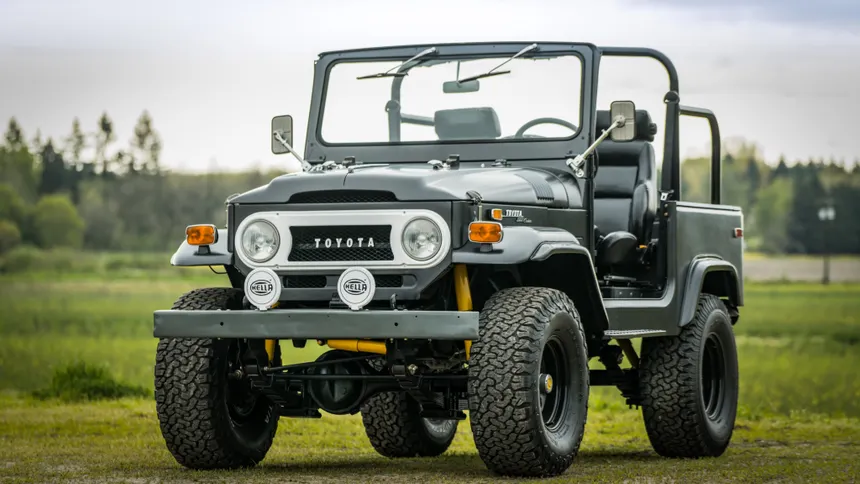
Toyota FJ40: the truck that won by never breaking down
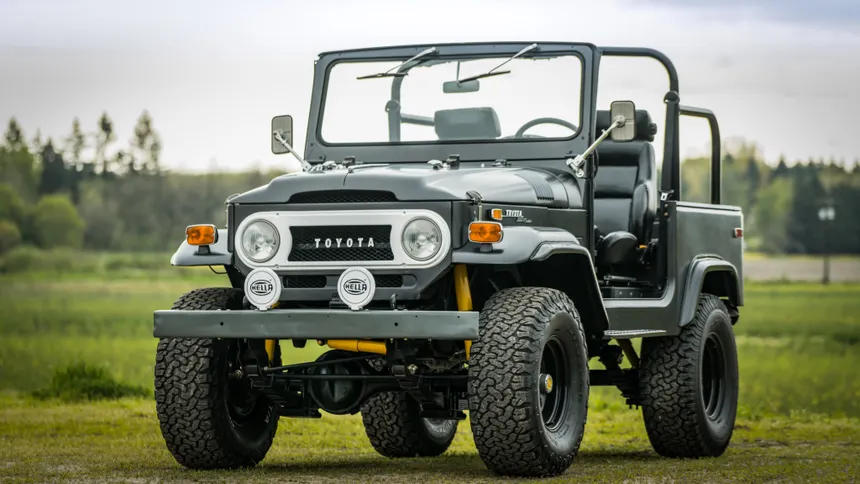
Here’s a fact that should sting a little if you grew up on American iron. The vehicle that first put Toyota on the map in the United States wasn’t the Corolla, or the Corona, or the Celica. It was a boxy Japanese 4×4 that looked suspiciously like a Willys — and then proceeded to out-tough, out-last and quietly out-sell the very Jeep it was accused of copying, in market after market, for two decades straight.
The Jeep had all the charisma. It won a war. It stormed beaches, climbed into a hundred movies, wore that flat cartoon face every kid can draw. The Land Rover had the British Empire bolted to its hood and a look that reeked of safari and colonial adventure. Both were legends before Toyota knew how to build a proper off-roader.
And yet, across half the planet, both ended up parked in the barn while the truck that actually did the work was a square, homely Japanese thing nobody remembers from a single film.
That’s the FJ40. The truck that didn’t win by being epic. It won by being boring.
A captured Jeep and a war nobody wanted
The romantic legend says it started with an abandoned Jeep. When Japanese forces swept into the Philippines in WWII, they found an American 4×4 left behind by retreating U.S. troops — a Willys, a Ford GPW, maybe a Bantam BRC, the sources don’t agree. And here’s where honesty matters: Toyota itself has never put that captured vehicle in its official history and starts the story cleanly in the 1950s. Either way, the Japanese military saw the little American mule and wanted its own.
But the FJ40 proper wasn’t born in a jungle. It was born of another war. Korea, 1950. The U.S. military still occupying Japan needed light 4x4s, and shipping them across the Pacific was expensive. So they asked for locally built ones. Toyota answered on August 1, 1951, with the Toyota Jeep BJ — the letters stood for the B-series engine and “Jeep” — a prototype with a 3.4-liter inline-six making 75 horsepower. That’s the grandfather of everything.
And right here comes the gesture that defines this truck forever. To prove what the BJ could do, test driver Ichiro Taira drove it up the rocky flanks of Mount Fuji in July 1951, reaching the sixth station — higher than any motor vehicle had ever climbed. It didn’t summit, whatever some retellings claim, but the point landed hard: this thing climbed where nothing else would.
Funny enough, the stunt didn’t fully work. The Americans passed on the big contract. But Japan’s own Self-Defense Forces and police were sold, and by 1953 the first 298 BJs were built for the Japanese army. When Willys trademarked “Jeep” in 1954, Toyota needed a new name. Technical director Hanji Umehara picked “Land Cruiser” — deliberately aimed at the Land Rover, which was already colonizing markets worldwide. The name was practically a dare: if you’re a land rover, I’m a land cruiser.
1960: when the thing found its final shape
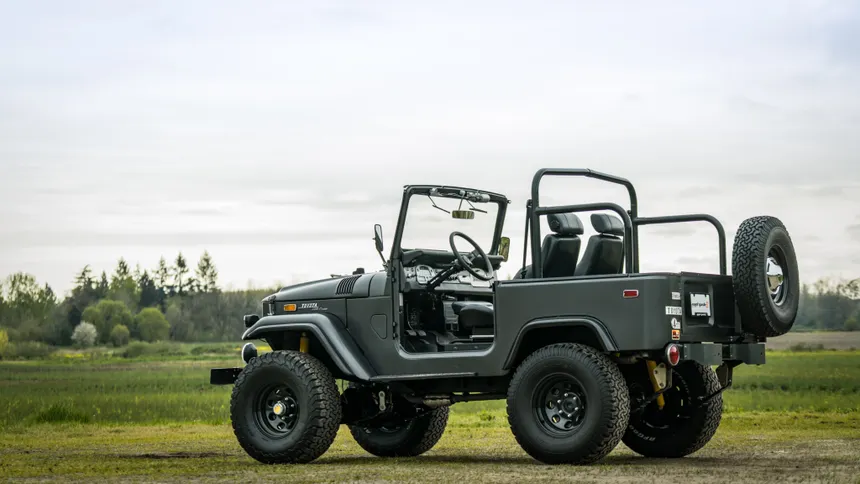
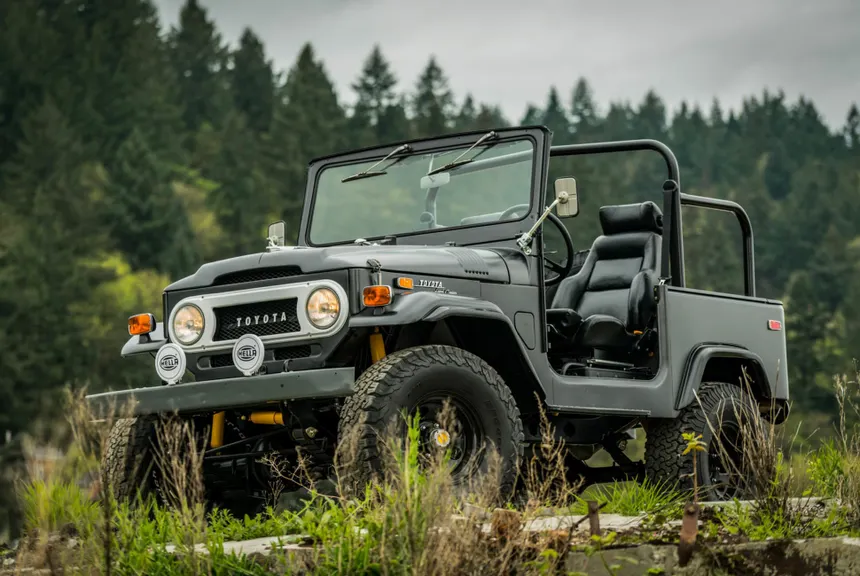
The FJ40 as we know it arrived in 1960. Toyota bought new steel presses, reworked the body, and finally gave the 40 what it lacked: real low-range gearing. The heart was the F engine, a 3.9-liter cast-iron inline-six making 125 horsepower and — this is the part that matters — 209 lb-ft of torque low in the rev range. That F engine is a monument to longevity: Toyota built it from 1949, and the family soldiered on into the 1990s. Enormous iron block, a mountain of low-end grunt, and a refusal to break that became the company’s signature.
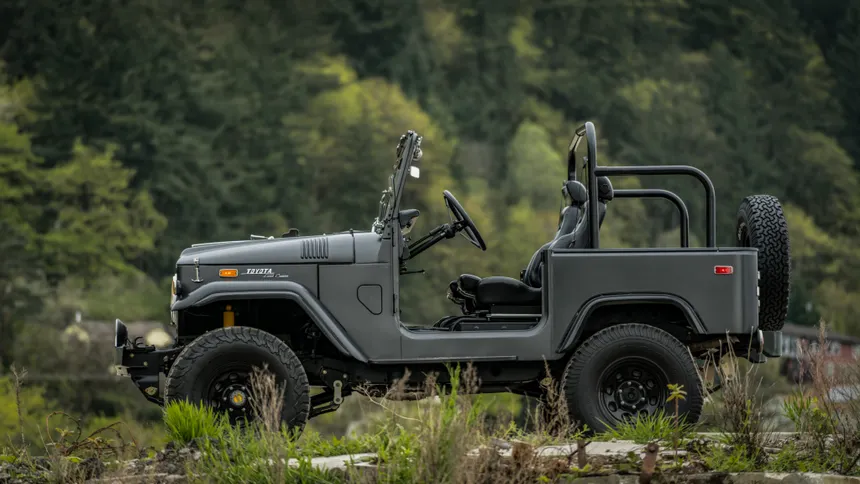
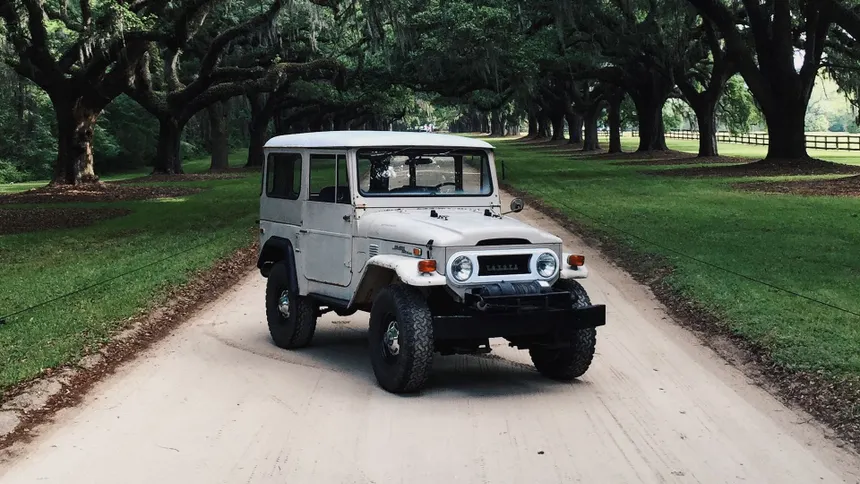
Underneath, nothing fancy. Leaf springs front and rear, solid axles, a reinforced ladder frame, part-time 4WD you shift by hand, a three-speed box. Zero electronics. Zero sensors to fail. Pure mechanics a guy with a wrench can pull apart in the middle of nowhere. The interior was a wasteland: vinyl seats, no sound deadening, no plastic, nothing extra. Boxy, flat white roof, fold-down windshield, short overhangs. Ugly with conviction. And that honest ugliness eventually became a look all its own.
Australia: where the Land Rover actually lost the war
Here’s the part almost nobody tells with real numbers, and it’s the one that explains how the FJ40 ate the world. Go to Australia, because it’s the best lab on earth for finding out which 4×4 survives and which one doesn’t.
The Land Cruiser’s Australian story starts on the Snowy Mountains Scheme, the brutal hydroelectric project launched in 1949 that needed off-roaders to haul men and materials into impossible mountains. At first the Dodge Power Wagon and the Land Rover Series 1 ruled. But the British, true to reputation, didn’t listen to their customers and couldn’t build Land Rovers fast enough to meet demand. That gap is where Toyota walked in.
But it didn’t win on logistics alone. It won on physics. Out in the outback the speeds aren’t high, but the distances are savage — hundreds of miles between one point and the next. The Land Rover, with its 2.2-liter four, cruised comfortably at about 55 mph. The Land Cruiser, with its bigger inline-six, loafed along at least 10 mph faster, at 65. That meant the Toyota could keep pace with cars and trucks on the main roads and the Land Rover simply couldn’t. When you’re crossing what Australians call “perish country” — land where a breakdown can kill you — that gap isn’t a luxury. It’s the difference between arriving and not.
Line up the era’s numbers and the gulf is obvious. An early-’70s Land Rover Series III ran the 2.25 four: 70 horsepower, 119 lb-ft. The FJ40 of the same years made 125 horsepower and 209 lb-ft — nearly double the torque. In mud, on a loaded climb, low-end torque is everything. The Land Rover pushed. The Land Cruiser dragged mountains.
The result was a rout. By the early-to-mid seventies the Land Cruiser had shoved the Land Rover clean out of the Australian bush. Farmers coined the highest praise a work truck can earn: “boringly reliable.” In a vehicle you bet your life on, boring is the whole point.
El Macho, the UN, and an engine that won’t die
What happened in Australia happened across the planet. In South America they called it “El Macho” for its brute face and its go-anywhere nerve. In Brazil it was built as the Bandeirante from 1962 with a locally made Mercedes-Benz diesel, and the J40 line rolled off Brazilian assembly lines all the way to 2001. Read that again: while Japan stopped building the FJ40 in 1984, the same basic truck stayed in production in Brazil for another seventeen years. Africa fell to it. The UN and armies worldwide adopted it. NGOs chose it because it didn’t break. The pitch was never that it was best at anything — only that it wouldn’t strand you.
The sales milestones tell the snowball: 50,000 units globally by 1965, 100,000 by 1968, 200,000 by 1972, 300,000 by 1973. By 1980 there were a million Land Cruisers out in the world. In the States the FJ40 was Toyota’s best-selling vehicle from 1961 to 1965, before the Corona and Corolla drowned everything. It was the tip of the spear — the first Toyota millions of people ever laid eyes on, sometimes because it was one of the only vehicles that could reach where they lived. And yes, it even outlasted Jeep’s own CJ series as a utility 4×4 in plenty of eyes.
There’s an American wrinkle worth knowing, too. The pickup versions of the Land Cruiser mostly never made it to U.S. buyers, throttled by the 25 percent “Chicken Tax” — the tariff on imported light trucks that’s shaped what Americans can and can’t buy since 1964. So while the rest of the world got Land Cruiser utes hauling everything from cattle feed to UN medical kits, the States mostly got the two-door wagon. The truck that conquered the planet showed up in America wearing only part of its wardrobe.
And let’s not pretend the thing was flawless, because it wasn’t. The FJ40 rusted. Badly, in wet climates. When the Irish Army took delivery of 77 FJ45s in 1977 they found the trucks fast, tough and capable off-road — and prone to rotting in the damp Irish weather, to the point that only a handful survived to serve as ceremonial gun tractors at military funerals. Frame rot at the rear crossmember and the spring hangers is still the first thing any honest buyer checks today. Toyota built a truck that could outrun a river crossing but couldn’t always outrun the water afterward. Reliability isn’t the same as immortality — the mechanicals kept going long after the bodywork started losing its own quiet war with oxidation.
The F engine had one glorious vice: it was eternal. It’s routine to find FJ40s still running on their original blocks forty years on. So much low-end torque and so little interest in dying that one of the most common restomod moves today is dropping in a GM V8 — not because the F is bad, but because by modern standards it’s got reliability to spare and horsepower to want. People swap the heart of the truck precisely because the original heart won’t quit.
What died and what just moved
Careful with the easy nostalgia. The FJ40 didn’t vanish in 1984 — that’s just the end of Japanese production. The Brazilian Bandeirante ran to 2001, and more to the point the 40’s DNA didn’t die, it transformed. The FJ55 — nicknamed the “Iron Pig” or “Moose” — was the saga’s first true wagon and one of the pioneering SUVs. Then the FJ60, plusher, with A/C and power windows, aiming straight at the Range Rover. And on down the chain to today’s Land Cruisers that cost as much as a house. The truck that began as a Jeep knockoff for somebody else’s war ended up inventing the luxury off-roader.
Physical death and paper death aren’t the same. Original FJ40s are still out there — not in museums, but working, in African villages, Australian stations and deserts across half the world. It’s one of the few vehicles you can honestly say never stopped doing its job.
What the FJ40 teaches
This one gets under my skin for a specific reason. We’re surrounded by trucks sold on what they make you feel — the roar, the badge, the photo. The FJ40 sold on the opposite. On never making a scene. On starting first try when it was twenty below or fifty above outside. On never snapping an axle. On being fixable with whatever a lost little town happened to have on the shelf. It didn’t ask you to love it. It asked you to trust it. And trust, over the long haul, wins every war charisma loses.
The Jeep won a world war and became a movie star. The Land Rover wore the Empire on its hood. Both were prettier, more famous, more romantic. And both, in the one place that actually mattered — far from everything, your life riding on whether the engine turned over again — got sent to the barn by a square Japanese truck without a single pretty story to tell.
Ask yourself this: when you’re truly out in the middle of nowhere, what do you want — a truck you fall in love with, or a truck that starts again? The FJ40 has been answering that question for you for sixty years.
Check you’re still alive.