
TVR: The Complete History of the British Sports Cars That Hated Safety
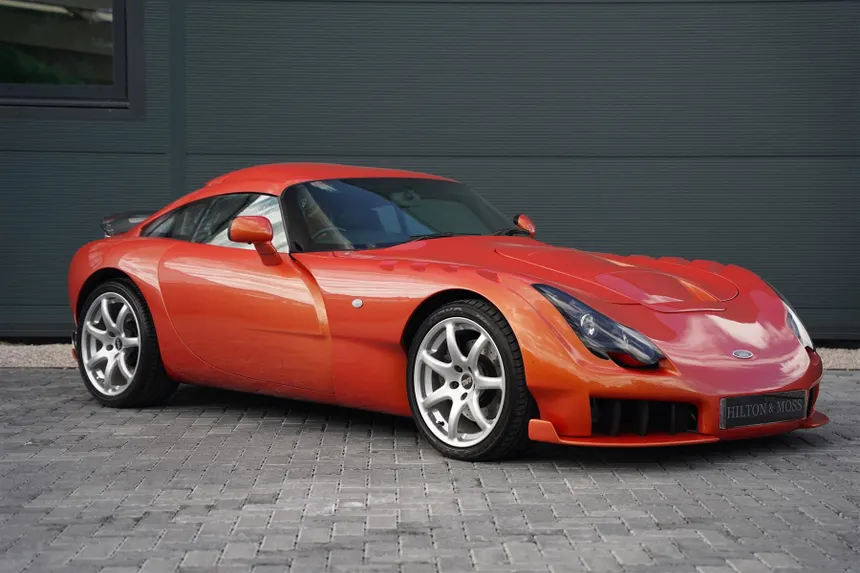
In Blackpool, an English coastal town known for its fish and chips and stag parties, a group of engineers built some of the wildest, most unpredictable, and gloriously dangerous sports cars in automotive history. TVR wasn’t a car brand: it was a manifesto against everything the industry considered “sensible.”
Peter Wheeler: The Chemist Who Built Monsters
Peter Wheeler bought TVR in 1981 with a radical philosophy: lightweight cars, powerful, without unnecessary electronics, and absolutely without the driver aids that “made drivers lazy.”
No ABS. No traction control. No airbags. No mercy.
Wheeler argued that electronic safety systems created a false sense of security. A TVR communicated exactly what was happening at every moment. If the rear started to slide, you felt it immediately. There was no electronic safety net. You and the car, alone against physics.
Critics called it irresponsible. Wheeler called it honesty.
The Golden Era: The Monsters of the 90s
The 1990s were TVR’s golden age. Wheeler and his team created a series of cars that defined a unique philosophy:
Griffith 500 (1992-2002): The car that put TVR on the international map. A Rover V8 5.0-liter engine producing 340 hp, installed in a fiberglass body weighing just 1,060 kg. The power-to-weight ratio was comparable to a Ferrari F355, but at a fraction of the price. The Griffith was brutally fast in a straight line, surprisingly capable in corners, and absolutely terrifying when driven at the limit.
Chimaera (1992-2003): The “civilized GT” of the range, if that word could apply to any TVR. It shared platform and engine with the Griffith but with softer bodywork, a slightly more refined interior, and marginally more predictable behavior.
Cerbera (1996-2003): The Cerbera marked a turning point. For the first time, TVR didn’t depend on borrowed engines. Wheeler and chief engineer Al Melling developed the AJP8: a 4.2-liter V8 designed completely in-house. And the Speed Six: a 4.0-liter inline-six producing 350 hp and a roar that no other six-cylinder in the world could match.
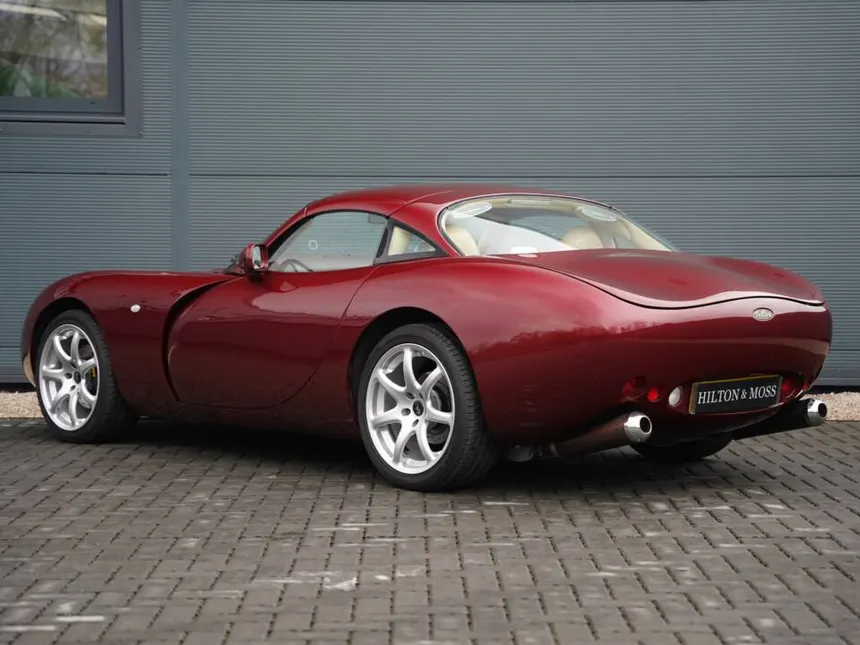
Tuscan (1999-2006): With the Tuscan, TVR abandoned any pretense of normality. The design was alien: no conventional mirrors, no visible door handles, forms that seemed designed by someone under psychotropic influence. And it worked.
Sagaris (2005-2006): The last creation of the Wheeler era, and perhaps the most extreme. The Sagaris looked built for intergalactic warfare: exposed air intakes everywhere, functional spoilers, visual aggression that made contemporary Lamborghinis look conservative.
But the Sagaris has a distinction no other modern car can claim: it was banned in several markets for being too dangerous to legally sell.
The car didn’t meet EU crash safety standards or American regulations. No airbags. No ABS. No programmed deformation zones. TVR simply refused to modify the design to comply, arguing it would ruin the car’s character.
The result: the Sagaris could only be sold in the UK and a few markets with laxer regulations. In Germany, France, Italy, the US… it was literally illegal. TVR preferred to give up entire markets rather than compromise their philosophy.
The Philosophy of Honest Speed
What made TVRs special wasn’t just their brute power or extreme lightness. It was their visceral honesty.
Every gram of chassis feedback arrived unfiltered through the steering wheel. Every engine vibration was felt in the seat. Every reaction to driver inputs was immediate, without computers deciding what the driver “really wanted to do.”
Driving a TVR fast required real skill. You couldn’t just floor the accelerator and let traction control save your incompetence. If you made a mistake, you paid the consequences. Immediately.
For true enthusiasts—those who considered driving an art requiring practice and dedication—this was exactly the point.
The Reliability Problem
Let’s be honest: Wheeler-era TVRs had a reliability reputation that, being generous, we could describe as “characteristic.”
Fiberglass panels that didn’t quite fit. Electrics that worked when they felt like it. Engines requiring constant attention. Water leaks appearing mysteriously. Electrical problems defying all logic.
But TVR owners accepted this as part of the deal. You didn’t buy a TVR expecting Toyota reliability or Porsche build quality. You bought a TVR because you wanted something no other brand in the world could give you.
The Collapse
Peter Wheeler sold TVR in 2004 to a young Russian businessman named Nikolai Smolensky. The promises never materialized. In 2006, the Blackpool factory closed definitively.
In 2017, a new Griffith was announced. Today, deliveries remain more promise than reality.
The Legacy
Perhaps it’s better this way. TVRs represent an unrepeatable moment in automotive history: when a small company could build cars following only its own vision, without safety committees, without focus groups, without fear.
That era won’t return. Modern regulations make it impossible to sell a car without ABS, without airbags, without the hundreds of safety systems legislation demands.
But the cars TVR left behind still exist. Still in the hands of owners who care for them obsessively, who take them out on sunny days to remember what it meant to drive a car that treated you as an adult responsible for your own decisions.
They’re machines from another era. Dangerous, imperfect, exciting.
And the automotive world is better for their existence.