
Volkswagen New Beetle RSI: The 250-Unit VR6 Monster That Predated Every R-Badged VW
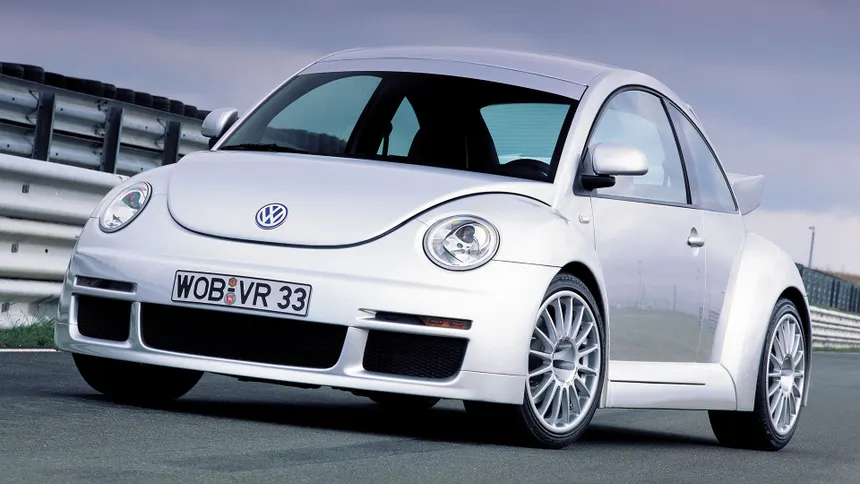
There is an unwritten rule in the car industry: if you build a cute, round, universally likable car — the kind that comes with a dashboard flower vase — you do not stuff a 3.2-liter six-cylinder engine inside it, bolt on all-wheel drive, fit carbon fiber racing seats, and slap on a rear wing that looks like it was stolen from a touring car. Volkswagen read that rule in 2001, crumpled it up, and built the New Beetle RSI.
250 units. All silver. Except one. The one Volkswagen painted blue for its chairman, Ferdinand Piëch, because when you run Wolfsburg, you get your car in whatever color you want.
The RSI was not a cosmetic package bolted onto a New Beetle. It was a road-homologated race car born from Volkswagen Motorsport, carrying the first-ever production application of the 3.2-liter VR6 engine. The same block that would later power the Golf R32, the Audi TT 3.2, and the Porsche Cayenne. But before any of those cars existed, that engine debuted here. Inside a Beetle. With manual window cranks.
Origins: from Detroit to the Beetle Cup
It started in January 1999 at the Detroit Auto Show, where Volkswagen unveiled the New Beetle RSi Concept: a widened, bespoilered New Beetle with a twin-turbo V6 and 4Motion all-wheel drive. The crowd lost its mind. Demand was immediate.
That same year, VW launched the Beetle Cup — a one-make racing series based on the New Beetle with widened bodywork and a 2.8-liter VR6 producing 201 hp, front-wheel drive, and a six-speed manual. Approximately 60 race cars were built for the German series. The swollen bodywork of the Cup car — flared arches, dual rear spoilers, aggressive stance — set the visual template for what came next.
And what came next exceeded both the concept and the race car in ambition.
The heart: 3,189 cc at a narrow angle
RSi stands for RennSport Injection — race sport injection. The engine that justified that name was the 3.2-liter VR6 in its first production application. A narrow-angle V6 with just a 15-degree bank angle — a VW-exclusive architecture that compresses a six-cylinder engine into the width of an inline four. Cast iron block, aluminum alloy head, 24 valves, variable intake timing.
The numbers: 224 hp (221 bhp / 165 kW) at 6,200 rpm and 236 lb-ft of torque at 3,200 rpm. Naturally aspirated — no turbo, no supercharger. Unlike the Detroit concept’s twin-turbo setup, the production RSi relied entirely on displacement and mechanical engineering. The result was an engine that delivered substantial low-end torque with a linear pull to 6,500 rpm, channeled through a standard-fit Remus twin-tip exhaust that gave it a properly deep snarl.
Transmission was a close-ratio six-speed manual — no automatic option existed. Power went to all four wheels via VW’s Haldex-based 4Motion on-demand AWD system. The Cup race car was front-wheel drive; the road RSi added all-wheel drive. That was the first signal that this was not simply a Cup-derived special edition but something more ambitious.
Performance: 0-62 mph in 6.7 seconds, top speed of 140 mph. Those numbers would not scare a Porsche 911, but in 2001 they were firmly in sports car territory — especially for a car that looked like a Beetle that had been eating other Beetles.
For American context, this matters: the RSI debuted the 3.2 VR6 before the Golf R32 existed. Before the Audi TT 3.2 existed. Before the Porsche Cayenne used a version of this engine family. Every VR6-powered performance VW that Americans eventually did get to buy traces its mechanical DNA back to this car. A car that was never sold in the United States.
The body: 3.4 inches of attitude
The New Beetle RSI was approximately 3.4 inches wider than the standard New Beetle. That sounds modest until you see it applied to a car that was already round — the result was a visual presence that had nothing in common with the friendly Beetle people associated with flower vases and daisy stickers.
The fender flares were pronounced and functional, necessary to house the 18-inch OZ Superturismo wheels in a 9-inch width, wrapped in 235/40 ZR18 rubber. The front bumper incorporated a massive central air intake flanked by oversized side scoops feeding brake cooling. Turn signals and parking lights were compressed into narrow horizontal slots above the intakes.
The profile showed curved side skirts connecting the front and rear flares in a continuous line of aggression. And the rear was where the RSI made absolutely clear it was not a regular New Beetle: a roof-mounted spoiler plus a massive wing on the trunk lid — a dual-plane arrangement that gave the car an unmistakable silhouette. Below, a rear diffuser integrated into the bumper framed the twin Remus exhaust outlets.
The visual result was extreme and polarizing. People either loved it or thought it was a joke. There was no middle ground. And that is always a good sign.
Suspension: VW Individual, not Porsche
A persistent myth about the RSI claims the suspension was tuned by Porsche. That is false. The chassis work was done entirely in-house by VW Individual — Volkswagen’s special projects division — at their Hanover facility. Rear suspension was substantially reworked from the standard New Beetle, with completely reconfigured geometry oriented toward track use and a reinforced rear cross-brace behind the rear seats. Shorter, stiffer springs, specific dampers, and recalibrated anti-roll bars completed the package.
The result was a car significantly stiffer and more responsive than any other New Beetle, but with trade-offs: road noise was considerable and rear tire life was shortened noticeably. Acceptable compromises for a car that was never meant to be a grand tourer but a sports car wearing a Beetle costume.
The interior: carbon fiber, billet aluminum, and orange leather
If the bodywork was extreme, the interior was deliberately provocative. Front seats were single-piece Recaro racing buckets — carbon fiber shells with no backrest recline adjustment, only fore-and-aft sliding. Upholstered in tropical orange leather that clashed deliberately and spectacularly against the exposed carbon fiber covering the door panels, instrument binnacle, and center console.
Billet aluminum accents appeared on door pulls, instrument frames, and decorative details. Pedals were aluminum. And in a move that might seem absurd in a car at this price point and performance level, the windows were manual. Not power. Manual. Hand-crank. In a car that cost more than a Porsche Boxster.
It was a weight decision — literal and philosophical. Every gram counted, and electric window motors weigh more than cranks. It was also a statement of intent: this is a homologated race car for the road, and in racing you do not need power windows.
Volkswagen officially listed the RSI as a four-seater, but the reality was that the rear seats were virtually inaccessible to anyone over 5’3″, since the one-piece front buckets did not fold forward. VW’s own literature acknowledged this with characteristic German understatement, advising that rear passengers taller than 1.60 meters should avoid long journeys. In practice, the rear seat was a storage shelf with seatbelts.
The dashboard carried additional gauges beyond the standard New Beetle instrument cluster, though the overall layout retained the recognizable New Beetle architecture underneath all the carbon fiber and aluminum. It was a contrast that captured the entire philosophy of the RSI: the bones of a cheerful economy car, dressed in the clothes of a thoroughbred racer. That tension — between the ordinary and the extraordinary — is what gave the RSI its personality.
Production: 250 + 1 + 1
Production took place on a dedicated assembly line at VW’s Puebla plant in Mexico, between 2001 and 2003. Exactly 250 units were built, all in Reflex Silver Metallic. No color options. No exceptions.
Except one: car number 002, painted blue for Ferdinand Piëch, VW’s chairman at the time, who reportedly only drove blue cars. That blue RSI is one of the most exclusive pieces in VW’s heritage collection.
There is also an RSI Cabriolet prototype that Volkswagen built in 2003, with identical mechanical specifications to the coupe. It was never sold and remains in the factory collection, occasionally appearing at events like the Techno Classica in Essen.
Of the 250 production units, 45 went to Japan. The RSI was never sold in the United States or Canada. The new price in Germany was 127,000 Deutsche Marks — approximately €64,950, or roughly $80,000 at the time. More than double a Porsche Boxster. It was an obscene price for a Beetle, and VW knew it. They also knew that 250 units did not need to justify themselves on a spreadsheet. They needed to justify themselves in history.
The legacy: the seed of R
What very few people acknowledge is that the New Beetle RSI was the first Volkswagen road car to combine a 3.2-liter VR6 engine with 4Motion all-wheel drive. The Golf R32 — the car that officially launched VW’s R performance lineage — did not arrive until 2002. The Beetle RSI beat it to market.
The RSI’s 3.2-liter VR6 was the first production application of that engine. From the RSI, that powerplant migrated to the Golf R32 Mk4, the Audi TT 3.2 quattro, and eventually the Porsche Cayenne. The technical DNA of the RSI sits at the foundation of every performance VW that carries an R badge today.
And yet almost nobody mentions it. The Golf R32 gets all the credit. The RSI remains a footnote. 250 units tend to disappear from collective memory when the model that follows sells in the tens of thousands.
The 2026 factor: America’s turn
Here is the detail that changes everything for American enthusiasts: in 2026, the earliest 2001-model RSi units turn 25 years old. Under the federal 25-year import rule, they become legally eligible for importation into the United States for the first time.
Current market values sit around $58,700 on average, with the highest documented sale at $66,500 and the most recent auction result — in Italy in December 2025 — reaching €60,500 (approximately $70,000). A clean Golf R32 Mk4, which shares effectively the same mechanical package, goes for half that. But the R32 was not limited to 250 units, did not have carbon fiber race seats, and did not debut the 3.2 VR6.
If the American collector car market catches wind of this — and it will — current European prices are going to look like a bargain in hindsight.
What remains: a Beetle that made no apologies
The Volkswagen New Beetle RSI made no commercial sense. It cost more than a Porsche. So few were built that most VW dealers never saw one. Its rear wing made it look like a race car disguised as a toy. Its manual window cranks were an insult to the luxury its price tag suggested. Rear seat access was a joke. Cabin noise at highway speed was significant enough that long trips required commitment. Rear tire wear was measurably worse than the standard car due to the track-focused suspension geometry.
And none of those things diminish what the RSI actually was.
It was the demonstration of what happens when a mainstream manufacturer gives its Motorsport department blank-check authorization to build something without marketing constraints. No focus groups. No compromise with practicality. Just engineering, ambition, and the question: what happens if we put everything we have inside a Beetle?
In a way, the RSI was Volkswagen’s equivalent of the Renault Espace F1 or the Mercedes 190E 2.5-16 Evolution II — a car that existed not because a business case demanded it, but because engineers demanded it. The difference is that the RSI actually went on sale to the public. You could walk into a VW dealer in Stuttgart or Tokyo and buy one. Assuming they had not already sold their single allocation.
For Americans who have spent decades watching European hot hatch culture from the outside, the RSI represents something unique: the absolute extreme of what VW was willing to do with the New Beetle platform, built during the Ferdinand Piëch era when the VW Group operated with an ambition that bordered on recklessness. The Bugatti Veyron was conceived under the same leadership. The Phaeton W12 luxury sedan was built under the same leadership. And the Beetle RSI — a six-cylinder, all-wheel-drive, carbon-fiber-equipped racing Beetle that cost more than a Porsche — was built under that exact same vision.
250 cars. The first production 3.2 VR6. The seed of VW’s entire R family. Carbon fiber and orange leather. Hand-crank windows in an $80,000 car. And a VW chairman who had his painted blue because he could.
The rarest, most aggressive, and most misunderstood Beetle ever built.
Check you’re still alive.