
Dear EVs: Don’t Try to Beat This. Just Try to Match It.
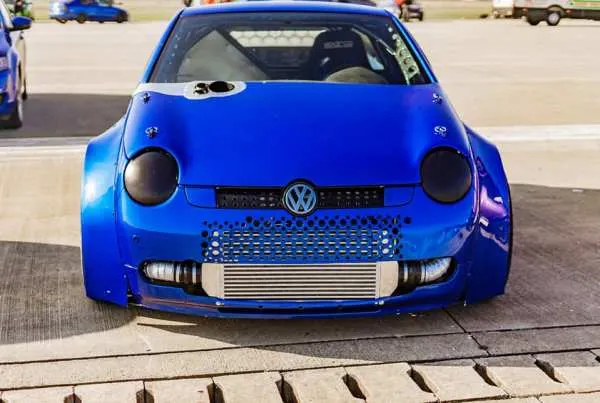
DOP Motorsport’s Twin-Engine VW Lupo: 3,600 HP, 7.71 Seconds, and a Garage-Built Slap in the Face to Every Electric Hypercar on Earth
Section: Builds & Swaps | Not Enough Cylinders
Somewhere outside Bucharest, in a workshop that most Americans couldn’t find on a map, a physicist-turned-tuner named Silviu Ghita has done something that should be physically impossible.
He took a Volkswagen Lupo — a European city car that was never sold in the United States, smaller than a Geo Metro, originally powered by a three-cylinder diesel making 61 horsepower — and turned it into a 3,600 HP, twin-engine, compound-turbocharged monster that runs the quarter-mile in 7.71 seconds at 194 mph.
For Americans unfamiliar with the Lupo: imagine the smallest, most fuel-efficient car Volkswagen ever made. Now imagine cramming two turbocharged VR6 engines into it, one in the front and one in the back, each making 1,800 horsepower. Each with its own seven-speed dual-clutch transmission. Each with its own ECU, intercooler, and cooling system. Two complete powertrains sharing one tiny body that weighs less than your average American refrigerator collection.
The result doesn’t just beat the fastest electric cars on the planet. It embarrasses them.
The Numbers That Broke the Internet
Let’s get straight to the drag strip receipts, because that’s what matters in this country:
| Vehicle | Power | 1/4 Mile | Trap Speed | Approx. Price |
|---|---|---|---|---|
| DOP Motorsport Lupo Bimotor | 3,600 HP (runs 2,400-3,000) | 7.71 s | 194 mph (313 km/h) | Private build |
| Rimac Nevera | 1,914 HP | 8.58 s | 167 mph | ~$2.4 million |
| Pininfarina Battista | 1,900 HP | 8.55 s | N/A | ~$2.8 million |
| Tesla Model S Plaid (stock) | 1,020 HP | 9.23 s | 152 mph | $135,000 |
| Tesla Model S Plaid (stripped/modded) | 1,020 HP | 8.56 s | 162 mph | $135k + mods |
Read that again. A garage-built Volkswagen from Romania is nearly a full second faster than a $2.4 million Rimac Nevera in the quarter-mile. It’s 1.52 seconds faster than a stock Tesla Model S Plaid — and in drag racing, 1.52 seconds is the difference between winning and watching the other guy’s taillights disappear.
But here’s the detail that really stings for the EV crowd: trap speed. The Lupo crosses the finish line at 194 mph. The Nevera? 167 mph. The Plaid? 152 mph. That means the Lupo isn’t just quicker off the line — it’s still pulling harder at the top end, precisely where electric cars start to fade as battery thermal management and motor RPM limitations kick in.
And the acceleration numbers from a standing start are straight-up violent:
- 0-60 mph: approximately 1.6 seconds
- 0-124 mph (0-200 km/h): 3.86 seconds
- 0-186 mph (0-300 km/h): 7.09 seconds
Zero to 186 mph in seven seconds flat. In a car shorter than a Honda Civic’s wheelbase.
The Donor: VW’s Most Obsessive Engineering Project
To understand why Silviu Ghita chose the Lupo 3L as his canvas, you need to understand what Volkswagen built in 1999.
The Lupo 3L TDI was Wolfsburg’s moonshot fuel economy car — the name literally means “3 liters per 100 km,” or roughly 78 mpg. To achieve that figure, VW’s engineers went full aerospace: aluminum doors, hood, rear hatch, and fenders. Magnesium seat frames and steering wheel. Thinner-gauge high-strength steel for the body structure. A drag coefficient of 0.29 — better than most modern sports cars. An automated manual transmission with engine start-stop, in 1999, years before anyone else thought of it. Total curb weight: 1,830 pounds.
The car was so efficient that in July 2001, Dr. Miyano, a Japanese economy driver, set a Guinness World Record by circumnavigating Britain averaging 119.48 mpg — nearly 2 liters per 100 km in a bone-stock production vehicle.
This was peak-era Volkswagen engineering, from the same period that produced the Phaeton, the Golf R32, the Touareg V10 TDI, and ultimately the Bugatti Veyron. An era when Ferdinand Piëch’s philosophy of “because we can” permeated every division.
For a drag car builder, the Lupo 3L’s aluminum body panels and featherweight construction were pure gold. As Ghita himself has put it: the 3L is the only Lupo with aluminum for the doors, hood, trunk lid, and fenders. That makes the body incredibly light — and when you’re building a drag car, light is everything.
Phase 1: The TFSI Twins (2018-2023)
DOP Motorsport started in 2010 as a side project. Based in Bragadiru, a suburb of Bucharest, the shop specialized in Volkswagen performance tuning and quickly built a reputation: Romania’s three fastest Volkswagens all came out of Ghita’s workshop.
But the Lupo project, started in 2018, was something entirely different.
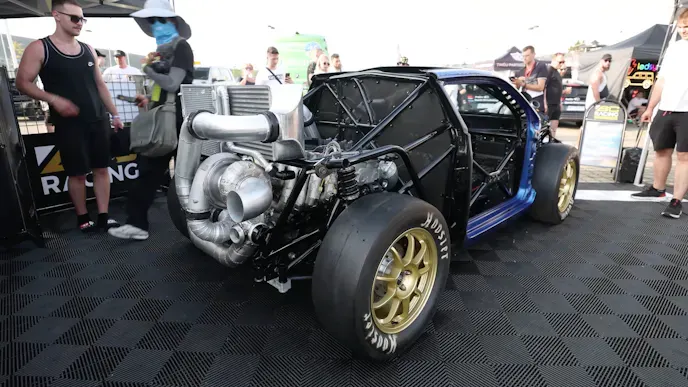
The chassis: The stock Lupo body was stripped down to nothing. DOP designed and fabricated a custom tubular chassis from chromoly steel — lightweight, incredibly rigid, and purpose-built for drag racing. The 3L’s aluminum body panels were then mounted over the tube frame. Total weight of the chassis and body combined: approximately 440 pounds. The wheelbase was extended by roughly 23.6 inches over stock to accommodate the rear engine and improve stability.
The engines: Two 2.0-liter TFSI inline-four engines sourced from the VW Golf R, one mounted in front and one in the rear. The front engine produced 603 HP and 443 lb-ft; the rear made 640 HP and 483 lb-ft. Combined output: 1,243 HP and 926 lb-ft of torque.
The transmissions: Two DSG DQ250 six-speed dual-clutch units, one per engine, operating completely independently. This created a mechanical AWD system without a center differential, transfer case, or driveshaft. Each engine drove its own axle through its own gearbox. Ghita discovered that the bimotor layout actually protects the transmissions — each gearbox only sees half the car’s weight, so even relatively fragile DQ250 units can survive power levels that would destroy them in a single-engine car.
The rubber: 26-inch Hoosier drag slicks on custom 15×10 steel wheels fabricated by DOP using bands from three additional wheels per corner.
The results: 0-62 mph in 2.2 seconds. Quarter-mile in 8.788 seconds at 169.92 mph. Romanian national drag racing record.
In September 2019, Ghita drove the Lupo 1,500 miles to Santa Pod Raceway in England for the VW Action event. With the engines dialed down to 900 HP each (1,800 total), the car ran 9.22 seconds at 161 mph. Videos from that event showed the car violently pulling to the left at speed — two independent engines trying to do their own thing inside a car the size of a shopping cart.
The TFSI configuration eventually pushed to a best of 8.78 seconds at 170 mph with both engines at full power, producing roughly 1,200 HP each for a combined 2,400 HP. But the four-cylinder blocks were reaching their limits. Ghita needed more displacement, more airflow, more everything.
Phase 2: VR6 Compound Turbo and the 7-Second Zone
The upgrade from TFSI to VR6 wasn’t an evolution. It was a revolution.
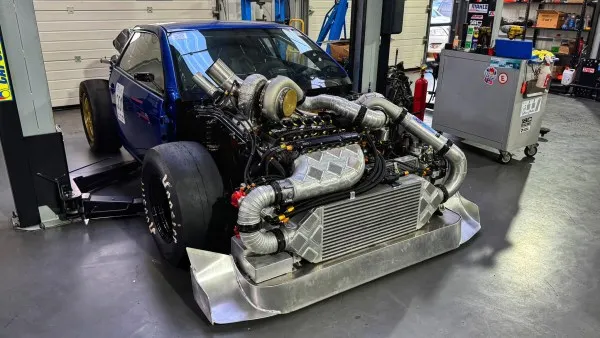
DOP Motorsport replaced both four-cylinder engines with VW’s iconic VR6 — the narrow-angle six-cylinder architecture that Volkswagen developed to fit six cylinders into engine bays designed for four. These are 3.6-liter VR6 blocks, but calling them “stock” would be like calling a Top Fuel dragster a “modified Dodge.”
The blocks are factory VR6 units filled with HardBlok — an aluminum-based engine block filler that provides structural support to the cylinder walls under extreme boost pressure. The cylinder heads are water-cooled with completely separate cooling circuits for each engine.
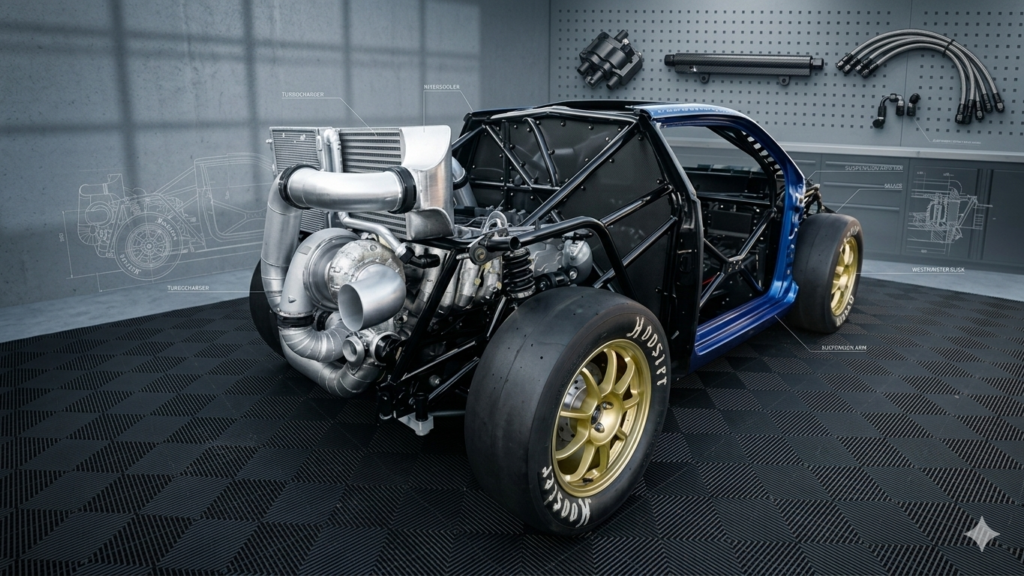
The turbo system is where DOP’s engineering reaches another level entirely. Each VR6 runs a compound turbo setup: a Garrett GTX5533 as the primary turbo and a G42 as the secondary. Compound turbo systems use a smaller, faster-spooling turbo to feed compressed air into a larger turbo, which then compresses it further before sending it to the engine. The result is consistent boost across the entire RPM range with virtually zero lag — critical for drag racing where any hesitation off the line costs tenths of a second.
The transmissions were upgraded to DQ500 seven-speed dual-clutch units — the same gearbox VW uses in the Golf R, Tiguan, and other high-torque applications. Stronger internals, faster shifts, better heat management than the DQ250s they replaced.
The electronics: Each engine runs its own Haltech ECU, its own intercooler, its own coolant system, and its own fuel system. They are, functionally, two complete cars sharing one body.
Maximum potential output: 1,800 HP per engine, 3,600 HP combined. In competition, Ghita runs between 2,400 and 3,000 HP depending on track conditions, surface prep, and ambient temperature.
Even at reduced power, the numbers are staggering. At roughly 700 HP per engine (1,400 HP total — “warm-up mode”), the Lupo has run 8.102 seconds at 179 mph. That’s faster than a stock Tesla Model S Plaid on what DOP considers a shakedown run.
At full competition power, the records speak for themselves: 7.71 seconds at 194 mph. The fastest European bi-motor car. Period.
Why Twin Engines Make Sense (When Nothing Else Does)
For American drag racing fans raised on big-block Chevys and Hemis, the twin-engine concept might seem unnecessarily complicated. Why not just build one enormous engine?
The answer is transmissions.
In a conventional single-engine drag car making 3,000+ HP, the transmission becomes the weakest link. Purpose-built racing transmissions — Lenco, Liberty, Bruno — can handle the power, but they’re heavy, expensive, and add complexity. A Lenco four-speed weighs over 100 pounds and costs north of $10,000. You also need a transfer case or a sophisticated differential to get AWD, adding more weight and more failure points.
With two independent engines, each DQ500 transmission only sees half the car’s total weight and half the total torque. That means production gearboxes — mass-manufactured, reliable, fast-shifting, and relatively cheap — can survive in an environment where any single-engine solution would require purpose-built racing hardware.
The system also provides mechanical AWD without a center differential, driveshaft, or transfer case. Each engine drives its own axle independently, with its own ECU managing power delivery, traction control, and shift strategy. The synchronization between the two systems — making sure both engines launch together, shift together, and respond to wheel spin independently — is the real black art of this build.
Ghita’s physics background (he studied at the University of Bucharest) is no coincidence. Managing the dynamics of two independent powertrains in a car with a shorter wheelbase than a Miata requires a deep understanding of forces, weight transfer, and mechanical limits that goes beyond traditional hot-rodding.
The EV Elephant in the Room
Here’s the conversation nobody in the automotive industry wants to have.
The dominant narrative is that internal combustion is dead. That electric motors with instant torque have rendered pistons and turbos obsolete. That the future belongs to batteries and software and over-the-air updates.
And then a guy in Romania puts two turbocharged VR6 engines in a Lupo and runs a 7.71 in the quarter.
The Rimac Nevera — widely considered the fastest accelerating production vehicle on Earth — is a $2.4 million marvel of Croatian engineering with 1,914 HP from four electric motors, the most sophisticated torque vectoring system ever built, and a curb weight of 4,740 pounds. Its best official quarter-mile time is 8.58 seconds.
The Tesla Model S Plaid — the car that democratized hypercar acceleration for $135,000 — does 9.23 stock. The most modified Plaids on the planet, stripped to bare metal with CAN Bus hacks and drag radials, have managed 8.56 seconds.
Ghita’s Lupo, built in a suburban Bucharest workshop, beats them all by a margin that ranges from significant to humiliating.
Does this mean ICE is better than electric? No. These are fundamentally different machines designed for different purposes. The Plaid is a four-door sedan you can drive to work. The Nevera is a GT car that handles like a sports car and can cross continents in silence. The Lupo is a purpose-built drag weapon that breathes ethanol and shoots flames.
But it does mean something. It means that the internal combustion engine, in the hands of people who truly understand it, is far from finished. It means that innovation doesn’t require billions of dollars in venture capital. It means that a physics graduate with a workshop and a VW obsession can build something that makes the world’s most advanced electric vehicles look slow.
And it means that the story of speed is still being written — in garages, in workshops, in places that don’t have press departments or investor calls or Super Bowl ads.
What’s Next: The Sub-7 Quest
DOP Motorsport isn’t done. The stated goals for the Lupo bimotor project are clear: break the 7-second barrier and exceed 200 mph (322 km/h) in the quarter-mile.
Given the trajectory — from 8.78 seconds with the TFSI setup to 7.71 with the VR6 compound turbo, with the engines still not running at full potential — the question isn’t if they’ll get there. It’s when.
If and when the Lupo breaks into the 6-second zone, it will become something unprecedented: a car built in a Romanian garage that is categorically faster than anything the combined resources of Rimac, Tesla, Pininfarina, Bugatti, or any other manufacturer have ever put on a drag strip.
And it will still look like a Volkswagen Lupo.
Technical Specifications: DOP Motorsport VW Lupo Bimotor (Phase 2 — Current Config)
| Specification | Detail |
|---|---|
| Base vehicle | VW Lupo 3L TDI (Typ 6E, 1999-2005) |
| Builder | DOP Motorsport, Bragadiru, Ilfov, Romania |
| Project lead | Silviu Ghita |
| Chassis | Custom chromoly tube frame (DOP design) |
| Chassis + body weight | ~440 lbs (200 kg) |
| Front engine | 3.6L VR6 compound turbo (Garrett GTX5533 + G42) |
| Rear engine | 3.6L VR6 compound turbo (Garrett GTX5533 + G42) |
| Engine blocks | Factory VR6, HardBlok-filled |
| Max potential power | 1,800 HP per engine / 3,600 HP combined |
| Competition power | 2,400 – 3,000 HP (varies by conditions) |
| Front transmission | VW DQ500 7-speed DCT |
| Rear transmission | VW DQ500 7-speed DCT |
| Engine management | 2x Haltech ECU (independent) |
| Cooling | Independent intercoolers + separate cylinder head circuits |
| Drivetrain | AWD (independent twin-engine) |
| Suspension | 2x Mk5 Golf front subframes, D2 Racing coilovers |
| Brakes | Golf GTI all four corners |
| Tires | 26″ Hoosier drag slicks |
| Wheels | 15×10 steel (DOP custom fabrication) |
| Fuel | Ethanol |
| 0-62 mph (0-100 km/h) | 1.71 seconds |
| 0-124 mph (0-200 km/h) | 3.86 seconds |
| 0-186 mph (0-300 km/h) | 7.09 seconds |
| Quarter-mile | 7.71 sec @ 194 mph (313 km/h) |
| Target | Sub-7 seconds / 200+ mph |
Project Timeline
| Year | Milestone |
|---|---|
| 2010 | Silviu Ghita founds DOP Motorsport as a hobby project |
| 2018 | Lupo bimotor project begins with twin 2.0 TFSI engines |
| April 2019 | Personal best: 8.788 sec @ 170 mph (TFSI configuration) |
| Sept. 2019 | Santa Pod Raceway (UK): 9.22 sec @ 161 mph (conservative tune) |
| 2020-2023 | Development and construction of VR6 compound turbo configuration |
| 2024 | VR6 bimotor debut. Larry Chen covers the car at Ultrace event |
| 2024-present | Personal best: 7.71 sec @ 194 mph. Active development toward sub-7s |
Original feature by Not Enough Cylinders for the Builds & Swaps section. Data verified through Fast Car Magazine, Dragzine, Engine Swap Depot, Autozeitung, and direct DOP Motorsport statements.
Know a build that deserves the Builds & Swaps treatment? Hit us up.
Pingback: VW Lupo 3L TDI: 78 MPG, 1,830 lbs, and a 3,600 HP Drag Car Legacy