
Bugatti W16: ten radiators for a 987-hp engine
On September 13, 2007, on a closed stretch of State Route 221 near Benton City, Washington, a car built by a company most people had never heard of averaged 256.18 mph over two runs in opposite directions. The SSC Ultimate Aero TT had a twin-turbo V8 bored out from a Chevrolet LS6, roughly 1,180 hp, and a six-speed manual. Only 24 were made. Guinness verified the run that October, and Volkswagen’s Bugatti Veyron, the car the German giant had spent the best part of a decade building, was no longer the fastest production car in the world.
That is the part Americans remember. The part that matters for this story is what came next. A shop in eastern Washington could bolt two turbochargers to a small-block and go faster than the Veyron for a few miles on a closed road. What nobody else had done was build a 1,000-hp engine that would idle in Monaco traffic in August, take its owner to the opera with the air conditioning on, then run flat out at Ehra-Lessien until the tank ran dry. That second job is why the Bugatti W16 needed ten radiators.
The engine with no rulebook
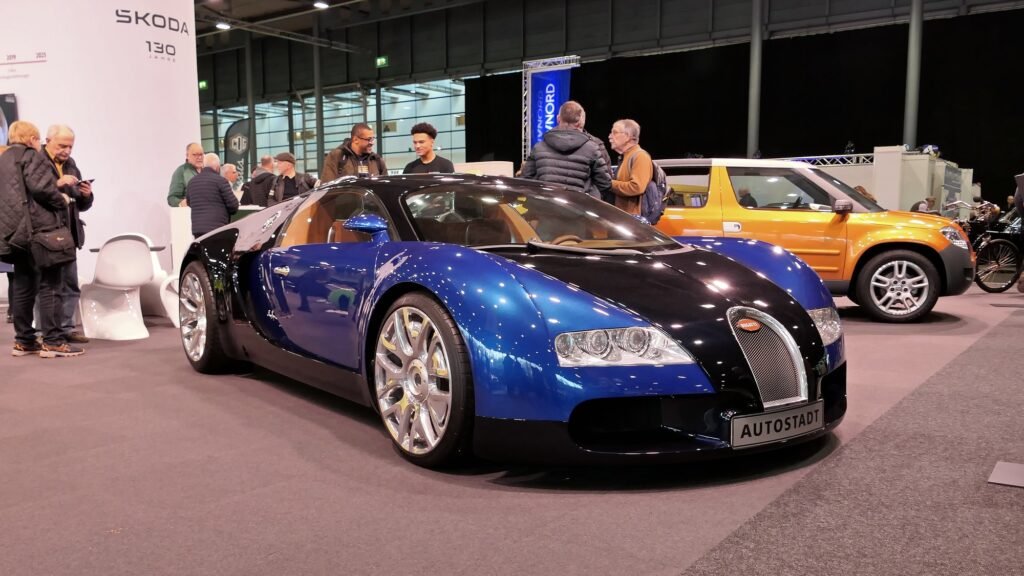
When Volkswagen started on the Veyron’s engine, Karl-Heinz Neumann, who ran engine development, said there was no published data for any production engine with more than twelve cylinders, or for any production car above 350 km/h, about 217 mph. Gregor Gries, head of technical development, added that the team had to build everything from scratch, down to the dynamometer the engine would be tested on.
Neumann’s line needs one footnote, and it is an American-friendly one. In 1998, at the Ehra-Lessien test track, Andy Wallace had already taken a McLaren F1 prototype to 240.1 mph with a naturally aspirated BMW V12. The road car existed. What did not exist was an engine with nearly three times the power of a Corvette of the day and could live with it.
The idea started with Ferdinand Piëch, then boss of the Volkswagen Group, who in 1997 sketched an eighteen-cylinder engine on the back of an envelope during a bullet-train ride between Tokyo and Nagoya. That one was three VR6s on a common crankshaft, 6.25 liters, no turbos, 555 hp. It was never going to make the 1,001 metric horsepower Piëch announced at the Geneva show in March 2000, and by that fall the show car had a new badge, EB 16.4, and a new engine: sixteen cylinders, 8.0 liters, four turbochargers.
Two VR8s and one crankshaft
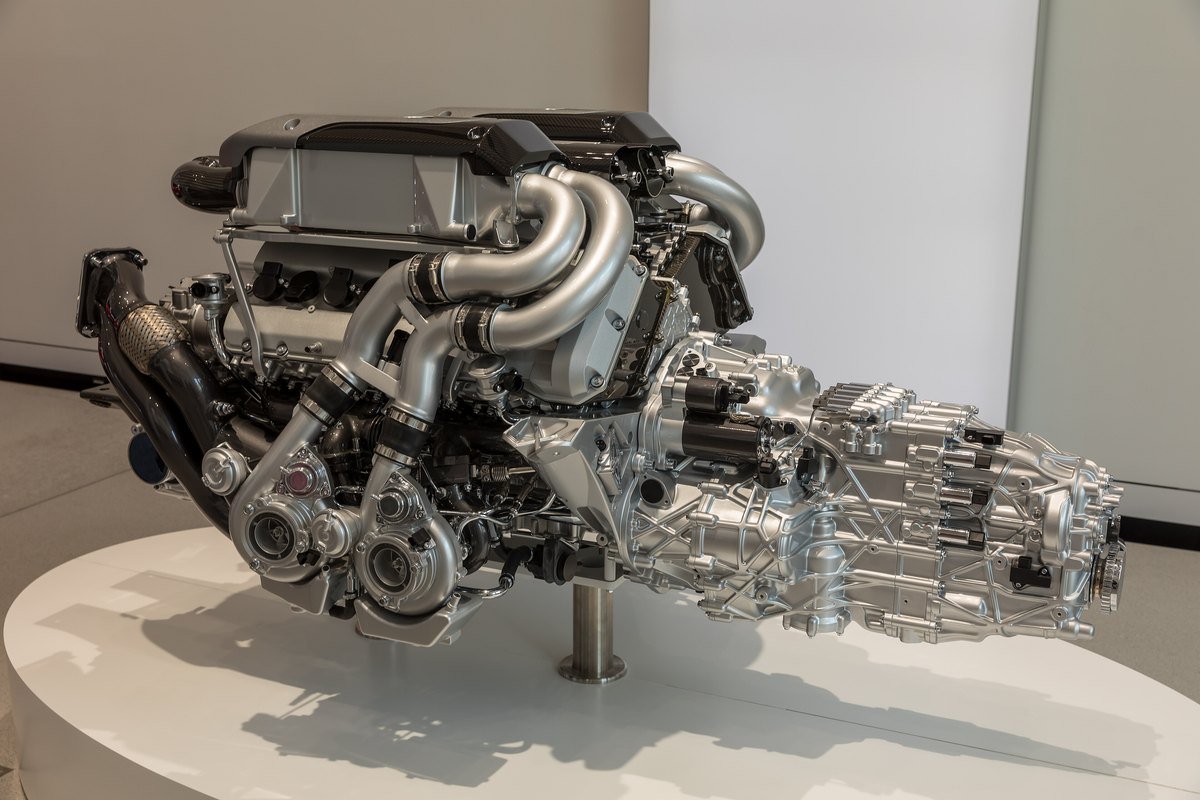
To understand the W16 you have to start with a stranger Volkswagen engine, the VR6 that went into the Corrado and the Golf in the early 1990s. It is a V6 with the two banks of cylinders set at an angle so narrow, 15 degrees, that they share one cylinder head. The engine ends up barely longer than an inline four, which is why VW could fit six cylinders sideways in a compact car.
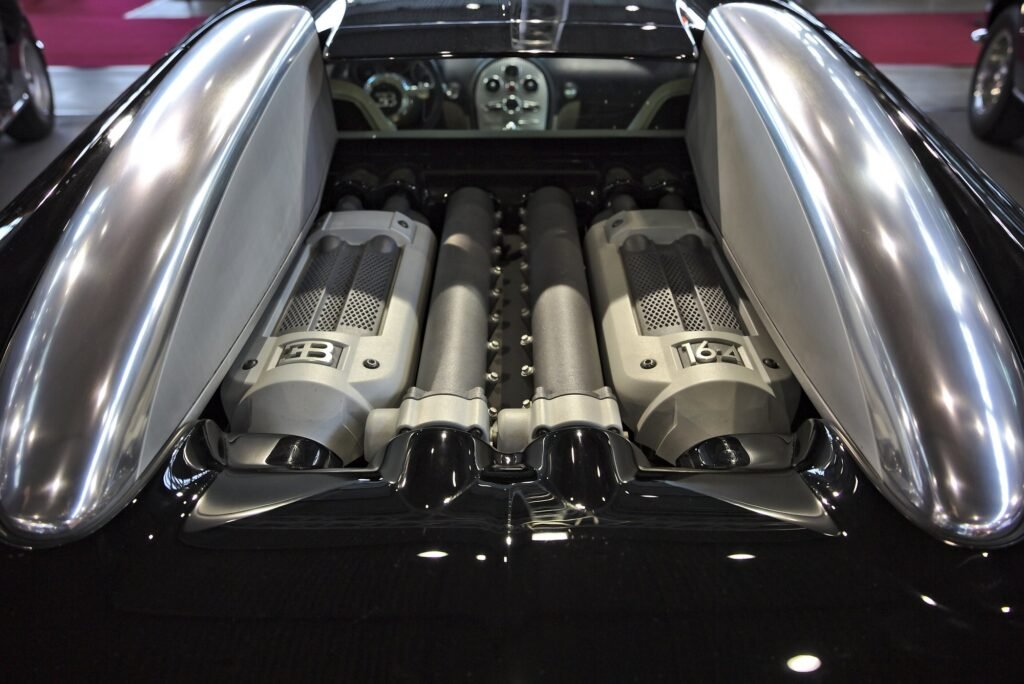
A W engine takes two of those narrow blocks and spreads them apart. The Veyron’s W16 is two VR8s joined at 90 degrees on one crankshaft, which gives four rows of four cylinders. Bugatti says the result is no bigger than a V12 and weighs about 400 kg, around 880 lb.
The rest of the spec sheet reads like it was written by an engineer who refused to round anything off. 7,993 cc, or 488 cubic inches. Bore and stroke both 86 mm, which makes it a square engine. Four camshafts, chain driven. Four valves per cylinder, 64 in all. Dry-sump lubrication, meaning the oil lives in a separate tank instead of a pan under the crank, so the engine can sit lower in the car and never starves for oil under hard cornering. Bugatti rated it at 1,001 PS, which is 987 hp, at 6,000 rpm, and 1,250 Nm (922 lb-ft) of torque from 2,200 to 5,000 rpm.
For scale, the American supercars of the Veyron’s launch year: the 2005 Ford GT made 550 hp from a supercharged 5.4-liter V8 and listed at $139,995. The Dodge Viper SRT-10 made 500 hp. The Ferrari Enzo had 660 PS and the McLaren F1 627. The Veyron had 52 percent more power than the Enzo, and a top speed of 253 mph, set in 2005 by test driver Uwe Novacki.
Where 2,400 horsepower of heat goes
An engine burns fuel and turns only part of that energy into motion. The rest leaves as heat, through the exhaust and through the coolant. Bugatti put a number on it: for every 1,200 hp the engine sends to the wheels, roughly 2,400 hp more has to be thrown away as heat. That ratio is the whole engineering problem of the car in one line, and it is why the front of a Veyron is mostly holes.
The cooling hardware, as Bugatti lists it:
- A high-temperature circuit with 40 liters of coolant, about 10.5 gallons, running through three radiators up front, a big one in the middle and two small ones on the sides. A thermostat can shut off the side radiators so the engine warms up faster.
- A low-temperature circuit with its own pump and 15 liters, about 4 gallons, dedicated to the air coming out of the turbos. A turbo works by squeezing air so more of it fits in the cylinders, and squeezed air gets hot, and hot air makes less power. Bugatti’s two charge-air coolers drop that temperature by as much as 130 °C, about 234 °F of difference. The company says this is what lets the car make full power on a hot day or sitting still.
- Separate coolers for engine oil, transmission oil and the rear differential, which gets its own active cooling.
- A heat exchanger for the air conditioning, and another that cools the hydraulic fluid with water.
Bugatti’s total is ten radiators. The parts named on its own technical page add up to ten, though we could not find an official numbered list. The two water circuits alone hold 55 liters, a bit over 14.5 gallons.
Brakes that see 2,000 degrees
Stopping from 250 mph is the same problem in reverse: all that speed has to become heat somewhere. The Veyron’s brakes are carbon-ceramic discs, 400 mm (15.7 in) across and 38 mm thick up front, squeezed by eight-piston titanium calipers. Bugatti says they were designed to work from -40° to roughly 1,100 °C at the disc surface, which is just over 2,000 °F.
At 200 mph, braking power peaks at 5,600 kW, about 7,500 hp. That is seven and a half times what the engine makes. Deceleration tops 2 g. At high speed the rear wing helps: in a hard stop it tilts from 15 to 55 degrees in under 0.4 seconds and works as an air brake.
Carbon tub, steel cradle
The center of the car is a carbon-fiber monocoque with an aluminum honeycomb core, around 110 kg (243 lb) according to Supercar Nostalgia’s technical guide. Aluminum crash structures sit up front. At the back, the frames that carry the engine and the rear axle are aerospace-grade stainless steel, and the reason is heat again: the turbos send exhaust gas out at around 1,000 °C (1,832 °F).
The target weight was about 1,500 kg. The car came out at 1,888 kg, or 4,162 lb. Neumann admitted before launch that it weighed too much and said he would not change anything.
Seven gears, two clutches
The transmission is a seven-speed dual-clutch. One clutch handles the odd gears, the other the even ones, so the next gear is already engaged and waiting when the shift happens and drive to the wheels never stops. Ricardo supplied the unit, and it shifts in 150 milliseconds, per Supercar Nostalgia.
Bugatti calls it the world’s first seven-speed twin-clutch gearbox, and the wording is careful for a reason. The dual-clutch itself was already in Volkswagen showrooms: the Golf R32 got a six-speed DSG in 2003, two years before the Veyron. Bugatti’s launch material quoted 1,250 Nm of torque capacity for the gearbox; its current technical page says up to 1,500. Electric cars skip the whole problem with a single gear.
Tires nobody had
Bugatti says no existing tire could survive the Veyron and that Michelin spent five years developing one. It is a Michelin PAX, which carries a plastic support ring on the wheel so the car can keep rolling after a puncture. German magazine Auto Zeitung worked out that at 400 km/h, around 250 mph, each tread block pulls outward with roughly 27 kg of force, about the weight of a car battery, and there are more than a hundred blocks per tire. Standing still, each one weighs a few grams.
A set cost around €38,000. Michelin recommended replacing them at about 4,000 km, some 2,500 miles, for owners who used the car hard.
The Speed Key
Top speed was locked behind a second key. The driver stops, puts the Speed Key into a slot to the left of the seat, and the car drops to 65 mm of ground clearance at the front and 70 at the rear, about 2.6 and 2.8 inches. Without it, the Veyron stayed in a milder mode.
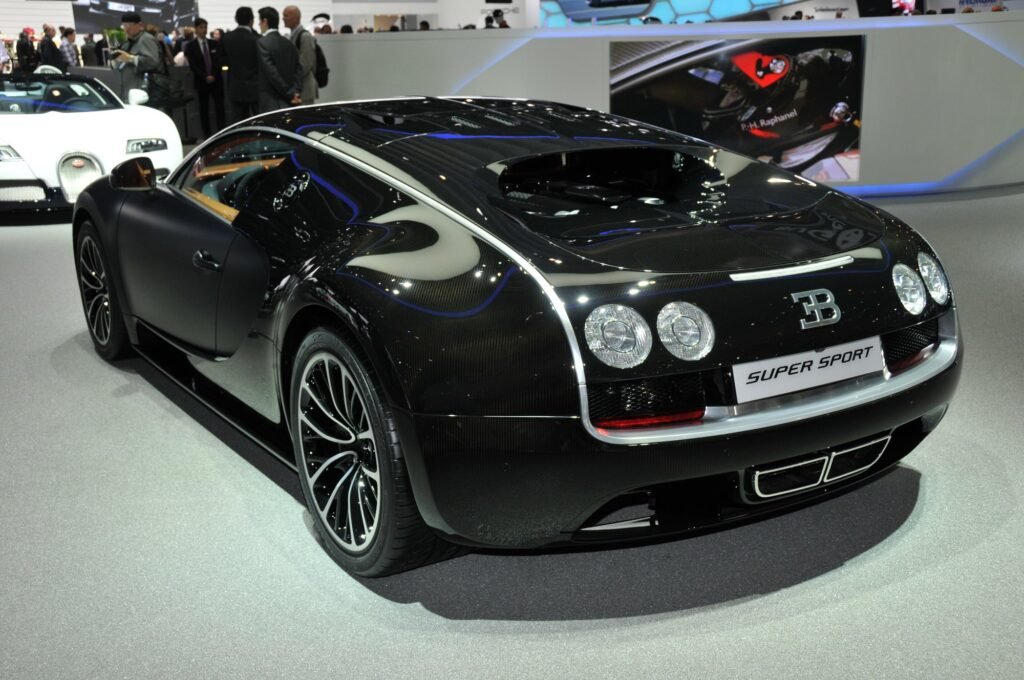
That key ended up in a Guinness dispute. In 2010, on July 4, Bugatti test driver Pierre-Henri Raphanel averaged 267.856 mph at Ehra-Lessien in a Veyron Super Sport, now with 1,200 PS (1,184 hp), and took the record back from SSC. Customer Super Sports were electronically limited to 258 mph. In April 2013 Guinness said the record was invalid because the limiter had been switched off, and five days later, after a review, it confirmed the record again, ruling that a speed limiter does not change the fundamental design of a car.
Six days per engine
Bugatti says each W16 has more than 3,500 parts and that every one is fitted by hand. In the Chiron era, two technicians built each engine over six days in a separate room inside Volkswagen’s engine plant in Salzgitter, and the finished unit traveled to Molsheim to meet its gearbox. Bugatti says the first production-spec engine ran in 2001 and made its 1,001 PS on the first test.
What Volkswagen spent is another matter. In 2013 The Economist published an estimate by analysts at Bernstein Research: about €4.6 million lost on every Veyron sold. That is an analyst’s calculation. Volkswagen never published its own figure.
Barcelona got there first, in a straight line
The Spanish angle on a sixteen-cylinder Bugatti is seventy years older than the W16. In 1931, a Catalan inventor named José Tous Forrellat owned two Bugatti Type 30s. One had been crashed, but its engine was intact. Tous stretched the engine bay of the better car, moved the cabin back, and put both straight-eights in a row, one behind the other. The result was an inline sixteen-cylinder roughly 1.8 meters long, close to six feet, which Spanish outlet Diariomotor considers almost certainly the longest engine ever fitted to a car. It was registered in Barcelona with plate B-13284. Tous eventually sold it because Spain’s road tax was calculated on engine size and the bill made the car impossible to keep. Restored, it was shown at Classic Madrid in 2024.
Eight liters, retired
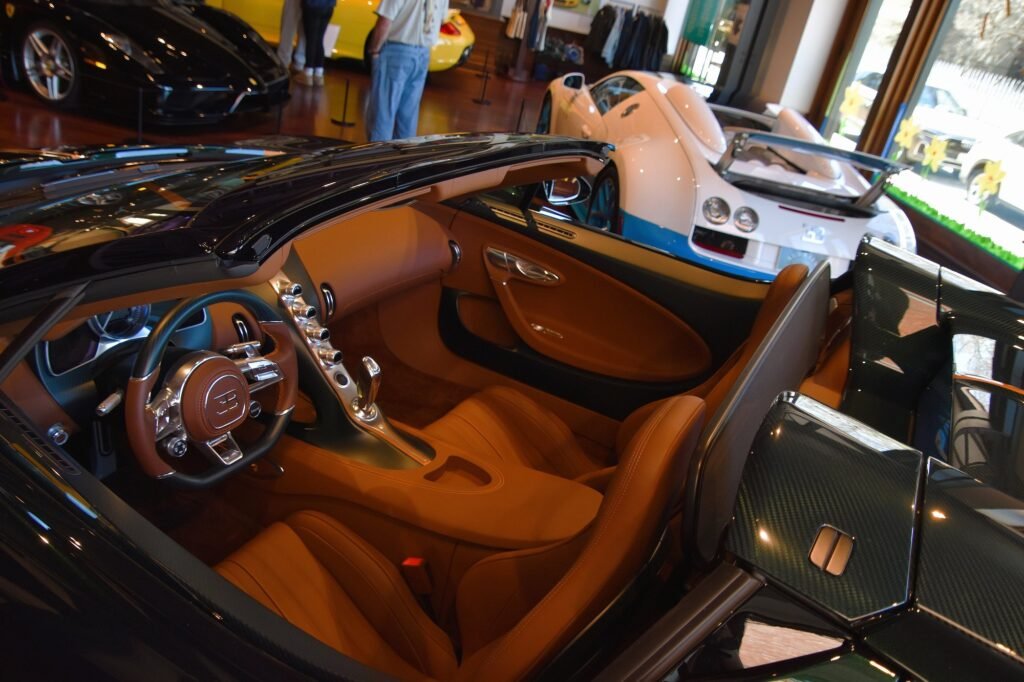
The W16 kept growing for almost two decades. It made 1,001 PS in the 2005 Veyron, 1,200 in the 2010 Super Sport, 1,500 in the 2016 Chiron and 1,600 in the Chiron Super Sport and the Centodieci. The Bolide track concept was quoted at 1,850 PS. In 2019 a pre-production Chiron Super Sport 300+ hit 304.773 mph, according to Bugatti.
In 2022 Bugatti announced the engine’s retirement. The last car to use it is the Mistral roadster, 99 units at €5 million each, all sold, with 1,600 PS. In November 2024 it ran 282.05 mph and was billed as the fastest roadster in the world.
Its replacement, unveiled on June 20, 2024, is the Tourbillon: a naturally aspirated 8.3-liter V16 developed with Cosworth, revving to 9,000 rpm and backed by three electric motors for 1,800 PS combined, about 1,775 hp. 250 will be built at €3.8 million, around $4.1 million. Mate Rimac, the Croatian who made his name with the Nevera and now runs Bugatti, said he is an electric-car guy but that a Bugatti should keep its combustion engine a while longer.
Check you’re still alive.
Photos: Matti Blume (CC BY-SA 4.0); Alexander Migl (CC BY-SA 4.0); More Cars (CC BY 4.0); Autoviva (CC BY 2.0); Charles from Port Chester (CC0). Wikimedia Commons.