Porsche Cayenne — The SUV That Saved Porsche by Betraying Everything It Stood For
Porsche Cayenne: The SUV That Saved Porsche and Destroyed Its Soul

Let me tell you the most uncomfortable story in the history of Porsche. It’s not the IMS bearing. It’s not the 914. It’s not the tractor Ferdinand Porsche designed before the war.
It’s the story of how Porsche — the sacred temple of the rear-engined sports car, the cathedral of air-cooling, the church of the driver — built a two-tonne SUV and saved itself from extinction by doing so.
The Porsche Cayenne is the greatest contradiction in motoring. It’s the car that purists swore they’d never forgive, and that now literally finances every car they worship. Every GT3, every GT4, every 911 S/T that sells at auction for the price of a flat — it exists because Porsche had the nerve to put their crest on a truck.
And the hypocrisy of the enthusiast community about it is so thick you could cut it with a Porsche Classic technician’s torque wrench.
The Bankruptcy Nobody Wants to Remember
We’ve touched on this in the 996 article, but it bears repeating because the enthusiast community has astonishing selective memory when it comes to Porsche’s finances.
In the early 1990s, Porsche was in genuine trouble. Production had plummeted to levels that made independent survival essentially impossible. Manufacturing costs were absurd for the volumes they were producing. The range was limited to the 911, the dying 928, the 968 that nobody was buying, and the Boxster still in development. In a global market where production scale determined survival, Porsche was a dwarf surrounded by giants.
Wendelin Wiedeking took over as CEO in 1993 and diagnosed the problem with brutal clarity: Porsche needed volume. The 911 and Boxster, however good they were, would never generate the volume needed to fund the R&D investment required to compete with BMW, Mercedes, and Audi. Porsche needed a product that would sell tens of thousands of units annually, attract new buyers to the brand, and generate sufficient margins to fund the sports cars that were the soul but not the sustenance of the company.
The answer, after years of market analysis, financial projections, and internal debates that must have been epic, was an SUV.
The decision was announced internally in the mid-1990s and the reaction was exactly what you’d expect. Within Porsche itself, engineers who’d dedicated their careers to building lightweight, driver-focused sports cars received the news with something between disbelief and horror. The internal culture at Porsche was built around the idea that lightness, precision, and driver connection were sacred values. A two-tonne off-roader was the antithesis of everything they stood for.
Outside Porsche, the reaction was worse. Enthusiast forums — which in those days were bulletin boards with fewer emojis but the same level of outrage — burned with boycott promises. Motoring publications ran hand-wringing editorials. Collectors prophesied the death of Porsche as a sports car brand.
What none of these vocal critics had was a viable alternative. What should Porsche have done? Kept selling 20,000 cars a year and bled to death slowly? Sold themselves to Volkswagen as a subsidiary without autonomy? Merged with another manufacturer and lost their identity? The reality was that Porsche needed a high-volume, high-margin product, and in the early 2000s, that meant an SUV. The segment was exploding globally, BMW was about to launch the X5, Mercedes was preparing the ML, and the market was hungry for premium SUVs.
Porsche partnered with Volkswagen for the development — the Cayenne would share its platform with the VW Touareg, another decision that enraged purists but made complete economic sense. Sharing development costs with VW reduced the financial risk enormously and accelerated the launch timeline. Without VW collaboration, the Cayenne probably wouldn’t have existed — Porsche simply didn’t have the resources to develop an SUV from scratch.
The Launch: Public Shame, Private Success
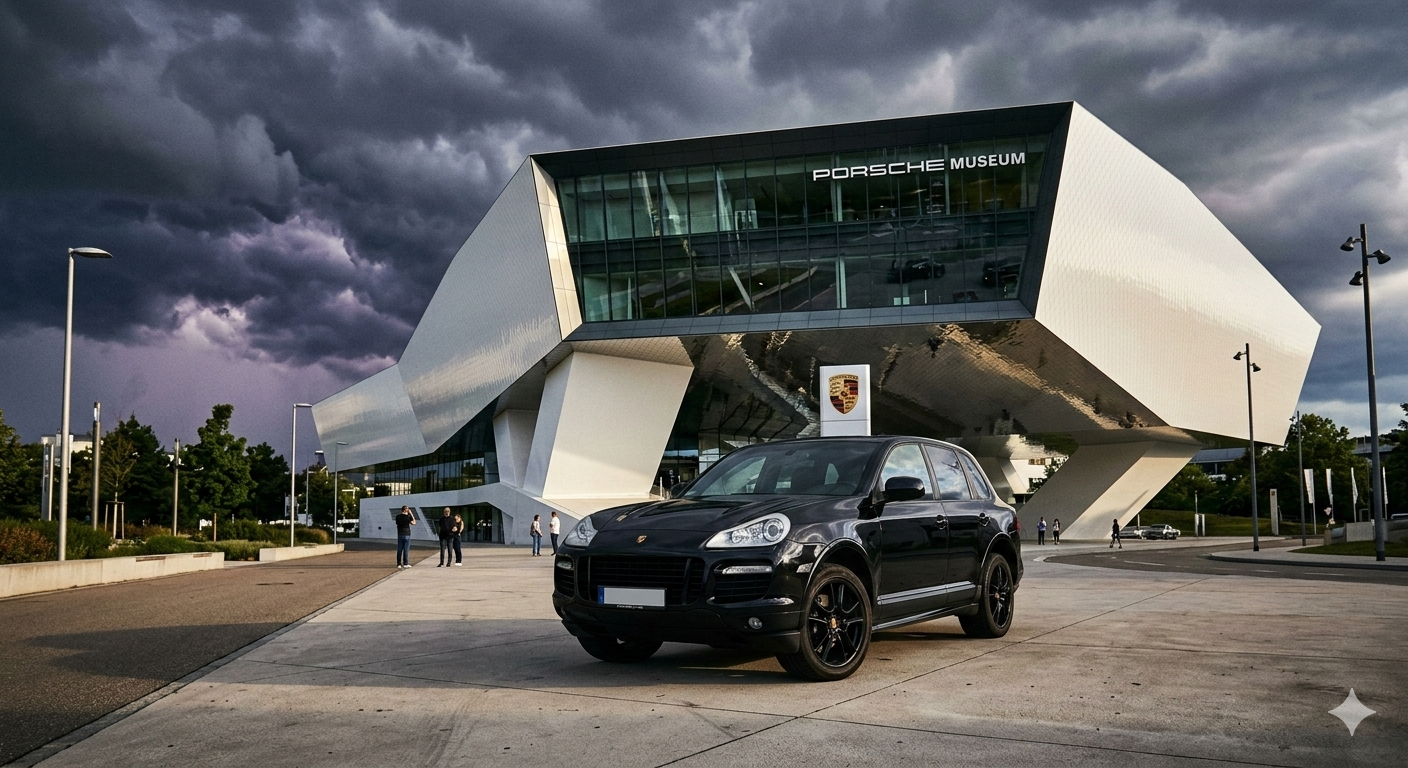
The first Cayenne arrived in 2002 and was, let’s be honest, an ugly car. The design attempted to incorporate elements of the 911’s visual language — the headlights, the descending roofline, the overall shape — into an SUV format that simply didn’t accept them naturally. The result looked like a 911 that had spent too long at an all-you-can-eat buffet. The proportions were awkward, the ride height was excessive for the sporting pretensions, and the front face wore an expression that oscillated between determination and confusion.
The interior was functional but uninspiring — it shared more DNA with the Touareg than Porsche would have liked to admit, and the materials, while adequate for the segment, didn’t have the special feel that a Porsche badge promised.
But the mechanical range told a different story. The Cayenne S used a 4.5-litre V8 producing 340 hp that delivered genuinely impressive performance for a car weighing over two tonnes. The Cayenne Turbo pushed that V8 to 450 hp with forced induction, creating something that shouldn’t physically exist: an off-roader capable of 0-62 mph in 5.6 seconds. And the base model with a 3.2-litre V6 and 250 hp offered an entry point that made the Porsche badge accessible to an entirely new market segment.
What genuinely surprised everyone — critics, purists, and competitors alike — was how it drove.
The Cayenne was genuinely good on the road. Not good “for an SUV” — good in its own right. The steering was communicative and precise in a way that neither the X5 nor the ML could match. The air suspension offered extraordinary dynamic range, from motorway cruising comfort to surprising firmness on twisting roads. The brakes were enormous and effective. And the chassis, despite its height and weight, transmitted a competence and confidence that made you momentarily forget you were sitting a metre above the tarmac.
It wasn’t a 911. It didn’t pretend to be. But it was unmistakably a Porsche in the way it interpreted driving — a machine that took dynamics seriously in a way its competitors simply didn’t in 2002.
And it sold like mad.
The Numbers That Humiliated the Purists
Within a few years, the Cayenne represented more than half of all Porsche sales globally. More than half. A manufacturer whose entire identity revolved around two-seat sports cars was selling more SUVs than sports cars.
By 2007, Porsche was the most profitable car manufacturer in the world per unit sold. Not one of the most profitable — THE most profitable. Cayenne margins were extraordinary because Porsche could charge a significant premium over competing SUVs thanks to brand strength, while production costs stayed controlled thanks to the shared VW platform.
The Cayenne money flowed directly into exactly where purists wanted it: 911 development, the GT3 programme, sports range upgrades, motorsport technology investment. Every penny of profit the Cayenne generated — and it generated billions — was reinvested into making the car purists worshipped even better. The irony was delicious: the SUV supposedly destroying Porsche’s soul was literally funding the evolution of Porsche’s soul.
But the truly revealing thing wasn’t the Cayenne’s sales figures. It was what happened to 911 sales.
The 911 didn’t fall. It rose. The Cayenne attracted buyers to the brand who would never have walked into a Porsche dealership, and a significant percentage of those buyers eventually added a 911 to their garage. The Cayenne didn’t cannibalise the 911 — it fed it. It was the most effective gateway Porsche had ever had, more effective than the 944, more effective than the Boxster, more effective than any marketing campaign.
Evolution: From Sin to Pillar
The second-generation Cayenne (2010) fixed virtually every aesthetic criticism of the original. The design was cleaner, better proportioned, and more confident. It had stopped apologising for existing and presented itself as what it was: a high-performance premium SUV that needed no justification. The mechanical options expanded with a V6 diesel that was a massive hit in Europe, and hybrid variants began appearing.
The third generation (2018) was a genuinely refined machine that rivalled anything in the luxury SUV segment. The Cayenne Turbo GT — 640 hp from a twin-turbo V8, 0-62 in 3.3 seconds, Nürburgring lap record for SUVs — was an engineering exercise as absurd as it was impressive. A two-tonne SUV lapping the Nordschleife faster than the vast majority of sports cars. Ridiculous. Unnecessary. Very Porsche.
The Cayenne Begat the Macan
The Cayenne’s success gave Porsche the confidence — and the profits — to launch a second SUV: the Macan, in 2014. Smaller, sportier, based on the Audi Q5 platform but transformed by Porsche engineering into something dynamically unrecognisable.
The Macan quickly became Porsche’s best-selling model, outpacing even the Cayenne. By the mid-2010s, SUVs represented more than two-thirds of all Porsche sales. A manufacturer that in 1995 sold exclusively sports cars was now generating the vast majority of its revenue from SUVs.
The purists who had sworn to boycott Porsche over the Cayenne had to perform mental gymnastics when the Macan appeared: there were now TWO SUVs in the range, and Porsche was more profitable, more innovative, and producing better sports cars than at any point in its history. The argument that SUVs were “destroying the brand” had become empirically unsustainable — though that has never stopped anyone on the internet.
The Hypocrisy That Defines the Community
This is where the Cayenne story gets genuinely interesting, because it exposes a fundamental hypocrisy in the enthusiast community that deserves to be named explicitly.
The same people who dismiss the Cayenne as “not a real Porsche” celebrate cars that wouldn’t exist without it. The GT3 RS, the 911 R, the 918 Spyder, every limited edition and every department special — all directly funded by Cayenne and Macan profits. Without the SUVs, Porsche wouldn’t have the R&D budget to develop 9,000-rpm naturally aspirated engines, active suspension systems of surgical precision, or carbon fibre chassis for production cars.
The enthusiast posting their 911 GT3 Touring on Instagram with #PorschePurismo while mocking the Cayenne in the comments is demonstrating a disconnect from reality that would be comic if it weren’t so widespread. Their car exists BECAUSE the Cayenne exists. Remove the Cayenne from the equation, and Porsche is a brand making 30,000 cars a year with thin margins and a development budget that doesn’t stretch to GT3s.
Porsche understood this symbiosis before anyone else. Ferrari eventually copied them with the Purosangue — after years of swearing they would NEVER make an SUV, which should win some kind of award for the most predictable broken promise in automotive history. Lamborghini copied it with the Urus. Aston Martin with the DBX. Lotus with the Eletre. Even Bentley and Rolls-Royce followed the SUV path. Porsche simply had the honesty to admit an uncomfortable truth that every other manufacturer eventually accepted: sports cars alone don’t pay the bills.
My Unpopular Opinion
The Cayenne didn’t destroy Porsche’s soul. It saved it.
Did it change the nature of the brand? Absolutely. Porsche stopped being an exclusive sports car manufacturer and became a luxury brand that also makes sports cars. That’s a real change with real consequences. The exclusivity diluted. The perception shifted. Seeing a Porsche stopped being an event and became an everyday occurrence in every shopping centre car park.
But the alternative was death. Or worse — irrelevance. A Porsche absorbed by Volkswagen without autonomy, reduced to a subdivision manufacturing 911s on a limited budget with no resources to innovate. That would have been the true destruction of the soul.
The Cayenne is proof that sometimes, to save what you love, you have to do something you hate. And then discover you don’t hate it as much as you thought.
Is it a “real” Porsche? The question is absurd. Porsche makes it. It wears a Porsche crest. Porsche engineers designed and built it. It drives better than any competitor. And it funds everything the purists value.
If that’s not a real Porsche, I don’t know what the hell is.