
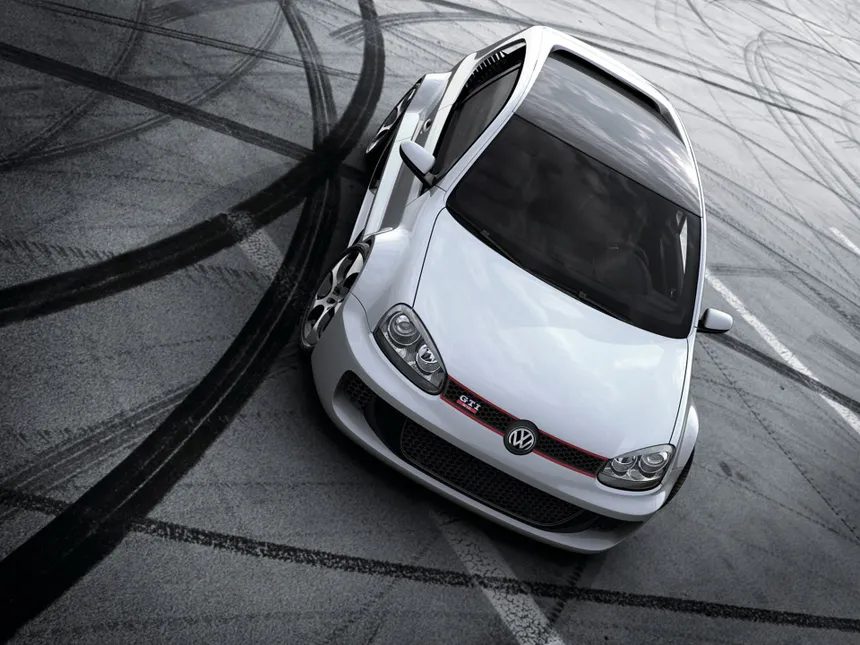
The Golf That Volkswagen Was Too Scared to Build
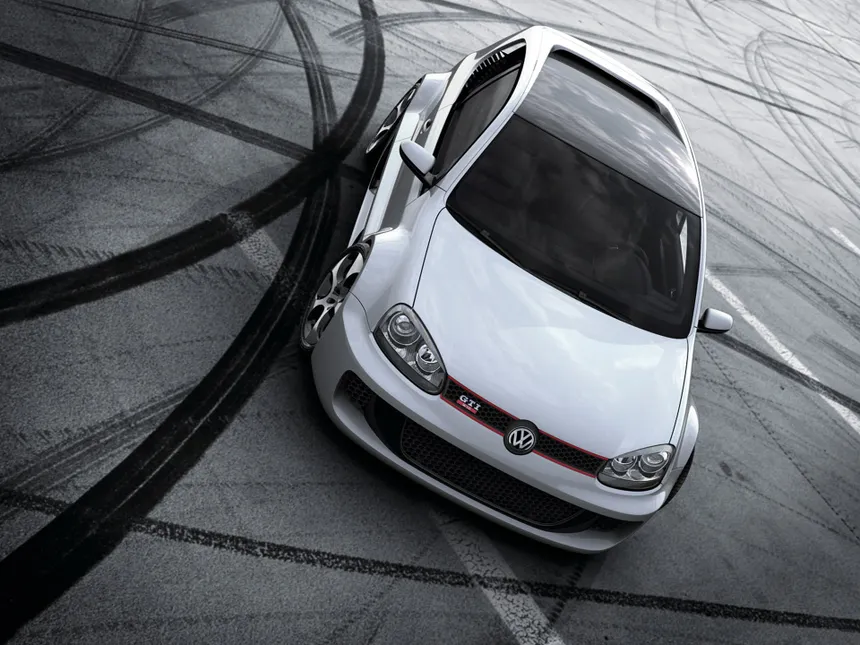
VW Golf GTI W12-650: A Bentley Engine, Lamborghini Axle, Audi RS4 Brakes, and the Most Terrifying Hot Hatch Ever Created — Built in Two Months
Section: Builds & Swaps | Not Enough Cylinders
Every major automaker has a parts bin. But only one ever had a parts bin that included Bentley engines, Lamborghini axles, Audi racing brakes, and Porsche engineering DNA — all under the same corporate umbrella.
In 2007, Volkswagen’s engineers decided to use that parts bin to build the most insane hot hatchback the world had ever seen. They took a regular Mk5 Golf GTI, ripped out the back seats, and shoved a twin-turbocharged W12 engine from the Bentley Continental GT right behind the driver’s head. Then they bolted on a Lamborghini Gallardo rear axle, Audi RS4 front brakes, and a Phaeton transmission.
The result was the Golf GTI W12-650: a mid-engine, rear-wheel-drive, 650-horsepower Golf that hit 201 mph and scared the living daylights out of Jeremy Clarkson on national television.
And they built it in two months.
For American readers unfamiliar with European car culture: imagine if GM took a Chevy Cruze, deleted the rear seats, dropped in a supercharged Cadillac CT5-V Blackwing engine behind the driver, fitted a Corvette Z06 rear axle and Camaro ZL1 brakes, and then let journalists drive it. That’s roughly what VW did, except the parts came from five different countries and three different continents.
The VAG Parts Bin: Five Brands, One Frankenstein
The year was 2007. The Volkswagen Group, under the legacy of chairman Ferdinand Piëch, controlled an empire of automotive brands spanning every market segment: Volkswagen, Audi, Bentley, Lamborghini, Porsche (partially), Seat, Skoda, and Bugatti. Piëch’s engineering philosophy was simple and megalomaniacal: technology should flow freely between brands with zero barriers.
That philosophy had already produced the Phaeton (a VW luxury sedan engineered to rival the Mercedes S-Class), the Bugatti Veyron (1,001 HP, $1.5 million, developed from scratch under Piëch’s insistence), and the Touareg V10 TDI (a twin-turbo diesel SUV that could tow a Boeing 747). Now it was about to produce the ultimate demonstration of cross-brand engineering.
Volkswagen wanted something jaw-dropping for Wörthersee — the annual GTI fan festival in Austria that draws thousands of Golf devotees every May. With only two months before the event, the team led by design director Klaus Bischoff raided the group’s global parts catalog and assembled the most unlikely combination of components in automotive history:
Engine: 6.0-liter twin-turbocharged W12 from the Bentley Continental GT. In naturally aspirated form (as fitted to the VW Phaeton), this engine makes 444 HP. With Bentley’s twin-turbo setup and joint optimization by VW and Audi engineers, output jumped to 650 HP (477 kW) at 6,000 rpm and 553 lb-ft (750 Nm) at 4,500 rpm.
Transmission: Six-speed automatic from the VW Phaeton, adapted for rear-wheel drive.
Rear axle and rear brakes: Lamborghini Gallardo. A Golf riding on the same rear axle as a mid-engine Italian supercar.
Front brakes: Audi RS4 — the benchmark sports sedan of its era.
Body: Mk5 Golf GTI three-door, widened by 6.3 inches (160mm) to accommodate the side-mounted air intakes and massive 295-section tires on 19-inch wheels — 9 inches wide at the front, 12 inches at the rear. The car sits 3 inches lower than the standard GTI.
Five brands. Two months. One completely unhinged Golf.

The W12 Engine: Ferdinand Piëch’s Greatest Hit
Americans know big engines. Big-block Chevys, Hemis, Coyotes, LS swaps into everything with wheels. But the Volkswagen W12 is different from anything Motown ever produced.
The W12 architecture was Ferdinand Piëch’s solution to an impossible packaging problem. A conventional V12 is too long for most modern engine bays. Piëch, who had already championed the VR6 — a six-cylinder engine with such a narrow 15° bank angle that it fits where an inline-four would — took the concept further: he fused two VR6 banks together at a 72° angle, sharing a single crankshaft.
The result: a twelve-cylinder engine shorter than many V8s and narrower than any conventional V12. Compact enough to fit under the hood of the Phaeton sedan. Powerful enough to rival BMW’s V12 and Mercedes’ V12 in the luxury segment. And in twin-turbo Bentley form, capable of producing supercar-level horsepower.
In the Golf W12-650, this engine sits longitudinally behind the front seats, cradled in a bespoke aluminum subframe. Two cooling fans the size of dinner plates sit behind it, surrounded by carbon fiber ducting. The configuration transforms the Golf into a classic mid-engine sports car — the same layout as a Ferrari 458 or a Lamborghini Huracán. The difference is that the bodywork wrapped around that layout belongs to Europe’s most popular family hatchback.
The trunk lid is permanently sealed. Maintenance access was not a design priority.
Design: Keeping the Golf a Golf
Klaus Bischoff set a non-negotiable rule for the project: the W12-650 had to remain recognizably a Golf GTI. Not a prototype racer. Not a concept car from a fever dream. A Golf.
That meant keeping the factory headlights, the original doors (rehung to accommodate the wider side sills), the front hood, and the taillights. The modifications had to integrate into the Mk5 silhouette without destroying its character. Bischoff put it this way: the Golf’s design is like a fingerprint — erase it and you destroy the entire character.
The biggest challenge was feeding enough air to the W12 without ruining the GTI’s side profile. The solution was a horizontal air intake on each flank, disguised as a design element but actually feeding air directly to the mid-mounted engine.
The roof is the aerodynamic masterpiece. Instead of bolting on a conventional wing — which would have destroyed the Golf’s clean roofline — the team created a carbon fiber roof that functions as a massive diffuser. Air flows over and under the rear spoiler to generate downforce on the rear axle. As Bischoff explained: this GTI carries its wing internally.
At the rear, dual chrome exhaust tips frame a massive air outlet. At the front, the straight-line grille with its red frame references the original 1976 GTI. The whole car is an exercise in restraint designed around something that has zero restraint.
Driving It: Clarkson, evo, and Controlled Chaos
The W12-650 wasn’t a static show car. Volkswagen actually let people drive it. The results were… educational.
Jeremy Clarkson drove it on Top Gear, and his verdict was predictable: straight-line performance was devastating, but in corners the car was essentially un-driveable. With 650 HP going exclusively to the rear wheels through tires that were never designed for this kind of power, and a chassis that was fundamentally a modified family hatchback, the W12-650 was a constant negotiation between physics and chaos.
The British magazine evo published a detailed driving account. Their test driver made multiple passes through a corner. First pass: understeer. Second: lifted slightly, tail twitched. Third: lifted hard, massive spin, engulfed in tire smoke. Fourth: cautious, back to understeer. Fifth: more speed, even bigger spin, sliding sideways toward the edge of the track.
The journalist noted the golden rule of driving priceless one-off concept cars: don’t be an idiot. That information apparently didn’t reach the driver.
Marc Lichte, then a VW designer who would later become Audi’s head of design, passionately argued that VW should put the W12-650 into production. His reasoning: it would be relatively easy because every component was an off-the-shelf item from the Volkswagen Group. Bentley engine, Phaeton gearbox, RS4 brakes, Gallardo axle, Golf platform. VAG Legos.
Volkswagen never built it. But the fact that they could have — that every single part existed in their catalog — remains the most staggering detail of the entire project.
2026: The Red Return for GTI’s 50th Birthday
Nearly two decades after its debut, the Golf GTI W12-650 has resurfaced. In early 2026, Volkswagen pulled the car from its collection and wrapped it in a new red livery to celebrate the 50th anniversary of the Golf GTI.
Top Gear, Carwow, and other outlets got close-up access. The unanimous verdict was astonishment: a concept hastily built in two months, 19 years ago, was in remarkable condition. The build quality — something that typically degrades fast in rapid prototypes — was impressive.
Inside, none of the buttons or switches actually work — they’re props completing the racecar aesthetic alongside the two-tone Alcantara bucket seats, turbo boost gauges, exhaust temperature readouts, and transparent switch guards including one for the built-in fire suppression system. Just in case the exhaust gases got hot enough to ignite the engine bay. Reassuring.
The car exists as a reminder that Volkswagen, underneath its sensible family-car image, once had an insanity gene in its corporate DNA. A gene that expressed itself less and less frequently as emissions regulations, electrification targets, and shareholder pressure eliminated the margin for projects with zero financial return.
Why the W12-650 Matters for Builds & Swaps
Here’s why this factory concept belongs alongside garage-built monsters like the DOP Motorsport Lupo and the Vilebrequin 1000Tipla in our Builds & Swaps section.
The W12-650 represents the ultimate parts-bin build. It’s the same ethos that drives every enthusiast who puts an LS into a Miata, a 2JZ into a BMW, or a Cummins into a first-gen Ram — taking components that were never meant to coexist and making them work together through engineering, fabrication, and sheer determination. The only difference is that VW’s parts bin happened to include Bentley, Lamborghini, and Audi.
It also represents a road not taken. Marc Lichte believed VW could have put it into production. Every component was production-ready. The W12-650 wasn’t limited by engineering — it was limited by corporate risk aversion. And in that sense, it stands as a monument to the kind of automotive insanity that only survives in garages, workshops, and the occasional corporate rebellion.
Jeremy Clarkson once said the W12-650 was “brilliant and terrifying in equal measure.” We can’t think of a better description for a Builds & Swaps feature.
Technical Specifications: Volkswagen Golf GTI W12-650 Concept (2007)
| Specification | Detail |
|---|---|
| Base | VW Golf GTI Mk5 (3-door) |
| Builder | Volkswagen AG (Wolfsburg) / development with Audi |
| Design director | Klaus Bischoff, VW Head of Design |
| Build time | ~2 months |
| Engine | W12 6.0L twin-turbo (Bentley Continental GT origin) |
| Engine architecture | 2x VR6 banks at 72°, longitudinal mid-rear mount |
| Power | 650 HP (477 kW) @ 6,000 rpm |
| Torque | 553 lb-ft (750 Nm) @ 4,500 rpm |
| Transmission | 6-speed automatic (VW Phaeton origin) |
| Drivetrain | RWD |
| Rear axle | Lamborghini Gallardo |
| Front brakes | Audi RS4 |
| Rear brakes | Lamborghini Gallardo |
| Engine subframe | Bespoke aluminum |
| Body widening | +6.3 inches (160mm total, 80mm per side) |
| Ride height reduction | -3 inches (75mm) vs. standard Golf GTI |
| Wheels | 19″ (9″ wide front / 12″ wide rear) |
| Tires | 295-section |
| Roof | Carbon fiber (functions as active diffuser) |
| 0-60 mph | ~3.5 seconds |
| 0-100 km/h | 3.7 seconds |
| Top speed | 201 mph (325 km/h) |
| Seating | 2 (Alcantara/leather buckets) |
| Units built | 1 |
| Status | Repainted red in 2026 for GTI 50th anniversary |
Timeline
| Date | Milestone |
|---|---|
| Spring 2007 | VW decides to create extreme concept for Wörthersee with only 2 months lead time |
| May 2007 | Golf GTI W12-650 debuts at Wörthersee GTI-Treffen, Austria |
| 2007 | Jeremy Clarkson drives it on Top Gear. evo magazine publishes drive review |
| 2007-2025 | Car remains in Volkswagen’s heritage collection |
| Feb. 2026 | Reappears in red livery for Golf GTI 50th anniversary. Covered by Top Gear, Carwow |
Original feature by Not Enough Cylinders for the Builds & Swaps section. Data verified through Volkswagen AG press materials, netcarshow.com, evo magazine, Carscoops, Top Gear, Carwow, Car Body Design, and Below The Radar.
Know a build that deserves the Builds & Swaps treatment? Hit us up.