Lotus: The Brand That Made Weight the Enemy
In May 2026, Lotus CEO Feng Qingfeng sat down at the Financial Times Future of the Car Summit and admitted the strategy that was supposed to conquer the world had hit a wall. His words were that the plan had been aggressive and that the company moved too fast. Translation: the promise of 150,000 cars a year by 2028 and a fully electric lineup ended up as 6,520 deliveries in a year, down from 11,984. The Hethel factory in Norfolk built roughly 2,000 units. There were 550 layoffs.
This is the company founded by the man who said “simplify, then add lightness.” The same company whose current sports car, the Emira, weighs 3,279 pounds: more than double the 1996 Elise, which came in at 1,598. Seventy-eight years after the first car, Lotus is trapped in precisely the contradiction its founder spent his life fighting.
For American enthusiasts, Lotus has always been the strange one. Not the loud one, not the fast-in-a-straight-line one, not the one that wins at the drag strip. And yet the brand’s fingerprints are all over American racing history, its most infamous scandal was bankrolled by a British government and immortalized by a Hollywood time machine, and the last American-born driver to win a Formula 1 World Championship did it in a Lotus. That was 1978. Nobody has done it since.
A shed, an Austin Seven, and no money at all
Anthony Colin Bruce Chapman was born on May 19, 1928, in Richmond, Surrey. He studied engineering at University College London and graduated in 1948, the same year he built his first race car in his parents’ garage: a 1930 Austin Seven torn apart and rebuilt into what he called the Lotus Mark I.
Nobody knows for certain where the name came from. Chapman never explained it. It has been written that it was a pet name for his girlfriend and later wife, Hazel Williams, and it has been written that he simply liked the sound of it. Neither version is documented by Chapman himself, so treat both as workshop folklore.
What is documented is that in 1952 he founded Lotus Engineering Company in a converted horse stable in Hornsey, north London. No capital, no investors, no industry contacts.
Early Lotus cars were sold as kits: the customer bought the parts and assembled the car at home. This usually gets told as the romantic idea of a broke engineer, and cost was part of it, but the real driver was tax. In postwar Britain, finished cars paid Purchase Tax. Kits did not. Chapman didn’t just design structures. He read regulations looking for the gap. That habit won him seven Constructors’ Championships and, in the end, cost him his name.
The Seven: the whole philosophy in 1,058 pounds
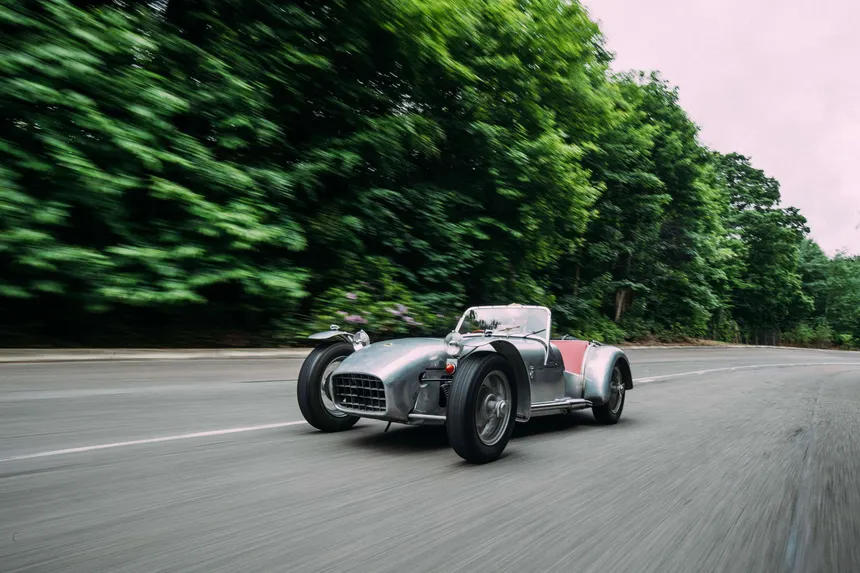
The Lotus Seven arrived in 1957 and is the cleanest summary of the company’s thinking. A steel space frame, meaning a skeleton of welded tubes calculated to deliver maximum stiffness with the least possible material, skinned in aluminum. Two seats. No doors on many versions. Nothing else.
A period Spanish road test of a Series 3 with the 1,599cc Ford Cortina engine and 84 horsepower recorded 480 kilos on the scales, roughly 1,058 pounds, a top speed of 99 mph, and 0-62 mph in 8.9 seconds. With 84 horsepower. For context, a 1957 Chevrolet Bel Air with the 283 V8 weighed north of 3,300 pounds and needed more than three times the displacement to run with it on anything resembling a corner.
The trick is not mysterious physics: acceleration is force divided by mass. If you can’t raise the force because you don’t have the money to build engines, you cut the mass. Everything else at Lotus is a consequence of that division.
Chapman lost interest in the Seven when new taxes arrived and sold the rights in 1973 to Caterham Cars, his largest dealer, which still builds it today, more than six decades after the original design. Before that, a licensed production run of about 50 cars was built in Argentina, the only legitimate Lotus Sevens ever assembled outside England. Around ninety companies worldwide have since built replicas, which is why American track day paddocks are full of Seven-shaped cars wearing a dozen different badges.
The monocoque: Chapman made the entire grid obsolete in two years
Lotus entered Formula 1 in 1958. Four years later it blew up the way race cars were built.
Until 1962 every single-seater used a space frame. The 1962 Lotus 25 introduced an aluminum monocoque, and the difference is worth explaining properly because everything since is built on it. In a space frame, loads travel through a cage of tubes and the bodywork is a cosmetic skin that carries nothing. In a monocoque, the outer skin is the structure, like an aircraft fuselage. The result is a car far stiffer in torsion, meaning it twists less between the front and rear axles, and considerably lighter, because you stop carrying two things when one can do both jobs.
Jim Clark won the 1963 World Championship in the Lotus 25. Within two years there wasn’t a space frame left on the grid. Every serious competition car since descends from that idea, and unibody road car construction runs on the same principle.
Clark won again in 1965, and that same year he won the Indianapolis 500 in a Lotus 38. A mid-engine car took the Brickyard from front-engine roadsters that had owned it for decades. American open-wheel racing never went back.
The 49, the DFV, and tobacco money
The Lotus 49 arrived in 1967 carrying two changes that still define Formula 1.
The first is mechanical. Chapman persuaded Ford to fund the engine Keith Duckworth was designing at Cosworth, the DFV, and installed that V8 as a structural member of the car: bolted to the monocoque at the front, carrying the rear suspension and gearbox at the back. The engine stops being a lump the chassis has to support and becomes part of the chassis. Less structure, less weight. Nearly every Formula 1 car since has been built that way, and the DFV went on winning races for fifteen years in half the field’s cars.
Clark won on the 49’s debut at Zandvoort and took three more victories that season.
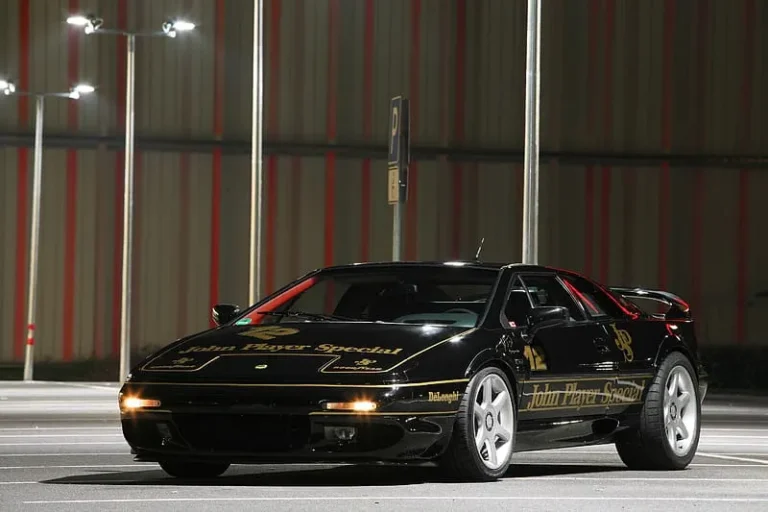
The second change had nothing to do with engineering and arguably altered the sport more than the monocoque: commercial sponsorship. Until then cars wore national colors, British racing green, Italian red, French blue. In early 1968 Chapman signed with Imperial Tobacco and ran his cars in the red, white, and gold of the Gold Leaf cigarette brand.
The first sponsored car in a championship race was a privately entered Brabham in Gunston colors in South Africa on January 1, 1968. What happened four and a half months later at Jarama, outside Madrid, was different: the first time a factory team contested a championship Grand Prix dressed as an advertisement. Gold Leaf Team Lotus. Every livery deal in modern motorsport, every sponsor decal on every NASCAR fender, traces back to that weekend.
The context makes it heavier. Clark had died on April 7, 1968, in a Formula 2 race at Hockenheim. His replacement, Mike Spence, was killed practicing for the Indianapolis 500 in May, five days before the Spanish race. Chapman was so shattered he didn’t travel to Madrid. The team brought one car. Graham Hill started sixth, won by 15.9 seconds over Denny Hulme’s McLaren, and held together an operation that was falling apart.
Montjuïc, 1969: the bill for the obsession
The 49 also brought Formula 1’s first wings, mounted on tall struts bolted straight to the uprights so they worked in clean air above the body’s turbulence. They worked. They were also long, thin, flexible structures held up by tubes Chapman refused to reinforce, because reinforcing meant adding weight.
For the 1969 Spanish Grand Prix on the Montjuïc street circuit in Barcelona, Chapman decided he needed more wing. Mechanic Dave Sims recalled in 2010 being told to widen it with aluminum and styrofoam, six inches each side, and that it generated so much load it bent during the race.
Hill crashed on lap 9 cresting the rise after the pits at around 160 mph, pinballing between barriers. Eleven laps later, at the exact same spot, Rindt’s wing failed the same way. He was leading by a huge margin. He hit his teammate’s wreckage, flipped, and came away with a broken nose, a broken cheekbone, and a hairline skull fracture. A marshal lost an eye.
Two weeks later at Monaco the CSI banned high wings mid-season. Rindt published an open letter in Autosport on May 23, 1969, arguing that everyone had grasped what could be done with air and nobody had stopped to think about what happens when the wings fail.
That is Chapman in a single race. He saw aerodynamics before anyone else and refused to pay the weight penalty of making it safe.
The Spaniard who sat in a works Lotus
On April 19, 1970, at Jarama, Catalan driver Alex Soler-Roig turned up for the Spanish Grand Prix in a Lotus 49C, the first Spaniard in Formula 1 since Alfonso de Portago‘s death in the 1957 Mille Miglia and Paco Godia’s retirement.
He never raced. The organizers had capped the grid at sixteen cars and left him out despite a lap only a tenth off Mario Andretti’s. The non-qualifiers’ cars had actually been placed on the grid before the decision was reversed. Later that season at Spa he was handed the Lotus 72 originally built for Rindt and failed to qualify again, this time because the car wasn’t ready and he got three laps of practice.
A Spanish driver in Chapman’s equipment, twice, and twice watching from the outside. Sources disagree over whether he was the second or third Spaniard to enter a World Championship race, depending on how Godia and Portago are counted, so the point is flagged as disputed. What isn’t disputed is that he was the first to get there in a car handed over by the works team.
Rindt, the 72, and the only posthumous champion
Jochen Rindt was killed on September 5, 1970, in practice for the Italian Grand Prix at Monza when his Lotus 72 failed under braking. His points lead was large enough that nobody caught him in the remaining races. He remains the only posthumous World Champion in Formula 1 history.
The 72 was another Chapman leap: wedge profile, radiators moved to the flanks to free up the nose, inboard brakes to cut unsprung mass. It won Constructors’ titles in 1970, 1972, and 1973, and Emerson Fittipaldi took the drivers’ crown with it in 1972.
Ground effect: air as a magnet
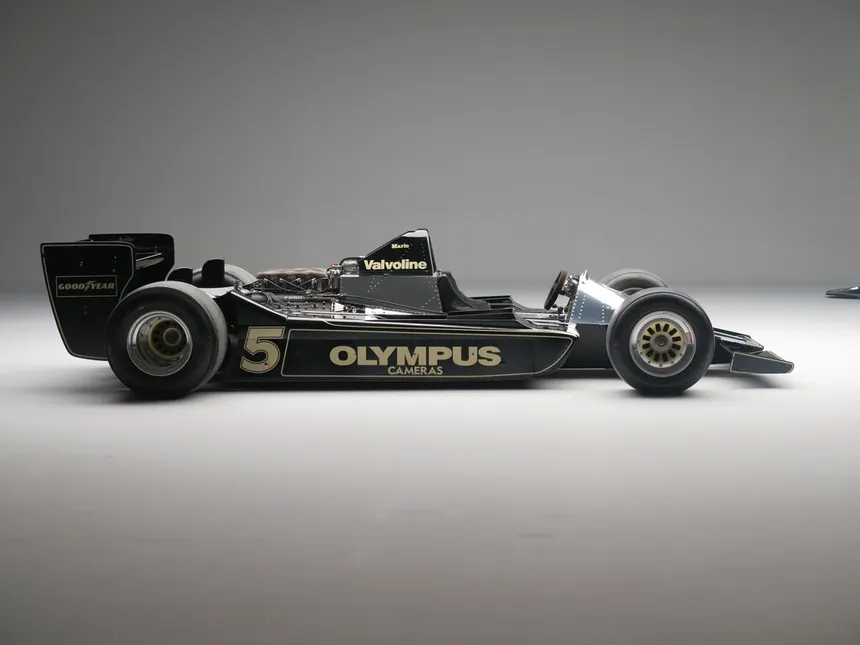
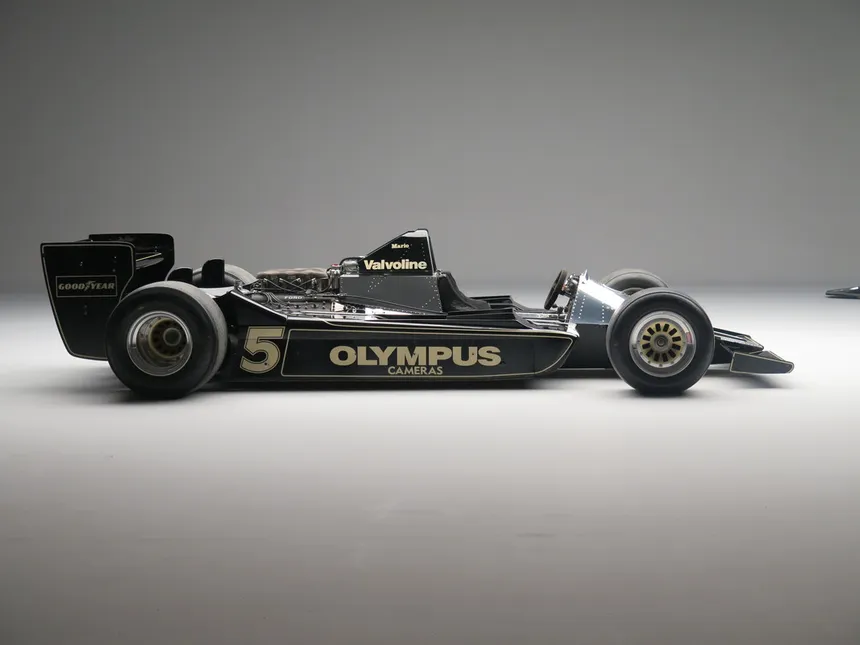
Chapman’s most radical contribution came late. The 1977 Lotus 78 and its refined successor, the 1978 Lotus 79, developed with Peter Wright, Tony Rudd, and Ralph Bellamy, turned the entire car into an inverted wing.
Plainly stated: an aircraft wing generates lift because air over its curved face speeds up and loses pressure. Flip the profile upside down and put it under the car, in the sidepods, and the air rushing through that tunnel accelerates, pressure drops, and the car is sucked onto the pavement. Seal the sides with sliding skirts and the effect holds. It is free downforce, without the enormous wings that scrub speed on the straights.
Mario Andretti, born in Italy, raised in Nazareth, Pennsylvania, and still the most versatile driver America has produced, won the 1978 title in the 79 and described driving it as being on rails. He is the last American-born Formula 1 World Champion.
The principle never died. The 2022 Formula 1 regulations were written specifically to bring back the ground effect Chapman invented in the 1970s.
The Lotus 88: the car that never raced
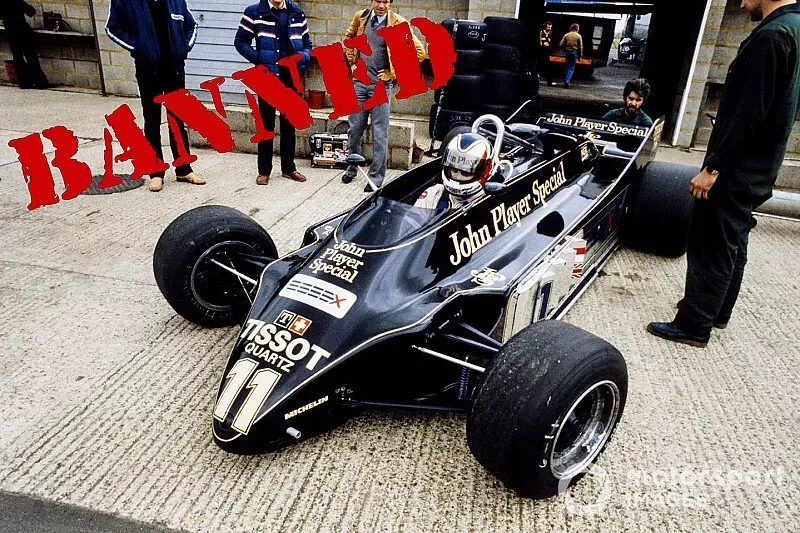
In 1981 FISA banned sliding skirts and imposed a minimum ride height to slow the ground effect cars, which were physically punishing drivers. Chapman answered with the Lotus 88, designed with Peter Wright, Tony Rudd, and Martin Ogilvie.
The 88 ran two chassis, one inside the other. The inner one carried the driver and engine on soft, human suspension. The outer one, the bodywork with the sidepods, had its own stiff suspension and sank as speed rose, generating the suction the rules were trying to kill. On paper it obeyed the letter of the regulation and ignored its intent entirely.
Its monocoque was carbon fiber. The 88 appeared in first practice at Long Beach in March 1981 and was, by a few weeks, the first carbon chassis to show up at a Grand Prix, ahead of the McLaren MP4/1 that debuted in Argentina.
It never raced. Rival teams protested that the twin chassis was a movable aerodynamic device, FISA agreed, and the revised 88B was rejected again at Silverstone. Chapman fought every hearing and lost every one. Peter Wright later said that was the point at which the most creative designer of his era stopped wanting to be in Formula 1. Chapman turned to light aircraft. A year later he was dead.
Road cars, and then DeLorean
While all this happened on track, Lotus sold road cars, and the doctrine carried over unchanged.
The 1962 Elan is the important one for American readers, because you have almost certainly driven its grandchild. It used a steel backbone chassis, an X-shaped spine running down the center of the car carrying the suspension at each end, with a fiberglass body dropped over the top. The spine does the structural work, the body does none, and the whole thing weighed around 1,500 pounds. Mazda has openly acknowledged studying the Elan when developing the original MX-5 Miata, which is to say that the best-selling roadster in history is a Norfolk idea from 1962 executed properly in Hiroshima in 1989.
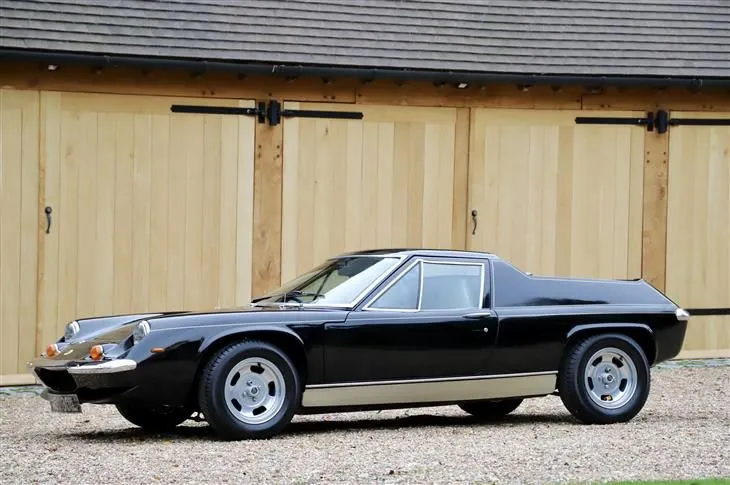
The 1966 Europa took the mid-engine layout, until then the preserve of racing prototypes, and put it into an affordable road car with genuinely efficient aerodynamics for the period. It looked strange enough that Americans mostly ignored it. It was also years ahead of anything Detroit was thinking about.
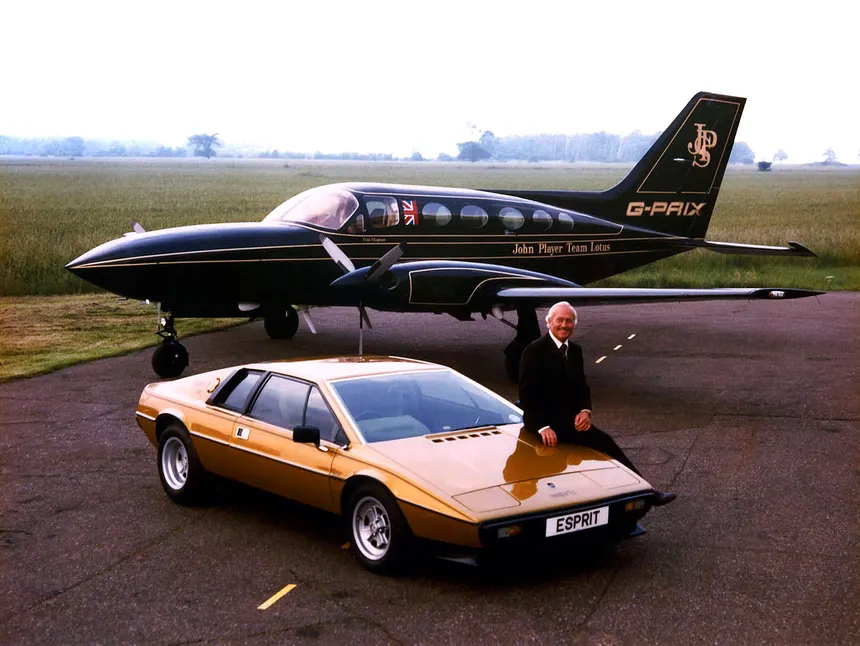
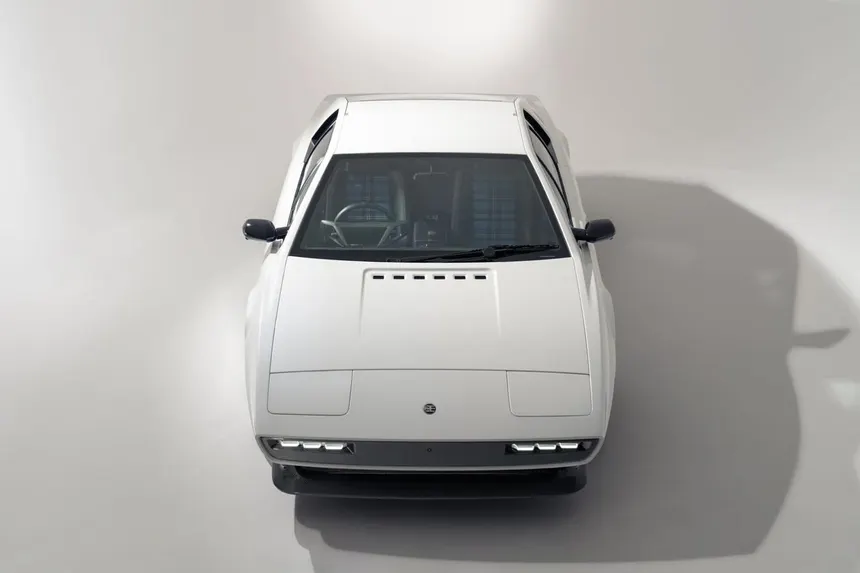
The 1976 Esprit, drawn by Giorgetto Giugiaro, is where Lotus entered American pop culture. It turned into a submarine in The Spy Who Loved Me in 1977 and for a generation of moviegoers that wedge was the entire brand. Under the folded-paper bodywork it stayed doctrinaire: light, mid-engined, four cylinders for most of its life, and eventually a twin-turbo V8 in the final cars. The Esprit ran for more than two decades on a shape drawn in a single year.
Then came the part Americans know best without knowing Lotus was in it.
In the late 1970s the British government put tens of millions of pounds of public money behind John DeLorean to build a factory at Dunmurry, near Belfast, and create jobs in a devastated region. Lotus handled the engineering of the DMC-12, the car that became a time machine in Back to the Future.
Somewhere between $17.5 and $18 million of that money, depending on the source, ended up in a Panama-registered, Geneva-operated entity called General Product Development Services, ostensibly paying for Lotus services. It never reappeared. The split alleged during the investigation, and it should be read as allegation rather than proven fact, was roughly half to DeLorean, 45 percent to Chapman, and 5 percent to Lotus finance director Fred Bushell.
DeLorean was acquitted in Detroit in 1986. Chapman had died of a heart attack on December 16, 1982, at 54, before facing any court. In 1992, at Belfast Crown Court, Lord Justice Murray sentenced Bushell, who pleaded guilty, and stated that Chapman had carried out a barefaced, outrageous, and massive fraud and would have gone to prison for ten years had he lived. Bushell got three. He never said where the money went.
Artioli: the Italian who bought Lotus and gave it a soul back
After Chapman, Lotus became an asset. British Car Auctions, then General Motors. In August 1993, GM sold it for £30 million to Romano Artioli, the Italian who had resurrected Bugatti at Campogalliano with the EB110 and was burning his fortune doing it.
Buying a struggling British brand on top of that looked reckless, and it was. But Artioli did what GM hadn’t done in eight years of ownership: he let Hethel design an actual Lotus.
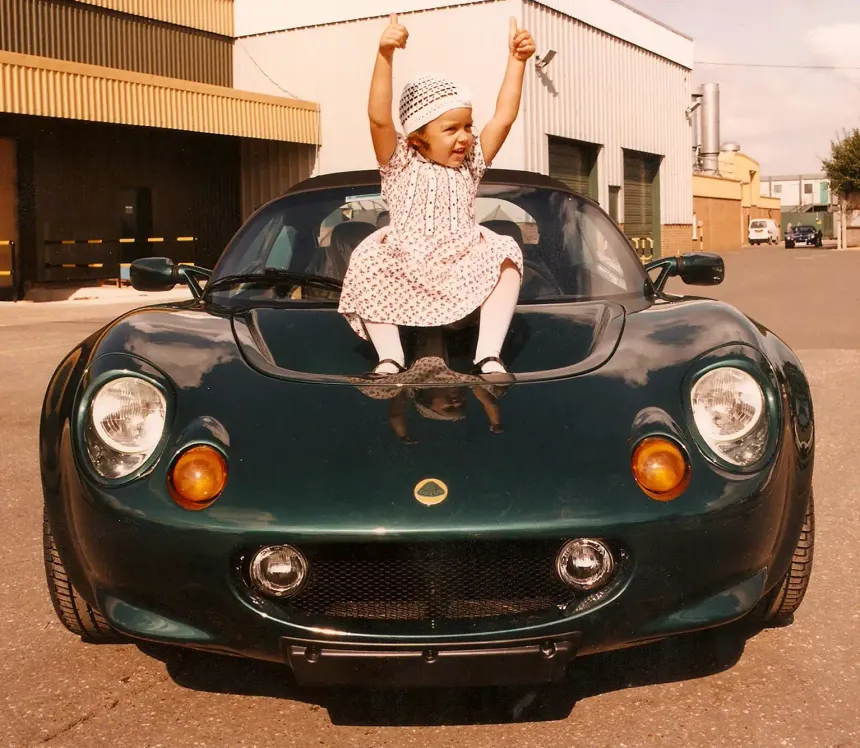
That became the Elise, shown at Frankfurt in September 1995 and in production from 1996. The chassis is the story: extruded aluminum sections bonded with structural adhesive instead of welded, a technique Danish firm Hydro Aluminium was developing and that Lotus took into a production car for the first time. Welding aluminum forces you to thicken the material at the joints. Bonding doesn’t. The bare tub weighed 67 kilos, about 148 pounds. The whole car weighed 1,598 pounds, with a 118-horsepower Rover K-Series 1.8 that was enough for 0-60 mph in 5.8 seconds.
The irony nobody puts in a press release: in September 1995, the same month Lotus unveiled the car that would save it, Bugatti Automobili S.p.A. was declared bankrupt. Artioli had to sell his majority stake in Lotus to Malaysia’s Proton at the end of 1996 to cover the Italian hole. He stayed on as special projects director until 1998. Around 12,000 Series 1 Elises were sold between 1996 and 2001, more than any previous Lotus road car, and every Lotus since has used a version of that structure.
Geely, tariffs, and a brand arguing with its own gospel
Proton, through DRB-HICOM, kept Lotus alive until 2017, stretching the Elise platform into the Exige and Evora. Geely bought 51 percent that year. On August 21, 2026, Lotus Technology completed the acquisition of 100 percent of Lotus UK, putting Hethel and the Lotus Engineering consultancy under the same management as the electric programs.
The American chapter has gone badly. Lotus posted a $313 million operating loss in the first half of 2025. A 25 percent US tariff on imported vehicles introduced in March 2025 made exports from Britain unviable until it was negotiated down to 10 percent. One of the brand’s electric SUVs still isn’t sold in America at all.
The Focus 2030 plan walks the electric-only promise back. The revised Emira gets a 3.0-liter turbocharged hybrid V6 from Horse, the 50:50 venture between Geely and Renault: 536 horsepower, 516 lb-ft, and a 160-kilo engine that its maker claims is about 10 kilos lighter than any comparable V6. A hybrid V8 supercar with over 1,000 horsepower, internally the Type 135 and widely expected to revive the Esprit name, is promised for 2028 and would be assembled at Hethel, where the company says it has invested more than £1 billion.
So the brand that made weight the enemy is being rescued by an engine co-developed with Renault, fitted to a car that weighs twice what the Elise did, and the lightness claim in the press release is ten kilos. That cuts two ways. Lotus still talks about engine mass, which almost nobody else does. And the bar has dropped so far that bragging about lightness now means beating a rival by ten kilos, when the founder would have asked why there are six cylinders in there at all.
Chapman built a company on the idea that weight is the enemy and horsepower is the expensive excuse of people who can’t design. He won seven Constructors’ and six Drivers’ Championships with it, invented the monocoque, brought sponsorship into the sport, made the engine structural, and worked out how to glue a car to the ground with air. He also destroyed two cars at Montjuïc rather than reinforce a strut, and moved public money meant for Belfast jobs into a Panamanian shell.
All of that is one man, and all of it is Lotus. A company that spends its life trying to get back to a place it should never have left, with different hands on the wheel every decade: a British engineer, a bankrupt Italian, a Malaysian conglomerate, a Chinese group. Seventy-eight years on, the question is the same one, and none of them has fully answered it: how much weight are you willing to take out.
Check you’re still alive.
12 thoughts on “LOTUS”