
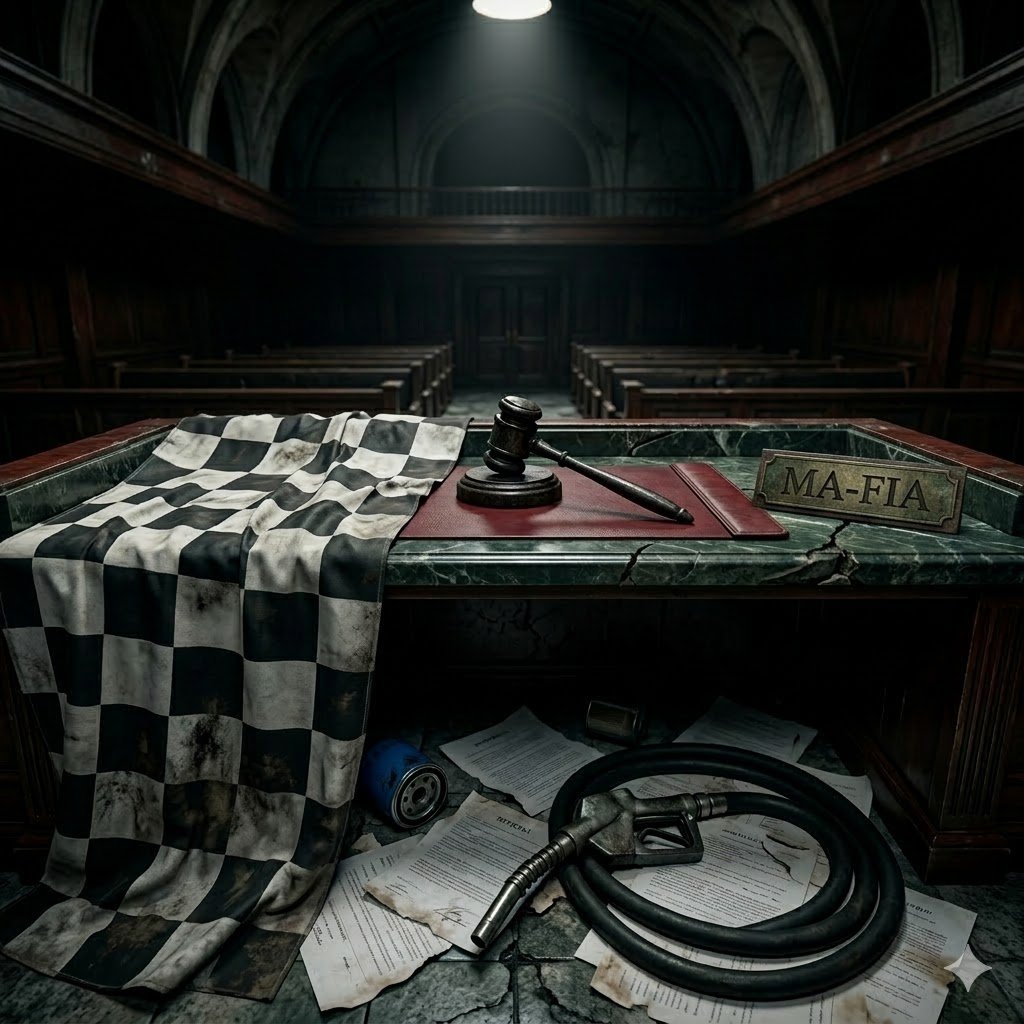
MA-FIA: How the FIA Is Destroying the Very Sport It Claims to Protect

They sell you sustainability while cashing cheques from the world’s biggest oil company. They promise governance while gutting their own ethics committees. They talk about sport while blocking anyone who won’t pay the toll. And when you ask where your money goes, they tell you it’s none of your business.
This is not an opinion piece. It’s a case file. Every single claim you’re about to read is backed by official FIA investigations, court rulings, published reports, freedom-of-information documents, or public statements from the people involved. If you still believe the FIA exists to protect motorsport after reading this, you either didn’t understand it or you’re part of the problem.
Welcome to the MA-FIA file.
This Is Not Just About Formula 1
First things first. The FIA isn’t just Formula 1. The Fédération Internationale de l’Automobile governs everything: F1, WRC, WEC, Formula E, rallycross, GT racing, karting, regional championships, circuit licensing, car homologation, driver licensing. From the kid starting out in karts to the 24 Hours of Le Mans, through your local rally championship. Everything runs through their hands.
And those hands have been dirty for quite some time — and not with engine grease.
When we talk about the FIA, we’re not discussing a problem that only affects 20 millionaire drivers going round in circles on Sundays. We’re talking about an organisation that shapes the very existence of competitive motorsport worldwide. Its regulatory decisions affect the privateer trying to homologate a rally car, the driver who needs a licence, the small team attempting to compete without factory backing. The entire ecosystem depends on a body that, as we’re about to see, operates more like a private members’ club than a sports regulator.
Let’s get into it.
The Case File: Count by Count
1. Abu Dhabi 2021 — Rules Broken, Result Stands
Lewis Hamilton was leading the Abu Dhabi Grand Prix and the world championship. Five laps from the end, Latifi crashed, safety car deployed. Then race director Michael Masi did something unprecedented: he allowed only the five lapped cars between Hamilton and Verstappen to unlap themselves (the regulations require all of them), and withdrew the safety car without completing the mandatory additional lap. One final lap. Verstappen on fresh softs. Hamilton on worn hards. Championship gone.
The FIA itself admitted it in its March 2022 report: Masi “contravened F1 regulations” and there was “human error.” But in the same report, they declared the result “valid, final, and cannot now be changed.”
Read that again. The FIA says: yes, we broke our own rules, but the championship stays as it is. That’s not an error. That’s a message: the rules apply when it suits us.
Masi was sacked. Nobody else was held accountable.
2. The Secret Ferrari Deal — Neither Legal Nor Illegal, Just Confidential
2019 season. Ferrari’s cars were half a second faster than anyone on the straights. Half a second. Rival teams suspected they were manipulating fuel flow to bypass FIA sensors. The FIA investigated for months.
In February 2020, they dropped a bombshell: they had reached a “private settlement” with Ferrari. Terms confidential. Ferrari would “assist the FIA in regulatory duties and research into carbon emissions and sustainable fuels.” No sanction, no explanation, no detail. Nothing.
Seven teams — every single one not powered by Ferrari — issued an unprecedented joint statement declaring themselves “surprised and shocked” and threatening legal action. The FIA eventually admitted it had doubts about the legality of Ferrari’s power unit but couldn’t prove it in a tribunal.
The detail everyone forgets? The FIA president at the time was Jean Todt. Former Ferrari team principal. His son Nicolas was Charles Leclerc’s manager. And Ferrari still collects an annual “historical bonus” from the F1 prize fund that no other team receives.
2020 season: Ferrari came out with a dramatically slower car. The FIA introduced a second fuel flow sensor. The magic performance of 2019 vanished as if it had never existed. But nobody officially knows what Ferrari did. It’s a private agreement. Like family business.
3. Spygate and Crashgate — One Rule for Some, Another for Others, and a Cover-Up
Spygate, 2007. A disgruntled Ferrari employee leaked nearly 800 pages of confidential technical documents to a McLaren engineer. It was discovered because the engineer’s wife took the documents to a copy shop, and the clerk turned out to be a Ferrari fan. Surreal, but true.
McLaren: expelled from the constructors’ championship and fined $100 million — the largest sporting fine in history at that point.
Renault: the FIA discovered they also had confidential McLaren information. Chassis dimensions, fuel system, hydraulics, a novel suspension component… Penalty: none. “No evidence they used it.”
Same offence. Two completely different outcomes.
Crashgate, 2008. Renault boss Flavio Briatore and engineering director Pat Symonds ordered Nelson Piquet Jr. to deliberately crash at the Singapore Grand Prix to trigger the safety car and hand Fernando Alonso the advantage. Not a theory — Piquet confessed to the FIA in 2009 after being fired.
But here’s what makes it truly damning. Years later, Bernie Ecclestone — F1’s supreme authority — admitted that both he and FIA president Max Mosley knew about the deliberate crash shortly after Singapore. They did nothing. Felipe Massa lost the 2008 championship by a single point. Had the FIA acted when they knew the truth, Massa would be world champion. He’s now pursuing a £64 million lawsuit in UK courts.
4. Red Bull and the Cost Cap — Breaking the Rules on the Cheap
2021: Red Bull won the world championship (in Abu Dhabi — you know how) and it turns out they also breached the budget cap. The FIA confirmed an overspend of £1.86 million — 1.6% above the limit.
Penalty: a $7 million fine (which didn’t count against the following year’s cap, so zero operational impact) and a 10% reduction in aerodynamic testing for 12 months. Ferrari boss Fred Vasseur estimated the aero penalty at roughly a tenth of a second per lap. Red Bull dominated the first three races of 2023 without breaking a sweat.
If breaching the financial rules in the most contested year of the decade costs you pocket-change and a slap that doesn’t even sting, the message is crystal clear: if you can afford it, do it. The rules are suggestions for those with the budget.
5. The Andretti Case — A Private Club with 10 Members
2023: Andretti Global, backed by General Motors and Cadillac, applied to enter F1 as an eleventh team. The FIA assessed the application, confirmed it met every criterion, and approved it.
But Formula One Management (FOM), Liberty Media’s commercial arm, rejected the bid. Official reason: an eleventh team “would not add value to the championship.” The real reason everyone in the paddock knows: one more team means splitting the pie eleven ways instead of ten.
The backlash was fierce. Twelve US congressmen wrote to Liberty Media questioning whether the rejection violated the Sherman Antitrust Act. Mario Andretti, 1978 world champion, said he was “devastated.”
The door only opened when Michael Andretti stepped aside and General Motors took direct control. The team was accepted as “Cadillac.” The Andretti name vanished from FOM’s press release. The message wasn’t subtle: the problem was never the project — it was the person who wouldn’t kneel.
The Great Green Swindle: Preaching Sustainability, Cashing Aramco’s Cheques
Let’s get one thing straight from the start: we’re not here to demonise oil. The internal combustion engine is one of the greatest inventions in human history, and motorsport exists because of it. We have zero problem with an oil company sponsoring racing. We’ve said it before and we’ll keep saying it.
The problem isn’t Aramco. The problem is the monumental hypocrisy of those who cash Aramco’s cheques while selling you a green narrative they use to gut the spectacle.
F1 tells you its goal is Net Zero by 2030. 100% sustainable fuels by 2026. Very pretty on the PowerPoint. And meanwhile, who’s paying for the party? Saudi Aramco. The world’s largest oil company. 9 million barrels of crude per day. Over 59 billion tonnes of CO₂ emitted since 1965. Global sponsor of F1 with a deal reportedly worth around €42 million per year plus €60 million for every race including a Saudi Grand Prix.
If your sustainability commitment were real, you wouldn’t be cashing cheques from the biggest barrel-pumper on the planet. And if you’re cashing those cheques, don’t dress up in green to justify regulations that strangle the show. Pick a lane.
But it goes beyond cynicism. Documents obtained by investigative journalism unit SourceMaterial through freedom-of-information laws reveal that F1 has used its access to European politicians to lobby Brussels against the planned 2035 ban on combustion engines, promoting Aramco’s e-fuels to the European Commission. In September 2023, F1 wrote to the office of Frans Timmermans, then EU vice-president and climate action commissioner, arguing that the ban was “a huge one-way bet on a relatively new technology.”
F1 wasn’t affected by that legislation. Its cars were exempt. So why was it lobbying against it? As one analyst told SourceMaterial: “If you remove Saudi Aramco and put Formula 1 in its place, you’re removing from sight who is actually benefiting from this lobbying.”
Aramco isn’t even registered as a lobbyist in the EU. F1 is. F1 hired the same PR agency as Aramco — Boldt — to manage its contacts with EU lawmakers. It organised events inside the European Parliament with MEPs who later backed pro-e-fuel amendments.
This isn’t sports sponsorship. This is using motorsport as a Trojan horse for the geopolitical interests of the Saudi monarchy. While selling fans that “the future is green” to justify engines that sound like vacuum cleaners and regulations that gut the competition.
And the FIA, the body supposedly governing all of this, says nothing. Because the FIA is also pushing Aramco’s “sustainable fuels” in F2, F3, and across its regulatory roadmap. The fox guarding the henhouse.
Regulations That Are Killing the Sport — And the Spectacle
The FIA’s damage isn’t just political and financial. They’re destroying motorsport from within through regulations that have gutted the spectacle, priced out the grassroots, and emptied the grids.
They’ve stolen the races you fell in love with. Remember refuelling? Cars diving into the pits flat out, mechanics wrestling with fuel rigs, two- and three-stop strategies that could flip an entire race in 7 seconds. Real tension. Real risk. Real failures. That was competition. The FIA banned it in 2010 “for safety.” Now you get 50-lap processions where whoever comes out first from the single pit stop wins the race.
Remember the sound? F1’s V10s tore through the air at 19,000 rpm. They gave you goosebumps. They made you feel something. They swapped them for V6 turbo hybrids that sound like an industrial hoover. “Energy efficiency,” they told you. The same energy efficiency sponsored by an oil company pumping 9 million barrels a day.
Remember when mistakes had consequences? When you ran wide, there was gravel, and the gravel punished you. Now there are kilometres of tarmac run-off where you can sail off, lose nothing, rejoin, and carry on. Zero drama. Zero cost for getting it wrong. Safety matters, absolutely — but when you turn a racing circuit into a car park with painted lines, you strip out the very reason the spectator was watching.
And then they tell you it’s all for safety and the environment. While scheduling 24 races a year, shipping thousands of tonnes of air freight between continents, and signing contracts with countries where human rights are a theoretical concept. Safety and sustainability are the excuse. Money is the motive.
WRC: one million euros per car and shrinking entries. The FIA openly admitted that Rally1 car costs ballooned to nearly €1 million — far above the original target. The hybrid systems imposed in 2022, sold as the future of rallying, have been scrapped before completing their five-year homologation cycle. Teams that invested millions in hybrid technology are left holding the bill with nothing to show for it. M-Sport has sold just one Rally1 car. Top-tier WRC entries have dropped below 10. Volkswagen left after the diesel scandal, Citroën pulled out in 2019, and the FIA hasn’t attracted a single new manufacturer to Rally1 in its entire lifecycle.
The new WRC27 regulations, capped at €345,000 per car, are a belated admission of failure — though the FIA presents them as “forward-thinking vision.” If your regulations kill the category and then you replace them with cheaper ones, you’re not a visionary: you’re a firefighter putting out the blaze you started.
The disappearing privateer. Motorsport was always a sport where the bloke from your town with a workshop and enough passion could go racing. Today, between FIA licences, homologations, super licences costing €6.2 million collectively for F1 drivers in 2025, and regulations that change every few years forcing complete reinvestment, the ecosystem has become a theme park for billionaires.
While the small teams vanish, calendars balloon to bursting point — 24 F1 races, events in countries with zero motorsport tradition but plenty of petrodollars — and ticket prices reach levels that lock out the working-class fan who built this sport in the first place.
The Ben Sulayem Era: When Chaos Becomes the System
Mohammed Ben Sulayem became FIA president in December 2021. What’s happened since reads like a catalogue of institutional dysfunction.
Mass exodus. CEO Natalie Robyn left after raising governance concerns. F1 race director Niels Wittich was dismissed without explanation. Women’s commission chief Deborah Mayer said she was fired by text message. Vice-president Robert Reid resigned citing a “breakdown in governance standards,” declaring he could not “in good conscience remain part of a system that does not reflect those values.” The compliance officer, audit committee chair, sporting director, technical director… the list goes on.
Gag orders. In February 2024, the FIA demanded all attendees at a World Motor Sport Council meeting sign an NDA. Reid and David Richards, chairman of Motorsport UK, refused. They were barred from entering.
Dismantling oversight. In December 2024, the FIA proposed: stripping the ethics committee of its power to investigate, ensuring any investigation into the president is reported to the president himself, and removing the audit committee’s authority to approve accounts. Translation: the person under investigation controls their own investigation, and the watchdogs lose their teeth.
“None of your business.” When F1 drivers, through the GPDA, asked for transparency on where fine money goes (€270,000 in 2024 alone), Ben Sulayem responded that how the FIA spent its money was not the drivers’ concern. The maximum fine had been unilaterally raised from €250,000 to €1,000,000 without consultation. GPDA director George Russell had been asking for three years without receiving an auditable answer.
A “non-profit” organisation with $205 million in operating income in 2024 that refuses to tell its own participants how it spends the money it charges them. Nothing suspicious at all.
The Pattern
These are not isolated incidents. These are not management mistakes. This is a system.
A body that publicly acknowledges it broke its own rules in a world championship and doesn’t correct the result. That signs secret deals with teams suspected of technical illegality when the president is the former boss of that team. That applies $100 million fines to one and lets another walk for the same offence. That knew a race was fixed and stayed silent. That punishes budget cap breaches with fines paid from petty cash. That blocks new entrants to protect the existing members’ revenue share. That cashes cheques from the world’s biggest oil company while selling you sustainability — then uses that green excuse to ban refuelling, silence the engines, and turn circuits into car parks. That lobbies Brussels against climate legislation while promoting its Saudi sponsor’s e-fuels. That imposes regulations that blow up costs, empty grids, and push out the privateer. That fires executives by text message, guts ethics committees, demands NDAs to enter meetings, and tells anyone asking for transparency that it’s none of their concern.
That’s not a governing body. That’s a private club operating by cartel rules.
Still wondering why we call them the MA-FIA?
Every claim in this article is backed by official FIA investigations, published reports, statements from those involved, documents obtained through freedom-of-information laws, court filings, and reporting from SourceMaterial, Euronews, Motorsport.com, RaceFans, The Race, ESPN, Sky Sports, BBC, Motor Sport Magazine, ABC News, and Heatmap News.
Check you’re still alive.
15 thoughts on “MA-FIA”