Horse W40 V8
The V8 in Lotus’s next supercar wasn’t designed in Maranello, Sant’Agata or Woking. It comes from a company founded in 2024 out of what used to be the engine divisions of Renault and Geely, a company that until this year built mostly three-cylinders, four-cylinders and range extenders. It’s called the Horse W40. It has four liters, two turbos and more than 670 horsepower, and its maker says it works just as well in a supercar as in a pickup truck. For American readers, that second part may matter as much as the first.
Horse
Horse Powertrain Limited was formally set up on May 31, 2024, with headquarters in London. Renault and Geely each put their engine and transmission businesses into it: on one side Horse, Renault’s former combustion powertrain division, and on the other Aurobay, Geely’s equivalent. Saudi oil giant Aramco later bought in with 10 percent, leaving Renault with 45 percent, Geely with 45 percent and Aramco with 10. Aramco’s deal valued the company at €7.4 billion.
It’s a huge business most drivers have never heard of, because it doesn’t sell cars. From day one its customers were Renault, Geely, Volvo, Proton, Nissan and Mitsubishi, and its latest release counts 18 plants across Europe, China and the Americas. A good chunk of that network is old Renault industry, including a gearbox plant in Seville, Spain, that opened in 1966 and became part of Horse on July 1, 2023. Horse hasn’t said where the W40 will be built.
Until very recently, the most eye-catching item in the catalog was a two-liter four-cylinder called the B20, sealed so that Geely’s Galaxy Cruiser 700 off-roader can float. Nothing about that suggested a supercar engine was coming.
W30
The W40 didn’t come out of nowhere. In April 2026, ahead of the Beijing Auto Show, Horse revealed its first V6, the W30: three liters, 350 to 400 kW (roughly 470 to 536 hp), 443 to 516 lb-ft of torque, an 8,000 rpm ceiling and a weight of 353 pounds, which Horse says is 22 pounds less than the next-lightest V6 on the market. It was designed from the start to work alongside electric motors. Lotus CEO Feng Qingfeng told the British magazine Autocar that the W30 will power an evolution of the Emira that drops its current Toyota and Mercedes-AMG engines, an update Autocar places after 2030.
The key detail is where the W30 comes from. Horse CEO Matias Giannini explained that the V6 is derived from the company’s four-cylinders and that the same technology would serve as the basis for a V8. That’s the logic of a modular engine family: technology shared across engines with different cylinder counts. Horse hasn’t detailed exactly what the W30 and W40 share, whether bore and stroke, cylinder head design or production lines. But the starting idea is to spread development costs across several engines, which is what lets a volume engine maker step into territory usually reserved for luxury brands.
Four liters
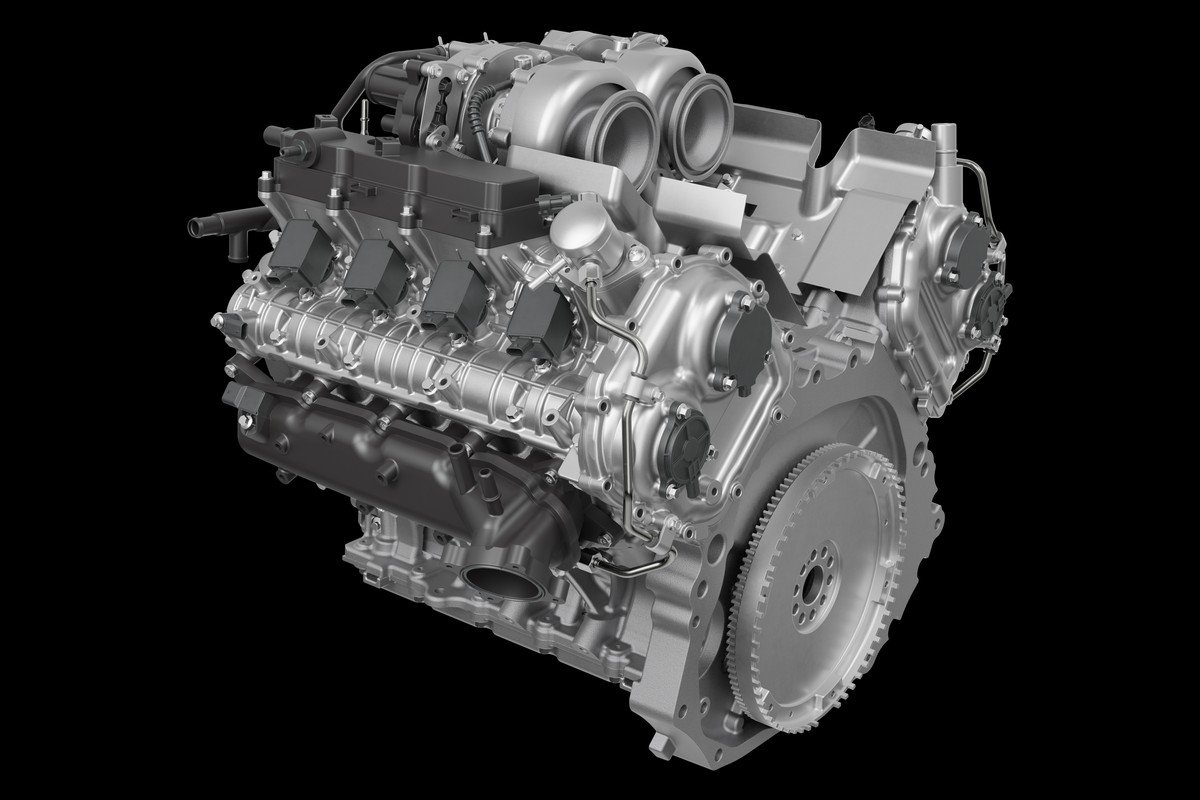
The W40 was unveiled in London on November 10, 2026. It’s a four-liter, eight-cylinder V engine with gasoline direct injection, designed to be mounted longitudinally, meaning the crankshaft runs front to back along the car, the way mid-engine supercars and front-engine, rear-drive cars carry theirs. Horse rates it at more than 500 kW, which works out to more than 670 hp, with 590 lb-ft of torque and a weight of 441 pounds. It hasn’t published a redline.
Kilowatts are the official unit of power in most of the world; one kilowatt equals about 1.34 horsepower, hence the conversion. Torque is the twisting force the engine puts on the crankshaft: it’s what you feel when you step on the gas at low rpm and what shoves the car out of a corner. At just over 670 hp from four liters, the W40 makes around 168 hp per liter, a high-performance number, but not a record.
Horse keeps calling it a “hybrid-first” engine, built from day one to work with electric motors rather than adapted later. In practice, that means the V8’s own output is only part of the math. Lotus has already said the Type 135, the supercar that will debut it in 2028, will top 1,000 hp once the electric side is added.
Hot-V
The W40’s most interesting feature is where the turbos sit. In a conventional V8, the intake manifolds, the plumbing that feeds air to the cylinders, sit in the valley of the V, and the exhaust manifolds exit on the outside. The W40 flips that around: the exhausts point into the valley and both turbos sit on top, between the two cylinder banks. The intake ends up on the outside. It’s called a “hot-V” layout because the hot side of the engine is concentrated in the middle.
A turbocharger is a turbine spun by exhaust gas, connected to a compressor that crams air into the engine. The shorter the path from the cylinders to the turbine, the less energy the exhaust loses along the way and the sooner the turbo starts making boost. That delay between stepping on the gas and feeling the shove is what everyone calls turbo lag. With the turbos inside the V, the exhaust path is as short as it gets, the engine is more compact, and Horse also mentions a shorter intake path. On top of that, the intake sits on the outside, away from the exhaust. That helps, but it isn’t enough on its own to guarantee cool air reaching the cylinder: the final charge temperature depends mostly on how much the compressor heats the air by squeezing it and how much heat the intercooler, the radiator that cools it before it enters the engine, pulls back out. Temperature matters because hot intake air encourages detonation, also called knock, which is when part of the unburned mixture ignites on its own after the spark has fired instead of waiting for the flame front to reach it. If combustion starts before the spark even fires, that’s pre-ignition. Either one can wreck an engine.
The idea isn’t new. Ferrari used it in Formula 1 in the early eighties, and the first production engine with the turbos inside the V was BMW’s N63 V8, which debuted in the 2008 X6 with about 400 hp. Mercedes-AMG followed with the AMG GT, Ferrari with the 296’s V6 and Lamborghini with the Temerario’s V8.
The downside is well documented too. Packing two red-hot turbos into the center of the engine makes cooling much harder, and BMW’s N63 went down in history for its failures and recalls. Horse hasn’t yet explained how the W40 handles the heat, and that’s the most interesting technical question the launch leaves open.
8LDCT
The engine comes with a new gearbox, the Horse 8LDCT: eight speeds, dual clutch, built to work as a hybrid transmission. A dual-clutch gearbox works like two manual transmissions in one. One clutch handles the odd gears, the other the even ones. While you’re in third, fourth is already engaged on the other shaft, waiting; a shift just means releasing one clutch and closing the other at the same time. That’s why there’s no interruption in drive. Horse quotes a shift response of under 20 milliseconds, without specifying whether that figure covers the complete maneuver.

The clutches are wet, meaning their plates run in an oil bath that cools them and lets them handle far more heat and torque than a dry clutch. Horse also quotes a pre-fill time of under 50 milliseconds: that’s how long it takes to fill the hydraulic chamber that actuates the incoming clutch, so it’s ready to act instantly. The control electronics use silicon carbide, a semiconductor material that handles higher voltages and temperatures than ordinary silicon and wastes less energy, and the oil pump is variable-displacement, so it doesn’t burn power moving more oil than needed.
The number that matters most is another one: the 8LDCT accepts up to 774 lb-ft of torque at its input. The V8 makes 590, so when the gas engine is delivering all its torque, there’s 184 lb-ft of headroom left at that input. How much electric torque can actually pass through the gearbox depends on where the electric motor is connected, at what ratio and whether its peaks coincide with the V8’s, and Horse hasn’t detailed any of that. After what happened with the 1996 Lotus Esprit V8, whose engine was held to 350 hp because its Renault gearbox couldn’t take more, a transmission developed alongside the engine with more capacity than the engine needs is the best news in the whole announcement.
Rivals
Horse pitches the W40 as one of the most power-dense V8s on the market, meaning one of those that makes the most power per pound of engine. Rival numbers help put it in context.
The V8 in the Lamborghini Temerario, known internally as the L411, displaces 3,995 cc, also has its turbos inside the V, makes 789 hp between 9,000 and 9,750 rpm, revs to 10,000 and delivers 538 lb-ft. That’s about 197 hp per liter, well above the W40, which answers with more torque. The McLaren 750S uses the M840T, a twin-turbo four-liter with a flat-plane crank that makes 740 hp and the same 590 lb-ft as the Horse. McLaren doesn’t list the engine’s weight on the 750S spec sheet, so a power-per-pound comparison with the W40 can’t be made from official data. And even if it could, manufacturers don’t always weigh their engines with the same accessories or fluids. For Mercedes-AMG’s M177, another twin-turbo four-liter with a hot-V layout, the trade press quotes 461 pounds, a figure that doesn’t come from any official Mercedes-AMG spec sheet.
What can be said is that the W40 plays in the same league as the V8s from the supercar brands without being the most extreme in power per liter. What it offers, according to Horse, is a lot of torque low in the rev range for a modest weight. Neither Horse nor Lotus has said what it costs.
Pickups
In its launch release, Horse says the W40’s low-end torque and peak power make it ideal for sports cars, pickup trucks and off-road vehicles. Say “V8 pickup” in the United States and nobody needs a diagram. That sentence helps explain the project. Developing a brand-new V8 for a few thousand supercars a year is a luxury very few companies can afford. A V8 that could also go into a pickup or a big off-roader from any of Horse’s customers could spread that cost across far more units. For now, the only confirmed customer is Lotus. Detroit is paying attention to the parent companies, too: Ford has recently signed separate partnerships with both Renault and Geely, though Horse hasn’t named Ford as a customer for this engine.
Lotus is first in line because it’s family: Geely has controlled the brand for nearly a decade, and the Type 135 needed a V8 after Lotus backed away from making it all-electric. Lotus has said the Type 135 will be built in Europe and is due in 2028. Separately, the company has reorganized Hethel, its Norfolk plant, as a flexible production site, but the W40 announcement doesn’t say which factory will build the car.
For Lotus, buying an engine from outside is nothing new. The Esprit was born with an in-house four-cylinder, but the brand spent years using Toyota and Mercedes-AMG engines, and its last homegrown V8 was the Type 918 in the Esprit, which went out of production in 2004. The difference now is that the supplier belongs to the same group and the engine arrives paired with its own gearbox.
What I take from the W40 is that the most interesting engine of the year comes from a volume engine maker that reached a V8 by starting from a modular base born in its four-cylinders. If that holds up, it will have something many exotic V8s have always lacked: an economic reason to exist. With more than 670 hp, 590 lb-ft and 441 pounds, it doesn’t need invented records to sell it. And if it really ends up in a pickup as well as a Lotus, it will have pulled off something very few supercar engines ever manage: paying for itself. What’s still missing is how it sounds when it fires up, because a V8 is also judged by its voice, and Horse hasn’t let anyone hear it yet.
Check you’re still alive.
Photos: Horse Powertrain.