Renault 5 Turbo 2: The French City Car That Humiliated Supercars in the World Rally Championship

In 1976, a Renault engineer named Jean Terramorsi had an idea that made no practical sense. He took the Renault 5 — the best-selling car in France, the car of mothers, students, and pensioners — and proposed ripping out the front engine, moving it behind the driver, bolting on a turbocharger, and sending it to win rallies against Lancia, Audi, and Porsche.
Nobody told him no.
And that was the most brilliant decision Renault made in the entire 1980s.
The Renault 5 Turbo was not a natural evolution. It was not a facelift with more power. It was a complete reinvention of an urban runabout, rebuilt from the ground up into a mid-engined, rear-wheel-drive competition weapon. And its road-going version, the Turbo 2, became the car that democratised that madness for anyone with the courage — and the money — to buy one.
This is the full story. Unfiltered. Data-backed.
Project 822: Born in Dieppe
The project that would give rise to the Renault 5 Turbo received the internal code 822. Renault lacked the infrastructure to produce such a radical car in its conventional factories. The solution was obvious: Alpine. The Alpine factory in Dieppe, Normandy, already had experience with limited-production sports cars — the Alpine A110, the A310 — and had been integrated into the Renault group since 1973.
Dieppe became the birthplace of the Renault 5 Turbo. Every unit was assembled there, by hand, in a process that transformed a standard Renault 5 monocoque into something entirely different.
The prototype debuted at the Paris Motor Show in 1978. The reaction was immediate. Nobody expected Renault, the manufacturer of the Renault 4 and the Renault 16, to produce something like this. Two years later, in 1980, the production car was a reality.
Turbo 1 (1980–1982): The Artisan
The first version, known simply as the Renault 5 Turbo or Turbo 1, was a handcrafted machine in the purest sense:
- Engine: 1,397 cc inline-4 (Cléon-Fonte block), Garrett T3 turbocharger
- Power: 158 bhp at 6,000 rpm
- Torque: 155 lb-ft at 3,250 rpm
- Weight: Approximately 970 kg (2,138 lbs)
- Drivetrain: Rear-wheel drive
- 0–62 mph: 6.9 seconds
- Top speed: 130 mph
- Transmission: 5-speed manual
The Cléon-Fonte engine was a cast-iron block that Renault had been using since the 1960s. A taxi engine. An engine that powered the Renault 4, Renault 8, and Renault 12. Renault took that block, bolted on a Garrett T3 turbocharger, an intercooler, Bosch K-Jetronic injection, and extracted 160 horsepower from 1.4 litres. In 1980, those were serious numbers.
But the truly radical element was not the engine. It was where it sat.
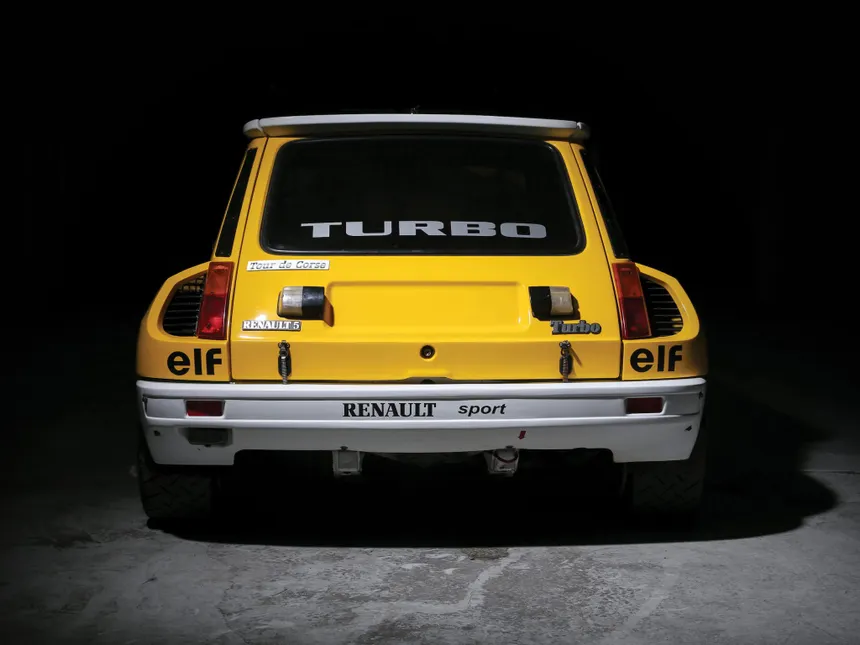
The Cléon-Fonte was mounted in a mid-rear position, longitudinally, directly behind the driver and passenger seats. To make room, every trace of the original Renault 5’s rear seat and boot was eliminated. The rear section of the monocoque was completely modified.
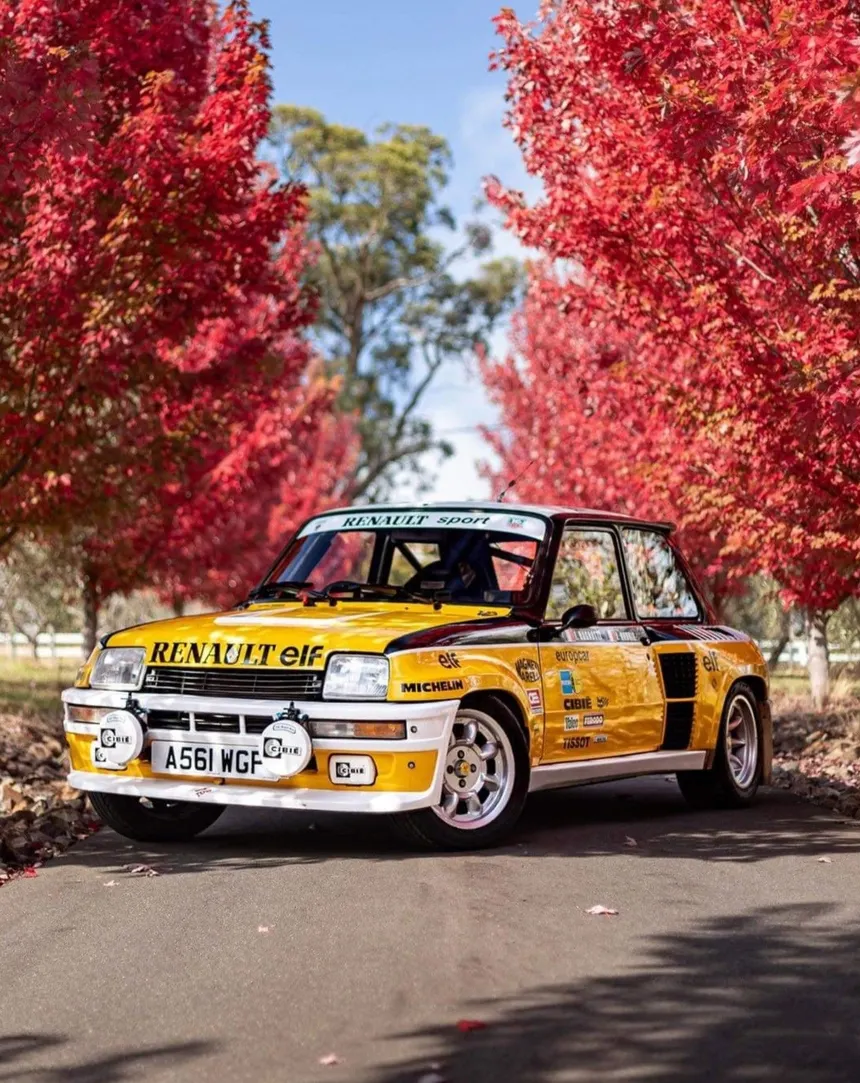
The exterior was the work of Marc Deschamps at the Bertone design studio. The massively widened arches were necessary to cover the track width of a car that now had competition running gear instead of a city car’s axles. The lateral air intakes, the rear grilles, the wide wheels: everything screamed that this car had nothing in common with the Renault 5 in the supermarket car park.
The Turbo 1’s interior was equally radical. The standard Renault 5 dashboard was replaced entirely by a bespoke design with satellite instrument pods — gauges grouped in independent modules — that shared not a single part with the production car. It was a competition car interior adapted for the road.
Approximately 1,820 Turbo 1 units were built between 1980 and 1982. Each cost significantly more than a standard Renault 5. Production at Dieppe was slow, manual, and deliberately limited.
The Beast in the Stages: Ragnotti and Monte Carlo
But the Renault 5 Turbo was not created for cruising the Côte d’Azur. It was created to win rallies. And it did so from the outset.
In January 1981, Jean Ragnotti and co-driver Jean-Marc Andrié entered the Monte Carlo Rally with a Group 4 Renault 5 Turbo. And they won. In its first year of serious competition, the little French Renault defeated the armada of Audis, Fiats, and Opels in one of the most prestigious rallies on the world calendar.
Ragnotti became synonymous with the Renault 5 Turbo. His driving style — aggressive, spectacular, with impossible drifts on mountain roads — was the perfect extension of a car that invited oversteer. With the engine behind and rear-wheel drive, the R5 Turbo slid with a naturalness that made it look as though the car had been designed specifically to travel sideways.
And in a sense, it had been.
Beyond Monte Carlo, the Renault 5 Turbo accumulated victories in the Tour de Corse, where its agility and relative power on the twisting roads of Corsica made it virtually unbeatable. The Tour de Corse became Renault territory during the early 1980s.
Turbo 2 (1983–1986): Democratising the Madness
In 1983, Renault introduced the Turbo 2, a revised version with a clear objective: reduce costs to expand production and facilitate homologation in additional competition categories.
The changes from the Turbo 1 were significant:
- Power: 162 bhp at 6,000 rpm (marginally more than the Turbo 1)
- Torque: 159 lb-ft at 3,250 rpm
- Weight: Approximately 920 kg (2,028 lbs)
- Body: Galvanised steel and plastic panels instead of the Turbo 1’s aluminium
- Interior: Standard Renault 5 Alpine/Copa Turbo dashboard instead of the exclusive Turbo 1 design
- 0–62 mph: 6.7 seconds
- Top speed: 134 mph
The key to the Turbo 2 was simplification. The Turbo 1 used aluminium body panels for the doors, bonnet, and several exterior elements, making it light but expensive to produce. The Turbo 2 replaced those panels with galvanised steel and plastic components, reducing production costs without significantly compromising weight — in fact, the Turbo 2 was actually slightly lighter than the Turbo 1 thanks to the simplified interior.
The most visible change was inside. The artisanal dashboard of the Turbo 1, with its satellite instruments, was gone. In its place, the Turbo 2 fitted a conventional dashboard derived from the Renault 5 Alpine/Copa Turbo: cheaper but less special. For purists, this was an unacceptable loss. For Renault, it was the difference between producing 1,800 cars and producing over 3,000.
Approximately 3,167 Turbo 2 units were built between 1983 and 1986. Combined with Turbo 1 production, the total output of mid-engined Renault 5 Turbos reached around 5,000 units.
The European Turbo Cup: Competition for Everyone
One of the lesser-known legacies of the Renault 5 Turbo was the European Turbo Cup, a one-make racing series that Renault organised to provide a competitive outlet for Turbo 2 owners. The cup allowed semi-professional drivers and fast amateurs to compete with near-standard cars, minimally prepared for circuit use.
These races were held as support events for major motorsport weekends at circuits across Europe. The grid was composed of Turbo 2s with homologated preparations: roll cages, competition seats, harnesses, and little else. The engine was maintained in near-standard specification.
The result was an accessible and fierce spectacle. The cup Turbo 2s were agile cars, with the mid-engine layout providing natural rotation through corners. Races were compact, with full grids and constant battles. For many European drivers in the 1980s, the Turbo Cup was their first taste of motorsport competition. For spectators, it was proof that the Turbo 2 was not merely a rally car — it was a versatile competition platform.
Turbo 1 vs. Turbo 2: The Eternal Debate
The Renault 5 Turbo ownership and collector community has been divided between Turbo 1 and Turbo 2 for decades. The debate has solid arguments on both sides.
Turbo 1 advocates point to its exclusive interior, aluminium panels, and more limited production. It is the original car, the one unveiled in Paris, the one with more artisanal character. Each Turbo 1 feels like a unique piece, hand-built with noble materials and a level of detail that was not repeated in the Turbo 2.
Turbo 2 defenders argue that the simplified car is actually more faithful to the project’s spirit. Terramorsi wanted an accessible competition car, not a luxury object. The Turbo 2, lighter, more direct, with fewer pretensions of comfort, best represents the original philosophy: a racing weapon with road registration. Furthermore, its greater production numbers facilitated its presence in competition, which was the project’s fundamental objective.
Who is right? Probably both. The Turbo 1 is the artisanal masterpiece. The Turbo 2 is the racing car with a number plate. They are two interpretations of the same radical concept, and both deserve their place in history.
The Maxi 5 Turbo: Group B Evolution
The madness did not end with the road-going Turbo 2. In 1985, Renault unveiled the Maxi 5 Turbo, the Group B evolution for the World Rally Championship. The Maxi represented the absolute extreme of the concept:
- 1.4-litre turbo engine pushed to approximately 350 bhp
- Weight stripped to the minimum
- Revised aerodynamics with wings and body extensions
- Long-travel competition suspension
The Maxi 5 Turbo was the uncompromised version, the car Terramorsi had envisioned from the beginning. But Group B’s fate was sealed. Following the tragic accidents at the Rally of Portugal and the Tour de Corse in 1986, the FIA abolished Group B. The Maxi 5 Turbo never had the chance to demonstrate its full potential over a complete championship.
160 bhp From a Taxi Engine: The Turbo Magic
To understand what 160 bhp meant in 1980, context is essential. A Porsche 911 SC of the same era produced 180 bhp from a 3.0-litre flat-six. A BMW 323i, considered a sporting benchmark, developed 143 bhp from 2.3 naturally aspirated litres.
Renault was extracting 160 bhp from 1,397 cubic centimetres. An engine that in standard, non-turbo configuration produced around 63 bhp in the Renault 5 GTL. Forced induction multiplied the specific output to levels that naturally aspirated engines of the period could only dream of: 114 bhp per litre.
And this was the road version — the tame one, the one that had to pass its MOT and run on any petrol station’s fuel. Competition versions exceeded 250 bhp in Group 4 trim and reached 350 bhp in Maxi Group B specification.
A taxi engine converted into a weapon of war.
The Renault Philosophy: The City Car as Competition Platform
What Renault did with the R5 Turbo set a precedent that the brand would repeat two decades later with the Clio V6. The philosophy was identical: take the most recognisable car in your range, the one everyone knows, and transform it into something nobody expects.
The Renault 5 was France’s best-selling car. It was harmless. It was friendly. It was the people’s car. Turning it into a mid-engined, turbocharged, rear-wheel-drive missile was not merely an engineering decision: it was a declaration of war against the perception that Renault only knew how to build practical, boring cars.
This philosophy was directly inherited by the Clio Williams, the Clio V6, and, to some extent, the entire subsequent Renault Sport range. But none of them were as radical as the original R5 Turbo. None started from such a low point — an urban runabout — to reach such heights — an international rally winner.
The Cléon-Fonte Block Legacy
The Cléon-Fonte engine deserves its own section. This cast-iron block, designed in the early 1960s, was one of the most enduring and versatile engines in French automotive history. It powered everything from the Renault 4 and Renault 8 to the Renault Express and, in its turbocharged form, the R5 Turbo.
The Cléon-Fonte’s robustness was the foundation that enabled aggressive forced induction. It was an over-engineered block for its original displacement, with thick cylinder walls and a solid construction that tolerated boost pressures that would have destroyed lighter, more modern blocks. It was not sophisticated. It did not have four valves per cylinder. It had no variable valve timing. It was iron, steel, and cast metal. And it worked.
That mechanical brutality is an essential part of the R5 Turbo’s character. Turbo lag was real and pronounced: during the initial portion of the throttle travel, the car barely responded. Then, suddenly, the Garrett T3 came alive and all the power arrived at once. There was no smoothness, no progressiveness. It was all or nothing. On or off.
This behaviour, which any modern engineer would consider an unacceptable defect, is precisely what made the R5 Turbo so addictive to drive. The arrival of boost was an event. Every time the T3 spooled fully, you felt the car come alive.
Current Market: An Investment on Four Wheels
The Renault 5 Turbo has become one of the most valuable French classic cars on the market. The Turbo 1 models, scarcer and with their artisanal interior, are the most coveted pieces. Well-documented examples in original condition have exceeded €150,000 at auction, with exceptional specimens approaching €200,000.
Turbo 2 models, more numerous and with their simplified interior, trade below those figures, but the trend is clearly upward. A Turbo 2 in good condition typically moves between €80,000 and €120,000, figures unthinkable a decade ago.
For a car based on a Renault 5, these valuations are definitive proof that the classic market recognises engineering, history, and scarcity above the badge.
What the R5 Turbo 2 Represents
The Renault 5 Turbo and its Turbo 2 variant represent something the modern automotive industry has forgotten: that audacity sells cars, and that a city car can become a legend if someone with sufficient vision decides it should.
Jean Terramorsi proposed an absurd idea. Renault approved it. Alpine built it. Ragnotti drove it to victory. And thousands of owners drove it across European roads, with the turbo blowing behind their heads and a grin that would not fit on their faces.
160 bhp. 1,397 cubic centimetres. A Garrett T3 turbocharger. Rear-wheel drive. Mid-engine. Under a thousand kilograms.
All packaged inside what, from the outside, still looked like a Renault 5.
That contrast between appearance and reality, between what was expected and what was delivered, is the essence of the R5 Turbo.
It was not a supercar. It never pretended to be.
It was something better: a people’s car that refused to be ordinary.
Now check you are still alive.