
Volvo 480 Turbo Coupe: The Swedish Heresy America Never Got

Here’s the cruelest joke in this car’s whole life: it was designed, top to bottom, for America. The pop-up headlights, the impact bumpers, half the decisions baked into it were made to charm the United States. And America never got it. Not one Volvo 480 was officially sold there.
Say “Volvo” in 1986 and everyone pictured the same thing: a brick. A boxy sedan or wagon shaped like a shoebox, indestructible, safe, dull as a wet Sunday afternoon. The car of the cautious architect, the high-school teacher, the person who’d rather arrive alive than arrive early. And then Volvo built this. A low coupe with taut lines, front-wheel drive, a French engine and headlights that hid inside the nose. Everything a Volvo was not supposed to be. More than a few people in Gothenburg must have taken it as a betrayal. And yet the 480 Turbo is one of the most fascinating Volvos ever made, precisely because it dared to break all the rules.
A Volvo that renounced Volvo
To measure how radical the 480 was, you have to understand where Volvo came from. The Swedish brand had built its reputation on three pillars: solidity, safety and rear-wheel drive. Its cars drove the rear wheels, as tradition demanded, and wore a cubic look that was almost a moral statement: you don’t come here to show off, you come here to survive.
The 480, shown to the press in 1985 and on sale from 1986, threw that rulebook in the bin. It was the first front-wheel-drive Volvo in history, meaning the first in which the engine drove the front wheels rather than the rear. And it was the only Volvo ever, before or since, to wear pop-up headlights, the kind that stay hidden and rise only when you switch them on. For the brand of the safe brick, that was close to a provocation.
It wasn’t even fully Swedish. The car was born at Volvo’s Dutch subsidiary and built in Born, in the southern Netherlands, in the old DAF factory. The design came out of a contest: proposals from Bertone’s styling center and from three in-house designers, Jan Wilsgaard, Rolf Malmgren and John de Vries. Wilsgaard was the man who had drawn Volvos for decades, the father of the Amazon and the 140, the guy who defined the brick. He lost. De Vries’s ideas won, and what came out looked like nothing Volvo had built before. That was exactly the point.
Headlights that hid an aerodynamic trick
The 480’s pop-up headlights weren’t a designer’s attention-seeking whim. They were born of a law. Volvo conceived the 480 with the American market foremost in mind, and the United States had strict rules on the minimum height at which headlights had to sit. A low, aerodynamic coupe like the 480 couldn’t meet them with fixed lights without wrecking its line. The solution? Hide them. When you don’t need them they lie flat, the nose stays clean and low, and when you switch them on they rise to the height the law demands.
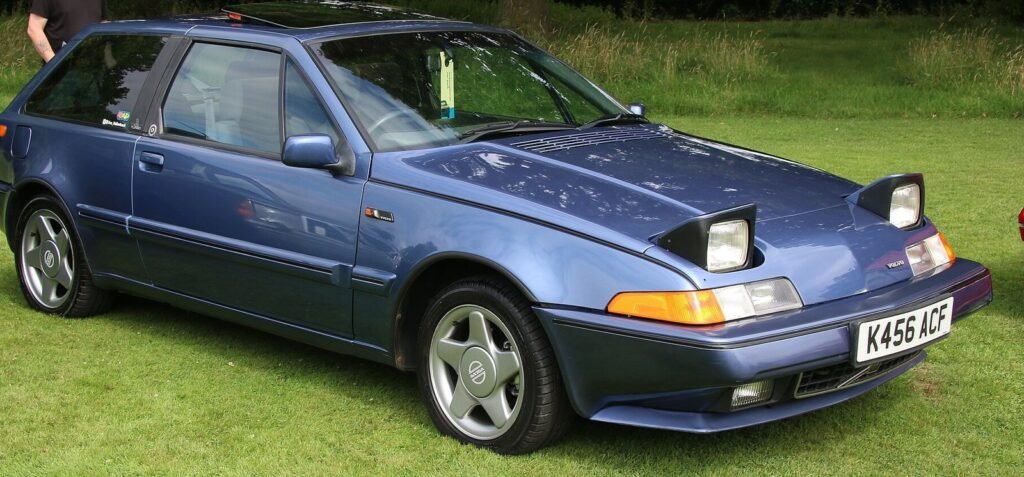
And here’s the technical detail many people miss. Those headlights weren’t just a styling trick: they genuinely changed the car’s aerodynamic behavior. With the lights down, the 480 had a drag coefficient of 0.34. That figure measures the resistance the car offers to the air: the lower it is, the better it slips through and the less effort it wastes shoving the wind aside. But the moment you raised the lights, those two vertical blocks broke up the airflow and the figure rose to 0.385. In other words, the 480 was literally more aerodynamic, and therefore more efficient, with its lights off than on. Driving at night cost you a toll in the form of drag.
French mechanicals in a Swede
If the front-wheel drive and the headlights already broke the mold, what sat under the hood finished off the heresy. The 480 didn’t carry a Volvo engine. It carried an engine of Renault origin, from the family of blocks known as the F-Type, the fruit of cooperation between the two brands. A Volvo with French mechanicals underneath, another of those industrial crossovers people don’t see coming, mated to a five-speed manual gearbox.
The version that interests us, the Turbo, arrived in 1988 with the B18FT engine code. It took the naturally aspirated 1,721cc engine and added a Garrett turbocharger with an intercooler, managed by Bosch LH-Jetronic injection. Let’s explain what each part does. The turbo is a turbine that uses the exhaust gases, which would otherwise be lost down the pipe, to spin a compressor that forces more pressurised air into the engine; more air lets you burn more fuel, and that gives more power without making the engine bigger. The intercooler is the radiator that cools that compressed air before it goes in: cold air is denser, more of it fits in the cylinder and it makes more power. And the boost wasn’t fixed. According to Volvo’s 1988 technical press kit, a mechanical wastegate was set to open at just 0.28 bar, and above it an electronic control unit let the pressure climb to suit conditions, and cut it if anything went out of bounds. The turbo itself was small, barely two inches across, and water-cooled: built to spool early, not to brag about peak boost.
The result? 120 horsepower (122 PS) at 5,400 rpm and 175 Nm of torque, the shove that pins you to the seat. And here’s the beauty of this engine: that torque didn’t arrive right at the top but from barely 1,800 rpm, staying flat all the way to 4,600. That, more than the raw figure, explains its response: the car pulled early and steadily, without forcing you to wring out the gears. They aren’t otherworldly numbers, and they weren’t on paper. But here’s the 480’s ace: Volvo quoted a curb weight of 1,040 kg (2,293 lb). The yardstick of the day was the 1988 Volkswagen Golf GTI 16V, good for 139 PS and 208 km/h by VW’s own figures. On paper the Volvo lost, and nobody in Gothenburg pretended otherwise. But with that weight and all that low-down torque, those 120 horses genuinely shoved: Spain’s Autopista magazine got 202 km/h (126 mph) out of it, and the press of the day praised how eagerly it answered the throttle.
Lotus set how it moved
The low weight was no accident, and neither was the way it drove. For a car this light to behave well, Volvo turned to the best: it brought Lotus engineering into the chassis development, and the rear axle carried Lotus’s signature. The Hethel firm, as expert as any at keeping a car pinned to the road, helped shape how the 480 moved over the tarmac, with special attention to weight distribution. The front was a semi-MacPherson layout and the rear a rigid tubular axle with a Panhard rod and a Watt linkage, two mechanisms that keep the axle well located and stop it shifting sideways through corners.
Period road tests described an agile car that barely leaned in corners and steered with precision. And, very much in the Volvo spirit, without sacrificing comfort: the suspension soaked up bumps well. A coupe that really went sweetly, yet didn’t pummel your kidneys. Much of that composure came from the Lotus rear axle.
A car full of ideas ahead of its time
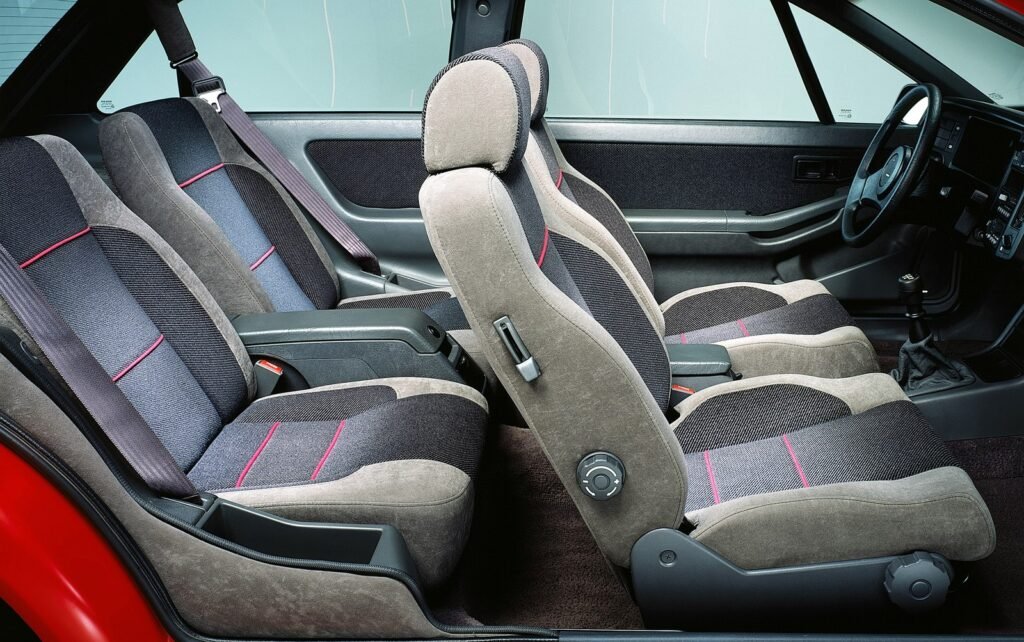
The 480 didn’t only break the mold mechanically. It was packed with details that ran ahead of their era. It had a fully electronic trip computer, the Info Centre, which on top of the fuel gauge gave you estimated range, instant mpg and average speed, something fairly new in a car this size. It had an illuminated driver’s door lock so you’d find the keyhole at night, and a rear wiper that switched itself on when you engaged reverse. And it carried one of Volvo’s earliest applications of what we now call “Follow Me Home,” the function that leaves the headlights on for about 30 seconds after you park and lock, lighting your way to the front door before switching off by themselves. Almost every car has it today; back then it was close to magic.
It also carried bumpers built to take a 5 mph hit, the NHTSA standard, with no damage to the engine, lights or safety equipment. Volvo boasted that it was one of the first cars sold in Europe to meet that American rule. Very Volvo, in the end: however heretical it was on the outside, the obsession with safety was still there underneath.
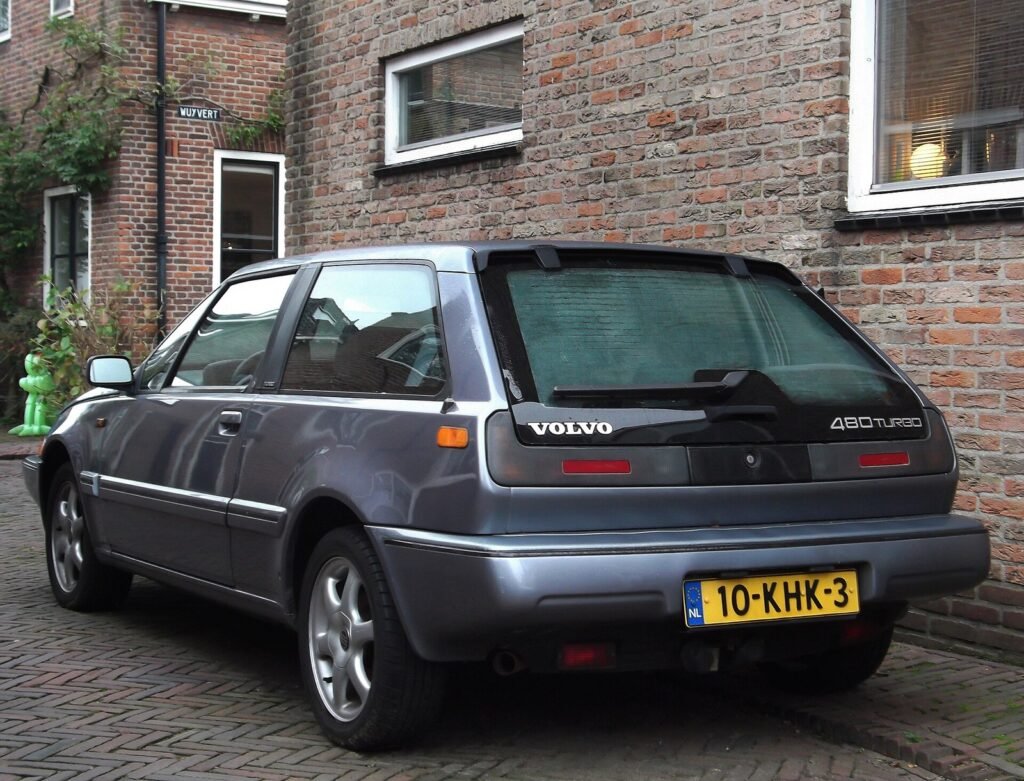
And its big frameless glass hatch recalled the one on the Volvo P1800 ES, the early-’70s shooting brake that Americans knew well. Nothing like it came out of Volvo in between, and after the 480 it took more than a decade to try the formula again, with the 2006 C30.
The car that was going to conquer America and never crossed the pond
Here’s the great irony of the 480. It was designed for the United States. The pop-up headlights, the impact bumpers, a good chunk of the car’s decisions were made to seduce the American market, where Volvo wanted to sell a sporty, youthful coupe. The launch was set for the fall of 1987, and Volvo expected to place around 25,000 cars there.
And then it all went wrong. The dollar collapsed against the European currencies and the US market turned unstable, so selling a European-built car there stopped adding up. On top of that came another snag: Volvo judged that the naturally aspirated 480 ES fell short on performance for American tastes. In February 1988, the brand postponed the launch indefinitely. The car conceived to conquer America was never sold in America. All that effort to meet its rules, the headlights that hid away, the reinforced bumpers, was left for a market that never received it.
The fault that hung a label on it
No rule-breaking car reaches the world without paying a price, and the 480 paid in reputation. The early cars dragged build-quality and electrical-reliability problems that did it real harm. A Dutch magazine went as far as nicknaming it the “coupe from hell” for the faults those first examples threw up. Britain’s Honest John classic-car guide lists the usual suspects: seals above the rear side windows that start to leak, a windshield that lets go along the top edge, and electrics that are “very hit and miss.” And that reputation, once stuck, is a devil to peel off.
The truth is that over the years Volvo kept refining the car, and the same guide admits almost all the problems were sorted out with the cars already in service. But the damage was done: the 480 always carried the label of a fragile car, an unfair stigma for the mature versions. Its owners, mind you, defend it with a passion few Volvos inspire.
The convertible that stayed in Geneva
The 480 lived through a string of projects that fell by the wayside. There was a convertible, announced to the press in the summer of 1987 and not seen in public until the 1990 Geneva Motor Show. It was due in early 1991. It never came: the supplier making the body parts went bankrupt, and doubts remained about the car’s safety in a rollover, something non-negotiable for Volvo. A few factory prototypes survive, how many depends on which source you read (two is the figure most often quoted), along with plenty of aftermarket conversions. There was even a targa roof, pitched by the American Sunroof Company of Detroit, that never got past the prototype stage either.

And there was also, back in 1986, an electric 480 prototype claiming around 120 km (75 miles) of range. It carried a 15.6 kWh nickel-cadmium battery weighing 300 kg where the rear seats should have been, a 42 hp motor, and it plugged into a household socket hidden behind the front license plate. Volvo never meant to sell it. Three decades before electric cars became the trend, the little Swedish heretic was already flirting with batteries.
76,375 heretics
Born turned out 76,375 cars of the whole 480 range between 1986 and September 7, 1995, and according to Motor1 a quarter of them were sold in Italy. Today it’s a rare sight, increasingly sought by those who understand what they’re looking at. Because the Volvo 480 Turbo is far more than an ’80s coupe with funny headlights. It’s the car with which an entire brand dared to question itself, to renounce everything that had made it famous in order to explore a new path.
It took a French engine, dropped it into a Dutch coupe with a Swedish soul, asked Lotus to make it dance, and dressed it in a nose designed for American laws that in the end served it for nothing. An improbable crossover of cultures and disciplines that shouldn’t have worked, and yet produced a car with character, light, agile and full of ideas the rest of the industry would take years to copy.
Richard Bremner put it in writing in Britain’s Car magazine: “Good grief, a Volvo worth preserving. And there aren’t many of them.” The 480 was the family’s black sheep, the one that rebelled, the one that refused to be a brick. There has never been another Volvo with hidden headlights.
Keep reading: Fiat S76 "Beast of Turin": the 28.5-Litre Monster Explained
Check you’re still alive.
Photos: Volvo Cars (Volvo press), kitmasterbloke (CC BY 2.0), Volvo Cars (Volvo press), Dennis Elzinga (CC BY 2.0), Herranderssvensson (CC BY-SA 3.0).