
ASTON MARTIN LAGONDA: THE DISASTER THAT INVENTED THE FUTURE
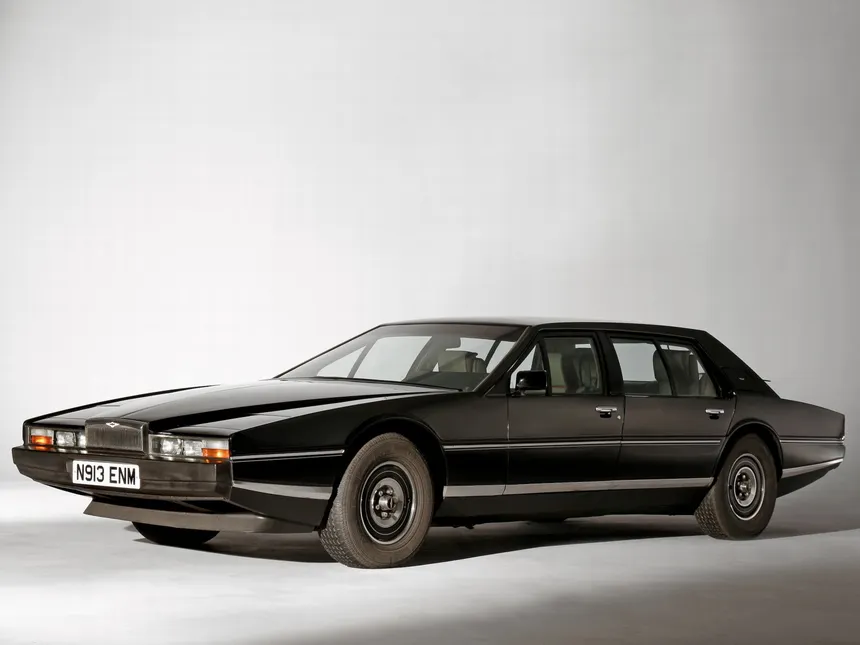
In the spring of 1978, during a press demonstration at Woburn Abbey, smoke began rising from the dashboard of a brand-new Aston Martin Lagonda. Executives had to push the car out of sight while journalists grinned and took notes. That single moment tells you everything about this car: it was the most advanced automobile in the world, and it didn’t work.
That is the thesis. The Aston Martin Lagonda was the first production car with fully digital instrumentation. The first with touch-sensitive controls instead of mechanical switches. The first that treated the dashboard as a screen rather than a clock face. It did this in 1976. It was built by a bankrupt company. It was designed by a man who later ended up making cars out of plywood. And the dashboard caught fire. It was an absolute disaster. And it was right about everything.
If your car has screens instead of dials today, thank this 5.1-metre monster that nobody could build properly.
Aston Martin built 645 of them between 1976 and 1990. Each one took 2,200 man-hours by hand. Maximum production rate: one per week. The electronics delayed deliveries by two full years. The price doubled before the first customer took possession. And it sold better in the Middle East than it ever did in Britain. This is not a success story. It is something more interesting than that.
Bankruptcy as a business plan
Aston Martin was dead in 1974. Shut down. Finished. A consortium of American, Canadian, and British businessmen bought it from the receiver for just over a million pounds. The plan: forget two-seat sports cars and take the fight to Rolls-Royce and Bentley with a four-door luxury saloon.
They tried the Series 1 first — seven units based on a stretched Aston Martin V8, designed by William Towns. They worked, but they were just a longer V8. Nothing to justify the price. So Towns was given a blank sheet.
Nine months. From first sketches to the prototype unveiled at the London Motor Show in October 1976, Mike Loasby’s engineering team took nine months. Aston Martin needed a media bomb to fill its coffers. It got one. Hundreds of deposits poured in. The problem: the prototype the BBC filmed gliding across the show floor was a non-runner. The footage of the Lagonda moving was the car coasting downhill under gravity.
The wedge: 5.1 metres of provocation
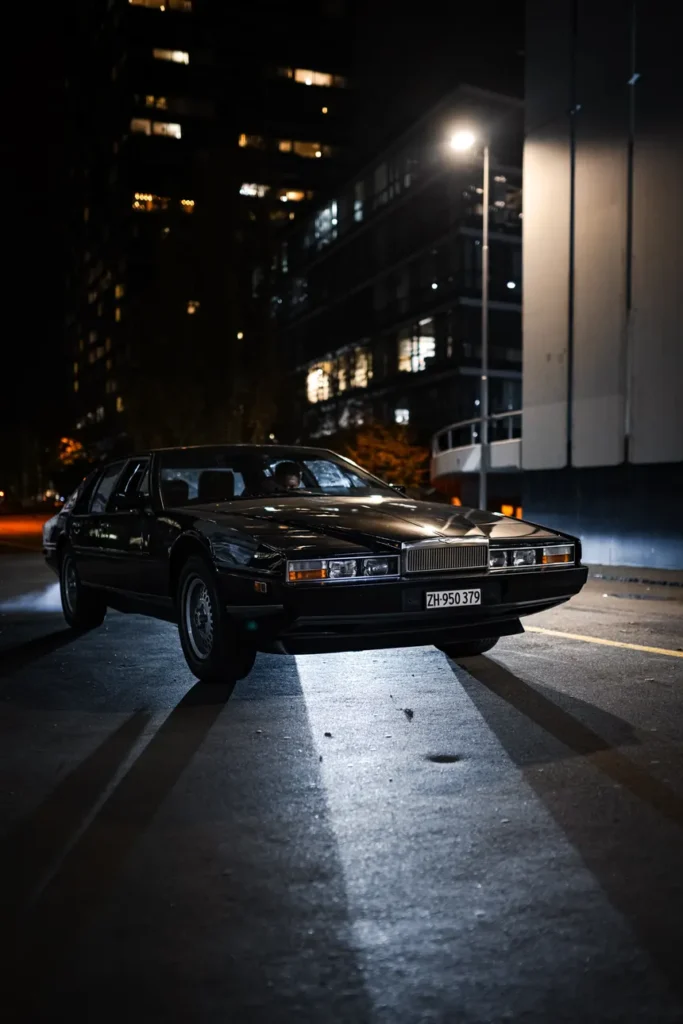
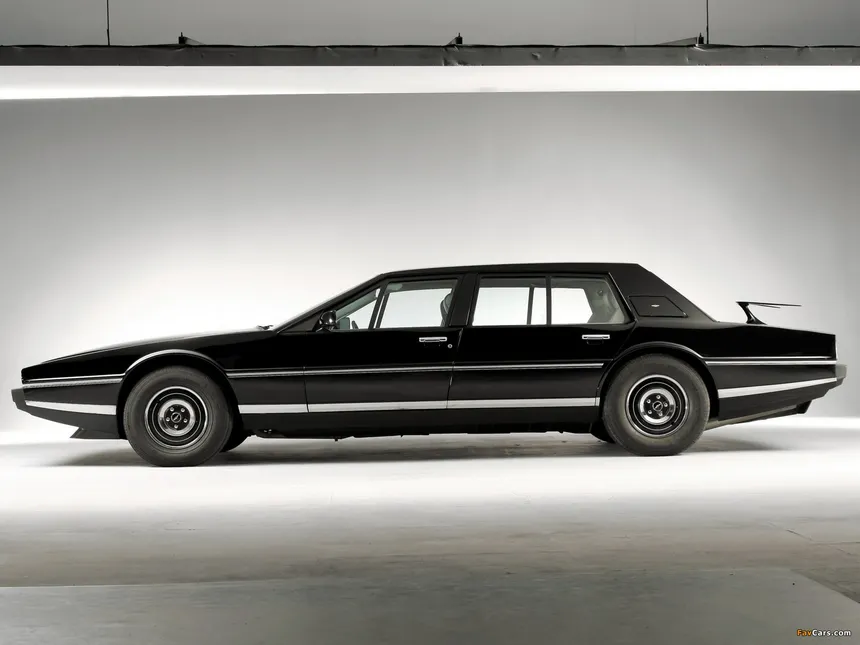
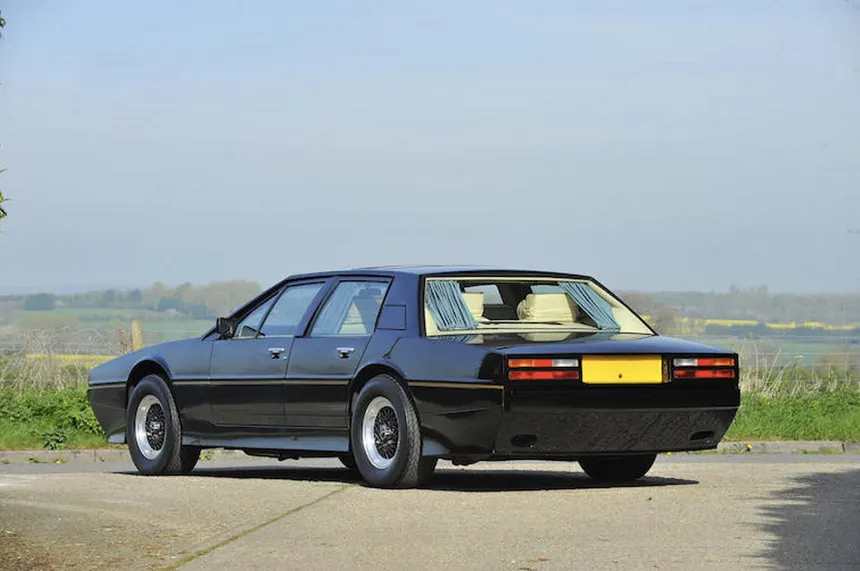
William Towns designed the Lagonda as a folded sheet of paper. The ultimate expression of 1970s wedge styling — but with four doors and genuine room for four adults. That is what nobody else did. The Countach was a wedge, yes. The Esprit was a wedge. The DeLorean was a wedge. But those were two-seaters or cramped 2+2s. The Lagonda packed that impossible silhouette into a full-sized executive saloon. 5.1 metres long. 1.82 metres wide. Just 1.30 metres tall. Occupants grazed the headliner with their hair. The boot held two overnight bags and an umbrella.
Pop-up headlights. Electrically heated glass panels concealing fog lamps and indicators. Rear lights that Towns would later reuse on the Bulldog concept and the V8 Vantage Zagato. Each car required 2,200 man-hours of hand assembly. Maximum output: one car per week. For the US market, roughly 25 units a year.
The dashboard that caught fire (three times over)
This is where the Lagonda becomes legend. Peter Sprague, one of the directors of the consortium that bought Aston Martin, was also chairman of National Semiconductor. He wanted the Lagonda to carry the most advanced interior on Earth. Over 40 touch-sensitive buttons. Zero mechanical switches. A single-spoke steering wheel to leave the full instrument display visible. Everything digital.
Development was entrusted to postgraduate students at the Cranfield Institute of Technology. Not industry engineers. Students. The result was a system weighing 180 pounds, connected by a 300-pair cable running from the instrument cluster to computer boxes hidden under the rear seats.
When that system caught fire at Woburn Abbey in 1978, Aston Martin scrambled. Sprague contacted the Javelina Corporation in Texas, specialists in electronics for the F-15 Eagle fighter jet. Brian Refoy, Javelina’s president, described the Cranfield system as “pretty much a nightmare.” His team scrapped everything and started from scratch. Within 45 days the car was road-testing. Within 90, Aston Martin was delivering cars to customers who’d waited up to two years.
Three generations of dashboard. First: LEDs, the Cranfield system, a fire hazard. Second: three CRT screens — actual televisions — developed by Javelina using F-15 technology. They displayed speed, fuel, and diagnostics with the flickering reliability of 1970s TV. They generated enough heat to warm a room. Third: vacuum fluorescent displays, the same technology found in VHS players and microwave ovens. That one mostly worked.
Lucas Electronics — known to the British press as “the Lords of Darkness” — supplied the components. Touch controls ignored human contact. Displays flickered without warning. Systems crashed mid-journey. All at Rolls-Royce money. A Rolls came with the quaint but desirable feature of actually working.
The V8 that made no apologies
Under that endless bonnet sat Aston Martin’s V8: 5,340cc, twin overhead cams per bank, four Weber carburettors in Series 2 form, producing 280 bhp. This was not an engine designed for a saloon. It was a grand-tourer powerplant hammered into a four-door body that weighed nearly two tonnes. Transmission: Chrysler TorqueFlite three-speed automatic. No manual option was ever offered — Aston Martin knew its clientele. Fuel economy: between 8 and 12 mpg, depending on whom you asked and how much they were willing to lie. The car carried a 25-gallon fuel tank and had two fuel doors — one on each C-pillar — feeding a single tank. Nobody has ever adequately explained why.
Independent front suspension with double wishbones, coil springs, and anti-roll bar. Rear: De Dion tube with Watts linkage and trailing arms. Power-assisted rack and pinion, two turns lock to lock. Four-wheel disc brakes. The car weighed nearly two tonnes. It moved like an ocean liner with a speedboat engine. Top speed: around 143 mph. Zero to 60 in 8.7 seconds. For a 1976 saloon, that was fast. For a £50,000 saloon, it was the minimum.
And there lies the contradiction that defined every mile of the Lagonda. The dashboard was from 2010. The engine was from 1969. The electronics were trying to invent the future while the V8 burned fuel as though oil were infinite. The Lagonda wasn’t a car ahead of its time. It was a car living in two eras simultaneously, belonging fully to neither.
The Middle East: where the Lagonda found its audience
There is a perfect irony here. A car designed to take on Rolls-Royce in the British market ended up selling most of its units in the Middle East. The sheikhs didn’t need reliability. They had chauffeurs and mechanics on retainer. What they needed was a car that looked like nothing else on Earth, and the Lagonda was precisely that. No Rolls-Royce Silver Shadow, however elegant, provoked the reaction that a 1.30-metre-tall wedge parked outside a hotel in Dubai provoked.
The order book filled from the Gulf. Aston Martin didn’t achieve US homologation for the Lagonda until 1982. By then, hundreds of units had already been delivered to the other side of the world, to clients who paid without blinking and didn’t complain when the dashboard switched itself off. The price, which had started at £50,000 in 1976, had doubled to over £100,000 by the time the first cars reached America — the equivalent of roughly $200,000 at the time. Rolls-Royce territory. But a Rolls always started.
The Series 3, introduced in 1986, brought Weber fuel injection to the V8 and VFD displays that finally worked with some dignity. But the real mechanical improvement was almost invisible: the same 5,340cc block, barely any change in fuel consumption. What did change was perception. By the mid-1980s, the Lagonda was no longer a promise of the future. It was a ten-year-old car that felt dated on the outside and too far ahead on the inside. A perfect temporal mismatch.
Tickford: the version nobody knows
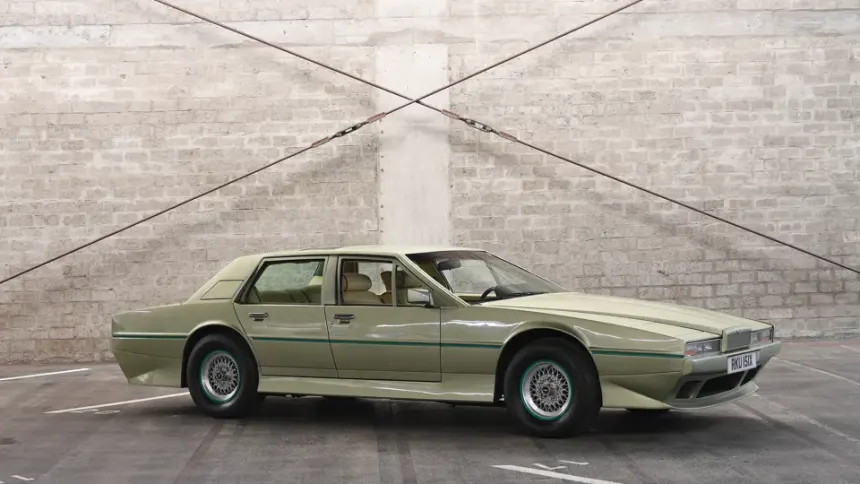
In 1983, Tickford — the group’s special engineering division — offered a conversion for five Series 2 Lagondas. Aluminium sports bodykit. 15-inch BBS wheels with Pirelli P7 tyres. Interior fitted with televisions front and rear, VHS player, fold-out picnic table, cocktail cabinet with crystal decanters engraved with the Tickford logo, and a car phone costing an additional £4,000 in 1980s money. Total price: £85,000. Roughly £250,000 in today’s terms.
Five were sold with the sports kit. Four long-wheelbase limousines at £110,000 each. And one of those five sports-kit cars sits at the Museo del Motor in Finestrat, ninety minutes from Valencia. But that’s another story.
Series 4: Towns vs. Towns
In 1987, William Towns redesigned his own car. Rounded the edges. Removed the pop-up headlights and fitted six smaller units. New 16-inch alloys. The result was smoother, more digestible, and lost precisely what made the Lagonda unforgettable: its aggression. With the Series 4, Towns killed what he’d created. The Lagonda became acceptable. And the public, which had never understood it when it was radical, stopped looking at it once it stopped being radical. 105 units were built at a rate of one per week before production ended in January 1990. Total: 645 cars. The most forward-thinking wedge in the world went quietly.
Or nearly. Because the Lagonda spawned mutations no factory ever planned. A Swiss-built shooting brake by Roos Engineering in 1998, using a 1987 donor car. A two-door coupé that was actually a disguised prototype for the Virage. A Lagonda Vantage commissioned by an Indian businessman in London with a hotter engine. And at least two cars with the V8 bored out to 7.0 litres by R.S. Williams in Cobham, capable of between 440 and 480 bhp. Versions the factory never imagined, built by people who looked at the Lagonda and thought: “This can be more.”
Today, of the 645 built, only 113 remain registered in the United Kingdom. Of those, 82 are declared off-road. The Lagonda is becoming a car that exists more in photographs than on tarmac. And that is exactly why every surviving example matters more now than it did when it rolled out of Newport Pagnell.
What the Lagonda actually invented
Let’s take stock. In 1976, the Aston Martin Lagonda became the first production car with fully digital instrumentation. The first with touch-sensitive controls. The first to eliminate mechanical switches from the cabin. The first to treat the dashboard as an interface rather than an instrument panel.
Today, every car you drive has screens. Every Tesla, every Mercedes, every £15,000 Hyundai. Touch controls. Digital interfaces. Zero mechanical switches. Everything the Lagonda attempted. The difference is that technology needed 40 years to catch up with what that dashboard imagined.
The Aston Martin Lagonda was a reliability catastrophe, a financial sinkhole, and a car that turned its owners into involuntary beta-testers for a scientific experiment. But somebody has to be first. Somebody has to put a screen where the dials used to be and accept that smoke will follow. That somebody was a bankrupt company, in a factory that looked like a shed, with a designer who folded paper and a dashboard built by students.
The future always smokes the first time you switch it on.
Check you’re still alive.