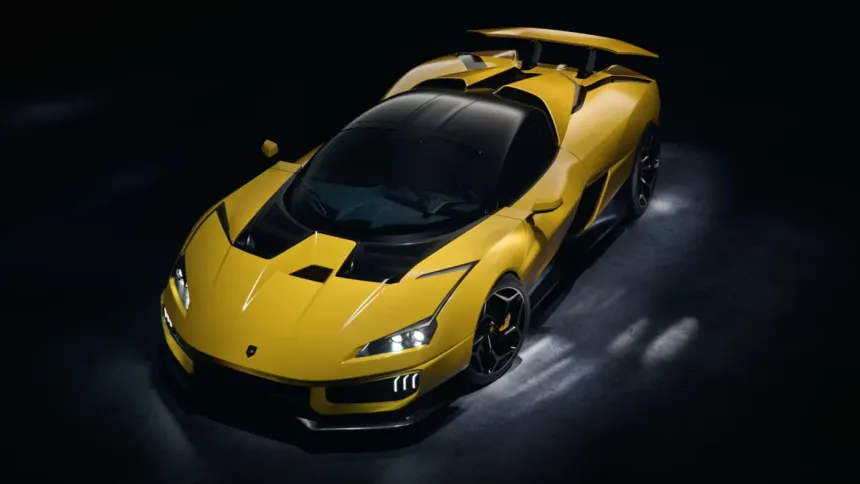
GIAMARO KATLA: 2,157 HP, FOUR TURBOS, ZERO ELECTRONS — AND A QUIET ANSWER TO A LOUD POLITICAL DEMAND
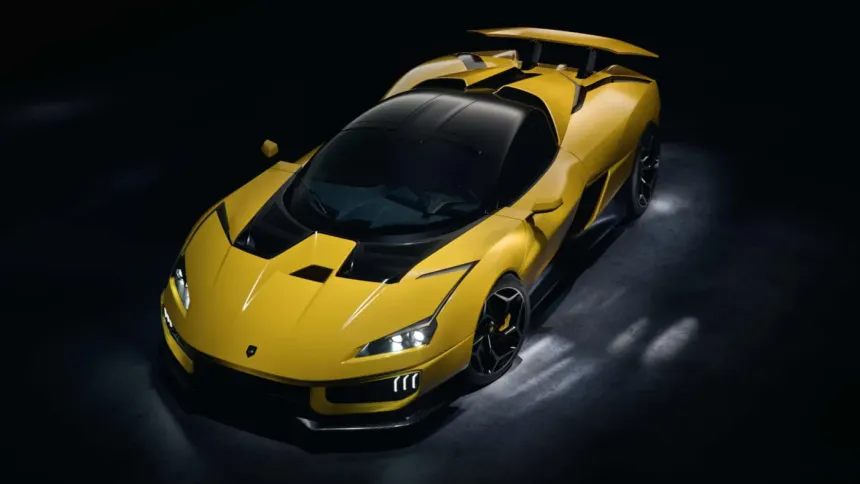
The headline number is the easy part. Two thousand one hundred and fifty-seven horsepower, from a 6,988 cc V12 with four turbochargers, no hybrid assistance of any kind. A seven-speed manual gearbox driving the rear wheels. A starting price of 2,470,000 euros before tax. Production already sold out for the first year. Deliveries in late 2027.
The hard part is what to do with that information.
The Italian motoring press has been treating the Giamaro Katla as a pure act of defiance — a middle finger raised in the direction of Brussels, of the EU 2035 deadline, of every regulator who has ever signed a directive on tailpipe emissions. That framing is wrong. Or at least, it’s incomplete. And the founder himself has gone out of his way to say so.
Giacomo Commendatore, asked by the Italian wire service ANSA about the rejection of electrification, did not deliver the soundbite that the anti-EV crowd wanted. What he said, almost word for word, was that he respects the electric car, that it has its own role to play, but that it doesn’t deliver the kind of mechanical experience some drivers still demand. That is not the same thing as being against the EV. That is something quieter, and considerably more interesting.
It is a defence of choice. Of the right to want a thing that is being legislated out of existence. And in 2026, with most of the established hypercar makers genuflecting to electrification in some form or another, that defence is being made by a brand-new outfit nobody had heard of two years ago.
Pay attention to this one. Even if you never drive it. Even if you don’t believe a word of the brochure.
THE FAMILY BEHIND THE LOGO
Giamaro Automobili was founded in 2021 by a father-and-son team: Giacomo and Pierfrancesco Commendatore. The name is an acronym pulling together Giacomo, plus business associates Massimo and Roland.
In Italy, the Commendatore name is associated with mattresses. Specifically, with Permaflex and Eminflex, two brands that built much of their visibility through television tele-sales in the 1980s and 1990s. The fortune is real. The industrial base is real. The leap from selling beds on late-night Italian television to building V12 hypercars in Modena would, on the face of it, be ridiculous — except that there is one biographical detail that almost nobody is putting on the front page.
Giacomo Commendatore was an early investor in Pagani Automobili. He was inside the project before it became one of the most respected hypercar marques in the world. He left over a difference in vision.
That single fact reframes everything. This is not a wealthy outsider playing dress-up. This is a man who has been in the room when the modern Italian hypercar industry was being designed, who watched what worked, who watched what he disagreed with, and who has now spent more than three decades preparing the moment in which his own name appears on the engine cover. The headquarters are in Castelfranco Emilia, in the restored Villa Pietramellara. The R&D facility is in Cavezzo, twenty-five minutes from Maranello, twenty minutes from Sant’Agata Bolognese, a short drive from Pagani’s own factory.
The geography is not accidental either. Almost nothing in the Motor Valley is.
THE V12 IS NOT A RUMOUR
The reasonable response to a brand-new hypercar marque is scepticism. Renderings, press releases, declared figures and seven-figure price tags exist on a sliding scale of credibility, and most projects of this type never reach a customer car. Italian motoring history alone contains a graveyard of beautifully painted prototypes that never moved under their own power.
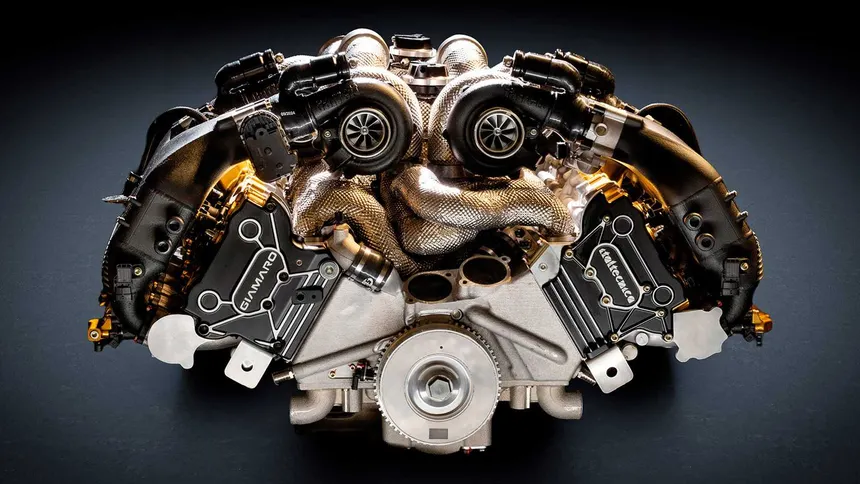
The Giamaro V12, however, exists. It has been seen, photographed and heard by independent journalists. The Italian arm of Motor1 was given access to the Cavezzo facility before the public reveal, watched the engine on the test bench, and reported on the visual and acoustic experience in some detail. According to the manufacturer, the unit has now accumulated more than 500 hours of bench testing. A running prototype is undergoing on-road and on-track development.
The technical specification is unusual enough to be worth slowing down for.
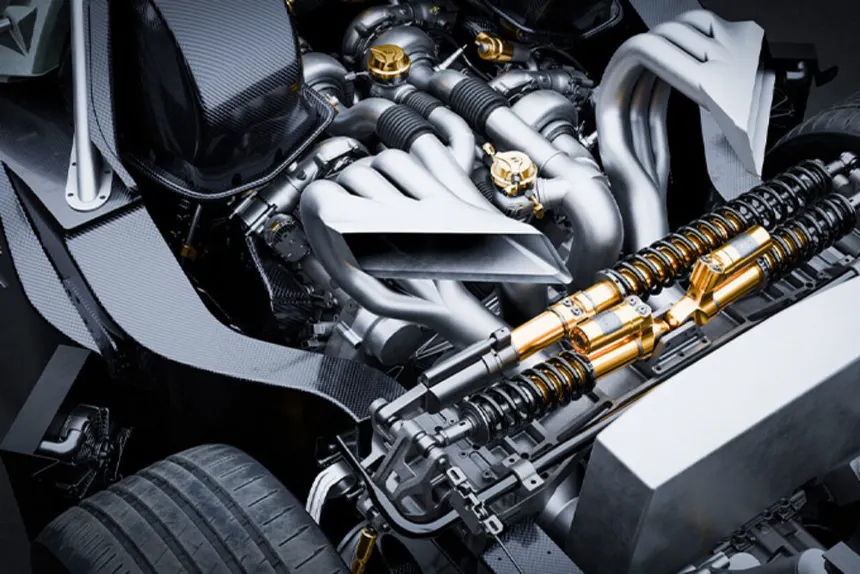
It is a 6,988 cc, sixty-degree-displacement V12 — except that the V is not a conventional sixty or ninety degrees. It is a 120-degree “hot V” architecture, with the four turbochargers mounted in the centre of the V rather than on the outside of the block. The objective of that layout is twofold: lowering the centre of gravity of the entire powertrain, and shortening the path between exhaust manifold and turbine for sharper response and improved thermal management. It is the same general philosophy that AMG and BMW M have pursued in their hot-V V8s, but on a V12 of this size and turbo count, it becomes a structural argument as much as a thermal one.
The engine was designed in-house by Giamaro and built in collaboration with Italtecnica, a Turin-based engineering specialist with a deep history in extreme-duty internal combustion. The output, in the most aggressive of three calibrations, is 2,157 PS at 9,000 rpm with 2,008 Nm of torque. In the standard configuration, those numbers settle to a still-absurd 1,670 PS and 1,556 Nm.
For comparative scale: a Bugatti Tourbillon, the most expensive series-production hypercar currently sold, draws on a naturally aspirated 8.3-litre V16 plus three electric motors for a combined 1,800 PS. A Pagani Utopia uses an AMG-built V12 biturbo for 864 PS. A Ferrari 12Cilindri, with its naturally aspirated V12, makes 830 PS. The Giamaro Katla, in race mode, more than doubles either Italian benchmark and outpaces the Bugatti from a single combustion source. There is no electric motor in this conversation.
There is also a piece of historical continuity worth registering. The last quad-turbo V12 to come out of the Modena area was the 3.5-litre engine in the Bugatti EB110, built at Campogalliano under Romano Artioli and unveiled in 1991. That car is widely credited as the engineering ancestor of the modern hypercar. Thirty-five years later, the same cluster of villages produces another quad-turbo V12, twice the displacement and almost four times the output. That line of descent is real.
THREE KEYS, THREE CARS, ONE INVOICE
The Katla is delivered with three physical keys. Each one unlocks a different power profile and, in effect, a different vehicle.
The white key restricts the engine to roughly 400 PS — enough for road use that does not require a notarised psychiatric evaluation. The black key opens up the road-going envelope at 1,670 PS. The red key, intended exclusively for circuit use, releases the full 2,157 PS at 9,000 rpm. Three drivers, in essence. Three contracts between owner and machine. The decision to physically embody the choice in three separate keys is part theatre and part legal hygiene: it allows the manufacturer to market a vehicle with civilised manners, while reserving the genuinely lethal calibration behind a tangible barrier.
It is also unmistakably Italian. The choreography is what Maranello and Sant’Agata have been doing for decades, dressed up for a 2026 audience.
THE REST OF THE CAR
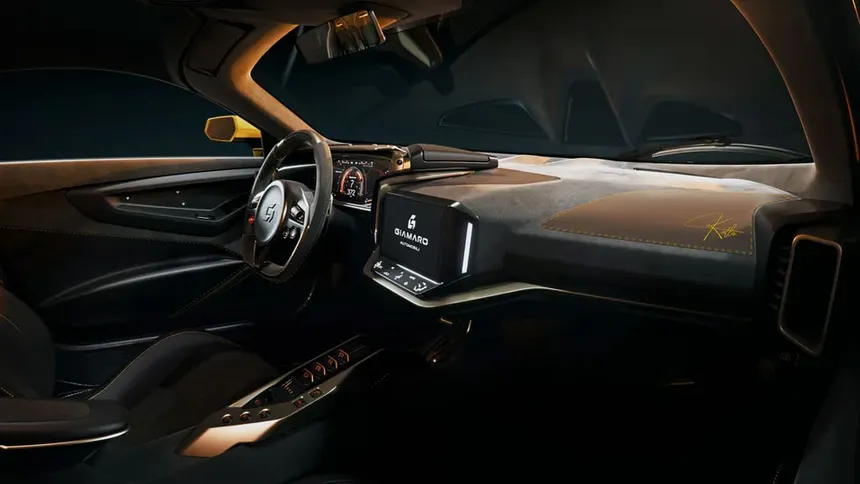
A V12 by itself is a sculpture. A hypercar is everything around the V12, and this is where Giamaro will either consolidate its credibility or come apart.
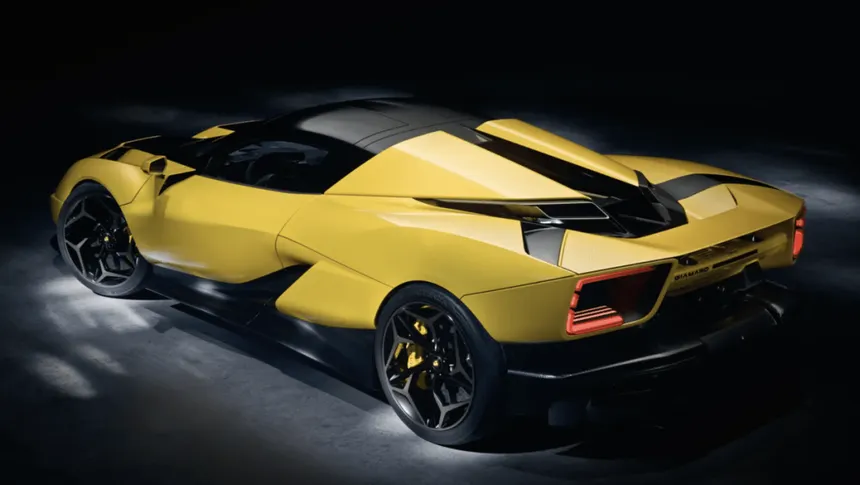
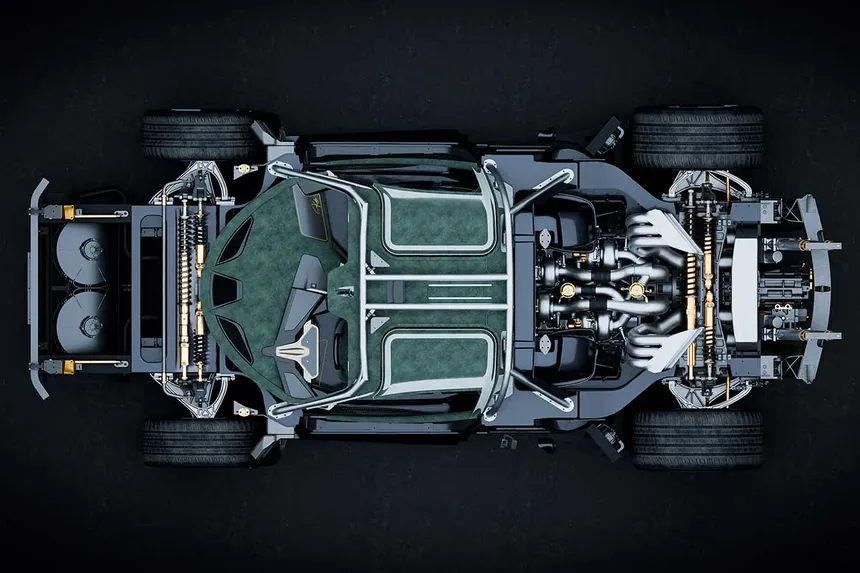
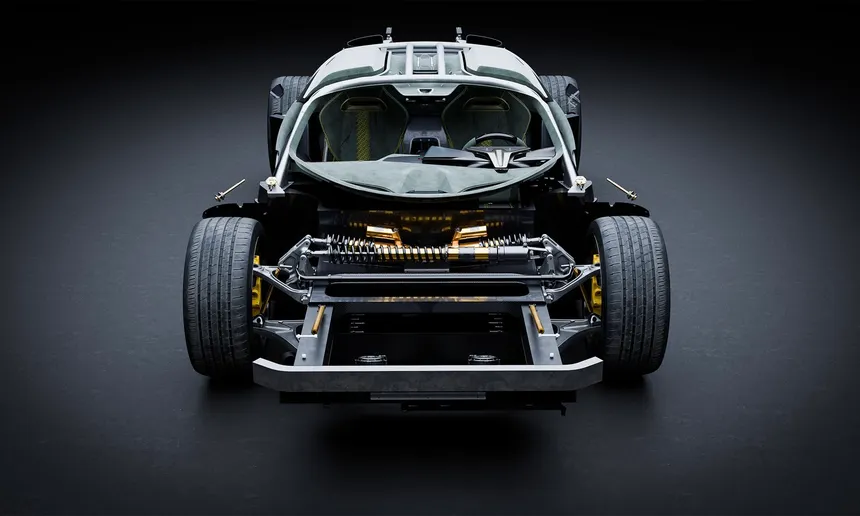
The architecture is mid-engine, longitudinally mounted, with a transaxle gearbox and a 42:58 weight distribution. The chassis is a carbon-fibre monocoque. The standard transmission is a seven-speed manual with a mechanical limited-slip differential — an extraordinary specification at this power level, and arguably a bigger statement than the engine itself. An optional eleven-speed dual-clutch is in development. Drive goes to the rear wheels only. There is no all-wheel-drive system. Bridgestone is supplying a bespoke set of Potenza Sport tyres developed specifically for the car. Suspension is a CNC-machined double-wishbone arrangement carved from solid aluminium blocks. Brakes are carbon-ceramic with ten-piston front calipers and four-piston rears. The reported kerb weight is below 1,450 kg.
There is one name on the development team that, more than any other, explains why so many serious observers are taking Giamaro seriously. Loris Bicocchi. He developed the chassis dynamics on the Lamborghini Countach, the Diablo, the Pagani Zonda and the Bugatti Veyron. He is, by general consensus, the most accomplished hypercar chassis development engineer alive. He is on this project. That kind of credibility cannot be bought; it can only be earned, and it is rarely lent to vapourware.
The performance figures published by the manufacturer — 0–100 km/h in 1.6 seconds, top speed near 450 km/h — should be treated as declared targets rather than verified results. Until somebody independent times the car, those numbers belong to the press kit. The hardware that supports them, however, is real and accounted for.
WHY THIS IS NOT AN ANTI-EV STORY
The temptation, watching a 2,157 PS V12 emerge in the same year that European regulators are tightening their grip on the internal combustion engine, is to read the Katla as a political object. It is, but only in the most narrow sense.
The Katla is not arguing that electric cars are bad. It is arguing that the kind of physical, mechanical, sensory experience offered by a high-revving multi-cylinder combustion engine is qualitatively different from anything an electric drivetrain can produce, and that demand for that experience is real, paying, and willing to put 2.47 million euros on the table to defend it. That is a market argument, not a culture-war argument.
What the regulators are eroding is not the electric car. It is the option to choose. And as long as somebody, somewhere, is willing to spend serious money on the alternative, somebody else will build it. The Katla is what that supply curve looks like in physical form.
The first year of production is already sold. That is the most relevant data point in the entire story. It means that wealthy collectors with no incentive to be sentimental have looked at this project, looked at the engine, looked at the founder’s history, looked at Bicocchi on the development team, and decided to commit real money before any customer car has been delivered. They are betting that this thing will be real. So far, the evidence is on their side.
THE PROVISIONAL VERDICT
It is too early to declare Giamaro a success. The graveyard of failed hypercar startups is full of marques whose first prototype ran beautifully and whose second one never appeared. Twenty months separate today from the planned start of customer deliveries, and twenty months in the development of an extreme road car can absorb almost any disaster.
What can be said, with reasonable confidence, is this. There is a real engine, on a real bench, accumulating real hours. There is a real chassis, with a real Bicocchi developing it. There is a real factory, in a real building, with a real production schedule. There is a founder with a real history inside the modern Italian hypercar industry, a real reason to want his own name on the cover, and a real first year of orders to fund the development.
And there is the question that the Katla quietly raises. If the political class continues to remove options from the table, what does the resistance to that removal actually look like in the real world? It does not look like protests. It looks like 2.47 million euros, three keys, no electric motors, and a 7,000 cc V12 idling on a dyno in Cavezzo. Quiet, well dressed, and entirely uninterested in being told what is or is not acceptable to want.
That is what is interesting here. Not the horsepower. Not the price. Not even the manual gearbox. The quiet part is that this car exists at all in 2026, and that it has already found its buyers.
Pay attention.