
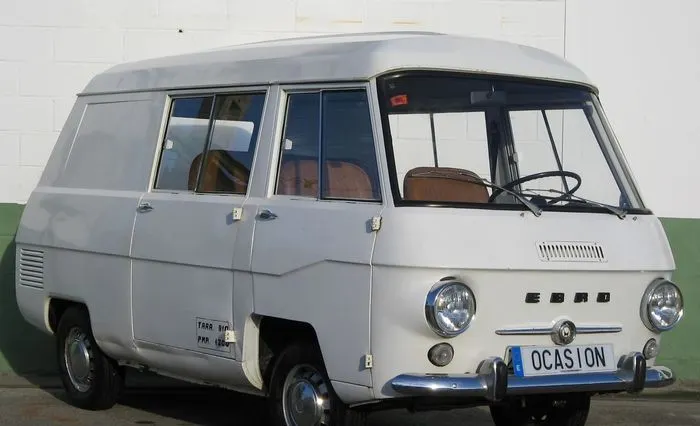
Ebro: how Henry Ford founded a Spanish brand, a Nazi-sympathising falangist built it into an empire, Nissan swallowed it, and the Chinese just brought it back
Stop a hundred random British or American car enthusiasts on the street, ask them where Henry Ford ran factories outside the United States, and most will say Britain (Dagenham). A few will mention Germany (Cologne). Maybe one in a hundred will know about the Ford plants in Cork, Ireland. Almost nobody will know about the one Henry Ford personally chaired in Spain.
It existed. It was real. Henry Ford — the man, not the corporation — was the founding president of Ford Motor Company SAE, registered in Cádiz, southern Spain, on 2 June 1920, with starting capital of 500,000 pesetas and 99 employees. They started by assembling Model Ts and Fordson tractors. By 1923, after a long industrial dispute, the entire operation had been moved to Barcelona.
That Cádiz-born factory eventually became something called Motor Ibérica. Motor Ibérica created a brand called Ebro. Ebro became the Spanish heavyweight of commercial vehicles for half a century. Then Nissan bought it. Then Nissan closed it during the COVID-19 pandemic. Then a Chinese giant called Chery brought it back from the dead in 2024.
And in the middle of all that, the man who turned Motor Ibérica from a struggling post-war company into Spain’s industrial giant of the 1960s and 70s was a former Falangist hardliner who had personally hosted Heinrich Himmler in Madrid in 1940, met Goebbels and Ribbentrop in Berlin in 1941, and survived a Spanish cabinet meeting where one minister proposed having him executed.
Pour yourself a coffee. This story has a few corners.
Cádiz, 1920: when Henry Ford put his name on a Spanish company
By 1920, the Ford Motor Company was already a global operation. Branches in Britain, Germany, Argentina, Brazil. Spain was added that year, and the location chosen was Cádiz — a port city in Andalusia, on Spain’s southern Atlantic coast. The reasoning was logistical: deepwater port, free-trade zone, established maritime links with the rest of Europe and the Americas.
The Cádiz adventure didn’t last long. And the reason it ended is worth a paragraph of its own, because it shaped the entire geographic distribution of Spanish automotive industry for the next century.
Spain in 1918-1923 was, to put it mildly, on fire. The country had been neutral during the First World War but had profited massively from selling to both sides; the wealth ended up concentrated in Catalan industrial families while wages stayed at pre-war levels. Combined with the seismic effect of the Russian Revolution, this triggered what Spanish historians call the trienio bolchevique (1918-1920) — three years of mass land occupations across rural Andalusia and general strikes across industrial Catalonia. Then came the so-called Barcelona pistolerismo (1919-1923): hired gunmen, paid by the industrial class, hunting down trade-union activists in the streets of Barcelona. Over 3,000 Catalan union militants were imprisoned in 1921 alone. In March 1923, the leading anarcho-syndicalist organiser Salvador Seguí was assassinated. In September 1923, the military coup of Miguel Primo de Rivera outlawed the CNT trade union and installed a dictatorship.
Somewhere in the middle of all that, in 1923, a prolonged strike paralysed Ford’s Cádiz operation enough for Detroit to decide southern Spain was incompatible with its assembly-line model. The whole operation moved to Barcelona, into newly built premises at number 149 of Avenida Icaria in the Pueblo Nuevo district. The irony is brutal: Ford fled Andalusian conflict only to drop itself into the epicentre of Spain’s industrial violence. But Barcelona offered something Cádiz didn’t — an existing industrial fabric, specialised metalworking suppliers, and a skilled workforce. The shareholders’ tolerance for street violence was the price they were willing to pay for industrial readiness.
Barcelona kept the operation alive. Model Ts, Model As, light trucks, Fordson tractors. The factory survived the Primo de Rivera dictatorship, the Second Republic, and crashed into the Spanish Civil War (1936-39).
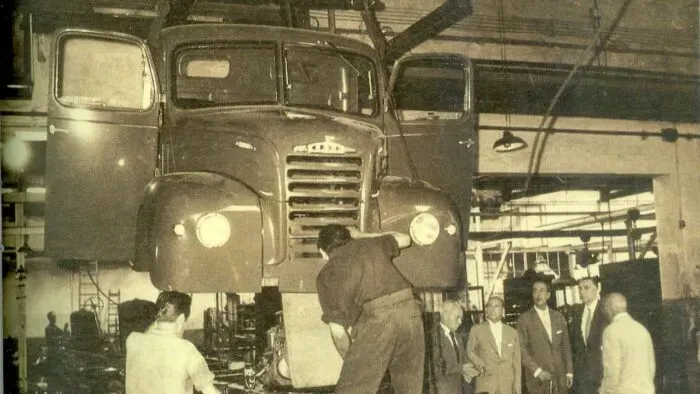
After the war, with Franco in power and Spain isolated economically, Ford Motor Ibérica became a ghost of itself. There were no foreign exchange reserves to import parts. No raw materials. The plant survived for over a decade making spare parts and refurbishing whatever vehicles still ran on Spanish roads.
1953-54: Ford gives up, new shareholders take over, the Ebro brand is born
After the Spanish Civil War (1936-39), with Franco in power and Spain economically isolated, Ford Motor Ibérica became a shell. No foreign exchange to import parts. No raw materials. The plant survived for over a decade making spare parts and refurbishing whatever vehicles still ran on Spanish roads.
By the early 1950s, the Franco regime had clearly committed to two state-backed automotive projects: SEAT, founded in Barcelona in 1950 by the Instituto Nacional de Industria under FIAT licence, and FASA, established in Valladolid in 1951 under Renault licence. Ford’s leadership looked at this landscape and saw two competitors with full political backing taking over its market niche. The decision: walk away.
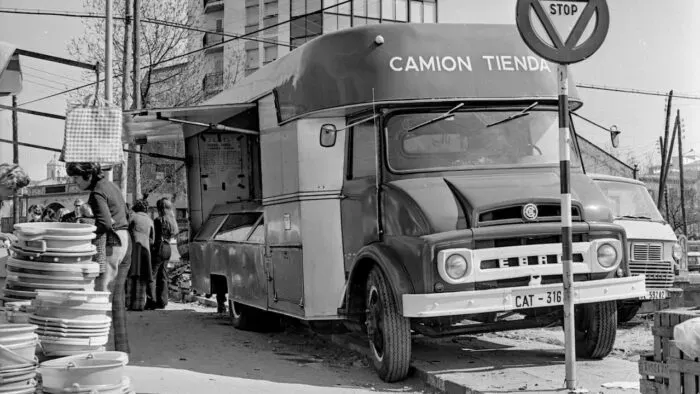
In 1954, Ford sold its Spanish stake to a group of Spanish investors. The company was renamed Motor Ibérica, S.A. A new commercial brand was registered for the trucks and tractors: Ebro.
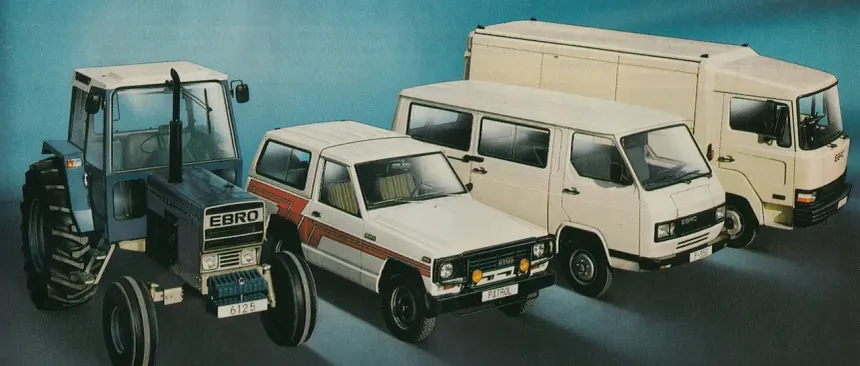
The name carried a quiet joke. Ford UK sold its trucks under the brand Thames — after the river that flows through London. The new Spanish owners, looking for a parallel, picked Spain’s largest river: Ebro. The first Ebro truck, launched in 1955 with 3.5 tonnes of payload, was a direct adaptation of the British Ford Thames truck range. The first Ebro tractor, the Ebro 38 of 1955, ran a 4-cylinder 3,600 cc engine, 38 horsepower, 6+2 gearbox, and was a direct descendant of the British Fordson family (New Major, Power Major, Super Major). Technological nationalisation was slow, but it started.
The iron mine, or how you built a truck factory in Franco’s Spain
What happened next captures Spain in the 1950s better than any textbook.
In 1955, with Motor Ibérica freshly created and the first Ebro trucks coming out of the doors, the company ran into a bureaucratic wall typical of the Franco regime: the authorities wouldn’t grant it enough foreign currency to import specialised machinery from the UK. Spain was internationally isolated, hard-currency reserves were minimal, and the Ministry of Industry rationed every dollar and every pound through layers of paperwork.
Motor Ibérica’s solution? They bought an iron mine.
The logic was crude but devastating: if the state won’t give me hard currency, I’ll generate it myself. Export iron ore to markets that pay in pounds and dollars, pocket the foreign exchange, and use it to buy machinery from Ford in the United States and Perkins in Britain. The company went from being a truck manufacturer to running a mining operation in less than a year, all to dodge Franco’s autarky. To round off the picture: until 1960, the selling price of every Ebro truck and tractor had to be approved by the Ministry of Industry before going to market. You built the truck, you calculated the cost, and before you could sell it a civil servant decided whether your asking price was acceptable.
This wasn’t a free enterprise. This was a private company operating inside a permanently directed economy. And yet, the production figures that followed look like those of a modern multinational.
The avalanche: 500 tractors, 8,000 tractors, 10,000 trucks a year
Tractors in 1955: 500 units. Tractors in 1964: 8,000 units. Trucks in 1962: 10,000 units a year. Sixteenfold tractor production growth in seven years. By the early 1960s, Ebro had become the default Spanish workhorse — the truck that delivered concrete, milk, fuel, vegetables and military supplies across the entire country.
Who piloted that expansion? Now we get to the part of Ebro’s story that nobody tells.
The man who hosted Himmler and ran the company
Gerardo Salvador Merino, born in Herrera de Pisuerga (Palencia, Spain) on 8 September 1910. Notary, lawyer, hardline falangist. In September 1939, aged just 29, the Franco regime appointed him First National Delegate of Trade Unions — the man in charge of building the vertical syndicalist apparatus that replaced the pre-war labour movement after the Civil War.
Salvador Merino was a radical. He genuinely believed in building a powerful, autonomous trade-union structure modelled — and this is the uncomfortable detail — explicitly on Nazi Germany’s Deutsche Arbeitsfront (DAF). When Heinrich Himmler made his official visit to Spain between 19 and 24 October 1940 — a trip extensively documented in the historiography of Francoism —, Salvador Merino was among the Spanish officials who received the SS chief in Madrid, alongside Pilar Primo de Rivera (head of the Falange’s female section) and other senior regime figures.
In late April 1941, Salvador Merino travelled to Nazi Germany on an official tour. According to the periodical research published by El Debate, by the close of his visit on 7 May 1941 he had already met with three ministers — Joseph Goebbels (Propaganda), Joachim von Ribbentrop (Foreign Affairs) and Walther Funk (Economy) — and with Rudolf Hess, then still Hitler’s deputy in the Nazi Party.
The American ambassador in Madrid, Alexander Weddell, sent a cable to the State Department reporting on Salvador Merino’s statements to the Spanish press upon his return. The cable is preserved in the Foreign Relations of the United States, 1941, volume II. Weddell quoted Salvador Merino as follows: “Entire Germany is a prodigious machine for making war which functions with extraordinary precision. Three million foreign workmen and six million prisoners of war are working today in Germany. The German labor front has achieved solidarity of the human element in the enterprise and the entire German people feels itself united in a common destiny.”
His political power in those months was enormous. Too much. Spain’s industrial elite, the Catholic Church, sections of the army, and the regime’s pro-British faction all turned against him. The coordinated counter-offensive accused him of freemasonry — an accusation he always denied. The Special Tribunal for the Repression of Freemasonry and Communism sentenced him to twelve years under the regime’s anti-Masonic legislation. In the cabinet meeting that decided his fate, Minister José Antonio Girón openly proposed having him executed. Franco settled on the tribunal sentence: commuted to internal exile in the Balearic Islands. Salvador Merino was expelled from the Falange. Banned from public office. Officially erased.
And here comes the twist. After serving his exile, he reinvented himself as a notary in Sardañola del Vallés (Catalonia) and then moved into business. From the 1960s until his death in 1971, he served as director-general of Motor Ibérica — the operational helm of the company. Under his management, Massey Ferguson entered the shareholder structure in 1965 with a 36% stake, bringing Perkins Hispania (diesel engines) into the group as part of the deal. Under his management, the new Zona Franca plant in Barcelona was inaugurated in 1967. And under his management, throughout the sixties and into the early seventies, Motor Ibérica began the buying spree that would turn it into an industrial empire.
He died in Barcelona on 31 July 1971, still tied to the company. The most aggressive phase of the absorption spree — including VIASA — would unfold after his death.
There’s a particular kind of moral untidiness in that biography. A man who in 1940 had been part of the welcoming committee for Hitler’s SS chief ended up, twenty-five years later, running the company that brought a Canadian agricultural-machinery multinational into the Spanish industrial bloodstream. Both parts of the story are true. Both are usually ignored. The official corporate history of Ebro doesn’t mention Himmler, and the official history of Spanish fascism doesn’t mention tractors. We mention both at NEC, because pretending one or the other didn’t happen is editorial cowardice.
The badge-engineering carnival of the 1970s
Between 1965 and 1976, Motor Ibérica went on a buying spree that swallowed half of Spain’s light-vehicle industry: from FADISA in Ávila (Alfa Romeo Romeo vans under Italian licence) to VIASA in Zaragoza (American Jeep CJs under licence), passing through AISA / Avia in Madrid, Perkins Hispania, and Catalan-based Siata Española. Five separate manufacturers absorbed into a single corporate organigram in just over a decade.
The result, as the English-language Wikipedia entry for Ebro Trucks describes it without irony, was “a real frenzy of badge engineering.” You could buy a Jeep wearing an Avia badge. You could buy an Alfa Romeo van wearing the Ebro shield. You could buy a SEAT-platform minivan wearing whichever brand was on the dealership wall that month. The same chassis, in some cases, passed through three different brand names within five years on the production lines.
By the mid-1970s, Motor Ibérica operated twenty specialised factories across Spain — Barcelona for trucks, tractors and engines; Moncada i Reixac for body stamping; Tarrasa for steering and crankshafts; Noáin (Navarre) for agricultural equipment; satellite plants in Madrid, Ávila and Cordoba. It was, after SEAT, the largest automotive industrial group in Spain.
Too big to sustain itself without an international partner.
1979-86: the Japanese arrive, Ebro disappears into Nissan
In 1979-1980, Massey Ferguson — by then holding 36% of Motor Ibérica’s shares (some sources refine this to 38.85%) — sold its stake. Massey Ferguson was facing its own global financial problems, and the timing aligned with Spain’s clear path towards European Economic Community membership (which would happen in 1986). The buyer was Nissan Motor Company.
Nissan’s reasoning was strategic. Vehicles built on Spanish soil, once Spain joined the EEC, would qualify as European production and bypass the strict import quotas the Community enforced against Japanese cars. Buying into Motor Ibérica gave Nissan a ready-made European factory, an established supplier network and a trained Spanish workforce, all at a recession-discount price.
From 1980 onward, the Barcelona plant began assembling the Nissan Patrol — the SUV that would become an icon of Spanish working-class motoring through the 1980s and 1990s — alongside the Nissan Vanette light van. By the autumn of 1982, Nissan had increased its stake to 53%. And in 1986, coinciding exactly with Spain’s accession to the EEC, Nissan moved to majority control, taking 80% of the shares. The company was renamed for the last time in 1987: Nissan Motor Ibérica, S.A.
The tractor division was sold to Japanese manufacturer Kubota, and for a brief period Japanese tractors were assembled and sold in Spain under the Ebro-Kubota brand. For everything else, from 1987 onwards the Ebro brand gradually faded until it was definitively replaced by Nissan. The light commercial Ebro Trade van was rebadged as Nissan Trade in 1986 and stayed in production until 2001. By the mid-1990s, “Ebro” was already a memory — kept alive only by veteran mechanics and middle-aged hauliers.
28 May 2020: Nissan announces the closure
Forty years after the Japanese had taken over from Massey Ferguson, Nissan announced the closure of all three of its Catalan plants: Zona Franca (assembly and engines), Montcada i Reixac (stamping) and Sant Andreu de la Barca (steering racks and suspensions). Around 3,000 direct jobs, according to the figures handled by the company and the Spanish government, plus between 20,000 and 30,000 indirect jobs across the supply chain. The announcement landed in the middle of the first wave of the COVID-19 pandemic, with Spain still under strict lockdown.
The final settlement, signed on 5 August 2020 after 30 hours of negotiation, postponed effective closure to late 2021 in exchange for resuming production and buying time for the authorities to find replacement industrial projects. The company set up a voluntary redundancy and early-retirement plan with conditions, in the words of chief Nissan negotiator Frank Torres, “well above the legally established maximum thresholds.” The last Nissan Navara rolled off the Zona Franca line on 16 December 2021. Across the full Nissan era in Barcelona, the plant had produced 3,345,000 vehicles.
A century, almost to the day, after the first Ford T had been assembled in Cádiz, the inheritor factory’s lights went out.
One political detail worth keeping in the public record: Spain’s Prime Minister Pedro Sánchez had published a tweet on 22 January 2020 from the Davos Economic Forum stating literally: “Employment at the Nissan Barcelona plant is guaranteed. During our meeting today at #Davos2020, the Spanish government and @Alliance_RNM have reaffirmed our commitment to keep working together to ensure the factory’s viability.” Four months later, the workers who had read that tweet were on strike.
April 2024: Chery, Ebro Factory, and a brand resurrection
The Ebro brand was dormant but not legally dead. In April 2024, a Spanish company called EV Motors — focused on electric mobility — signed a joint-venture agreement with Chery, one of China’s largest automotive groups (annual production well over 2 million vehicles globally).
The deal, announced inside the very Zona Franca buildings where Nissan had switched off the lights three years earlier, was personally framed by Pedro Sánchez as “a symbol of the reindustrialisation of Spain and Catalonia.” The factory was rebranded Ebro Factory. Target headcount: 1,250 direct jobs. Production goal: 150,000 vehicles per year by 2029.
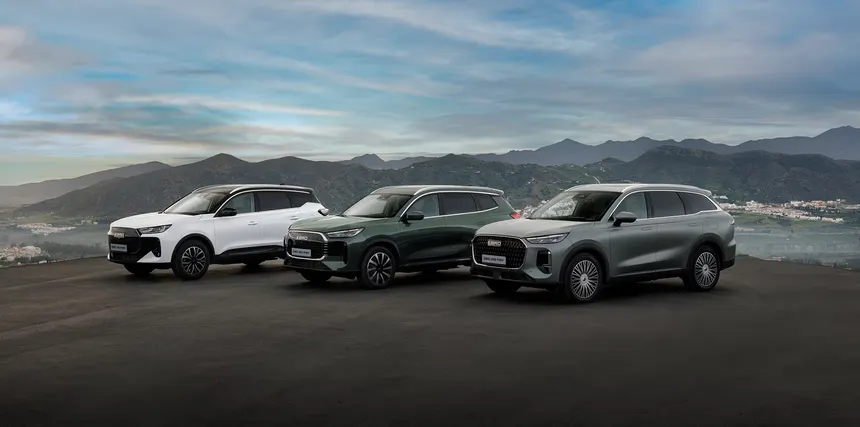
The first vehicle to wear the resurrected Ebro badge was the S700, a mid-size SUV based on the Chery Tiggo 7 Pro. The S800 (Tiggo 8) followed. Then the S400. By late 2026, Ebro plans to launch its first electric model designed specifically for Europe — a 4.2-metre compact with a projected 400-kilometre range, also built on Chery underpinnings.
The new Ebro doesn’t make trucks. Doesn’t make off-roaders. Doesn’t make agricultural tractors. It makes urban SUVs based on Chinese platforms, built in Barcelona for the European market.
Which, looked at coldly, is almost exactly what the original Ebro did in 1955: take a foreign manufacturer’s truck design — back then, the British Ford Thames Trader; now, the Chinese Chery Tiggo — bolt the Ebro shield onto the front, and call it a Spanish vehicle. The only thing that’s changed is the source of the donor technology. From British, to American technical partnership, to Japanese ownership, and now Chinese alliance.
The deeper pattern
If you’ve read our Santana Motor piece — the Linares factory that humiliated the Land Rover Defender and was resurrected this December with Chinese money — you’ll notice the parallel. Two historic Spanish industrial brands. Two brutal closures within a decade. Two near-simultaneous resurrections backed by Chinese capital and Chinese platforms. Santana came back on 5 December 2025 with BAIC, ZZ Nissan and Anhui Coronet in a SKD assembly arrangement, 170 jobs, a pickup starting at €29,900. Ebro came back in April 2024 with Chery in a deeper industrial joint venture, 1,250 jobs, full local welding and painting, targeting 40,000 units in 2026.
Two scales of the same reality. Spain has the factories, the workers, the supplier network and the engineering know-how to build cars. What Spain doesn’t have, and hasn’t had since the 1950s, is enough domestic industrial capital to sustain its own automotive brands without a foreign technical partner. That capital came from Henry Ford in 1920, from Massey Ferguson and Nissan in the 1970s and 1980s, and now from Chery in 2024.
That’s not a sad conclusion. It’s a structural one. Almost every European country with a substantial automotive industry — Spain, Belgium, Czech Republic, Slovakia, even parts of the UK — operates the same way. Foreign capital, local workforce, mixed national pride.
Henry Ford founded Ebro in 1920. A former fascist hardliner whose colleagues had wanted him executed turned the company into a giant in the 1960s. The Japanese absorbed it in 1987. The Chinese resurrected it in 2024. A century after a Model T was first assembled in Cádiz, the only thing that has remained constant is the factory’s postcode.
Check you’re still alive.