
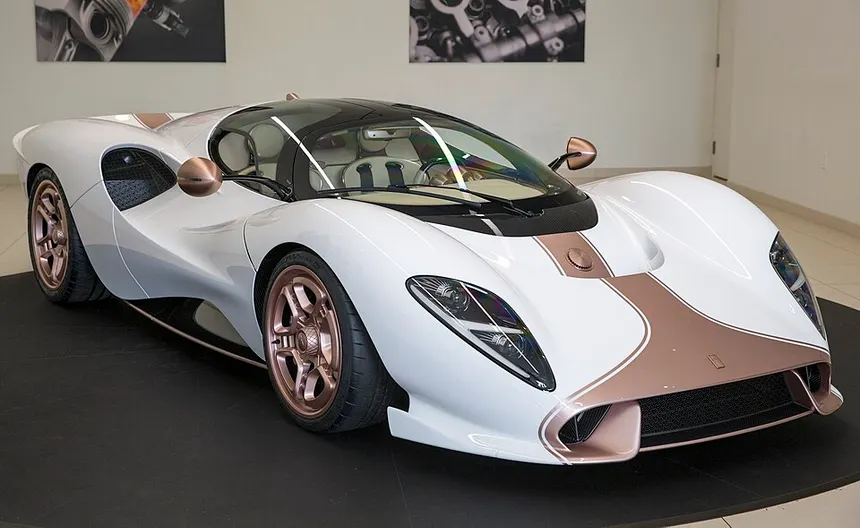
De Tomaso P72: The Time Machine That Took Six Years to Start
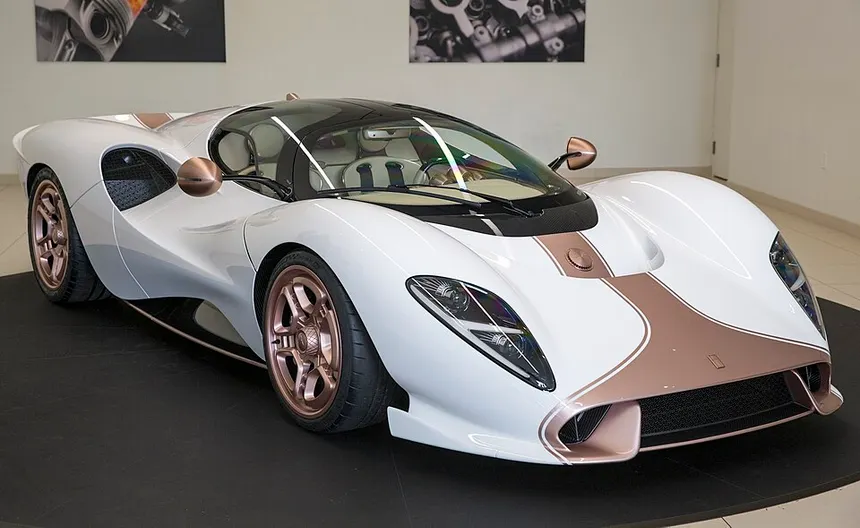
There are promises that get kept. And there are promises that take so long to deliver that by the time they arrive, nobody believes them anymore. The De Tomaso P72 was unveiled as a concept at the Goodwood Festival of Speed in July 2019. Six years later, in May 2025, the production version was revealed in Affalterbach, Germany. Between those two moments lies a story of chassis redesigns, industrial partner changes, a federal lawsuit against the brand’s owner, and a global pandemic. And yet, the car that emerged at the end of that process is — against all odds — exactly what they promised.
This is not a press release. This is what we know, verified, about the most important car De Tomaso has built since the Pantera.
Where the P72 Comes From
To understand the P72, you need to understand two things: the original P70, and the man who decided to bring the brand back from the dead.
The P70 was a 1965 racing prototype born from a collaboration between Alejandro de Tomaso and Carroll Shelby. Peter Brock designed the body. The car ran a 4.7-liter Ford V8 and was intended for Can-Am competition. The partnership collapsed before the project bore fruit, but the P70’s backbone chassis became the foundation for the Mangusta, and the philosophy of American engine in Italian chassis was etched into the brand’s DNA forever. The P70 never raced. But its shadow stretched across six decades.
Norman Choi, a Hong Kong-based entrepreneur with expertise in brand restructuring, acquired the De Tomaso rights in 2014-2015 through Ideal Team Ventures — the same holding company that had purchased German manufacturer Gumpert (later rebranded as Apollo Automobil). The vision was clear: resurrect De Tomaso with a car that directly honored the P70. The project name: P72, referencing the 72 units that would be produced.
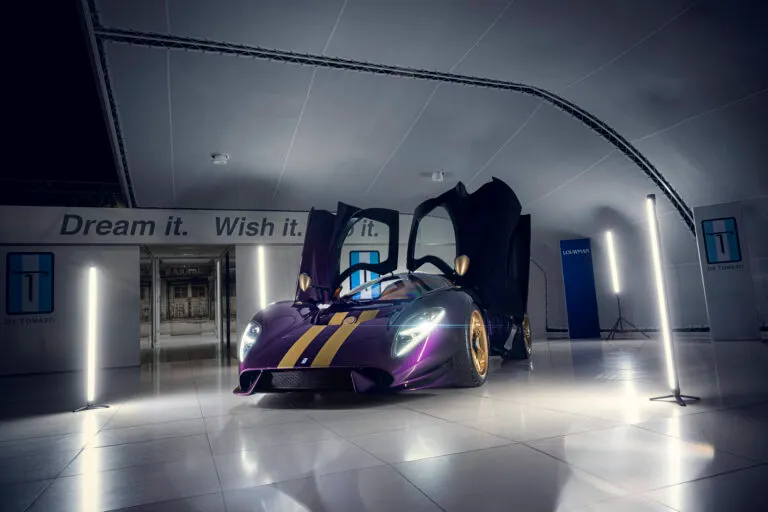
The design was commissioned from Jowyn Wong, founder of Wyn Design and the man behind the Apollo Intensa Emozione. Wong, who trained at McLaren under Frank Stephenson (designer of the McLaren P1), created a car with organic forms inspired by 1960s Le Mans prototypes — continuous curves that deliberately avoid the hard edges and sharp creases dominating current supercar design.
The Tortured Road to Production
What should have been a three-year development program became six. And the reason isn’t a single failure — it’s a chain of decisions, some forced by circumstances, others by internal problems.
The original plan was to use the Apollo Intensa Emozione’s platform as a starting point for the chassis. That would have accelerated development but compromised the design and dimensions. It was scrapped.
Phase two involved Capricorn Group, a German company specializing in carbon fiber with impeccable credentials: they were partially responsible for the Porsche 919 Hybrid, the car that won the 24 Hours of Le Mans three consecutive years from 2015 to 2017. Capricorn developed a new carbon fiber chassis, and a production facility was planned at the Nürburgring. First deliveries were targeted for 2023.
They didn’t happen. De Tomaso cut ties with Capricorn in early 2023 and partnered with HWA, the motorsport and engineering company founded by Hans Werner Aufrecht — AMG co-founder. HWA had direct experience building road-legal homologation supercars: they were responsible for constructing the Mercedes-Benz CLK GTR Strassenversion. Development moved to HWA’s headquarters in Affalterbach.
In parallel, in May 2023, Ryan Berris — former CEO and CMO of De Tomaso — filed a lawsuit in New York federal court against Norman Choi and other entities linked to the company. The allegations included unpaid wages, financial manipulation, and an alleged scheme to artificially inflate the company’s valuation. Berris had been the person who unveiled the P72 at Goodwood in 2019 and claimed to have built the brand virtually single-handedly. The lawsuit was covered by Bloomberg, Hagerty, The Drive, and CarBuzz.
Despite that backdrop, P72 development continued. In December 2024, De Tomaso completed the first production-spec chassis (number 001) for final dynamic validation. And in May 2025, the definitive production version was officially presented.
What’s Under the Skin: Verified Technical Data
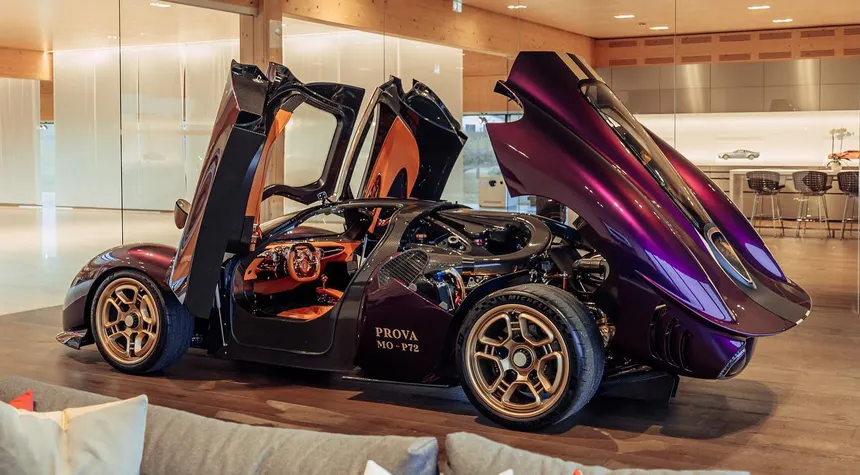
The production P72 is a ground-up new car. Nothing from the 2019 concept carried over directly except Jowyn Wong’s exterior design, which was preserved intact thanks to extensive aerodynamic work focused on the car’s underside. The early prototypes ran a V12 because they were based on the Apollo Intensa Emozione platform. The production car shares nothing with that — not the engine, not the chassis, not the suspension.
Aerodynamic development was conducted in the same wind tunnel used by Toyota for its LMP1 program, its Formula 1 efforts, and its LMH Hypercar campaign. The fact that De Tomaso has access to those facilities says something about the engineering caliber that HWA has brought to the project. The result is a car that preserves the concept’s flowing curves without resorting to aggressive wings, visible splitters, or canards — all aerodynamic work is concentrated on the underfloor.
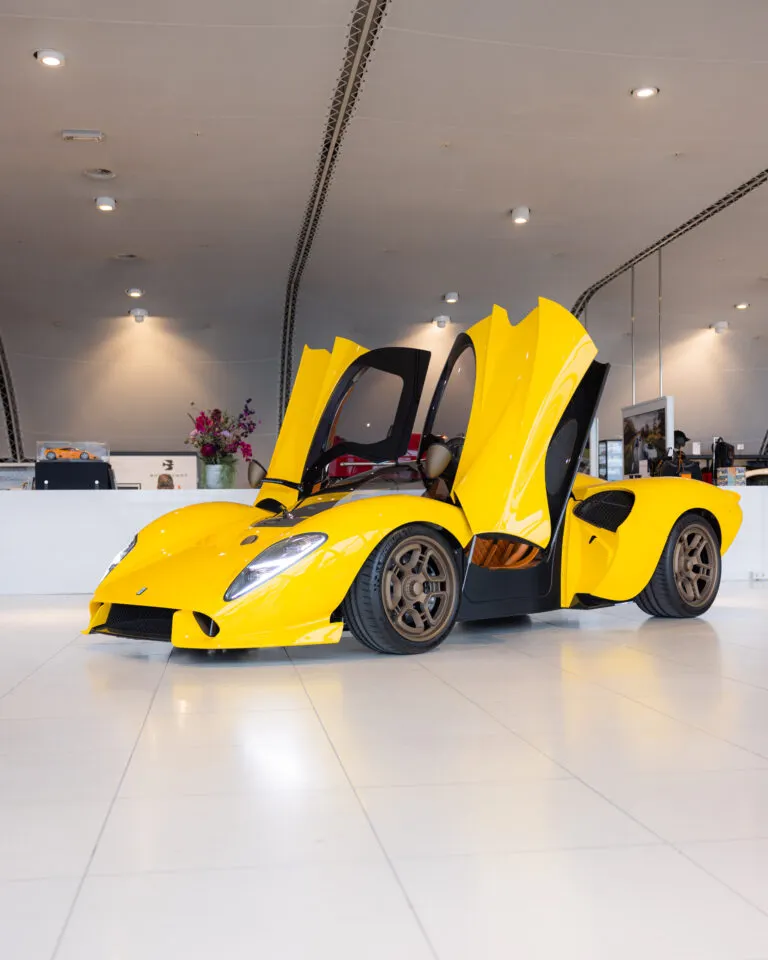
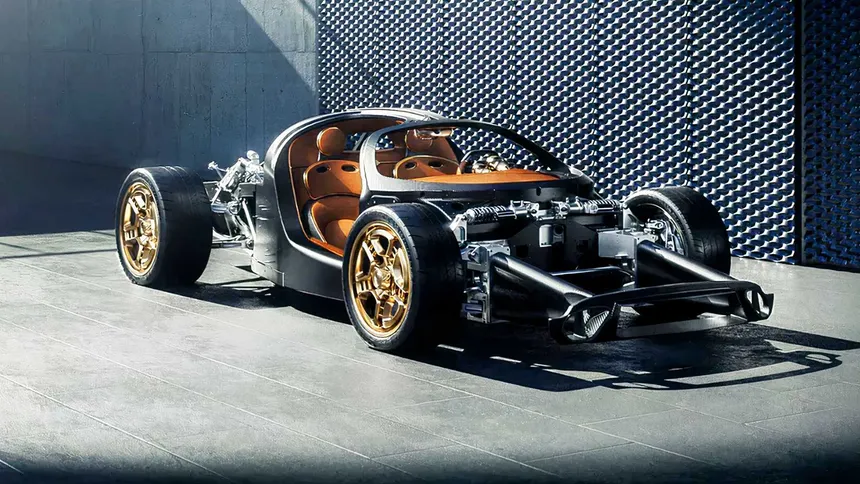
Chassis: Single-piece carbon fiber monocoque with no bonded sections or adhesive joints. 4×4 twill weave construction. The monocoque extends from the central tub through front and rear subframes. Developed from scratch with HWA.
Engine: Supercharged 5.0-liter Ford Coyote V8, hand-assembled with bespoke forged internals and a custom-designed De Tomaso supercharger. Prepared by Roush Performance. Output: 700 hp. Torque: 605 lb-ft (820 Nm). Header design inspired by 1960s racing.
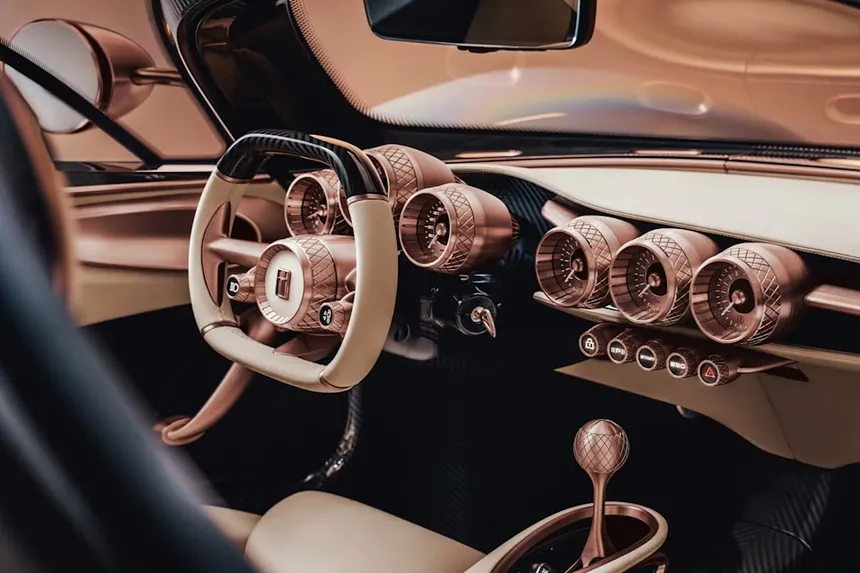
Transmission: Six-speed manual with short ratios and exposed metal shift linkage visible from the cabin. Rear-wheel drive. No drive modes. No electronic traction control. The only driving mode available is the right pedal.
Suspension: Pushrod system with three-way manually adjustable dampers. Geometry developed entirely with HWA.
Weight: Approximately 3,086 lbs (1,400 kg).
Power-to-weight ratio: Approximately 500 hp per ton.
Interior: 179 individually milled aluminum components. Zero screens. No infotainment system. No radio. Analog instrumentation. Fixed seats molded to the chassis. Phone holder as the sole concession to modernity. 26.4-gallon (100-liter) fuel tank.
Body: Full carbon fiber construction. Available in heritage-inspired paint finishes or visual carbon exterior.
Production and Pricing
Production limited to 72 units. All 72 build slots are sold out, with a waiting list for potential cancellations. Base price: €1.6 million (approximately $1.8 million) before taxes. Each car is individually commissioned with bespoke specification options. Customer deliveries are scheduled to begin in late 2025.
De Tomaso calls its buyers “custodians” rather than customers — a detail that says a lot about how the brand understands the relationship between a car and the person who owns it. Choi has stated that the 72 buyers were specifically selected because they’ll drive their cars, not store them in climate-controlled bunkers waiting for appreciation. Whether that’s true or aspirational is something only time will tell.
If you’re an American reading this and wondering where to find one: De Tomaso has established a U.S. presence through select dealer partners. This is the same country where you could walk into a Lincoln-Mercury dealership in 1971 and drive out in a Pantera for $10,000. The P72 costs 180 times more. But then again, you couldn’t get a single-piece carbon monocoque and 700 horsepower from Roush in 1971.
According to the company, all 72 build slots have been sold since 2023 — Norman Choi personally made the announcement at a private event in Toronto that March — with a waiting list for potential cancellations. No independent verification of that claim exists; what is verifiable is that multiple outlets (HiConsumption, Autoevolution, Hagerty) report it without contradiction. The base price has also more than doubled since the original 2019 announcement: from €750,000 to €1.6 million ($1.8 million). Customer deliveries are scheduled for late 2025.
What It Sounds Like (and What It Doesn’t)
A car with no radio, no infotainment, a retro-inspired exhaust design, and a supercharged V8 sitting behind your head. Sound should be a starring role. And here’s where there’s a paradox worth telling.
The videos currently available of the P72 in motion come from pre-production prototypes, several of which were still running the V12 engine from the Apollo Intensa Emozione platform. That engine sounded spectacular — journalists present described it as somewhere between a V12 Italian wail and a V10 Formula 1 howl. The production car’s supercharged Ford Coyote V8 will sound fundamentally different: deeper, more guttural, more American. A different character, not a lesser one.
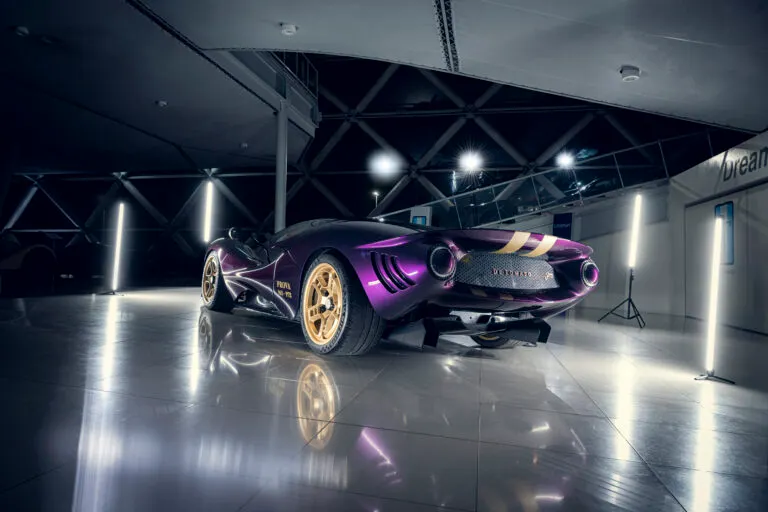
But there’s a regulatory wrinkle that few are mentioning: according to Top Gear, who had direct access to the production car, the P72 is capped at 63 dB by regulation, with ceramic-coated silencers designed for homologation compliance. For a car designed as a pure analog experience, having the exhaust muzzled below a delivery van is a considerable irony. What the P72 actually sounds like in the real world — not in a YouTube video of a prototype, but on an open road — is a question that won’t be answered until the first custodians turn the key.
The P900: The Doctoral Thesis
If the P72 is De Tomaso’s calling card, the P900 is the doctoral thesis. It’s not a hotter version of the P72 — it’s a pure circuit car that shares its designer (Jowyn Wong) and production facility (HWA, Affalterbach), but pursues a radically different objective: a 1:1 power-to-weight ratio.
The name comes from its target dry weight: 900 kg (1,984 lbs). Limited to 18 units at $3 million each. The P900 offers two engine options: a naturally aspirated 4.2-liter Judd GV4.2 V10 producing 775 hp at 11,000 rpm (the same engine family that has competed in Le Mans and Formula 1), or a bespoke naturally aspirated 6.2-liter V12 developed with Italian engineering firm Italtecnica, producing 900 hp with a revised redline of 10,200 rpm. De Tomaso claims the V12 is the smallest and lightest production V12 ever developed, weighing less than 441 lbs (200 kg), and designed to run on synthetic fuel. Transmission is a sequential Xtrac unit. The rear wing features an active DRS system similar to Formula 1.
Where the P72 says “I’m a grand tourer you drive without filters,” the P900 says “I’m an LMP1 car with an impossible license plate.” Two complementary statements, not competing ones. Together, they say that De Tomaso isn’t building a car — it’s building a brand with two pillars.
What the P72 Means for De Tomaso
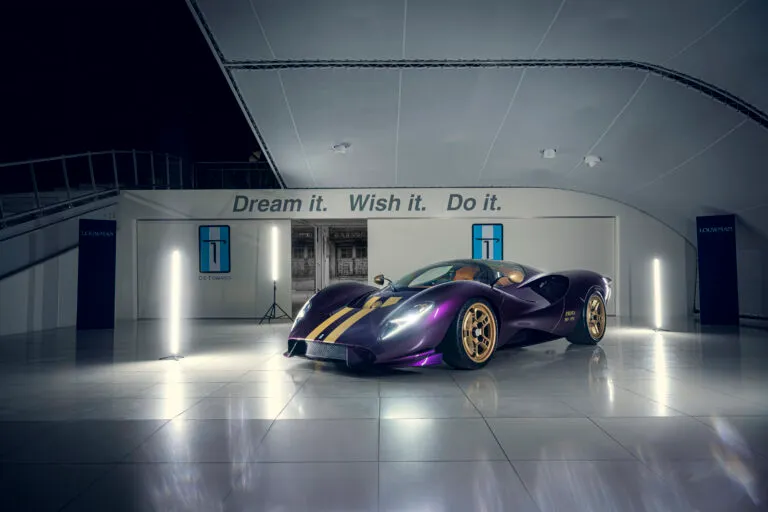
The P72 isn’t just a new car. It’s proof that the brand can exist beyond Alejandro de Tomaso. For a company whose identity was always inseparable from its founder, that’s the real achievement.
There’s a detail worth noting: the P72 keeps a Ford V8 at its core. Not an Italian V12, not an electric motor, not a hybrid. A supercharged Ford V8, prepared by an American company (Roush), in a carbon fiber chassis developed by a German firm (HWA), inside a body designed by a Hong Kong-based designer (Jowyn Wong), for an Italian brand founded by an Argentine. The P72’s globalization is, in a way, the modern version of what Alejandro de Tomaso did with the Pantera in 1971: take the best from every world without asking anyone’s permission.
The Ford Coyote engine — the same block that powers the Mustang GT — might seem like a modest choice for a $1.8 million car. But that’s exactly what De Tomaso did in the 1970s: use engines that any small-town mechanic could understand, maintain, and repair, and package them in something that competed with the Italian exotics running proprietary mills. The 351 Cleveland was the Mustang Mach 1’s engine. The Roush-supercharged Coyote 5.0 is its spiritual successor, with 700 horsepower and bespoke forged internals you won’t find in any dealer-lot Mustang.
Then there’s the interior. In an era where a Porsche 911 has more screens than a NASA control center, the P72 has exactly zero. No touchscreen, no built-in navigation, no audio system. Analog gauges, milled aluminum, and a phone holder. That’s it. The fair question is whether this is purism or a limitation disguised as philosophy. The answer probably depends on who you are and what you expect from a car at this price point. But what you can’t deny is that it’s a clear editorial position in a market that rewards ambiguity.
But the risks need to be stated clearly. Six years of delays erode confidence. The Berris lawsuit against Choi raises uncomfortable questions about internal governance. And those 72 sold units need to reach their owners in the condition promised — something no render or presentation can guarantee until the cars are on the road. The history of limited-production supercars is littered with broken promises and deposits that never came back. De Tomaso needs those first deliveries to be flawless — there’s no margin for a second failed launch.
The market for analog, manual, screen-free supercars is having a moment. And the P72 needs to position itself clearly against its direct rivals, because each one plays a different card.
The GMA T.50 from Gordon Murray is the most radical of the group: a 3.9-liter naturally aspirated Cosworth V12 that revs to 12,100 rpm, 654 hp, 2,174 lbs of dry weight, and a 400mm rear-mounted fan that actively manages aerodynamics. It’s a car designed by the engineer who created the McLaren F1, with the same obsession for extreme lightness. Its argument is total purity — and its €2.6 million price puts it a tier above the P72.
The Aston Martin Valiant, developed with Fernando Alonso to be “the most savage Aston Martin track car ever built,” runs the 5.2-liter twin-turbo V12 with over 735 hp, a six-speed manual, and a brutal weight reduction from the Valour on which it’s based. Its argument is controlled violence — a road car designed to be happiest on a circuit.
The Pagani Utopia bets on craftsmanship as its argument. AMG twin-turbo V12 engine, seven-speed manual with exposed linkage (similar to the P72), and a level of interior finish that borders on fine jewelry. Its argument is beauty as engineering.
What does the P72 offer that none of the others have? An American V8. That might look like a disadvantage in a segment where V12 is the norm, but it’s exactly what sets De Tomaso apart. The Roush-supercharged Coyote 5.0 isn’t trying to compete on cylinder count — it competes on character. It’s the same argument the Pantera used against the Ferrari Daytona in 1971: fewer cylinders, greater mechanical accessibility, and a price that — while high in absolute terms — sits below most of its direct rivals.
The P72 enters that conversation with an argument none of the others have: it’s a De Tomaso. It has a Ford V8. And it has 65 years of history behind it that give it permission to exist.
The Pantera proved in 1971 that you could build an accessible mid-engine supercar. The P72 proves in 2025 that you can build an analog supercar at $1.8 million and sell all 72 units before delivering the first one. The price has changed. The philosophy hasn’t.
And now, check you’re still alive.