Mercedes-Benz SLR McLaren: The Supercar Born from an “Impossible Marriage”
Imagine putting a German engineer obsessed with luxury and a British engineer obsessed with performance at the same table. Tell them they have to build a car together. Give them an unlimited budget and four years. What comes out of that meeting is the Mercedes-Benz SLR McLaren: a car that shouldn’t exist, that cost twice as much as planned, that split the specialized press, and that, twenty years later, turns out to be much better than anyone gave it credit for at the time.
The Spark: A Concept That Electrified Detroit
January 1999. The North American International Auto Show in Detroit. Mercedes-Benz parks a long, silver concept on its stand that leaves everyone breathless. They call it the Vision SLR, and they present it as the “Silver Arrow of tomorrow,” a direct reference to the legendary Silver Arrows that dominated racing in the 1950s.
The inspiration was clear: the 1955 Mercedes-Benz 300 SLR Uhlenhaut Coupé, a closed-roof version of the W196S race car. That car, which was never sold to the public, would end up becoming the most expensive car ever sold at auction decades later.
The Vision SLR concept featured a supercharged 5.0-liter V8 with 557 hp. It was low, long, wide, and looked like it was carved from a single silver ingot. The reception was so positive that Mercedes decided to take it into production. And for that, they called their Formula 1 partner: McLaren.
The Marriage That Nearly Ended in Divorce
This is where the story gets interesting. Mercedes owned 40% of the McLaren Group at the time. The F1 partnership was solid. But when executives from both companies sat down to define what the SLR should be, their visions clashed head-on.
Mercedes wanted a Grand Tourer: comfortable, luxurious, with every gadget imaginable. A car to cross Europe at 155 mph without breaking a sweat, with leather seats, perfect climate control, and a functional trunk.
McLaren wanted a race car with license plates. Lightweight, radical, uncompromising. Gordon Murray—the father of the McLaren F1 and head of the McLaren Cars division—led the technical development, and his philosophy didn’t allow for compromises on comfort.
The result was a tug-of-war that lasted nearly four years of development. The initial target price, around $200,000, more than doubled before the car hit production. When the SLR was finally unveiled to the public on November 17, 2003, it cost over $450,000. That placed it in the same territory as the Ferrari Enzo, the Porsche Carrera GT, and the Pagani Zonda. These were rivals the SLR was never designed to fight.
Originally, the intended competitors were the Ferrari F430, the Bentley Continental GT, and the Aston Martin DB9. These are very different cars from each other, but all were light-years away from the budget the SLR ended up costing.
Engineering Without Compromise (or with too many)
Regardless of the internal conflicts, what came out of the McLaren factory in Woking was technically extraordinary.
The chassis was a carbon fiber reinforced plastic (CFRP) monocoque, bonded via structural adhesive to an aluminum subframe that housed the drivetrain. It was one of the first production cars with a front crash protection system made entirely of carbon fiber.
The engine—a 5.5-liter V8 (5,439 cc exactly) with a twin-screw supercharger pumping out 13 psi (0.9 bar) of boost—was an evolution of the AMG block used in the Mercedes S55 AMG. But McLaren completely redesigned it for this application. All aluminum. 617 hp @ 6,500 rpm. 575 lb-ft of torque @ 3,250 rpm.
The transmission was the only automatic in the Mercedes catalog capable of handling such brutality: a 5-speed torque converter box with specific AMG software. This made the SLR the fastest production car equipped with a torque converter transmission of its time.
A fact few remember: to achieve acceptable weight distribution, McLaren had to move the engine nearly 3.3 feet (one meter) back from the concept’s original position. The engine sat behind the front axle in a “front-mid engine” configuration. This explains the SLR’s absurdly long hood: it’s not an aesthetic whim, it’s a direct consequence of engineering.
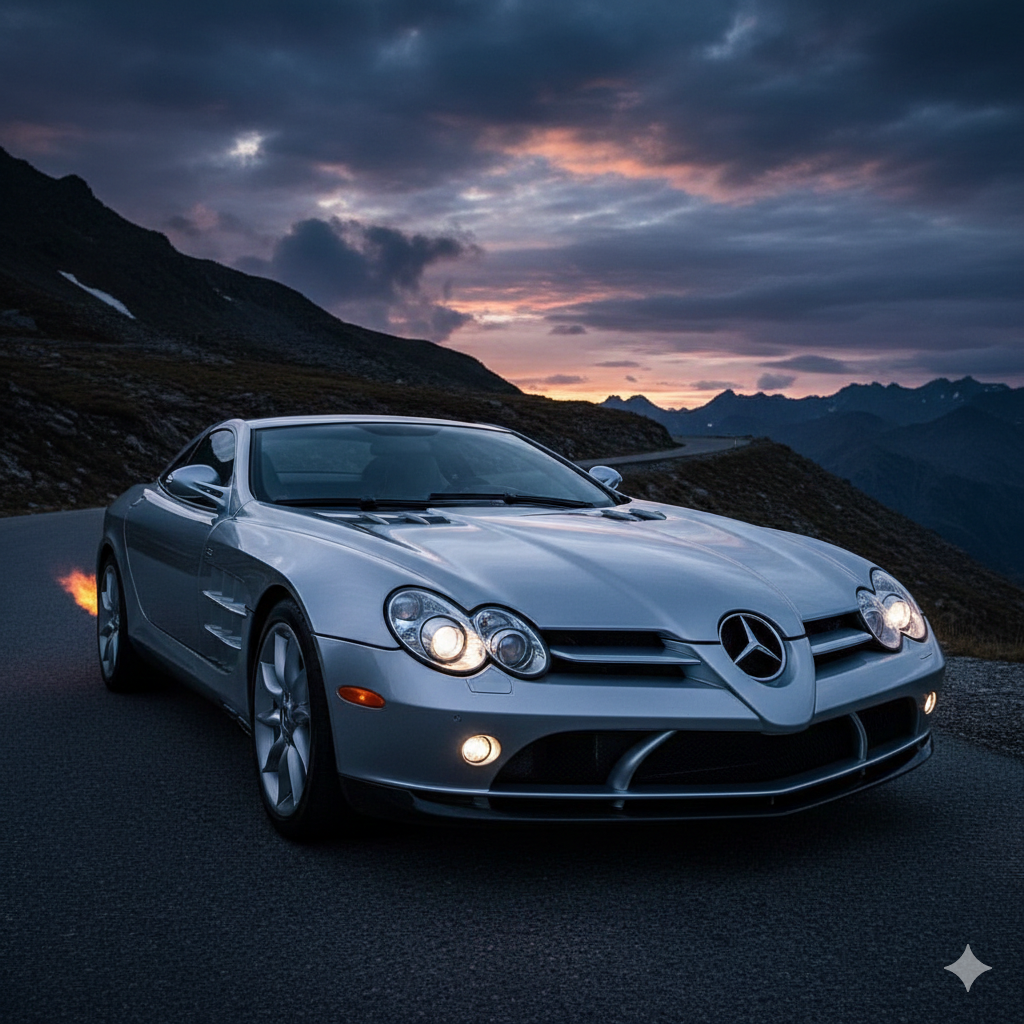
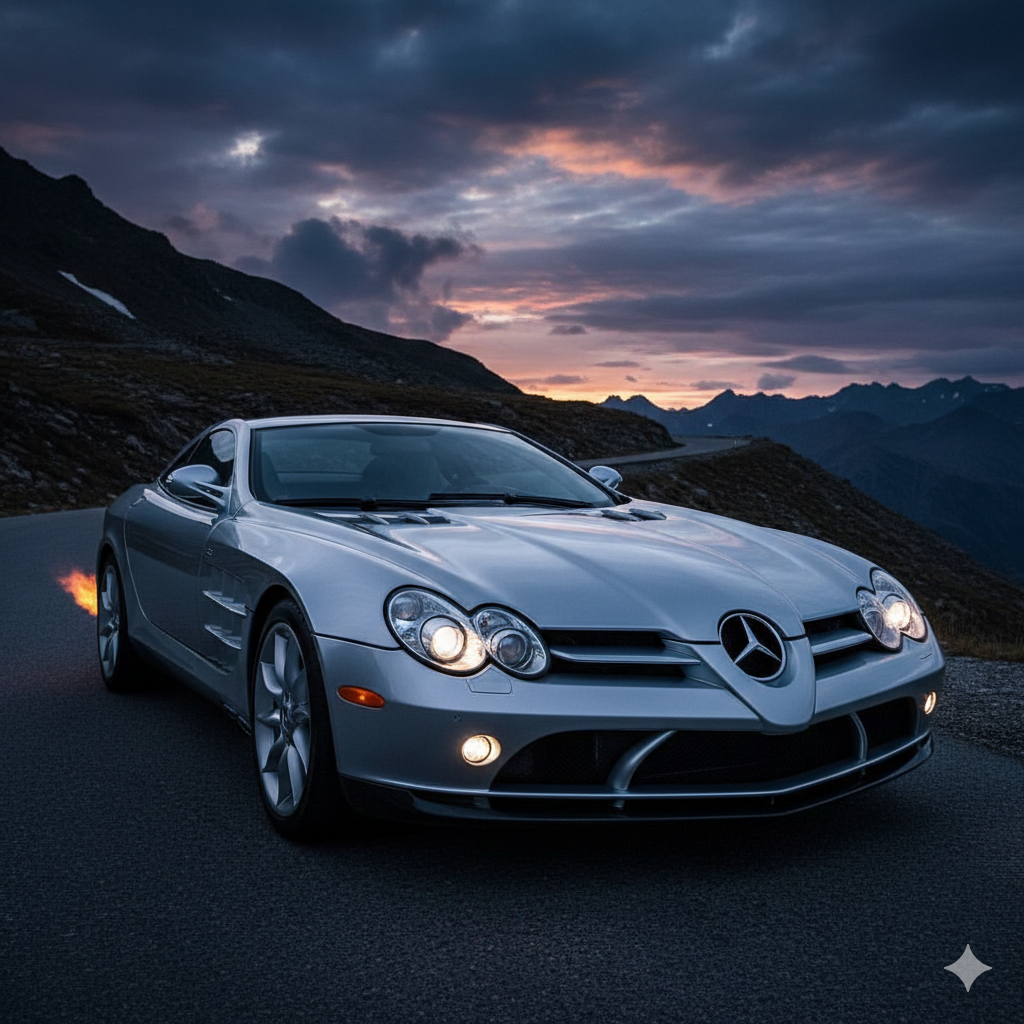
And there’s another cool detail: the exhaust pipes don’t exit out the back. To create an aerodynamic flat bottom, McLaren moved the exhaust outlets to the sides, in front of the cabin. When you floor an SLR, the flames literally shoot out next to your knees. It’s as theatrical as it is functional.
Active Aerodynamics: The Wing That Brakes
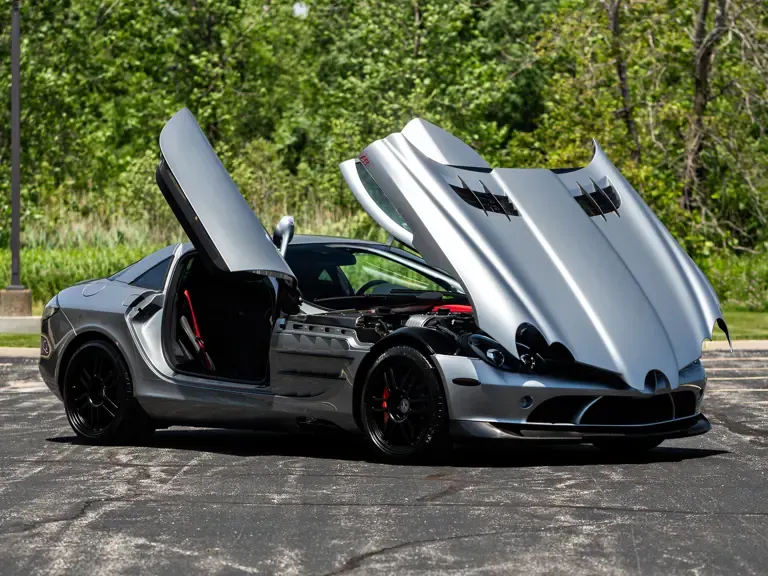
The SLR incorporated one of the most sophisticated active aero systems of its day. The rear spoiler had three positions:
In normal driving, it remained retracted to minimize drag. At high speeds, it rose automatically to generate downforce. And in emergency braking, it stood up completely vertical, acting as an airbrake that increased aerodynamic braking surface by 60%.
Combined with carbon-ceramic brakes—14.5-inch (370 mm) discs up front and 14.1-inch (360 mm) in the rear—the SLR had brutal stopping power. Mercedes claimed the ceramic discs could withstand up to 2,200°F (1,200°C) without fading. The complete braking system weighed 13 lbs (6 kg) less than a conventional equivalent system.
Technical Specs
| Specification | Data |
| Production Years | 2003–2010 |
| Design | Mercedes-Benz |
| Engineering & Manufacturing | McLaren (Woking, England) |
| Body Style | Coupé / Roadster / Speedster |
| Chassis | CFRP Monocoque + Aluminum Subframe |
| Engine | AMG M155 V8 5.5L Supercharged |
| Horsepower | 617 hp @ 6,500 rpm |
| Torque | 575 lb-ft @ 3,250 rpm |
| Transmission | 5-speed Automatic (Touchshift) |
| Drivetrain | Rear-Wheel Drive (RWD) |
| 0-60 mph | 3.8 seconds |
| 0-124 mph | 10.6 seconds |
| 0-186 mph | 28.8 seconds |
| Quarter Mile | 11.2 sec @ 130 mph |
| Top Speed | 208 mph |
| Lateral G-Force | 1.13 g |
| Brakes | Carbon Ceramic (370/360 mm) |
| Weight | 3,895 lbs (Coupé) |
| Length | 183.3 inches |
| Width | 75.1 inches |
| Wheelbase | 106.3 inches |
| Original Price | ~$455,000 USD |
| Total Units Produced | 2,157 |
| Current Market Value | $250,000 – $800,000+ |
The Variants: From the GT to the Wild Windowless Speedster
The SLR was not a single model. Throughout its six-year life, it evolved into several increasingly radical versions.
SLR McLaren Coupé (2003-2007): The original model. 617 hp, 208 mph. The ultimate grand tourer of its era. Most of the 2,157 total units were this version.
SLR McLaren 722 Edition (2006-2007): Named in honor of Stirling Moss’s 1955 Mille Miglia victory, whose race number “722” corresponded to his start time: 7:22 AM. Engine boosted to 641 hp and 605 lb-ft. Firmer suspension, ride height lowered by 0.4 inches (10 mm), 15.3-inch (390 mm) front discs, 19-inch wheels, and red and black exterior accents. Limited to 150 units.
SLR McLaren Roadster (2007-2009): Convertible version with a triple-layer fabric top that opened in less than 10 seconds, even while driving at 30 mph. It kept the coupé’s performance practically intact despite the extra weight.
SLR McLaren 722 S Roadster (2008-2009): The convertible version of the 722. Same 641 hp engine in an open-top format. Only 150 units.
SLR Stirling Moss (2009): The finale. The climax. The most radical car ever to wear a three-pointed star on its nose. No roof. No windshield. Every body panel redesigned. Engine pushed to 641 hp. Only 75 units, sold exclusively to existing SLR owners. It cost $1 million and sold out before the first one was even built.
What No One Told You
- TVR-bodied Prototypes: When the SLR was still in the prototype phase, Mercedes used two TVR Cerbera bodies as development mules. A cult British sports car serving as a disguise for a German-British supercar. The irony is delicious.
- The Longest Hood Ever: The SLR’s hood measures over 6.5 feet. It’s not a design whim: it’s the result of moving the engine nearly a meter back to improve weight distribution. McLaren turned an engineering constraint into a signature trait.
- Side Exhausts with Visible Flames: The exhaust pipes exit the sides of the car, just in front of the doors, to maintain the flat bottom. Under heavy acceleration, you can see flames spitting out the side outlets. It’s not a trick: it’s the most elegant solution to an aerodynamic problem.
- The SLR That Cost $142 Million: The 300 SLR Uhlenhaut Coupé that inspired the SLR McLaren sold in a private auction in May 2022 for $142 million (135 million euros plus commissions). It is, to date, the most expensive car ever sold. The spiritual connection between the two cars is direct and undeniable.
- Sales Far Below Target: Mercedes planned to sell 500 units a year and produce 3,500 in total. Reality was harsh: 615 units in 2005, 261 in 2006, 275 in 2007. Only 2,157 were made in total. The price, combined with the car’s ambiguous identity—neither a pure supercar nor a conventional GT—stunted sales.
- The Fight for Identity: Disagreements between Mercedes and McLaren over the nature of the SLR were so deep they contributed to the eventual split between the two companies. Mercedes sold its stake in McLaren and created AMG as its own in-house performance arm. The SLS AMG, the SLR’s spiritual successor, was a 100% German project.
- Analog Suspension in a Digital World: At a time when the competition was already using adaptive damping and air suspension, the SLR mounted conventional springs and shocks. McLaren chose simplicity and reliability over sophistication. The result was a stiffer ride than expected for a half-million-dollar GT, but purists argue it was the right move.
The Misunderstood Supercar
The SLR McLaren has a perception problem that has followed it since its launch. It cost like an Enzo but wasn’t an Enzo. It had the McLaren name but wasn’t a pure McLaren. It was a GT but accelerated like a supercar. It was a supercar but had a trunk and luxury climate control.
That duality, which confused critics and buyers at the time, is exactly what makes it fascinating today. The SLR was a car that tried to be two things at once and, against all odds, largely succeeded. You could pull off a 600-mile highway road trip without wrecking your back and then attack a mountain pass with 617 hp feeding the rear wheels through fire-spitting side exhausts.
Over time, SLR values have steadily climbed. McLaren Special Operations offered upgrade programs in 2011 and 2021 for existing cars. And in 2022, they announced the SLR McLaren HDK, a street-legal version of the 722 GT race car with 680 hp.
A car that seemed dead continues to evolve two decades later. That says a lot about what Mercedes and McLaren created together, despite their differences.
The Legacy of the Improbable Marriage
The SLR McLaren is proof that creative tension can produce extraordinary results. Mercedes wanted luxury, McLaren wanted performance, and the final car delivered both to an extent neither would have achieved alone.
It’s also a reminder that the auto industry has lost something valuable. Today, brand collaborations produce shared SUVs and generic platforms. In 2003, they produced a carbon fiber car with side exhausts, an automatic airbrake, and fire-breathing vents on its sides.
They don’t make them like they used to.
SLR: Sport. Leicht. Rennsport.
Sport. Light. Racing.
It says it all in three words.
4 thoughts on “MERCEDES-BENZ SLR McLAREN”