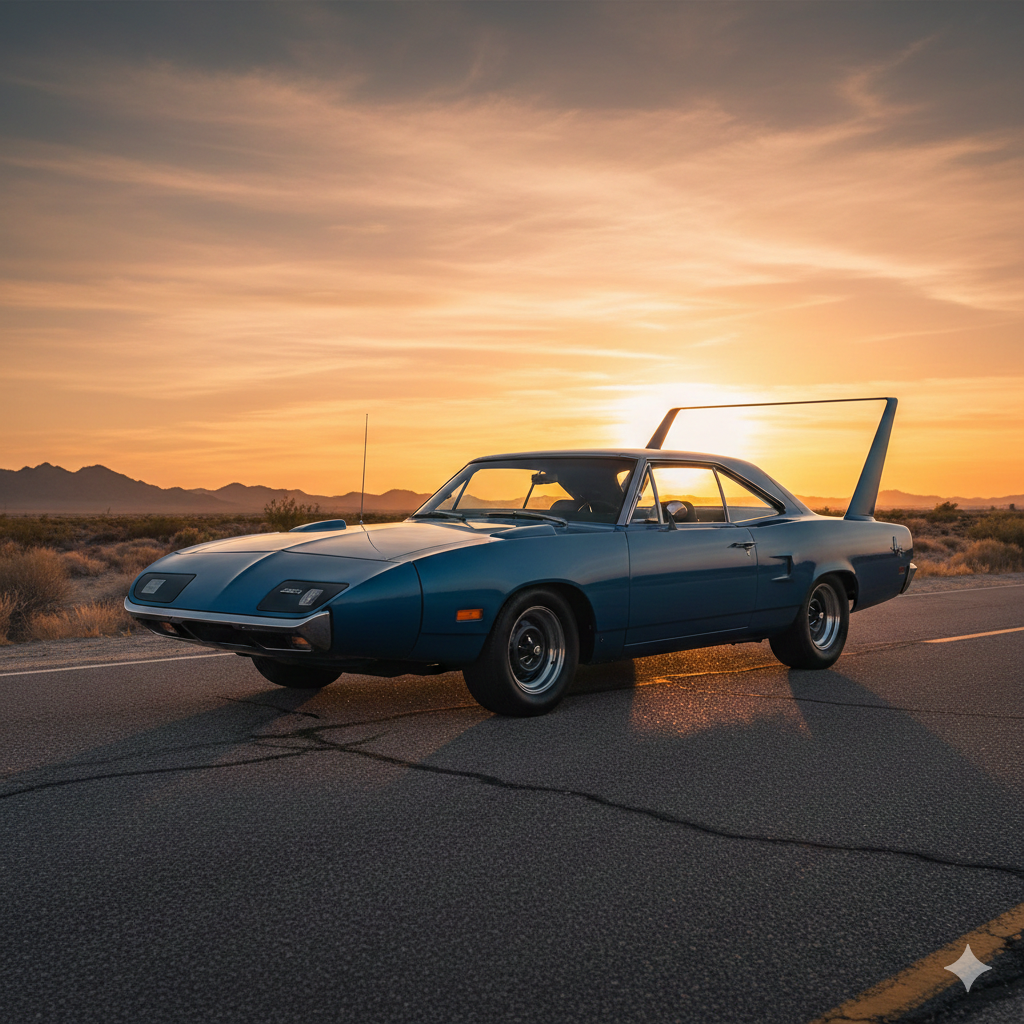
1970 PLYMOUTH SUPERBIRD
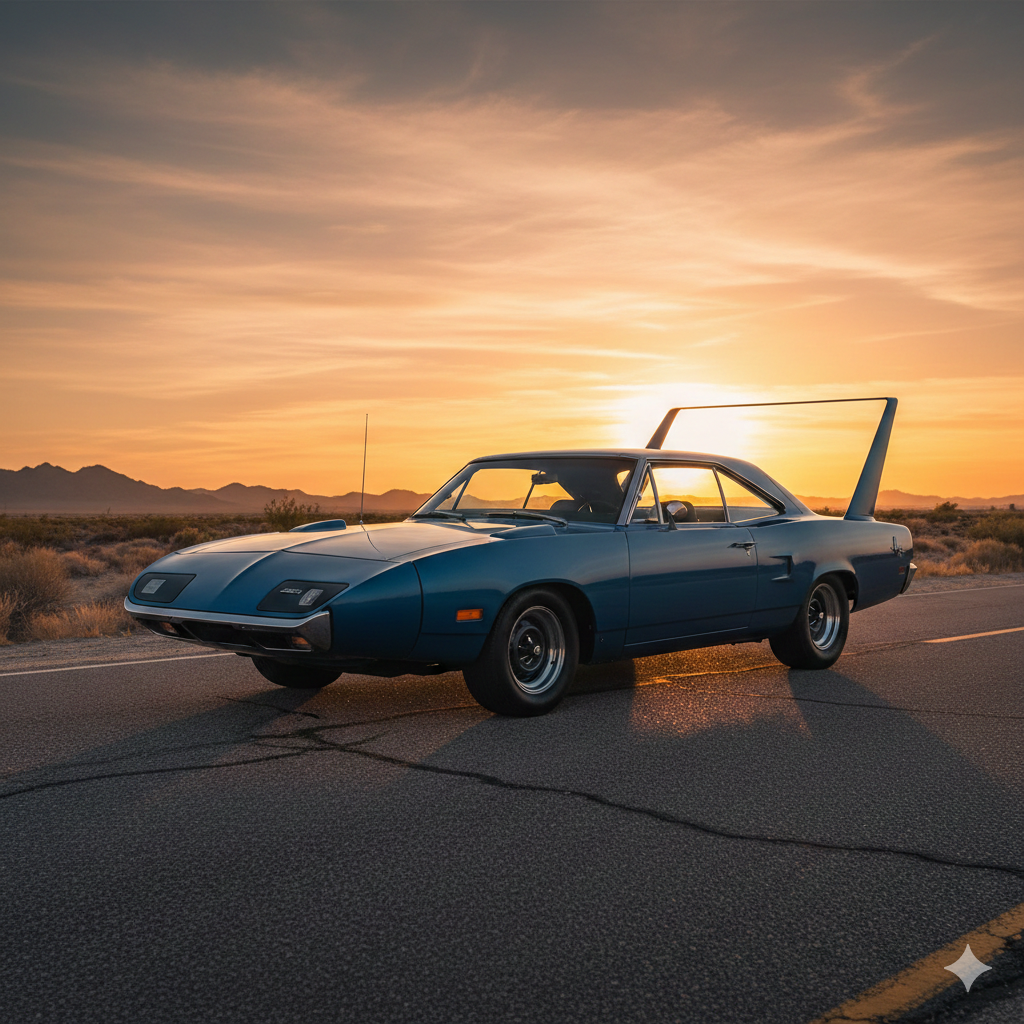
The 1970 Plymouth Superbird: The Bird That Landed Way Too Hard
Some cars are born for the open road. Others are born for the track. And then there’s the Plymouth Superbird—a car literally built to convince one man to come back to work. A car so extreme it terrified its own buyers. A car so fast they had to change the rulebook just to slow it down. This is its story, and it’s one of the greatest ever told in the automotive world.
A Divorce That Changed History
To understand the Superbird, you first have to understand the drama. It’s 1968, and Richard Petty—”The King” of NASCAR, the man who won 27 out of 48 races in the ’67 season—has had enough. His Plymouth Road Runner can’t touch the aerodynamic Fords dominating the high banks. Petty demands a winged car, a weapon capable of slicing through the air. Plymouth has nothing for him.
So, Petty does the unthinkable: he jumps ship to Ford.
Chrysler goes into full-blown panic. First, Dodge creates the 1969 Charger Daytona, which becomes the first American production car to break 200 mph on the track. But Plymouth needs its own version—not just to win races, but to bring their superstar back home. The Superbird was born with a personal mission: win back Richard Petty.
And it worked.
Anatomy of an Aero Warrior
The Superbird was based on the Plymouth Road Runner, but what Chrysler’s engineers did to it was surgical. They added an 19-inch nose cone with retractable headlights. A massive rear wing, standing 24 inches high on twin vertical stabilizers. A redesigned rear window that sat flush with the body.
Every design choice was driven by pure aerodynamics. The hood and front fenders were actually borrowed from the 1970 Dodge Coronet to fit the extended nose. Every production unit came with a vinyl top, and not for style—it was to hide the weld seams left behind when they installed that flush rear window.
Here’s a detail most people miss: the air scoops on top of the front fenders were purely cosmetic on the street versions. On the race cars, those same vents allowed air trapped in the wheel wells to escape, reducing pressure and lift. Pure functional genius disguised as a trim piece.
The aero result was spectacular: a drag coefficient (Cd) of just 0.28. To put that in perspective, many modern cars can’t even hit that number today.
Three Hearts, One Mission
The Superbird offered three brutal engine options:
- 440 Super Commando (4-barrel): The “base” engine—if you can call a 7.2L V8 with 375 HP “base.” This was the most civilized option with a single four-barrel carb. Most Superbirds left the factory with this mill.
- 440 Super Commando Six Barrel: Same displacement but fed by three two-barrel carbs, bumping output to 390 HP. 716 units were built in this configuration, and it was the sweet spot between performance and reliability.
- 426 Hemi: The beast. The legendary “Elephant Motor.” 425 HP officially, though anyone who’s ever dyno’d one knows Chrysler underrated the numbers to keep the insurance companies from panicking. Only 135 Superbirds were born with this engine. These are the “Holy Grail” units today.Available transmissions were the three-speed TorqueFlite 727 automatic—famous for being nearly bulletproof—and the A833 four-speed manual with the iconic Hurst Pistol Grip shifter. Of the 1,935 units produced, 1,084 were automatics and 851 were manuals.
The Numbers That Broke NASCAR
With a 426 Hemi under the hood, the Superbird clocked 0-60 mph in 4.8 seconds. But where it really shined was top-end speed. In March 1970 at Talladega, a race-spec Superbird shattered the 200 mph barrier, setting a NASCAR record.
The fascinating paradox of the Superbird is that on the street and in a straight-line drag race, a standard Road Runner was actually faster in the quarter-mile. The Superbird’s aero bits added downforce that didn’t help below 100 mph. It was only after that point that the nose and wing started to work, and above 200 mph, the car became an unstoppable missile.
Technical Specs
| Specification | Data |
| Production Year | 1970 (One year only) |
| Base Model | Plymouth Road Runner |
| Body Style | 2-Door Coupe |
| Base Engine | 440ci V8 (7,210 cc), 375 HP |
| Six Barrel Engine | 440ci V8 (7,210 cc), 390 HP |
| Hemi Engine | 426ci V8 (6,981 cc), 425 HP |
| Transmission | 3-speed Auto 727 / 4-speed Manual A833 |
| 0-60 mph (Hemi) | 4.8 seconds |
| Top Speed (Race) | 200+ mph (320+ km/h) |
| Drag Coefficient (Cd) | 0.28 |
| Wheelbase | 116 inches |
| Total Length | 220 inches (with nose cone) |
| Ground Clearance | 7.2 inches |
| Brakes | Drum (Front and Rear) |
| Total Produced | 1,935 |
| Hemi Units | 135 |
| Original Price | ~$4,298 (Base 440-4bbl) |
| Estimated Value | $200,000 – $450,000+ |
The Season That Changed Everything
Richard Petty returned to Plymouth for the 1970 season, and the #43 Superbird in its iconic Petty Blue proved the investment was worth it. Petty won 18 out of the 40 races he entered that year. His teammate Pete Hamilton won the Daytona 500 and Talladega in another Superbird.
In total, Mopar’s “aero cars” (Superbird and Charger Daytona) won 33 of the 48 races in the 1970 season. Their dominance was so absolute that NASCAR had to step in.
For 1971, the organization limited the engines of these winged cars to a maximum of 305 cubic inches (5.0L) or forced them to carry significantly more weight than the competition. Effectively, this killed the Superbird after just one year of production.
The Ugly Duckling of the Dealerships
And here’s the most ironic part of the whole story. While the Superbird was crushing it on the ovals, it was a commercial disaster in the showrooms. The car was just too radical for the average 1970 buyer. The long nose, the giant wing, the impracticality of daily driving it, and high insurance costs made most potential buyers walk right past it.
Plymouth had to build 1,920 units to meet NASCAR’s homologation rule (one car for every two dealerships). Many of these cars sat unsold for months, even years. Some desperate dealers, looking to free up lot space, actually hacked off the nose and wing and sold them as standard Road Runners.
Think about that for a second. Today, a 426 Hemi Superbird can clear $450,000 at auction. Back in 1971, a dealer took an angle grinder to the nose and sold it as a “normal” car at a discount.
What Most People Don’t Know
- The Trunk Myth: For decades, people claimed the wing was that high just so the trunk lid could open. A retired Chrysler engineer started this story in the 90s, but it’s an urban legend. The wing height was calculated to sit in “clean air” above the roofline, maximizing downforce on the rear wheels.
- The Road Runner Horn: The Superbird kept the Road Runner horn that imitated the “Beep, Beep!” of the Looney Tunes character. The body even featured decals of the bird wearing a racing helmet. All this on a car capable of 200 mph.
- The TVR Mules: Before the Superbird existed, Chrysler used TVR Cerbera bodies as “mules” to develop the aerodynamic modifications.
- The 1971 Design That Never Was: A 1971 Superbird was designed based on the new Sebring body style, nose and wing included. Only a few prototypes were made, and they never saw competition. Today, they are priceless museum pieces.
- Charger Daytona vs. Superbird: While they look similar, they are different. The Plymouth’s nose had a center crease, and the air intake was different. The Dodge lacked the crease and had a divided intake. Plymouth also kept the Road Runner’s original taillights and side profile.
A Legacy That’s Still Accelerating
The Plymouth Superbird was a car that existed for one reason—to win—and when the rules stopped it from winning, it vanished. There was no second generation, no gradual evolution. It was a lightning strike: brilliant, devastating, and gone.
Today, it’s one of the most sought-after muscle cars on the planet. Collectors hunt down the 135 Hemi units like they’re fine art. And in a way, they are. They’re proof that when a brand bets everything on a radical idea, the result is unforgettable.
The Superbird reminds us of something today’s industry seems to have forgotten: that sometimes, the best cars are born from obsession, not market research. That brilliant engineering can come wrapped in a design that scares people. And that a single year is enough to write an eternal legend.
Beep, beep.