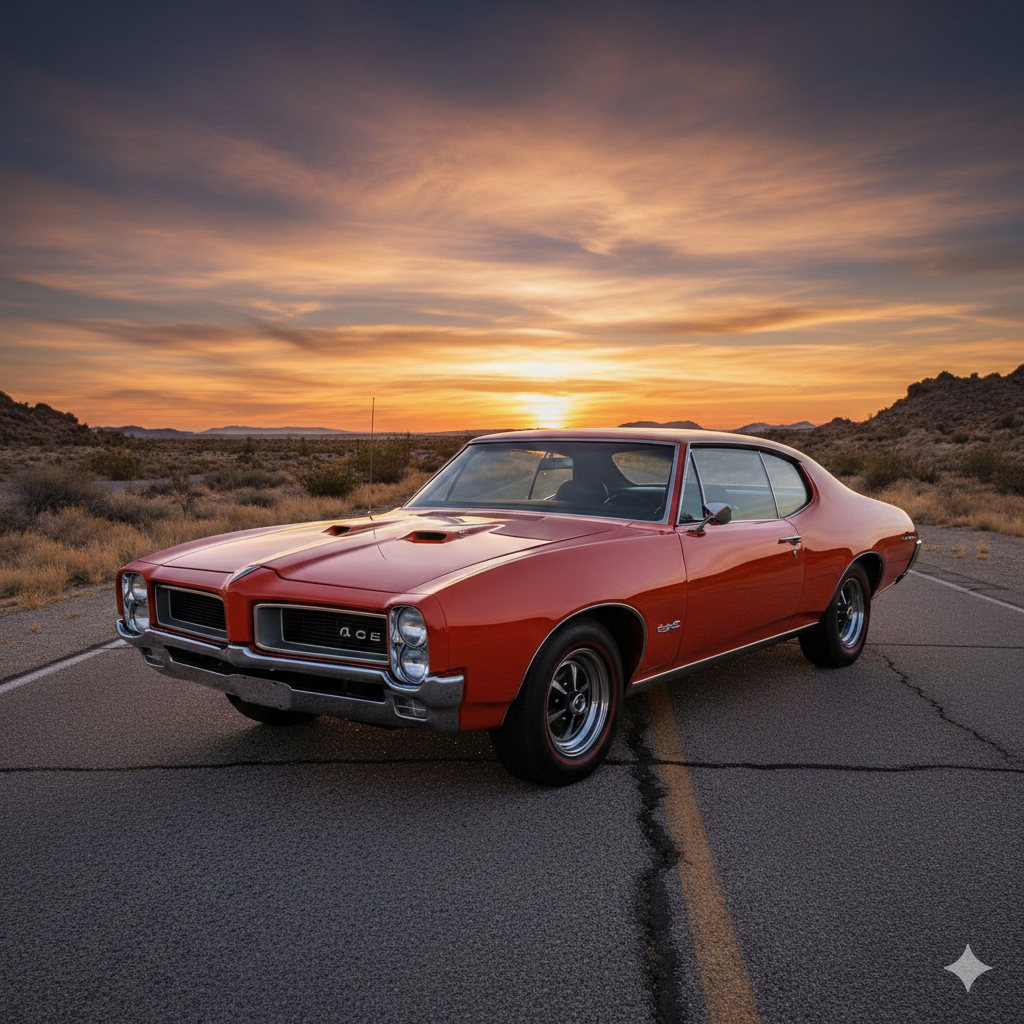
PONTIAC GTO (1964-1974): The Godfather of the American Muscle Car
The Birth of a Forbidden Legend
In 1963, General Motors had a crystal-clear policy: no division could install engines larger than 330 cubic inches in intermediate-sized cars. It was a corporate safety rule, designed to prevent “mad engineers” from putting bombs on wheels into the hands of young Americans.
John DeLorean—yes, the same man who would later create the Back to the Future car—had other plans.
As Pontiac’s chief engineer, DeLorean found a brilliant loophole. Instead of creating a new model, he offered the 389 V8 engine with 325 HP as a simple “option package” for the Pontiac Tempest. It wasn’t a new car. It was just… a checkbox on an order form.
The price of rebellion? $295.90 extra. For less than 300 bucks, an American could turn a boring family car into a 6.4-liter monster.
Why “GTO”? The Boldest Theft in Automotive History
Here is where it gets interesting—and controversial.
The acronym GTO stands for “Gran Turismo Omologato,” an Italian term Ferrari used for its race-homologated cars. The 1962 Ferrari 250 GTO had just won the World GT Championship and was arguably the most prestigious car on the planet.
What did Pontiac do? They stole the name. Boldly.
Enzo Ferrari was furious. European purists saw the move as typical American vulgarity. But DeLorean couldn’t have cared less. The name was catchy, sounded exotic, and it sold cars.
The irony: A Ferrari 250 GTO cost $18,000 in 1962. A Pontiac GTO cost $2,852. For the price of one Ferrari, you could buy six GTOs and still have enough left for gas.
The Numbers That Rocked Detroit
GM expected to sell 5,000 GTOs in 1964. It was an experiment, after all—a whim of rebel engineers.
They sold 32,450.
The second year: 75,352 units.
In 1966: 96,946 cars.
The corporation that had banned muscle cars now couldn’t build them fast enough. Chevrolet fired back with the Chevelle SS 396. Ford countered with the Fairlane GT. Dodge launched the Charger. Plymouth created the GTX.
John DeLorean didn’t just disobey orders; he created an entire industry.
The Evolution: From Gentleman to Beast
1964-1967: The Classic Years
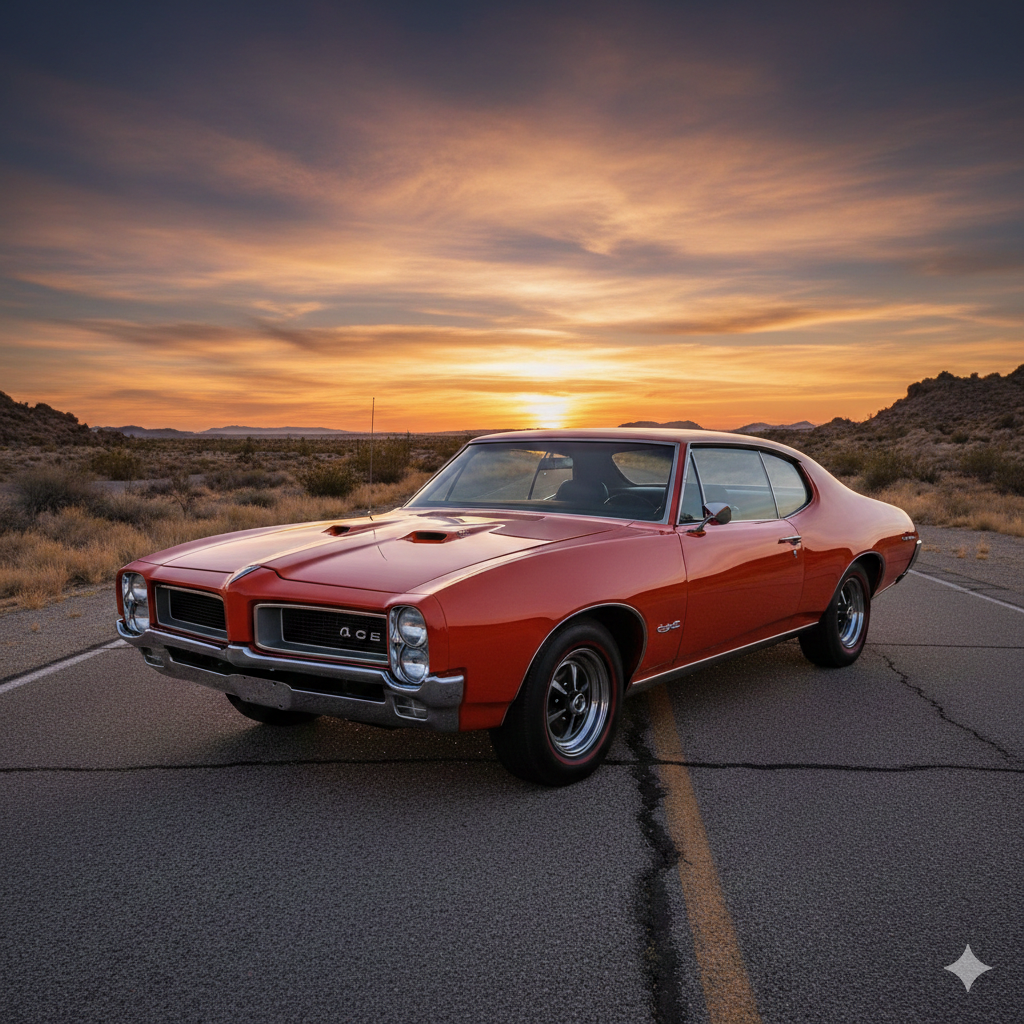
The original GTO had clean, elegant lines. The Tri-Power engine (three two-barrel carburetors) delivered 360 HP and a sound that still brings enthusiasts to tears. The interior smelled like vinyl and infinite possibilities.
1968-1970: The Golden Era
The 1968 redesign brought the “Coke bottle” body—sensual curves that would define the muscle car look forever. In 1969, “The Judge” arrived—an even more radical version with the Ram Air IV engine. Officially rated at 370 HP, many gearheads claim it easily cleared 400.
The name “The Judge” came from a sketch on Rowan & Martin’s Laugh-In where a character yelled “Here come da Judge!” It was absurd. It was perfect. It was the ’60s.
1970: Peak Torque
The 455 HO engine delivered 500 lb-ft of torque. To put that in perspective: a modern Porsche 911 produces about 390 lb-ft. This engine from 55 years ago had more raw grunt than a modern German sports car.
1971-1974: The Decline
Emission regulations, rising gas prices from the oil crisis, and skyrocketing insurance rates killed the muscle car. The 1974 GTO produced only 200 HP. It was a shadow of its former self.
Tech Specs You Need to Know
| Generation | Engine | Power | 0-60 mph | Total Production |
| 1964 | 389 Tri-Power | 348 HP | 6.6 sec | 32,450 |
| 1966 | 389 | 360 HP | 6.2 sec | 96,946 |
| 1969 Judge | Ram Air IV | 370 HP | 5.9 sec | 6,833 |
| 1970 | 455 HO | 360 HP | 5.5 sec | 40,149 |
| 1974 (Last) | 350 | 200 HP | 8.9 sec | 7,058 |
Trivia You Didn’t Know
- The Dealer Trick: Many dealers installed open exhausts and “accidentally” left off the mufflers to deliver more power. GM knew and looked the other way.
- The Consumer Reports Test: In 1964, the magazine tested the GTO and called it “dangerous to society.” Sales skyrocketed the next day.
- The Secret Engine: The Ram Air IV had special combustion chambers that never appeared in official documentation. Pontiac kept secrets even from GM.
- The Hit Song: “Little GTO” by Ronny & The Daytonas hit #4 on Billboard in 1964. It was the first song about a specific muscle car to reach the Top 10.
- Enzo’s Mistake: Ferrari never sued Pontiac for using the GTO name. Maranello’s lawyers figured it wasn’t worth chasing “American tractor makers.” Today, a mint 1969 GTO Judge clears $150,000.
The Controversy: Was It Really the First?
Technically, the 1949 Oldsmobile Rocket 88 combined a big V8 with a light chassis—the basic muscle car formula—fifteen years before the GTO. Even the 1956 Plymouth Fury and Dodge D-500 could claim the title.
So why does the GTO get the credit?
Because DeLorean didn’t just build a car; he built a marketing concept. The GTO was the first to be sold specifically as a high-performance machine for the youth. It was the first to spark imitators. It was the first to define a category. It didn’t just invent a car; it turned speed into a cultural identity.
Current Market Values
- 1964 Tri-Power Convertible: $80,000 – $120,000
- 1969 Judge Ram Air IV: $120,000 – $180,000
- 1970 455 HO: $60,000 – $90,000
- 1971-1974: $25,000 – $45,000
The 2004-2006 resurrection attempt (based on the Australian Holden Monaro) was a commercial flop. It was a good car, but it wasn’t a GTO.
Conclusion: Disobedience That Defined an Era
The Pontiac GTO proves something fundamental: sometimes the best ideas come from ignoring the rules. John DeLorean bet his career that Americans wanted raw, unpretentious power. Cars that accelerated harder than they thought. Cars that made noise, burned rubber, and defied common sense.
He was right.
The American muscle car exists because a rebel engineer decided that corporate policies were just suggestions.
Debate Question: If the GTO had been called the “Tempest Sport Package” as GM wanted, would it have had the same impact? How much was the car, and how much was DeLorean’s marketing genius?