
LAMBORGHINI MIURA (1966-1973): The Car That Invented the Supercar

The Forbidden Project
In 1965, Ferruccio Lamborghini was crystal clear about one thing: he did NOT want to build race cars.
His factory in Sant’Agata Bolognese was cranking out the 350 GT and 400 GT—elegant grand tourers designed for gentlemen who wanted to travel fast but in total comfort. Lamborghini hated Ferrari specifically because Enzo considered comfort secondary to competition.
“Racing is for idiots,” Ferruccio used to say. “Road cars are for smart men.”
But three of his engineers—Gian Paolo Dallara, Paolo Stanzani, and Bob Wallace—had other ideas. During their lunch breaks and long after the clock stopped, they started secretly designing the most radical car ever conceived.
The Mid-Engine Revolution
The idea was simple but revolutionary: put the V12 engine behind the driver, transversely (sideways), just like a Le Mans race car. No road car had ever done it.
The Ford GT40 and Ferrari 250 LM used mid-engine setups, but those were race cars with improvised street versions. Nobody had designed a mid-engine grand tourer from the ground up.
The technical challenge was massive: how do you pack a 4.0L V12, the gearbox, the differential, and the entire cooling system into a space where you’d normally only fit two suitcases? Dallara’s solution was brilliant: he integrated the transmission and differential into the same oil pan as the engine. The entire powertrain worked as one compact unit.
When Ferruccio discovered the project, he was livid.
“I told you: no race cars!”
“But Mr. Lamborghini,” Dallara replied, “this isn’t a race car. It’s a GT. It’s just… different.”
Turin 1965: The Chassis That Hypnotized the World
Without a finished car but with a revolutionary concept, Lamborghini decided to show it off at the 1965 Turin Auto Show. They presented just the bare chassis—engine, transmission, suspension—no bodywork.
The Lamborghini stand became the most visited spot in the show. Visitors couldn’t believe their eyes: a sideways-mounted V12, visible from every angle, with a tube structure so light it seemed impossible it could hold a real car. The press went wild. Orders started pouring in. Lamborghini didn’t have a body or even a name for the car yet. But he had something more important: the industry’s undivided attention.
Gandini: The 27-Year-Old Genius
To design the body, Lamborghini turned to Bertone. Nuccio Bertone assigned the project to his young designer: Marcello Gandini, who was only 27 at the time.
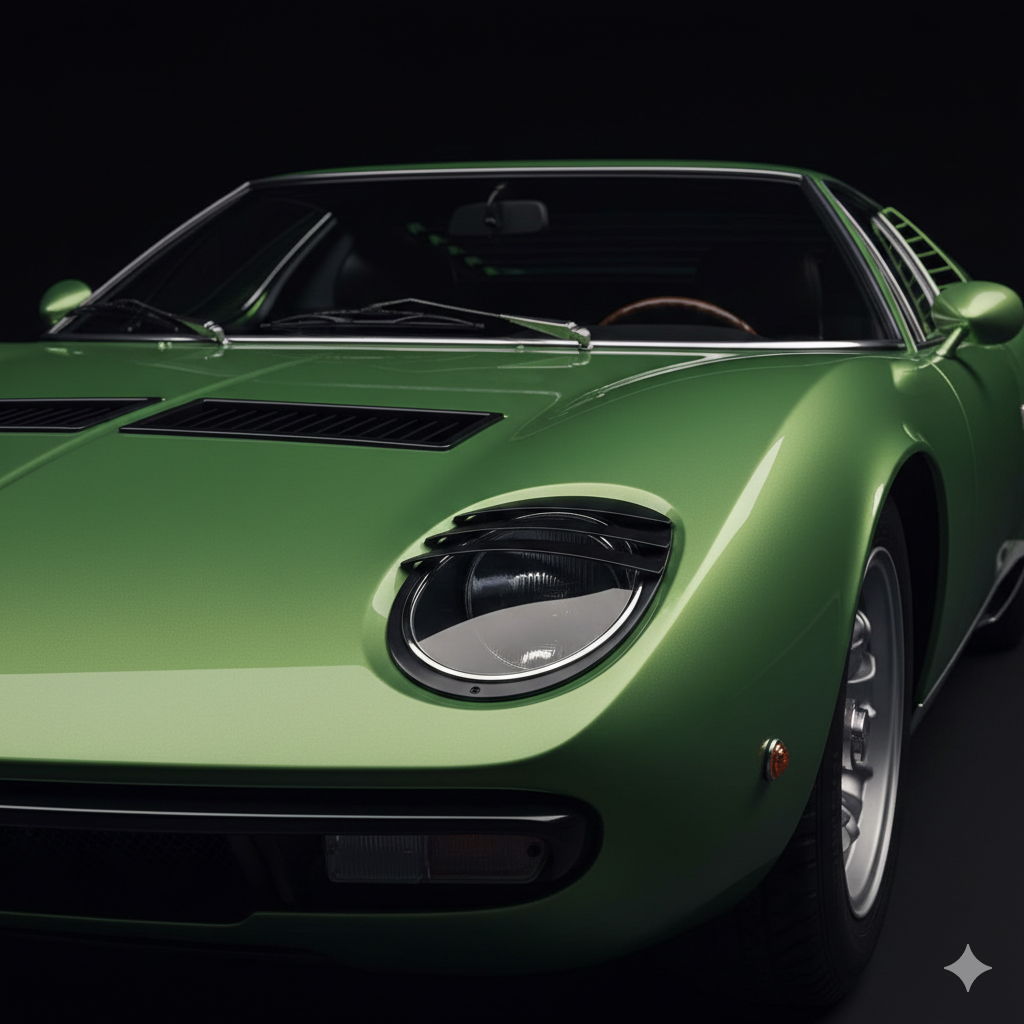
The result was the most influential design in automotive history. The Miura’s lines broke every rule:
- Extremely low nose (possible because there was no engine up front).
- Muscular rear fenders (to channel air to the engine).
- Headlights framed by “eyelashes” (which became a Lamborghini signature).
- Rear louvers that looked like shark gills.
Every Lamborghini after the Miura—the Countach, the Diablo, the Murciélago—carries the DNA of that 1966 original.
Why “Miura”?
Ferruccio Lamborghini loved bulls. His zodiac sign was Taurus. He made his fortune selling tractors. And he felt a spiritual connection to these beasts.
The name “Miura” comes from Don Eduardo Miura, the Spanish rancher whose family has been breeding fighting bulls since 1842. Miura bulls are famous for their aggression, intelligence, and lethality. A Miura bull killed Manolete, the most famous matador in history, in 1947. Ferruccio thought that name—associated with death, speed, and savage beauty—was perfect for his machine.
The Variants: P400, S, and SV
P400 (1966-1969)
- Engine: 3.9L Transverse V12
- Power: 350 HP @ 7,000 rpm
- Top Speed: 174 mph (280 km/h)
- Production: 275 units
P400 S (1968-1971)
- Power: 370 HP @ 7,500 rpm
- Upgrades: Power windows, luxury trim, and a revised overhead cam.
- Production: 140 units
P400 SV (1971-1973)
- Power: 385 HP @ 7,850 rpm
- Top Speed: 180 mph (290 km/h)
- Upgrades: Redesigned rear suspension, flared fenders, and separated oil systems (finally!).
- Production: 150 units
The Fatal Flaw Nobody Mentions
Here’s the “no filters” part of the Miura story. The transverse mid-engine design was brilliant, but it had a serious problem: the engine and the gearbox shared the same oil.
This meant metal shavings from the transmission contaminated the engine lubricant, and hot engine oil degraded the gearbox synchros. Early Miuras required oil changes every 1,800 miles.
Furthermore, high-speed handling was… “interesting.” With 40% of the weight over the rear axle, the car had a tendency to “nose up” or float at speeds over 150 mph. Many test pilots described the experience as “terrifying.” Bob Wallace installed an experimental front spoiler to fix it, but Lamborghini never offered it as a factory option.
The Italian Job: 3 Minutes of Immortality
In 1969, the movie The Italian Job opened with an orange Miura P400 snaking through the Alps to the soundtrack of Matt Monro’s “On Days Like These.” The sequence lasts 3 minutes and 48 seconds. No dialogue. Just the car, the mountains, and the music. It is arguably the most beautiful car intro in cinema history.
The Legacy: Forcing Ferrari to Reinvent
In 1966, Ferrari dominated the supercar market with the 275 GTB. It was fast and beautiful, but it was conventional: front-engine, rear-drive. The Miura made it look like a dinosaur overnight.
Ferrari’s response took five years. In 1971, they presented the 365 GT4 BB (Berlinetta Boxer), their first mid-engine production car. It was a direct response to the Miura. The Miura didn’t just invent a new category; it set the rules everyone else would follow for the next 50 years.
Tech Specs & Trivia
| Feature | Data |
| Engine | 60° V12, 3.9L |
| Position | Mid-Mounted, Transverse |
| Aero (Cd) | 0.35 |
| Weight | ~2,800 lbs (1,292 kg) |
| Chassis | Steel Monocoque |
| Famous Owners | Frank Sinatra, Miles Davis, Rod Stewart |
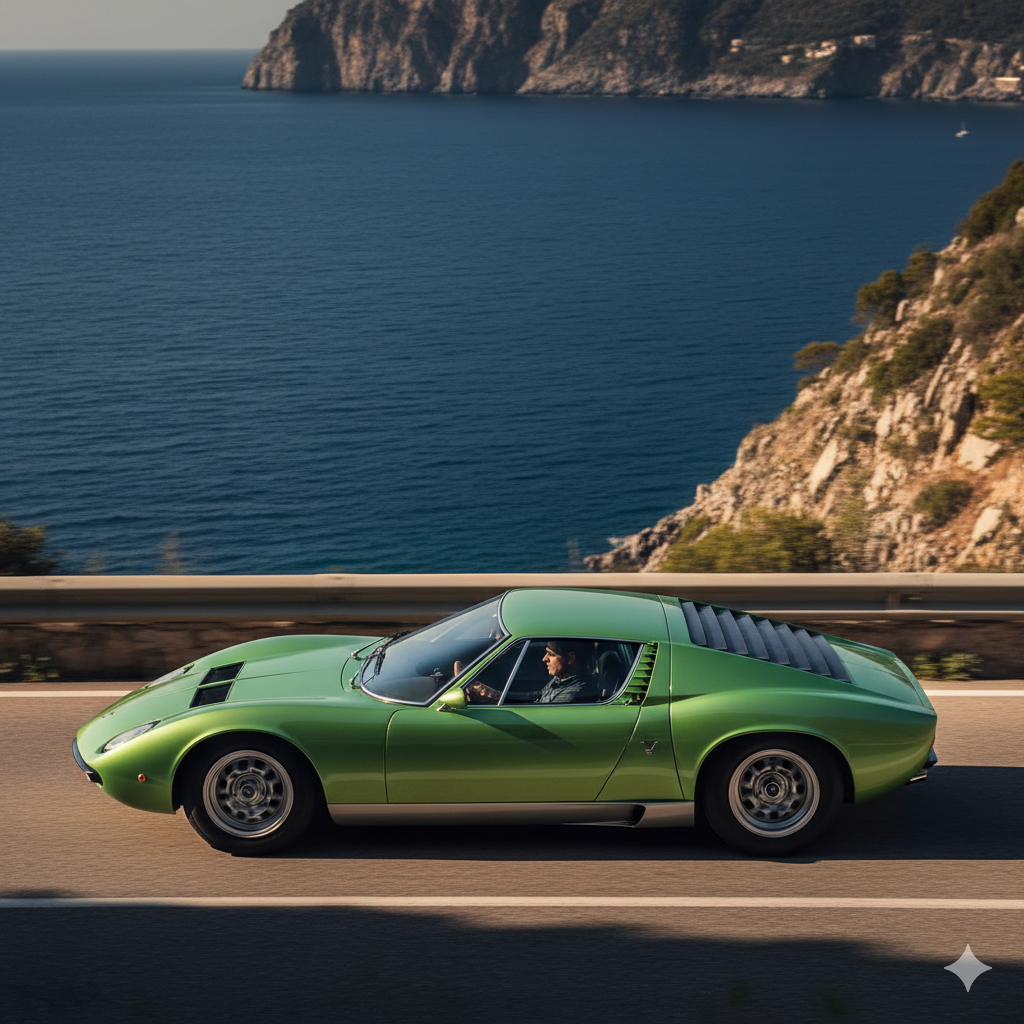
- The “Miura Green” Hue: That specific metallic green was a special-order color. Today, a Miura in this original shade carries a 15-20% premium.
- The Miura Jota: Bob Wallace built a one-off race-spec version called the “Jota.” It was 220 lbs lighter and pushed 440 HP. It was destroyed in a crash in 1972. The “SVJ” models sold later were mere tributes.
Conclusion: An Act of Rebellion
The most fascinating thing about the Lamborghini Miura is how it was born: in secret, against the boss’s orders, by engineers who believed they could do the impossible.
Ferruccio Lamborghini didn’t want a race car. His engineers built one anyway. That act of creative disobedience changed the automotive industry forever. It proves that sometimes, the best innovations come from people who ignore the instructions from the corner office.
Debate Question: What would have happened if Ferruccio had discovered the project early and killed it? Would the “supercar” as we know it even exist today, or was it an inevitable evolution of speed?
1 thought on “LAMBORGHINI MIURA”