
The French Disaster That Built Alfa: Portello, 1906
Picture this. A French industrialist with a handlebar moustache walks into a Naples hotel in April 1906, signs a stack of papers, and announces he’s going to teach Italians how to build cars. Eighteen months later his factory is bleeding money in the wrong city, his Italian customers have nicknamed his cars “shacks”, and the man he hired to run the place is quietly plotting to push him out. Eight years after that the company is bankrupt and a Neapolitan engineer who has never built a car in his life walks in to take over. That engineer is called Romeo. The rest you know.
What you probably don’t know is the part that comes before. The accidents, the wrong calls, the technical decisions that planted the genetic code of every Alfa that came after. Because Alfa didn’t fall from the sky in 1910. It was built on the rubble of someone else’s failure, by people most enthusiasts couldn’t name in a pub quiz. So let’s talk about who they were, what they got wrong, and what they got so right that nobody’s been able to undo it for over a century.
Alexandre Darracq’s Italian gamble
Pierre Alexandre Darracq isn’t a name you’ll find on many garage walls. He should be. By the early 1900s his Suresnes factory, just outside Paris, was building roughly one in ten of the cars sold in France. He’d licensed his designs to Opel in Germany. He’d opened up in Britain. He had a deal in Spain. The man wasn’t building cars for the love of it, mind you. He famously didn’t even like driving. To Darracq, cars were a business problem to be optimised, like bicycles before them.
His Italian play started in April 1906 in Naples. The company was called Società Anonima Italiana Darracq, SAID for short. The model was straightforward: ship knocked-down kits from France, assemble them in Naples, sell to Italian customers, pocket the margin.
Wrong city. Catastrophically wrong city.
Italy’s industrial axis in 1906 ran through Milan and Turin. The money was in Lombardy. The skilled labour was in Lombardy. The roads, the suppliers, the wealthy buyers, all in the north. Naples in 1906 had charm and history but no automotive ecosystem. Worse, every part shipped from France had to come down half the country before it could be screwed onto a chassis. Before he’d even broken ground on the planned Naples factory, Darracq realised the mistake and pivoted. Late 1906 he picked up land in Portello, on the north-western fringe of Milan, right next to where the city had hosted its International Fair that summer.
The factory took shape during 1907. Six thousand seven hundred square metres. Modern by the standards of the time. By 1908 it was assembling cars. And by 1909 it was already in trouble.
How to kill a car company in three steps
The trouble was partly bad luck. The 1907 financial panic that started in New York rippled across the European car market and the demand for new cars cratered. But trouble was also self-inflicted, and this is where any decent mechanic should sit up and pay attention. Because what Darracq did when sales fell was the worst thing you can do with an industrial product: he started cutting corners on parts.
Cheaper steel. Looser tolerances. Faster assembly. The Naples-then-Milan Darracqs had already been compromised designs, French cars built for French roads sold to a customer base that drove them on Italian terrain that punished suspensions and cooling systems in a way the engineers in Suresnes had never seriously contemplated. Now those compromised designs were being built to a lower spec.
The cars broke. Italian customers, never people who held back from giving their opinion, started calling the things “Barracq“. A play on the Italian word “baracca”, meaning shack or shanty. Sheds on wheels. When your customers nickname your cars after a building you’d be ashamed to live in, the brand is dead. You can’t fix that with a magazine ad.
Cavaliere Ugo Stella, a Milanese aristocrat and one of SAID’s Italian shareholders, had been promoted to managing director in 1909. Stella saw what Darracq couldn’t or wouldn’t see: the problem wasn’t the economy. The problem was the product. And as long as the product carried the Darracq name and the Darracq design language, no amount of marketing would lift it. The only fix was a clean break.
24 June 1910: a new company on the same shop floor
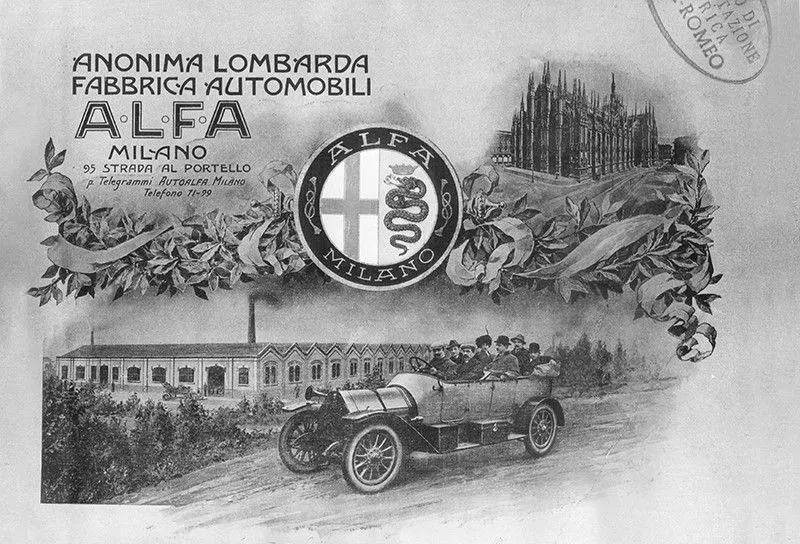
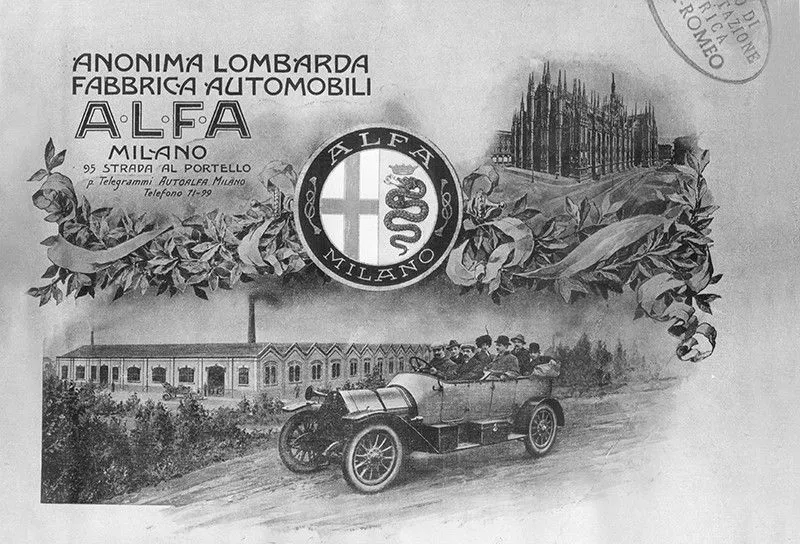
Stella convinced his fellow Italian investors and the bankers backing them that the path forward was a refoundation. On 24 June 1910 a new company was registered in Milan: Anonima Lombarda Fabbrica Automobili. A.L.F.A., with the dots, because Italians wrote it as an acronym in those days and the typography mattered. Same factory in Portello. Mostly the same Italian shareholders. New name, new ambition, the umbilical cord to Darracq cut.
It’s worth pausing here to look at the Italian industrial map A.L.F.A. was walking into. Fiat had been the dominant Italian carmaker since 1899, with a national distribution network already in place by 1910 and an export plant in Poughkeepsie, New York. Lancia had been turning out cars from Turin since 1906. Italian industrial production roughly doubled between 1896 and 1913, riding the coattails of Giovanni Giolitti’s moderate-protectionism policies — tariffs that shielded domestic makers from French and German imports and kept them growing without having to fight a head-on price war. The economy of the industrial triangle that linked Lombardy, Liguria and Piedmont ran on cheap Alpine hydroelectricity and a labour force migrating north from the agricultural south. The conditions were perfect, but the seats at the table were already taken. In 1911 the entire Italian motor industry produced something like 1,800 cars and 400 trucks, and Fiat had a hand in most of them. A.L.F.A., barely born, was a flyweight stepping into a ring already occupied by a heavyweight from Turin. The only viable route in was product. Build something a Fiat customer would consider switching to, or stop making cars altogether.
The company moved fast on the technical side because Stella, smart enough to see the disease, was also smart enough to hire the cure. In 1909 he had brought in a young engineer called Giuseppe Merosi. Merosi had come up through bicycles and motorcycles, which sounds humble until you remember that in 1909 those disciplines taught you exactly what you needed for early motoring: how to make light, robust frames, and how to design small engines that ran hard without grenading themselves.
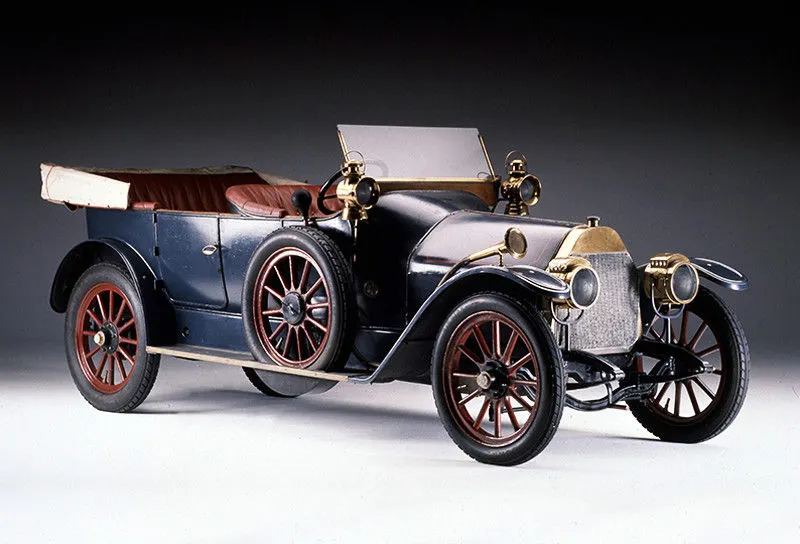
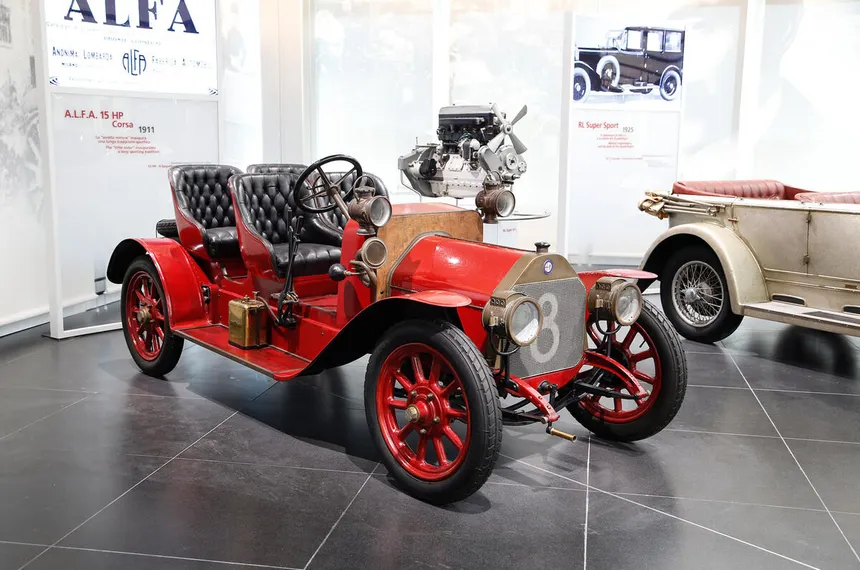
Merosi’s first proper Alfa, the 1910 24 HP, is the car worth pausing on. Not because of its performance, which by today’s standards is comically modest. But because of what its layout said about the engineering brain behind it.
The 24 HP: thinking like a builder, not a designer
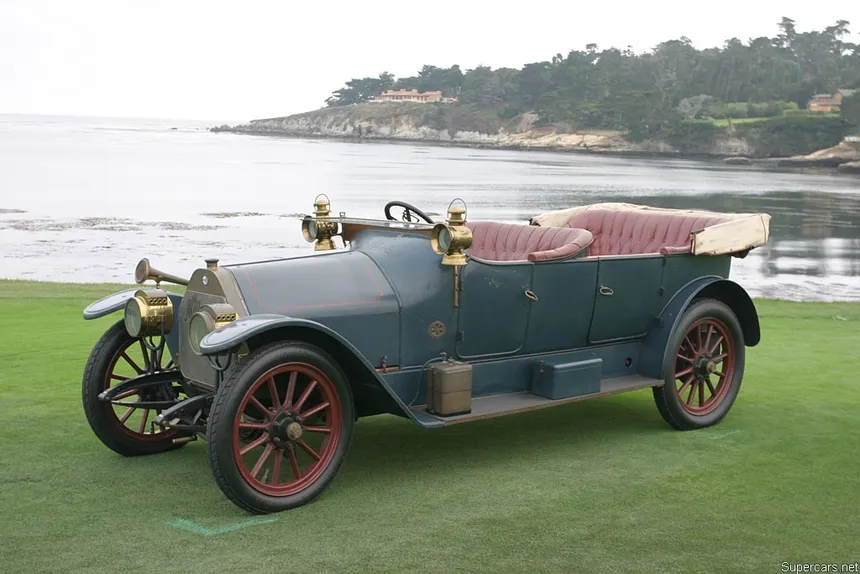
Look at the 24 HP not as a museum piece but as a set of decisions. Four cylinders, monobloc casting. That’s the first thing. Most engines of the era were cast in pairs, two cylinders fused together, then bolted to a separate crankcase. Casting four cylinders in one block was harder. It demanded better foundry work, better quality control on the iron. Merosi went there because a one-piece block flexes less, vibrates less, and seals the head gasket better. That’s not glamour. That’s a man who understands what fails first when the engine gets hot.
Capacity 4.084 litres. Side valves. The bore and stroke chosen so the piston speed at sustained motorway revs (well, the equivalent in 1910 terms) wasn’t going to chew up the rings. Top speed close to 100 km/h, on tyres that were essentially leather sausages and brakes that worked on two wheels. Pushing 100 in 1910 was a serious thing. The engine had been deliberately oversized so it would never have to scream to do its job, which meant it would last.
There’s a phrase in old British workshop manuals: “designed with margin”. You designed the part stronger than it needed to be on paper, because real-world conditions ate at the margin. The 24 HP was designed with margin. The proof isn’t anecdotal. The Italian Army’s high command picked the 24 HP as its officer transport during the First World War. Generals on the Caporetto front weren’t going to bet their lives on a chassis that snapped a leaf spring in a mountain pass. And the very first car you encounter today when you walk through the turnstile at the Museo Storico Alfa Romeo in Arese, before any P2, before any 33 Stradale, before any Giulia Quadrifoglio, is a 1910 24 HP. Founding piece. Still complete, still on display. Total production of the 24 HP and its 20-30 HP evolution reached around 680 units between 1910 and 1922 — modest in volume, but keeping the same chassis architecture in production for twelve years is its own quiet certificate of competence.
The Targa Florio, 1911
A.L.F.A. understood from day one that an Italian carmaker who didn’t race didn’t exist. In May 1911, less than a year after the company was founded, two 24 HP cars rolled up to the start of the Targa Florio in Sicily. Drivers were Nino Franchini and Ronzoni. The Targa was, even then, brutal. Mountain passes, dirt, dust, hairpins, no margin for error.
They didn’t win. Nowhere near. But they finished, and finishing the Targa Florio in 1911 with a car designed inside twelve months by a fledgling company was a serious calling card. It told the buying public that A.L.F.A.’s cars were the kind of cars you could push.
Merosi kept building. The smaller 12 HP. The bigger 40-60 HP, with a six-litre engine. Each iteration tightening up the formula. And then, in 1914, came something the textbooks usually skim past in a sentence and which deserves a chapter of its own.
The Grand Prix engine that history under-rates
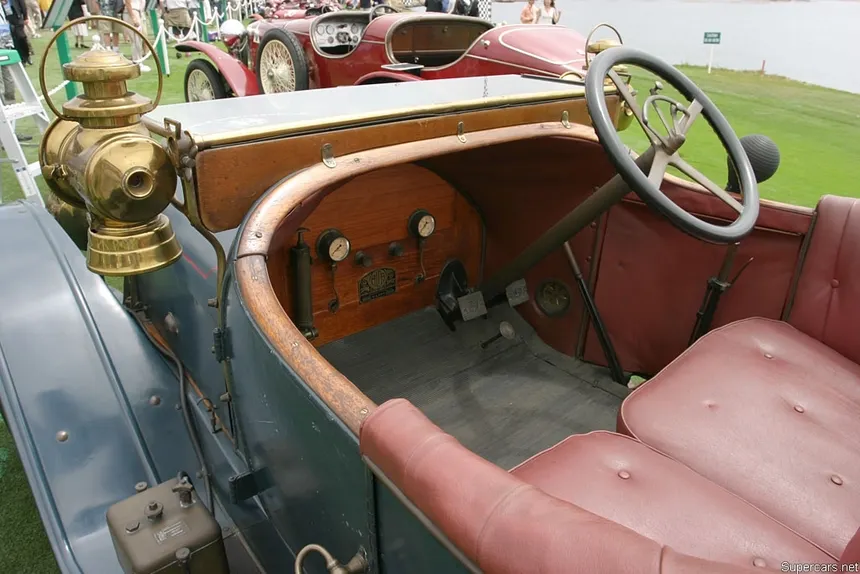
For the 1914 racing season Merosi designed an A.L.F.A. Grand Prix car with a four-cylinder, 4.5-litre engine. Overhead cams. Twin-spark ignition. Two plugs per cylinder, each fired by an independent magneto.
To understand why this matters, you have to understand what twin-spark actually does. When you ignite a fuel-air mixture in a big cylinder from a single plug, the flame front has to travel from one side of the combustion chamber to the other. That takes time. As you raise compression and revs, the time gap between ignition and complete burn becomes a problem: the unburnt mixture starts to detonate on its own from heat and pressure, and detonation is what kills pistons. Two plugs cut the journey in half. The flame front advances from two points, the burn is faster, more complete, the engine runs cooler at the edges of the combustion chamber, and you can run higher compression without knock.
In 1914 this was bordering on radical. Bugatti wasn’t doing it. Peugeot wasn’t doing it. Mercedes wasn’t doing it. A.L.F.A. was doing it, in a 4.5-litre racing engine designed by an engineer who had been making pushbikes a decade earlier.
The 1914 GP engine made around 88 horsepower. Forget the number. The architecture is what counts. Twenty years later Vittorio Jano’s Twin Cam in the 6C 1750 was going to take this same idea and refine it. Half a century later the bialbero in the Giulia would still be carrying twin-spark in its DNA. The “Twin Spark” badge you saw on Alfa 75s and 155s in the eighties wasn’t a marketing slogan. It was a bloodline that started in Portello in 1914.
That GP car barely raced before war broke out. The Italian motoring press had time to admire it, the engine ran on the bench, prototypes were built. Then everything stopped.
Picture Merosi in September 1914. He’s forty-two. He has just signed off on the most advanced engine of his career, the one he’ll never beat for technical ambition. The blueprints are on his desk, the prototypes are sitting in the Portello workshop, the 1915 Grand Prix season is on the calendar. Italy hasn’t entered the war yet — that won’t happen until May 1915 — but the international racing calendar has collapsed in four weeks. Chassis orders cool. Wealthy customers stop signing cheques. Foundry suppliers redirect capacity to military contracts. The 1914 GP car, with its twin-spark, its overhead cam, its 88 horses, gets quietly filed away in a drawer. The masterpiece of an engineer’s mid-career sits in a cabinet waiting for a world that’s never going to come back.
The slow bankruptcy
When Italy entered the First World War in May 1915, A.L.F.A. was already wounded. Civilian car demand had cratered the year before. The factory was running, the wages were being paid, but nothing was being sold. The lead creditor, Banca Italiana di Sconto, had carried more debt than was reasonable hoping the war boom would never come. By summer 1915 the bank wanted out. It wanted somebody to come in, take the factory, repurpose it for the war effort, and give the bank a chance of recovering its money.
The man they found was Nicola Romeo. He was forty years old. Born in Sant’Antimo, just outside Naples, on 28 April 1876. He’d taken his engineering degree at the Politecnico di Napoli, then crossed Europe to Liège in Belgium for a second qualification in electrical engineering. That kind of education in 1900 was unusual. Most Italian industrialists of his generation had a single technical degree, if they had any at all. Romeo had two, and the second one was earned abroad.
He hadn’t built cars. He didn’t know cars. What he knew was heavy industrial machinery. In 1911 he’d founded Ing. Nicola Romeo & Co., a company specialising in mining compressors. Mundane on paper, lucrative in practice, because mining was booming across Italy and his compressors were good. He had cash, he had factory-management discipline, and he had a track record of delivering on contracts to specification. The bankers didn’t need a car genius. They needed somebody who could make the Portello plant produce things the army would buy.
On 2 December 1915 Nicola Romeo & Co. formally took over the Portello works. Cars stopped. Production switched to artillery shells, aircraft engines, compressors and flamethrowers. Within three years the workforce had grown from a few hundred to over twelve hundred. The plant doubled in size. The smelting works were upgraded with American machinery.
But that’s the next story.
What A.L.F.A. left behind when it died
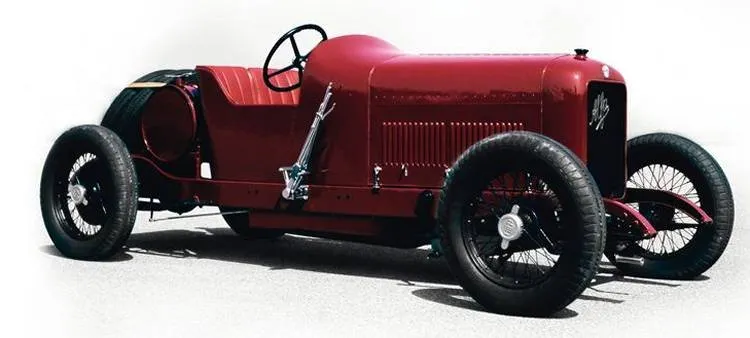
Between 24 June 1910 and 2 December 1915, A.L.F.A. as an independent civilian car company existed for exactly five years and a bit. Total production was modest, peaking at maybe 250 cars a year. By any measure of volume it was a small player.
But the genetic legacy it left was disproportionate to its size, and it really comes down to two things: a way of thinking about engines, and a way of proving the part.
The engine philosophy was Merosi’s signature, signed twice with five years between strokes. The monobloc four of the 24 HP set the casting standard for the house: cylinders cast as one piece rather than in pairs, more demanding for the foundry but cleaner for vibration and head-gasket sealing. Then the overhead-cam architecture of the 1914 GP engine took the marque off the side-valve treadmill that most volume manufacturers were content to ride. By the time Vittorio Jano arrives from Fiat in 1923, he’s not starting from a blank sheet. He’s picking up an architecture that already lives in the Portello drawing office. The straight line from that monobloc four in the 24 HP to the bialbero of the Giulia runs through several stations, but it’s a single line.
The way of proving the part came from two competition decisions. Targa Florio 1911, two cars on the grid when A.L.F.A. was barely a year old, established the house rule: at this marque, the car gets tested by racing it. And the twin-spark of the 1914 GP car — two plugs per cylinder, two independent magnetos — planted the first technical signature of the brand before the brand was even called Alfa Romeo. A root that kept growing for eight decades. When you see “Twin Spark” on the radiator grille of a 75 or a 155 in the 1990s, that signal isn’t from the marketing department. It’s from Portello, 1914.
What didn’t survive was the name. A.L.F.A., the bankrupt company that the bankers handed to a Neapolitan engineer with no automotive background, ceased to be a car company on 2 December 1915. The factory kept turning. The badge kept existing on stationery. But the firm that registered itself in Milan in June 1910 was effectively over.
Looking at this story from underneath
I spend my working life fitting and assembling things, and the lesson I keep coming back to with stories like this is that the romantic version is almost always wrong. The romantic version says Alfa was born of Italian passion. The truth is more interesting. Alfa was born from a French failure, salvaged by a Milanese aristocrat, given its first soul by an under-celebrated engineer called Merosi, and then handed off to a Neapolitan industrialist who didn’t even want a car company.
Every brand that survives a century has a similar messy origin story if you scrape off the gold leaf. Ford had model failures before the T. Mercedes was three rival firms before it was one. Ferrari started in somebody else’s racing department. The myths get cleaner with each retelling. The reality, as anyone who has ever rebuilt an old engine knows, is full of the same kind of rough edges and forced compromises you find when you take the sump off a forty-year-old block.
A.L.F.A.’s rough edges were what made the company. The Darracq disaster taught the survivors what not to do. The 1907 crash taught them not to over-extend. The “Barracq” insult taught them that quality wasn’t optional. Merosi’s overdimensioned 24 HP block taught the next generation what an Alfa motor should feel like. The 1914 GP engine planted the technological flags that would still be flying in the 1990s.
When Nicola Romeo opened the factory gate at Portello on 2 December 1915, he wasn’t walking into a car plant. He was walking into a workshop that had spent the previous twelve months mostly idle, that was about to spend the next four years making weapons, and that wouldn’t be called Alfa Romeo for another five years yet. But he was walking into a workshop that already had a soul. And no industrialist, no matter how much money he brings in, builds a soul from scratch.
That’s what came before the badge with the snake. A French firm that picked the wrong city and cut the wrong corners. An Italian aristocrat who saw the iceberg early. An engineer who quietly planted twin-spark and overhead-cam ideas in 1914 that would still be paying dividends in 1994. And a workshop on the wrong end of Milan, sitting on a road named after a medieval cart track, ready for the next chapter.
The next chapter belongs to Romeo. He doesn’t turn up to build cars. He turns up to build shells. The cars come later. That’s another story.
Check you’re still alive.