MERCEDES-BENZ C111: THE GERMAN SUPERCAR STUTTGART REFUSED TO SELL
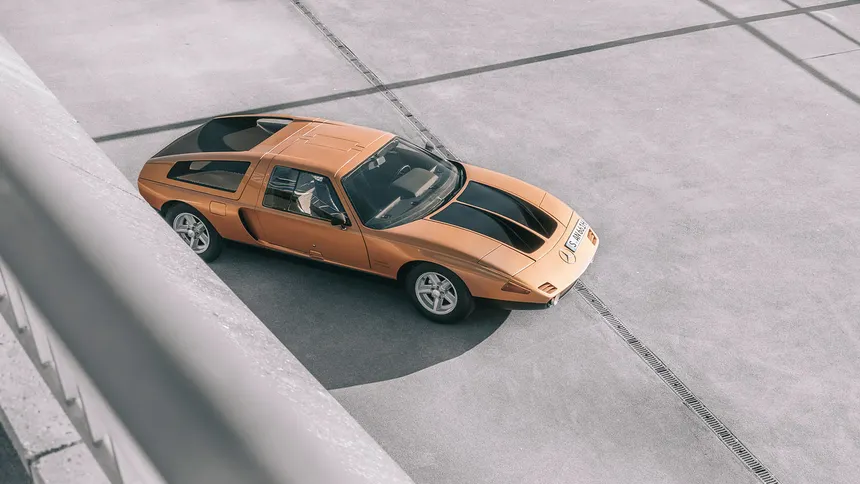
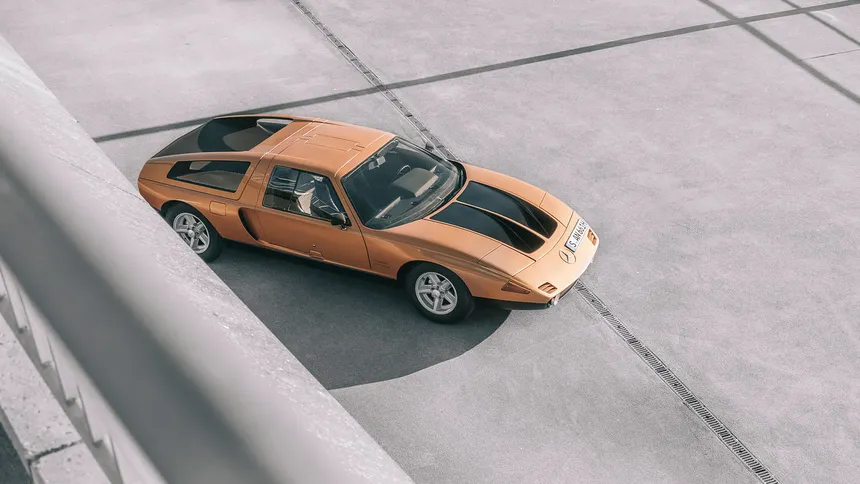
Bronze-orange testbed, white cheques on the counter
Every now and again, a car arrives that breaks the rules of how concepts are supposed to behave. It is not killed by its parent company. It is not abandoned because the engineering does not work. It is not buried after a corporate merger reshuffles priorities. It is, deliberately, kept off the road by the people who built it, despite a queue of customers offering whatever amount of money it would take to put it in their garage.
That is the story of the Mercedes-Benz C111. Sixteen examples were built across four generations between 1969 and 1979. Thirteen ran rotary engines. Two ran turbocharged diesels and obliterated nine world records at the Nardò bowl. The final one ran a twin-turbo V8 and set a closed-circuit average speed record of 250.958 mph in 1979. The orange gullwing wedge appeared on television in the early 1970s, in Top Gear retrospectives in the 2000s, and in Hagerty long-reads in the 2020s.
In all that time, not one of those cars was sold to a customer. Wealthy collectors who had attempted to buy one at the 1969 Frankfurt Motor Show, by handing over blank cheques to Mercedes staff for the company to fill in whatever number it liked, received polite letters declining the offer. The C111 is the rarest sort of supercar: not stillborn, not cancelled, but engineered, completed, and then quietly refused to the world by the company that made it.
What the C111 actually was
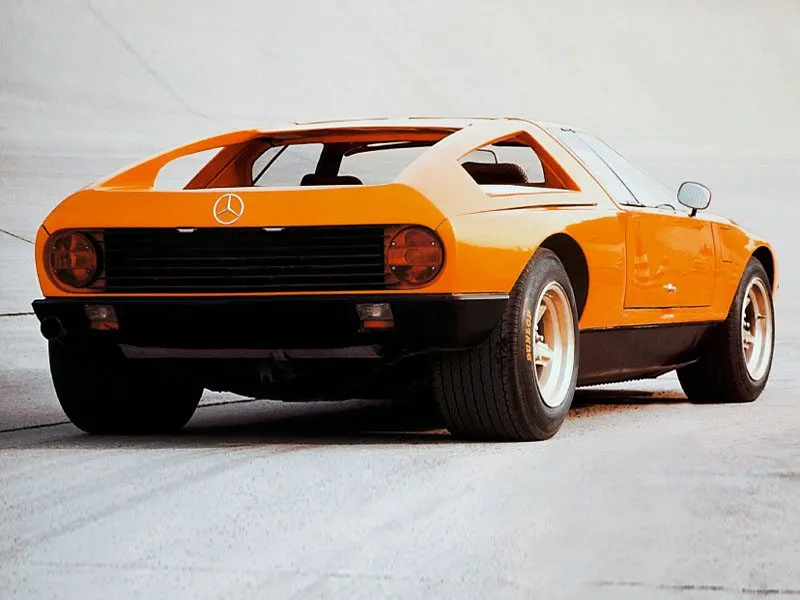
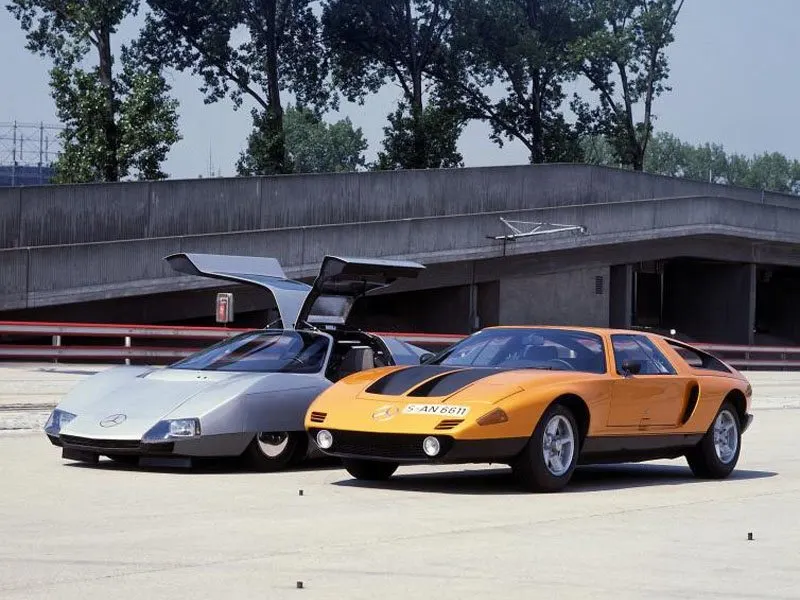
Confusingly, the C111 is not a single car. It is a research platform that wore four different bodies over a decade. What they all share is the underlying architecture: tubular steel chassis, glass-reinforced plastic (fibreglass) bodywork, gullwing doors echoing the original 1954 300 SL, mid-engined layout, two seats, pop-up headlights, and a bronze-orange paint job for the first two generations that became known internally at Stuttgart as Rennorange.
The body was designed by Bruno Sacco, then a young carrozzeria engineer at Daimler-Benz who would later design the W124, the R129 SL, and most of the brand’s defining shapes of the eighties and nineties. The C111 was one of Sacco’s earliest projects with significant creative freedom, and the wedge silhouette he produced sits comfortably alongside the Lancia Stratos HF Zero and the Lamborghini Countach LP500 prototype as a defining piece of late-sixties Italian-influenced wedge design, done in Germany.
What changed across the four generations was the powertrain. The C111 was, fundamentally, a moving engine bench. Mercedes built it to test technology, not to define a model line.
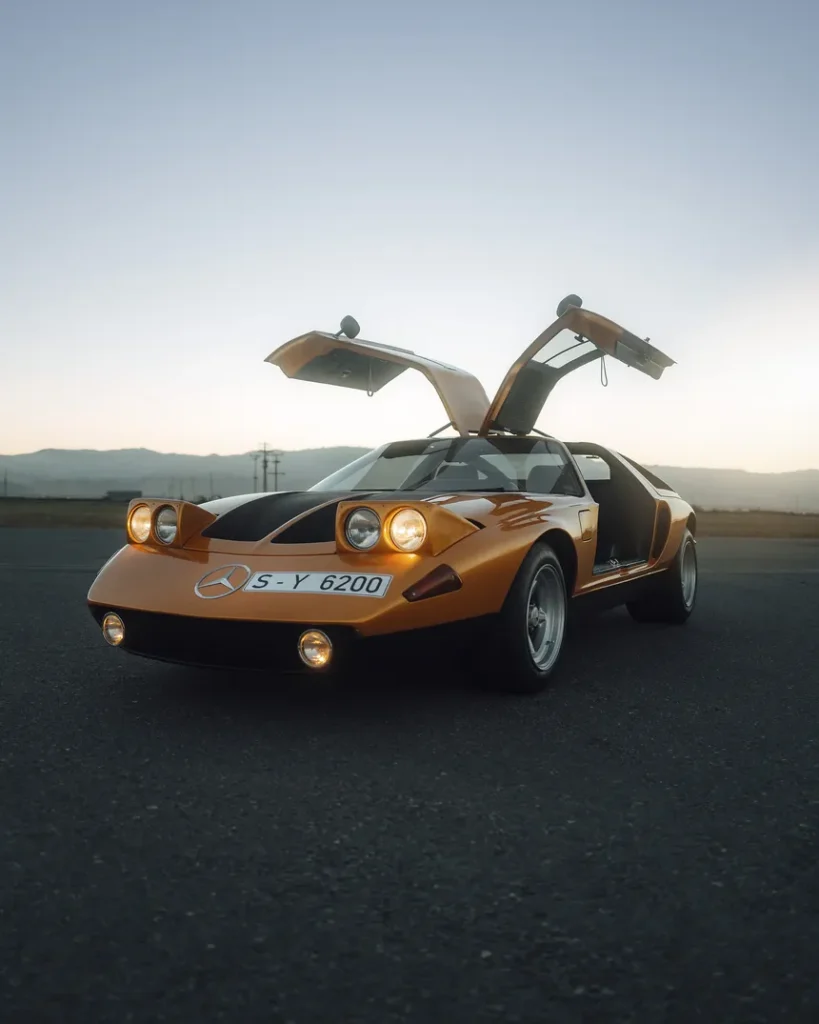
Generation One (1969): the three-rotor Wankel
The original C111, unveiled at the 1969 Frankfurt International Motor Show in September, carried a three-rotor Wankel rotary engine designated M950 F. Total displacement 3.6 litres (three rotor chambers of 600 cc each). Direct petrol injection by Bosch. Compression ratio 9.3:1. Output: 280 hp at 7,000 rpm. Top speed: 162 mph. Zero to 62 mph in five seconds flat.
Mercedes had purchased the Wankel licence in 1961, following the work that Felix Wankel and NSU had done on the Spider and were doing on the Ro 80. Nearly every major European manufacturer of the period had bought into Wankel licensing: Citroën, Mazda, GM, even Rolls-Royce. The pitch was irresistible: fewer moving parts, smaller package, smoother running, capable of revving like a turbine and delivering huge specific output per litre.
The C111-I, on the road, behaved very much as advertised. Paul Frère, the Belgian former Formula One driver who had become a road tester for Road & Track and auto motor und sport, was among the few journalists allowed to drive the prototype personally during the press tests at Hockenheim in the first week of September 1969. His write-up contained the most useful single observation ever published on the sound of the three-rotor Wankel: the exhaust was so thoroughly muffled that the engine was nearly inaudible from the driver’s seat, and only the dashboard rev counter informed him that he had once again exceeded the 7,000 rpm limit.
The implication of that sentence is bigger than it looks. The Wankel did not roar. It did not vibrate. It did not protest as it climbed through the rev range. It ran like a small turbine mounted behind the driver, and the only signal that the engine was approaching its limit was visual, not aural. For a 1969 journalist accustomed to V8 and V12 piston engines with audible vibration and an aural red line shouting at you from the firewall, that was a car that belonged in a different decade.
Then came Frankfurt, and the cheques.
Why Stuttgart said no
There are several competing explanations for the refusal, and the straight answer is that all of them are partially true. (See the next section: Mercedes had reasons that ranged from technical to philosophical.)
First, safety. Mercedes-Benz had built its commercial identity on passive safety engineering: crumple zones, collapsible steering columns, safety cell construction. A fibreglass-reinforced plastic body cannot, by physical property, absorb impact energy progressively. It does not crumple; it shatters. For a brand whose marketing in 1969 was largely about how you would survive a crash, selling a supercar that would disintegrate on impact was a problem that no amount of customer demand could solve.
Second, the engine. The Wankel was thirsty in a way that did not improve with development. The elongated, geometrically variable combustion chambers produced poor fuel economy and high hydrocarbon emissions, neither of which would survive the regulations coming down the pipe in the United States and Europe. Kurt Obländer, head of engine testing on the rotary at Daimler-Benz, made the formal call in 1971 to discontinue Wankel development for production cars.
Third, market timing. By 1973 the oil shock had hit. Selling a fuel-thirsty rotary supercar to a Europe queuing for petrol coupons would have been commercial suicide. The fact that the C111 was ready a couple of years before that crisis but not yet on sale gave Mercedes an unexpected vindication for its caution.
Fourth, brand identity. Mercedes was Mercedes: a builder of luxury saloons, taxis, lorries and buses. A supercar in the catalogue did not fit the corporate self-image at the time. The C111 was an engineering demonstration directed at the engineering community, not a product directed at the supercar market. The fact that the supercar market wanted it anyway was, from Stuttgart’s perspective, the customers’ problem rather than Mercedes’.
Generation Two (1970): four rotors and the press verdict
The C111-II was unveiled at the Geneva Motor Show in March 1970, five months after Frankfurt. The body was significantly revised: larger windscreen, front-mounted radiators replacing the central intake, lower dashboard. Under the skin, the rotary count went from three to four. The new engine, designated M950 KE409, displaced 4.8 litres (four chambers of 600 cc). Compression remained at 9.3:1. Bosch mechanical fuel injection. Single ignition replaced the earlier dual ignition setup, which had proven hard to calibrate. Peak output rose to 350 hp at 6,000 rpm and torque to 392 Nm across a usable band.
Top speed projected: 186 mph (300 km/h). Zero to 62 mph in 4.8 seconds. Faster than any Ferrari road car of 1970.
Paul Frère drove the C111-II as well, and his published verdict became one of the defining quotes of the early supercar era. He believed Mercedes had built what could become the fastest, smoothest and most comfortable car of its class on the world market, and that there would be thousands of customers for it globally if Stuttgart wanted to make them. The German motoring magazine Deutsche Auto-Zeitung was more concise. It called the C111 the car that takes your breath away.
Mercedes built six examples of the C111-II and then stopped. By December 1970, one chassis had been fitted with the 3.5-litre V8 from the 300 SEL 3.5 production saloon for further testing with a conventional piston engine. The Wankel programme as a production option was finished. The C111 platform, however, was just getting started.
Generations Three and Four (1976-1979): Nardò and the diesel revolution
This is the part most non-German automotive press tends to undersell. When the Wankel was shelved, Mercedes did not retire the C111. It repurposed it as a testbed for something almost nobody saw coming: a turbocharged diesel.
The engine was the OM 617, the 3.0-litre five-cylinder diesel from the 240 D and 300 D saloons (the indestructible million-kilometre taxis of the seventies and eighties). Mercedes fitted a Garrett turbocharger and an intercooler. Output: 190 hp in the C111-IID of 1976, then 230 hp in the C111-III of 1978. The same OM 617 in a road-going 300 D produced 80 hp. Mercedes had nearly tripled it.
In 1976 the C111-IID went to the Nardò Ring in southern Italy, the famous high-banked 12.5 km circular test track owned by Fiat (later by Porsche). Four drivers, sixty hours of continuous running, sixteen world records broken, all in a diesel. For a public who in 1976 still associated diesel engines with tractors and lorries, this was a category violation.
Two years later, in April 1978, the C111-III returned to Nardò with a redesigned body. Drag coefficient: 0.195, lower than nearly any production car today. Power up to 230 hp through an additional intercooler. Result: nine FIA-certified world records and eleven class records during a twelve-hour endurance run on 29-30 April 1978. Average speed over 100 km: 316.484 km/h. Average speed over twelve hours: 314.463 km/h. Fuel consumption at those sustained velocities: 16 l/100 km. Achieved with a five-cylinder diesel derived from a taxi engine. Driver Hans Liebold and three others took turns.
Generation Four: 500 hp, 250 mph, one car
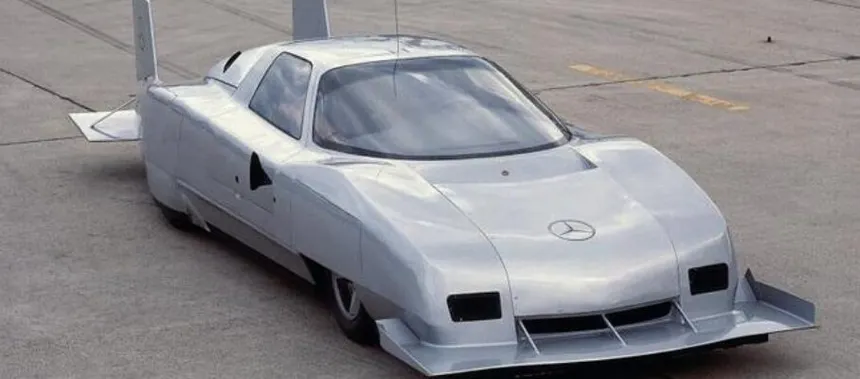
The C111-IV appeared in May 1979 and made no pretence of being a road car. Twin vertical fins at the rear, dual rear spoilers, silver paint replacing the famous bronze-orange. Under the bonnet, Mercedes took the production M117 4.5-litre V8, enlarged it to 4.8 litres, and added two KKK turbochargers, 48 sodium-cooled exhaust valves, and a triple-plate clutch rated for 600 Nm of torque. Output: 500 hp at 6,200 rpm. Transmission: five-speed manual.
The record attempt was set for 5 May 1979 at the Nardò Ring in southern Italy, then owned by Fiat (later Porsche), a near-perfect 12.5 km diameter banked oval with a total lap length of 24,633.35 metres. The driver was not a professional racer. He was Dr Hans Liebold, a Mercedes-Benz test engineer who had led the aerodynamic development of the C111-III two years earlier and knew the car better than anyone at the company. Mercedes’ logic was clean: send the engineer who had built it, not a hired hand.
One flying lap. Liebold covered the 24,633.35 metres in 1 minute 56.67 seconds. Lap average: 403.978 km/h, or 250.958 mph. The absolute closed-circuit speed record, FIA-certified, in a car whose chassis architecture was effectively unchanged from the 1969 Frankfurt show car.
Liebold was not finished after the headline lap. The same afternoon, the same car and driver lowered the world records for 10 km, 100 km, 10 miles and 100 miles distances, all on the same Nardò tarmac, all in a single test session. Achievements that normally require multiple days of logistics and several attempts, dispatched in one afternoon. The C111-IV never went out for another record attempt. One car built, one day of public glory, four world records in the bag. After that, straight to the museum.
What sits in the museum today
All sixteen C111s survive, most in the Mercedes-Benz Museum, others in private collections and one at the Petersen Automotive Museum in Los Angeles. Mercedes occasionally demonstrates them at heritage events. The Drive ran a feature in 2024 in which a journalist drove a C111-II Wankel at Salinas Airport, and the verdict echoed Paul Frère’s from fifty-four years earlier. Turbine-like engine note. Almost no vibration. Cornering balance that would not embarrass a modern mid-engined chassis. A finished car, presented as a moving exhibit.
But none was ever sold to a customer. The blank cheques from Frankfurt 1969 were declined one by one. The C111 stayed as what Mercedes wanted it to be: a rolling demonstration of multilink rear suspension, pop-up headlight assemblies, GRP composite bodywork, high-output turbodiesel passenger-car engines, and ultra-low-drag aerodynamic profiles, all of which would later filter into Mercedes production models.
The C112: Mercedes’ second attempt, killed the same way
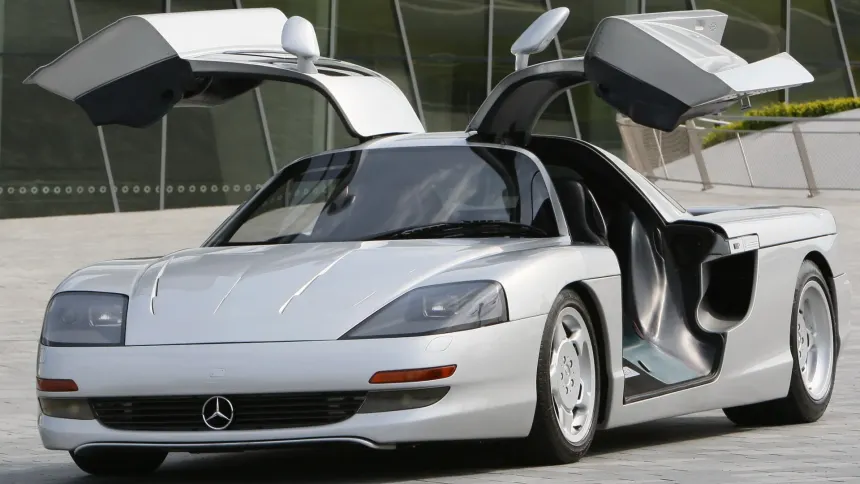
Stuttgart took twenty-two years to try again. In September 1991, at the Frankfurt Motor Show, Mercedes unveiled the C112, a road-legal interpretation of the Sauber-Mercedes C11 that had just won the 1990 World Sportscar Championship. The project was serious in a way the C111 had never tried to be. Riveted aluminium monocoque with integrated steel roll cage, aluminium and Kevlar body panels, gullwing doors echoing the 300 SL and the C111. The body itself was built in Turin by Carrozzeria Coggiola.
Under the engine cover sat the new 6.0-litre M120 V12 from the 600 SEL launched earlier that year. 408 hp at 5,200 rpm, 580 Nm, six-speed manual gearbox, rear-wheel drive. Kerb weight: 1,569 kg. Top speed projected at around 193 mph (310 km/h). The technology list was decades ahead of the market: Active Body Control (the first hydraulic active suspension in automotive history, which Mercedes would eventually commercialise on the W215 CL of 1999), electronic rear-wheel steering, active aerodynamics with motorised front splitter and rear wing, ABS, airbags, automatic climate control and electric seats. This was a production-intent car, not a styling exercise.
Mercedes accepted 700 deposits from potential customers. And then, again, stopped. The official reason given at the time was political pressure from emerging environmentalist movements in Germany, but the version recorded later by Autocar and evo is more credible. By late 1991 the global economy was sliding into recession. Mercedes had just launched the W140 S-Class, an enormous, late, over-budget flagship that was being savaged by the press for looking out of step with the times. Adding a gullwing supercar flagship on top of the W140 disaster was politically impossible. The M120 V12 designed for the C112, however, did not go to waste. Eight years after the cancellation, Horacio Pagani used it as the heart of the original Zonda C12 of 1999. The engine lived. The car did not.
Mercedes would not return to the supercar conversation under its own name until the SLR McLaren of 2003, more than three decades after Frankfurt. It would not produce a fully Stuttgart-designed supercar until the AMG GT of 2014. And it would not have a road-going mid-engined Mercedes in production until the AMG One of 2022.
The angle that makes the C111 different
What makes the C111 different from every other car in the prototypes-killed-by-the-boardroom canon is that it was never killed. It was, from day one, never allowed to live as a product. Other cars in this hub (the Jaguar C-X75, the Chrysler ME Four-Twelve, the BMW Nazca C2, the Italdesign Aztec) died because someone with corporate authority shut them down after their own engineering teams had pushed them toward production. The C111 died because the engineering team itself, and the company behind it, never wanted it to be anything but a moving research platform.
The harder counter-question is what would have happened if Stuttgart had said yes in 1970. The Lamborghini Countach as we know it might not have existed; Mercedes would have provided a serious mid-engined rival from day one. Ferrari might have rushed the Berlinetta Boxer to market two years earlier. Porsche might have started the 928 project with more urgency. The European supercar landscape of the seventies and eighties could have been a four-horse race instead of a three-horse race.
The C111 remains the most complete and most thoroughly developed supercar that its own manufacturer simply did not want to sell.
Check you’re still alive.