
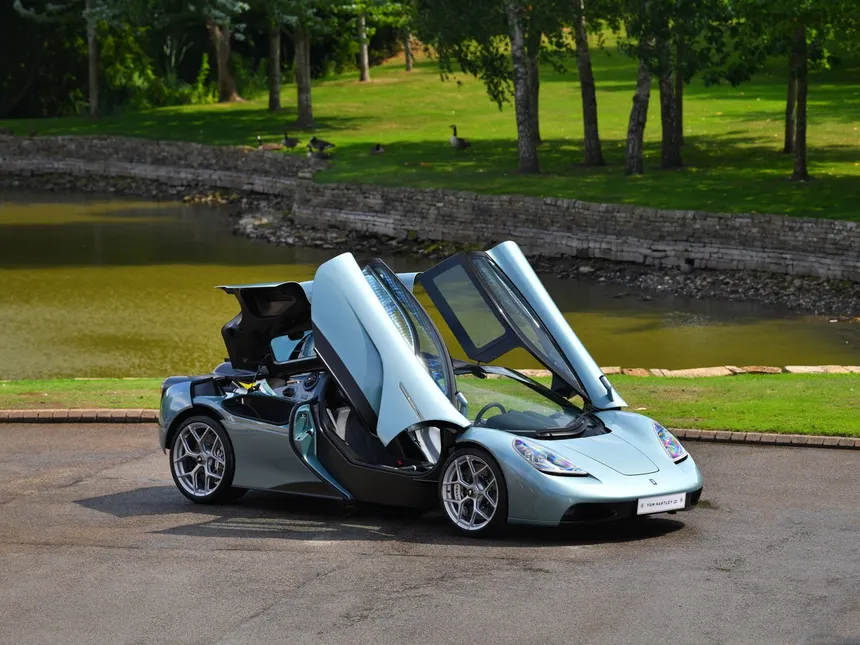
GMA T.50: The Car Gordon Murray Has Been Waiting 30 Years to Build
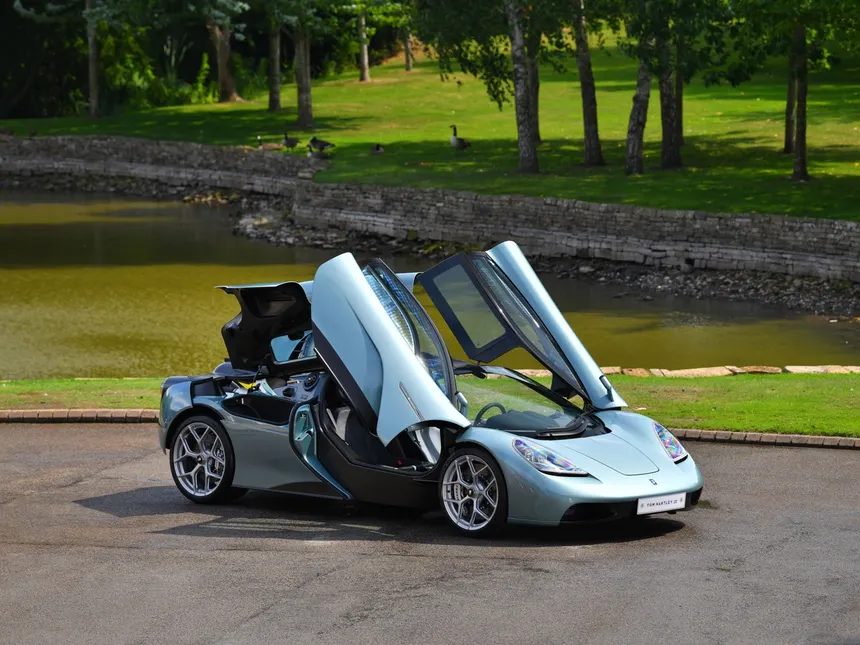
Gordon Murray has spent his entire career proving one thing: that lighter is better. He proved it with 22 Grand Prix wins at Brabham. He proved it with the MP4/4, the most dominant Formula 1 car ever made. He proved it with the McLaren F1, which won Le Mans in its debut year with what was essentially a slightly modified road car. And now, at 79, he’s proved it one final time with the T.50 — a 986 kg, naturally aspirated V12, three-seat, manually geared, fan-assisted weapon that has no interest whatsoever in what any other supercar is doing.
The T.50 is not an updated McLaren F1. Murray has been very clear about that. It’s the car the F1 should have been if he’d had full control. Three decades of frustrations, compromises, and unfinished ideas — all resolved in one car. And if that sounds like an old man’s vanity project, consider this: the 100 road cars sold out in 48 hours. At £2.36 million each.
The Man Who Designs by Weight
To understand the T.50, you have to understand Murray’s obsession. Not with speed. Not with power. With mass.
Born in Durban, South Africa in 1946, to Scottish immigrant parents. His father raced motorcycles and prepared racing cars. Murray studied mechanical engineering, built his own race car — the IGM Ford — and raced it himself in 1967 and 1968. At 23, he flew to England hoping to work for Colin Chapman at Lotus. He didn’t get the job. Instead, he bumped into Ron Tauranac, Brabham’s chief designer, who hired him on the spot. It was 1969.
At Brabham he designed the BT46B — the Fan Car that won the 1978 Swedish Grand Prix with Niki Lauda and was voluntarily withdrawn before the FIA could ban it — plus the BT49 and BT52, which won Nelson Piquet two World Championships in 1981 and 1983. Twenty-two Grand Prix wins between 1973 and 1985. At McLaren, the MP4/4 — Senna and Prost, 15 out of 16 races won in 1988. Then the F1 road car: fastest in the world for seven years, Le Mans winner in 1995 against purpose-built prototypes with a barely modified street car.
Murray left McLaren in 2004, frustrated by corporate constraints. He founded Gordon Murray Design in 2005, and in 2017, at 71, established Gordon Murray Automotive in Surrey. First car: the T.50.
The Engine: Cosworth GMA V12
Ask any engineer what makes the T.50 special and they won’t mention the fan first. They’ll mention this engine.
The Cosworth GMA V12 is a 3,994 cc naturally aspirated unit with a 65-degree vee angle. Bore: 81.5 mm. Stroke: 63.8 mm. Compression ratio: 14:1. Maximum power: 654 bhp at 11,500 rpm. Maximum torque: 344 lb-ft at 9,000 rpm. Redline: 12,100 rpm — the highest of any production road car engine ever made. And 71% of peak torque is available from just 2,500 rpm, which means you don’t need to be screaming at eight grand to enjoy the car on a British B-road.
Murray’s brief to Cosworth was deliberately savage: the lightest possible engine, the fastest throttle response ever achieved in a road car, a redline above 11,500 rpm, and it had to sound like nothing else on earth. His inspiration was the Honda RA121E V12 from the 1991 McLaren MP4/6 Formula 1 car — an engine he considers the finest ever built for competition.
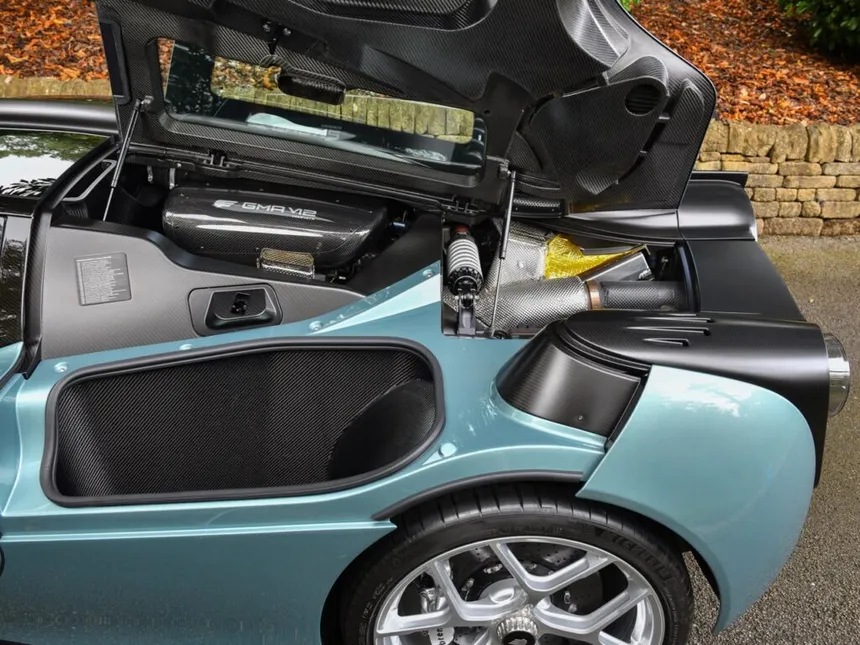
Cosworth delivered a unit weighing 178 kg. For context, that’s roughly the same as a modern turbocharged 2.0-litre four-cylinder. The steel crankshaft weighs 13 kg — the lightest V12 crankshaft in the world. Connecting rods and valves are titanium (the titanium valves are what permit the 12,100 rpm without the valvetrain coming apart). Pistons are metal matrix composite. The camshaft drive is gear-driven, not chain — exactly like a Formula 1 engine. Induction is through four throttle bodies with ram-air intake.
The number that matters most: throttle response of 28,400 rpm per second. That means from idle to redline in 0.3 seconds. Your right foot physically cannot move fast enough to outpace this engine’s response. That’s not a powertrain. That’s a reflex.
And one detail Murray insisted on: when you open the twin gullwing engine covers at the rear, the V12 sits there fully exposed — cam covers, inlet trumpets, exhaust manifolds, all visible. No plastic engine covers. No marketing graphics. Murray hates engine covers. The engineering is the aesthetic.
What It Sounds Like
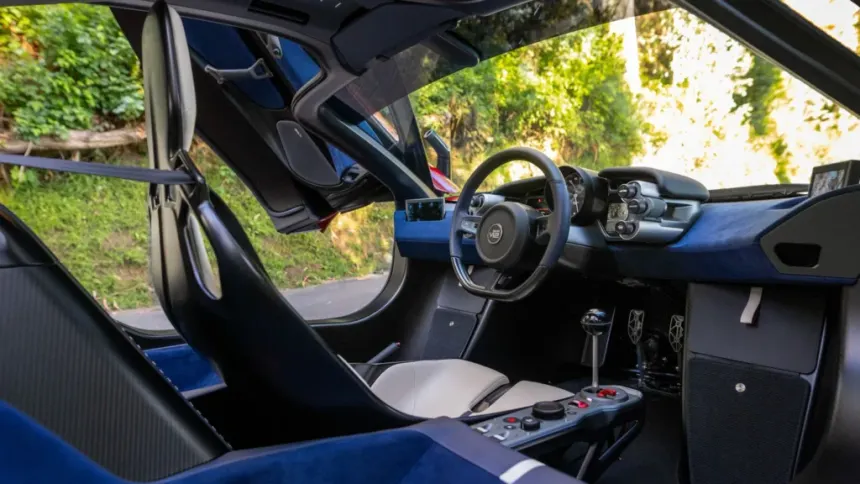
GMA hasn’t tuned the engine or exhaust to enhance the sound artificially. What they did was thin the carbon-fibre panel on the intake duct directly above the driver’s head, so it vibrates slightly and amplifies induction noise at lower revs — the same “Direct Path Induction Sound” concept Murray used on the McLaren F1, taken a step further. The ram-air intake mounted on the roof works literally as a low-frequency speaker, filling the cabin with natural engine sound.
The result, according to Top Gear’s full road test: below 5,000 rpm, a high-frequency valvetrain whistle — controlled, civilised, conversational. You can chat with passengers, take phone calls, listen to music. Above that, the character transforms. What Top Gear described as “not the most musical or operatic sound, just this raw, blood-curdling howl.” Evo Magazine was more direct: “the intense, complex, screaming sound combined with the performance is utterly addictive — a succession of upshifts with the tight, precise manual Xtrac gearbox will leave goosebumps on your arms for days afterwards. Possibly permanently.”
In 2022, during a McLaren F1 30th Anniversary Owner’s Tour through Italy, a T.50 joined the convoy and blasted through tunnels alongside several F1s. The Drive published the footage and concluded that the T.50 sounded better than the F1 — already considered one of the finest-sounding cars ever made. The Cosworth GMA, through its Inconel and titanium exhaust, produces what multiple journalists have described as identical to a 1990s Formula 1 car on the road. Except you can drive it to the shops.
The Fan: Where 1978 Meets 2020
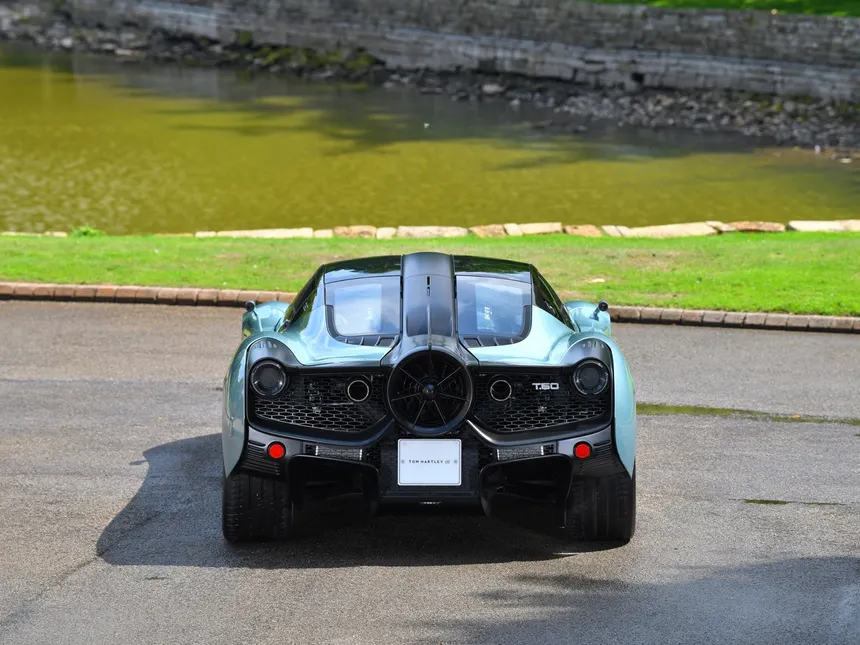
The 400 mm rear-mounted fan is the idea Murray has been carrying since the BT46B. In 1978, he used a fan on the back of a Formula 1 car to create artificial ground effect — sucking the car to the track surface without relying on wings. The BT46B won its first and only race (Swedish Grand Prix, Lauda driving) and was voluntarily withdrawn before the FIA could formally ban it. Murray has waited 42 years to put a fan on a road car.
The T.50’s fan is a carbon-fibre unit driven by a 48-volt electric motor, spinning at up to 7,000 rpm. It accelerates air flowing under the car, forcing it through active boundary-layer control ducts in the rear diffuser, creating active ground effect that doesn’t depend on the car’s speed.
This is the critical distinction from a conventional wing. A rear spoiler only generates meaningful downforce at high speed — the faster you go, the more it pushes you down, but the more drag it creates. The T.50’s fan generates downforce from standstill. Select High Downforce mode and you get 30% more downforce instantly, without a drag penalty. In Braking mode, downforce doubles to 100%, the active rear spoilers deploy to 45 degrees, and stopping distance from 150 mph is reduced by 33 feet. In V-Max Boost mode, the fan works with ram-air induction to raise output to 700 PS.
Six aerodynamic modes in total: Auto, High Downforce, Streamline, Braking, Test, and V-Max Boost. Streamline creates what Murray calls a “virtual longtail” — reducing drag by 12.5% for maximum straight-line speed. This is driver-controlled active aerodynamics, not computer-managed. You decide how much downforce you want. You decide when. The car obeys.
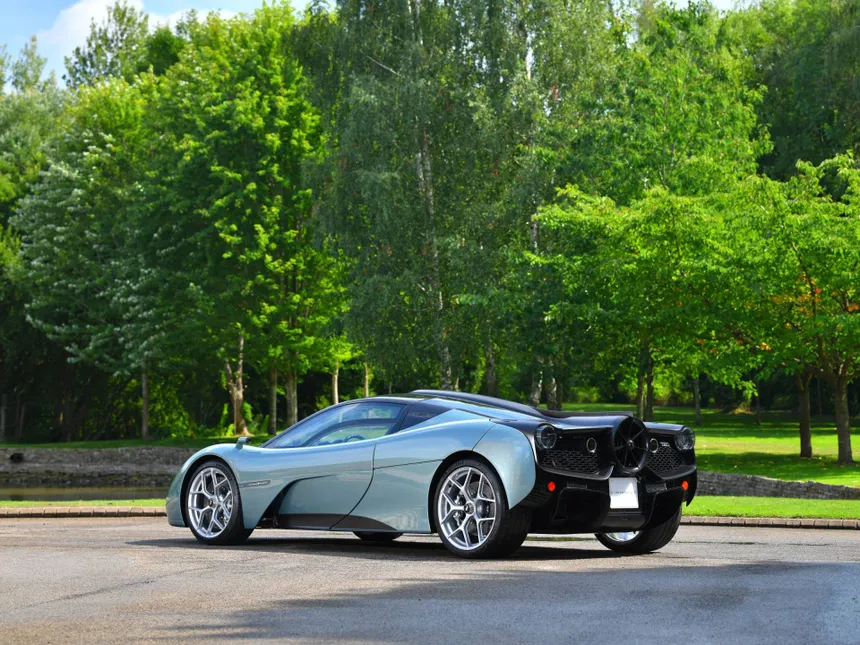
The aesthetic consequence is equally important. Because the fan handles the aerodynamic work, the body doesn’t need aggressive splitters, oversized intakes, or canards. The T.50’s upper surfaces are clean, flowing, and uninterrupted — it looks like a 1960s prototype from above and a spacecraft from behind. Function and beauty resolved by the same component.

The T.50s Niki Lauda: For Those Who Want More
For anyone who thinks the road-going T.50 isn’t enough, Murray built the track-only version: the T.50s Niki Lauda, named in honour of the triple World Champion who trusted Murray throughout his Brabham career. Twenty-five units at £3.1 million each. Dry weight: 852 kg. Engine: Cosworth GMA.S with compression raised to 15:1, titanium free-flow exhaust with no catalytic converters, and 725 bhp with ram-air induction.
This is where the fan becomes an unrestricted weapon. The road car has six modes. The T.50s has one: permanent High Downforce, with the fan spinning at 7,000 rpm without pause. Combined with a 1,758 mm delta wing (inspired by Murray’s 1983 Brabham BT52), front splitter, underbody aerofoil, and adjustable diffusers, total downforce exceeds 1,500 kg — 170% of the car’s weight. Murray stated that the T.50s could drive upside down from as little as 175 mph.
Based on GMA’s simulations, the T.50s is capable of exceeding the lap times of the McLaren F1 GTR that won Le Mans in 1995. That isn’t a casual reference. That’s Murray measuring his final work against his masterpiece.
Chassis, Weight, and the Numbers Murray Doesn’t Care About
Carbon-fibre monocoque designed entirely in-house by GMA, 30 kg lighter than the McLaren F1’s. Total dry weight: 986 kg. To put that in perspective: a current Mazda MX-5 weighs more. A Toyota GR86 weighs more. The T.50 weighs less than most of the hatchbacks in a Tesco car park, and it has a 654 bhp V12 behind the driver’s seat.
Transmission: bespoke six-speed Xtrac H-pattern manual gearbox. Thin-wall cast aluminium casing — a technique normally reserved for competition gearboxes. Murray insisted on the manual because the connection between driver and machine is more direct than any dual-clutch can provide. This isn’t nostalgia. This is a design decision.
According to Car and Driver: 0-60 mph in 2.9 seconds. Top speed: 226 mph. Murray has repeatedly stated that he has zero interest in lap records or acceleration benchmarks. What interests him is the experience. But the numbers are there for anyone who needs them.
Dynamic testing was conducted by Dario Franchitti — three-time Indianapolis 500 winner and four-time IndyCar champion. Franchitti described the T.50 as “epic” and said it “rewrites the supercar rule book.” His most memorable moment: getting wheelspin shifting from fourth to fifth above 11,000 rpm on a damp track at Goodwood. That tells you everything about how this engine responds.
Dario’s verdict, delivered with a grin at the 2021 Goodwood debut: “If that’s the full stop to the internal combustion engine supercar, it’s a pretty good full stop.”
Production and Price
One hundred road cars. Price: £2.36 million before taxes. All 100 sold within 48 hours of the global premiere on August 4, 2020. Production commenced in March 2023 at GMA’s facility in Surrey. Overall length: 4,352 mm — 6 mm shorter than a Porsche Boxster 987. Width: 1,850 mm. This is a supercar that takes up less road space than most of the SUVs surrounding it.
What the T.50 Means
Every generation gets one or two cars that define what driving is supposed to feel like before the regulations, the electrification, and the screens take it away forever. The Ferrari F40 was one. The McLaren F1 was another. The T.50 is Gordon Murray’s answer to the question nobody else dared ask: what happens if you remove every compromise and let the best car designer alive build exactly what he wants?
What happens is a 986 kg car with a V12 that revs to 12,100 rpm, a manual gearbox, active aerodynamics controlled by a fan that works from standstill, and a driver’s seat in the centre with nothing between you and the windscreen but your own nerve. No traction control managing your inputs. No AI adjusting the dampers. No screen telling you what to feel. Just a car that demands you drive it properly, rewards you when you do, and will bite you without hesitation if you don’t.
Murray has spent 56 years designing cars. He has won Formula 1 World Championships, created the most influential supercar in history, and built a company from scratch to produce exactly one car without asking anyone’s permission. The T.50 is the distillation of an entire life dedicated to a single idea: that a car should be light, direct, and free of lies.
If the McLaren F1 was the sketch on a notepad, the T.50 is the finished drawing. It took 30 years to arrive. But it arrived exactly as Murray imagined it.
And now, check you’re still alive.
2 thoughts on “GMA T.50”