
SUVs: The Greatest Four-Wheeled Fraud in Automotive History

Something doesn’t add up. And it hasn’t added up for years.
Every day, I see vehicles that weigh over two tons, with a ground clearance that is a joke compared to what they promise, all-season tires that are neither good for the road nor for the dirt, and aerodynamics that would make any engineer with half a brain weep. They call them SUVs. Sport Utility Vehicle. Sport and Utility. Two words that, when put together, are as big a contradiction as saying “healthy diet at a McDonald’s.”
And people buy them. By the millions. Without questioning a thing.
Today, we are going to dismantle, piece by piece, why SUVs are likely the biggest scam the automotive industry has pulled on consumers in the last three decades. And we are going to do it with data, with mechanics, and with the experience of someone who has spent over 30 years getting their hands greasy inside engines.
1. The Engineering Absurdity: When You Make Everything Worse on Purpose
Let’s go to the basics. To what anyone with minimum knowledge of vehicle dynamics understands.
You take a sedan platform. A proven chassis, optimized for years to offer the best compromise between comfort, stability, and fuel economy. And then, someone in a marketing office decides you have to “lift” it. Raise the center of gravity by 4 to 8 inches. Add 600 or 800 extra pounds of bodywork. Put on bigger wheels with higher-profile tires. Dramatically worsen the drag coefficient.
The result is predictable for anyone who understands elementary physics.
A Porsche Macan shares a platform with an Audi A4/A5. The A5 weighs about 3,500 lbs. The Macan exceeds 4,200 lbs. The A5 has a drag coefficient ($Cx$) of 0.25. The Macan is around 0.35. The A5 brakes better, turns better, consumes less fuel, and is more stable at high speeds. But the Macan costs more. A lot more. The reason? You feel “high up.” You feel “safe.” You feel “important.”
That isn’t engineering. It’s consumer psychology disguised as a premium product.
Volkswagen has one of the most flagrant examples. The Tiguan, that SUV you see on every corner, shares the MQB platform with the Golf Variant (SportWagen). The Golf SportWagen has basically the same trunk space: about 21.5 cubic feet. But the SportWagen weighs 450 lbs less, gets better gas mileage, has better access to the cargo area because you don’t have to lift grocery bags to chest height, and drives infinitely better. It costs less. And nobody wants it. Because it doesn’t sit you 6 inches higher off the ground so you can look down your nose at everyone else.
2. The “Space” Scam: The Myth Nobody Questions
“I just need the space for the family.”
That is the phrase I hear most often to justify buying an SUV. And it’s the one that makes the least sense.
A Škoda Superb Combi (or a VW Passat Wagon) has 23.3 cubic feet of trunk space. A Volkswagen Touareg, which weighs nearly half a ton more and costs twice as much, has about 28 cubic feet. Yes, the Touareg has a bit more space. But the weight-to-space-to-price-to-consumption ratio is aberrant. And if we talk about real accessibility for loading, a traditional station wagon wins every time. The load lip is lower, the trunk floor is flat, and you don’t need to do squats with your grocery bags.
And what about the back seats? A compact SUV like a T-Roc or a Peugeot 2008 has less legroom in the back than a conventional Golf. Less. Because the space goes into height, not real habitability. You are sitting higher up, but with your knees still jammed into the seat in front of you.
The industry has sold you the perception of space. Not real space.
3. The Fake Off-Roader: 95% Never Leave the Asphalt
This is perhaps the most irritating part of all.
A real off-roader has a low-range transfer case. It has locking differentials, or at least a center and rear one. It has approach, breakover, and departure angles designed to clear real obstacles. It has underbody protection. It has a transmission designed for torque at low speeds on complicated terrain.
A modern SUV has none of this.
A first-generation Volkswagen Touareg (2002-2010) was a real off-roader. Low-range gears, center and rear differential locks, 28° approach angle. You could cross a desert with it. And people did.
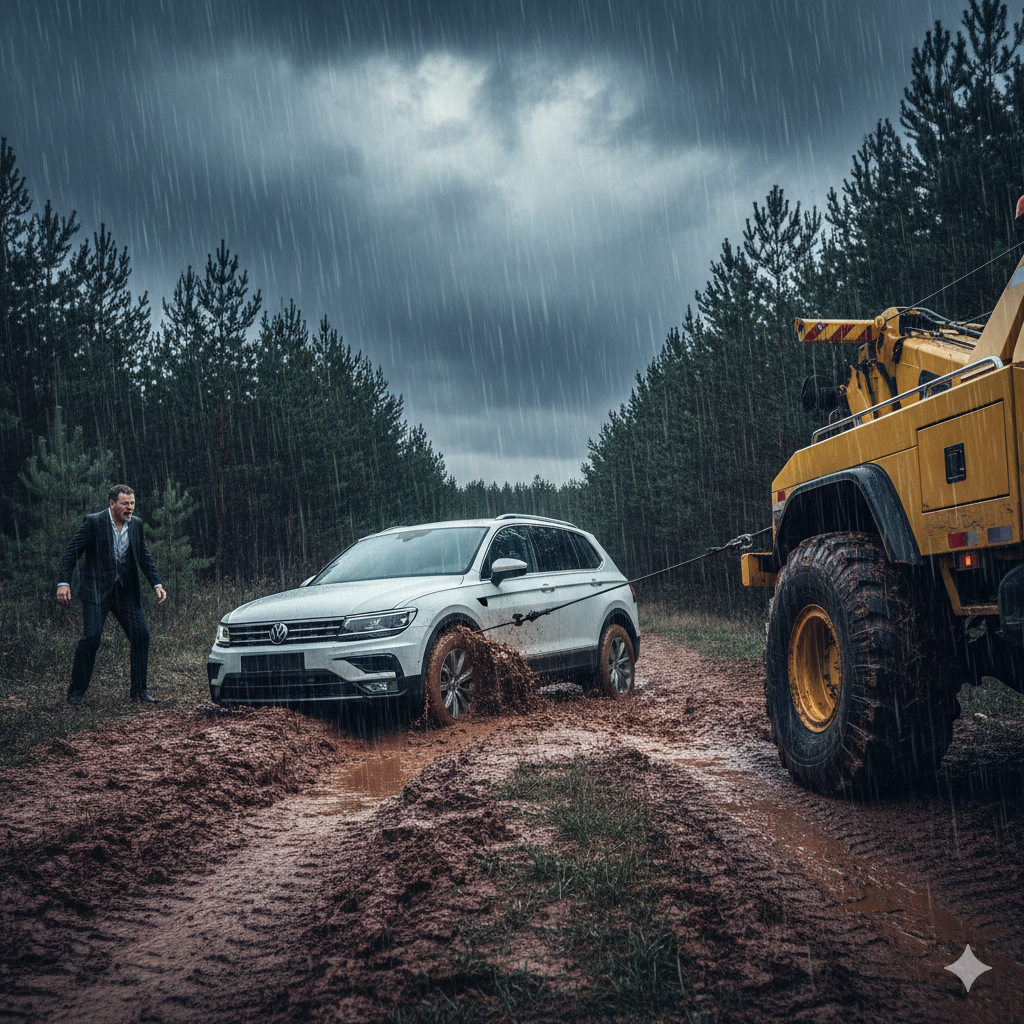
A T-Roc, a Kuga (Escape), a Qashqai (Rogue Sport), or a Tucson are elevated passenger cars with front-wheel drive and, optionally, a Haldex system or similar that sends a bit of torque to the rear axle when it detects a loss of traction. That isn’t all-wheel drive. It’s emergency traction. And most are sold as front-wheel drive exclusively. They are just sedans on stilts.
Do you know what is more of an off-roader than a modern SUV? A 90s Audi A4 B5 Quattro with the suspension lifted an inch and the fenders trimmed. Center Torsen differential, permanent all-wheel drive, mechanically simple and reliable. No unnecessary electronics. No parking sensors. No 360° cameras. Just iron, mechanics, and a driver who knows what they are doing.
And it would cost a tenth of what a new Tiguan costs.
4. The Herd Effect: Nobody Chooses an SUV, Marketing Chooses It
This is where things get interesting from a social point of view.
Nobody, absolutely nobody, sits in an SUV and an equivalent sedan from the same segment and says: “The SUV drives better.” That doesn’t happen. Ever. Because dynamically, it is impossible for a taller, heavier car with worse aerodynamics to drive better than its lower, lighter equivalent.
What people say is: “I feel safer.” “I see further.” “I like being high up.”
Those are feelings. They are not mechanical facts. And the industry knows this perfectly well.
The elevated driving position generates a false sense of security. You see further ahead, yes. But your center of gravity is higher, your braking distances are longer, and your probability of a rollover is significantly higher. Data from Euro NCAP and the American NHTSA are clear: SUVs are not safer than equivalent sedans. In many cases, they are less safe for pedestrians and other road users, precisely because of their weight and frontal height.
But marketing has done its job. It has created a need where there was none. It has convinced millions of people that they need a bigger, heavier, and more expensive car to do exactly what they used to do with a Golf, a Mégane, or a Corolla.
5. The Real Impact: What Nobody Wants to Hear
An average SUV consumes between 15% and 25% more than its sedan or wagon equivalent. That is a fact, not an opinion. More weight, more aerodynamic drag, more friction. The laws of physics do not negotiate with advertising campaigns.
But the impact goes beyond fuel consumption.
SUV tires are wider and wear out faster. More rubber microparticles released into the environment. The brakes work harder because of the additional weight. More brake dust. The asphalt suffers more, parking spots feel smaller, and visibility for the rest of the drivers worsens because you have a six-foot-tall wall of sheet metal in front of them.
And now comes the great hypocrisy: Plug-in Hybrid SUVs with “Green” labels. A Volvo XC60 Recharge weighs 4,700 lbs. It claims a fuel economy of 130 MPGe. Independent studies show that real-world consumption is around 30-35 MPG in mixed use because nobody plugs them in. These are cars bought to enter low-emission zones and park for free. Not to pollute less. It is greenwashing in its purest form. And governments allow it because the brands generate jobs and pay taxes.
6. The Alternative Nobody Wants to See
If you need space, buy a wagon. A Škoda Superb Combi, a Peugeot 508 SW, a Volkswagen Passat Variant. More real space, better dynamics, lower consumption, lower price. It is the rational choice.
If you need to go off-road for real, buy a real off-roader. A Toyota Land Cruiser, a Suzuki Jimny, a Jeep Wrangler. Cars designed for the mud, not for the school drop-off line.
If you need to feel high up to feel safe, maybe the problem isn’t the car.
And if someone tells you their SUV is “sporty” because it has 300 HP and a Sport mode that stiffens the steering and changes the throttle maps, remind them that a Golf R weighs 900 lbs less, has real all-wheel drive, and runs circles around it on any track on the planet.
Conclusion
SUVs are not bad cars. They are unnecessary cars. They are the answer to a question that nobody asked, manufactured by marketing departments that discovered people will pay more to feel “above” everyone else. Literally.
Every SUV sold is a sedan or a wagon that wasn’t built. It’s a heavier car occupying more space, consuming more resources, and offering less dynamic performance. And all for a feeling.
As we say in this business: data doesn’t lie, but marketing does.
And you—are you driving what you need, or what you’ve been told you need?
Not Enough Cylinders — Where cars are explained with grease on the hands, not with PowerPoints.
24 thoughts on “SUVs”