Fiat 500: when a car was actually a platform in disguise
Chris Harris once said the best small cars are the ones that feel honest about what they are. He was talking about a modern hot hatch. He could have been talking about the original Fiat 500, except the 500 takes that idea further than any modern car will ever go: it wasn’t even a car, properly. It was a platform pretending to be one, and that’s what makes it the most quietly important small vehicle of the twentieth century.
Forget the espresso-and-Vespa imagery for a minute. The Cinquecento isn’t interesting because it’s cute. It’s interesting because of what four coachbuilders, one tuner, and an entire Austrian licensee did to it — and how the underlying engineering took every bit of that abuse and kept working.
The man behind that platform was Dante Giacosa. And he’s the one Top Gear should have done a hagiography on, not the people they actually did.
A factory president, an impossible brief, July 1957
In post-war Italy, Fiat boss Vittorio Valletta had a numbers problem. The Fiat 600, launched in 1955, sold well — but not well enough. The average Italian worker still couldn’t afford one. Valletta needed something smaller, cheaper, and quicker to manufacture. He gave the brief to Giacosa, the engineer who had already designed the 1936 Topolino and the 600.
The brief was almost cruel: a car that could carry two adults, two children and 70 kg of luggage, priced near a labourer’s annual salary, in less than three metres of length, and — somehow — pleasant to drive.
What came out of Giacosa’s office on the 4th of July 1957 was the Nuova 500. A 479 cc air-cooled twin sitting at the back. 13 hp. 499 kg dry. 2,970 mm long. Suicide doors (rear-hinged). A fabric roof rolling all the way back to the engine cover, not for style but to save sheet metal. A four-speed crash gearbox — no synchros, learn to double-declutch or stall in traffic.
The first version, called “Economica”, flopped. Italians wanted a car, not a punishment. Fiat reacted within three months and added the “Normale” trim at the same launch price of 490,000 lire. That one sold.
Two years later, in 1959, Giacosa was awarded the Compasso d’Oro for industrial design. The Compasso d’Oro has been issued since 1954 by ADI (Associazione per il Disegno Industriale) and remains the oldest and most prestigious industrial design prize in the world. The 1959 edition marked the first time it had ever been given to a car manufacturer. Not for being beautiful. For being correctly solved. And the market agreed: 3,893,294 units were built over the model’s 18-year run.
The actual model lineage, with the internet myths removed
If you go on enthusiast forums, you’ll find people talking about all sorts of mythical 500 variants. Let’s clean this up. The official Fiat production series were these, and only these:
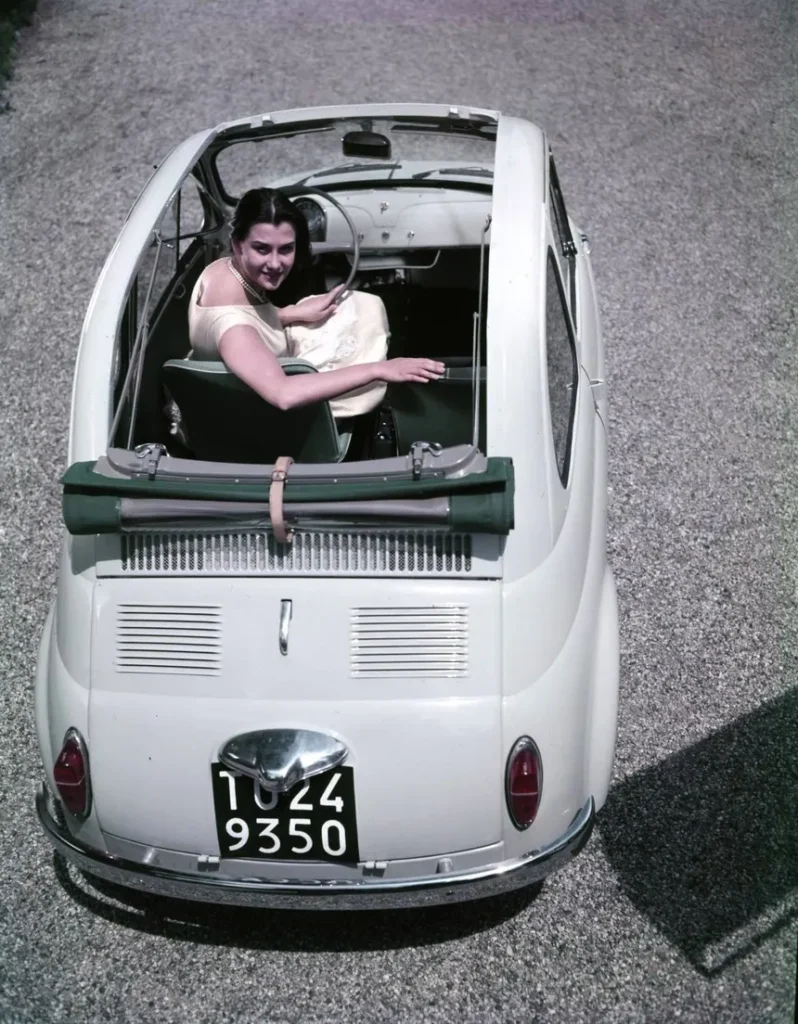
500 N (1957-1960). The launch car. 479 cc, 13 hp, suicide doors, full-length canvas roof. Two trim levels — Economica and Normale.
500 D (1960-1965). New 499.5 cc engine, 17 hp, derived from the 1958 500 Sport limited edition that had set Monza endurance records. Shorter fabric roof. Optional “Trasformabile” with larger roof. The Giardiniera estate launched alongside, with the engine laid flat under the boot floor — that’s surgical engineering, not carpentry.
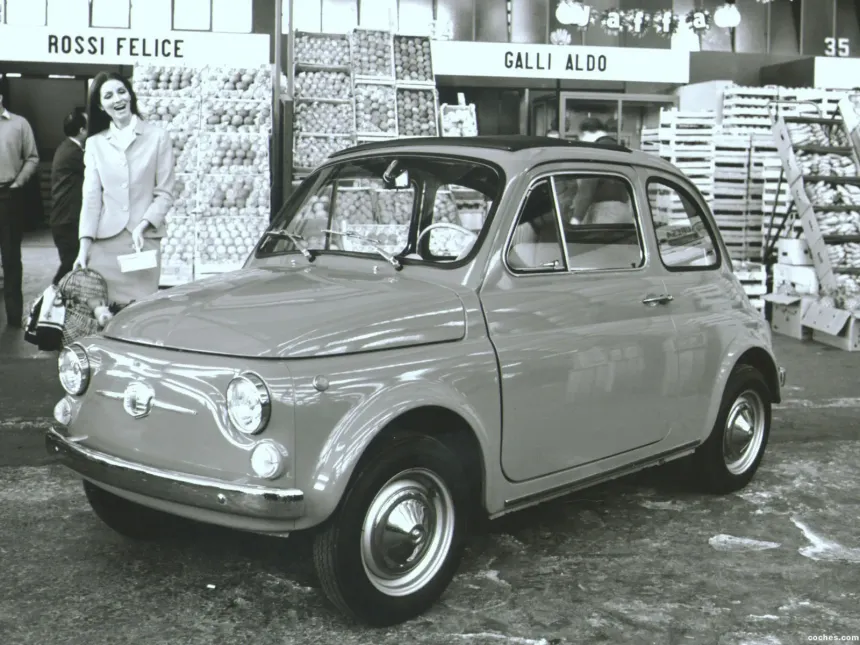
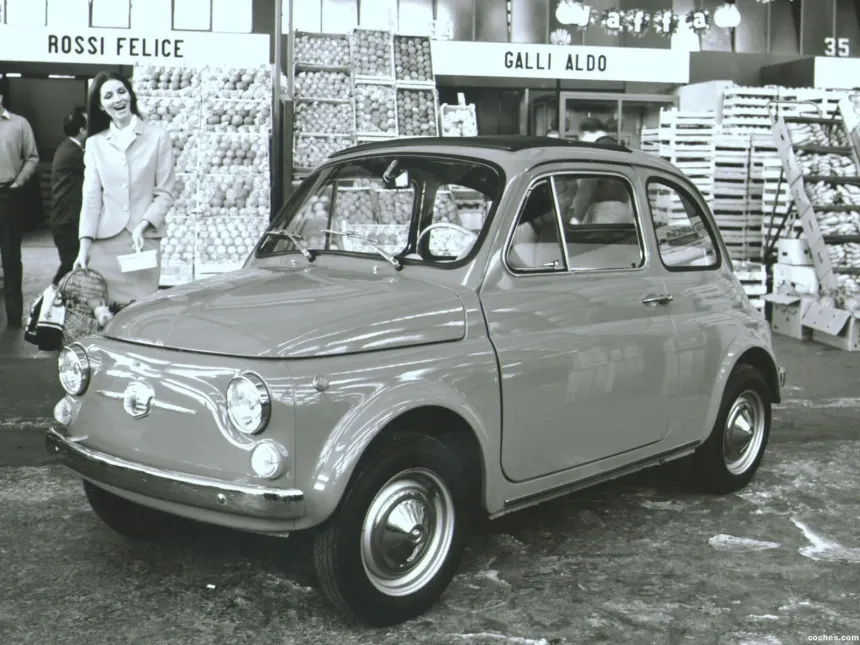
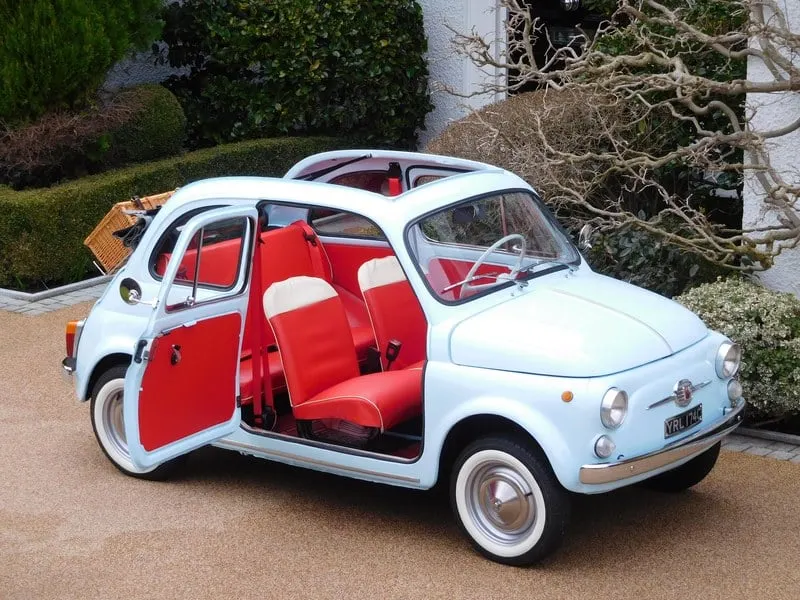
500 F (1965-1972). The big change: conventional front-hinged doors. European safety rules were tightening and Fiat moved ahead of legislation. Reinforced 499.5 cc engine. This is the silhouette most people picture when they say “classic Fiat 500”.
500 L (1968-1972). “Lusso”. Same F mechanically, but with nudge bars on the bumpers, better trim, horizontal dash with proper instruments. The polite attempt to turn the 500 into something aspirational without changing what mattered.
500 R (1972-1975). “Rinnovata”. Stripped back to F-style simplicity but fitted with the 594 cc engine from the new Fiat 126. More torque, more usable. The closing chapter, sold alongside its replacement before the final example rolled out of SicilFiat in Termini Imerese, Sicily, on 4 August 1975.
That’s the whole official lineup. N, D, F, L, R, plus the Giardiniera. There’s no factory “500 K”, and the “500 Sport” was a 1958 limited run — red roof, white side stripe, twin-Webered 499.5 cc — not a continuous series. Anything else you read is either coachbuilder confusion or marketing fan-fiction.
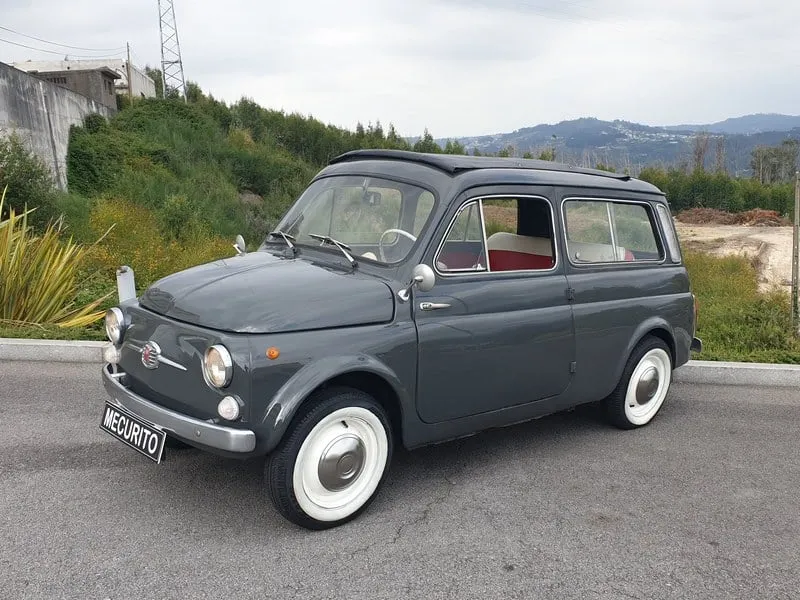
Where it actually got interesting: the ecosystem
Here’s the thing nobody tells you on those Italian-lifestyle Instagram reels: the most fascinating 500s were never built by Fiat. They were built on top of Fiat.
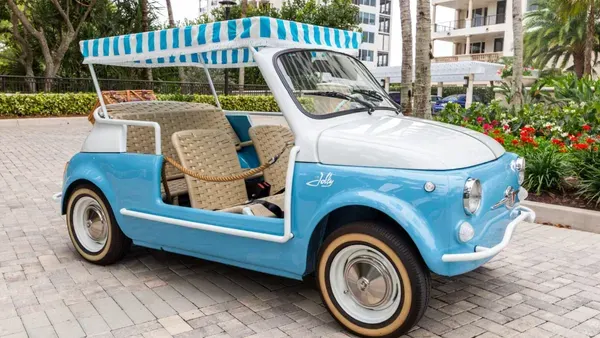
Ghia and the Jolly (1958-1966). Ghia stripped the doors off a 500, swapped the seats for wicker, added a fringed canvas top, and sold it to Aristotle Onassis, the Agnelli family, the Monaco royals. Hotel-to-yacht transport for people who didn’t carry their own bags. Tiny production numbers. Today they fetch six figures at auction, mostly because of the names attached to them. The platform underneath was pure Fiat.
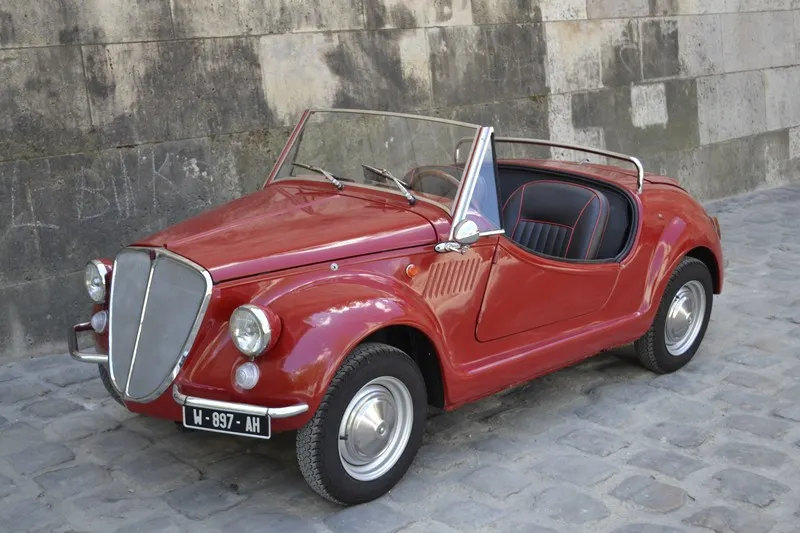
Vignale Gamine (1967-1971). Coachbuilder Alfredo Vignale rebodied a 500 F with what looked like a tiny Ferrari. Long bonnet, round lamps, fastback. Ridiculous and brilliant in equal measure. Built for adults who wanted to be in on the joke.
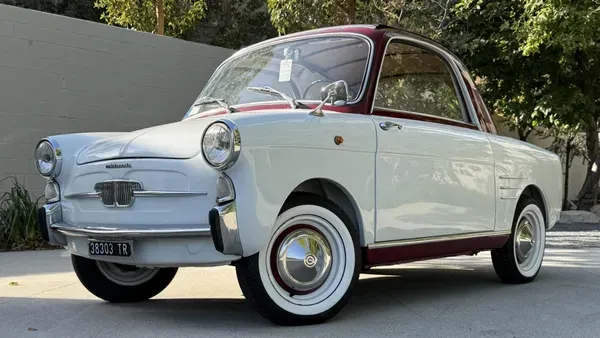
Autobianchi Bianchina (1957-1970). This one operated at another level. Autobianchi was a Fiat-Pirelli-Bianchi joint venture. They took the 500’s mechanicals and built a more elegant body around them — Trasformabile, Berlina, Cabriolet, Panoramica. Different car, same engineering, different buyer.
Steyr-Puch 500 (Austria, 1957-1973). A licensed version with the standard 500 body but a completely different engine — a flat-twin boxer designed by Steyr-Daimler-Puch in Graz. Better low-end torque, perfectly suited to Alpine driving. This wasn’t a re-badge. It was the 500 with an Austrian heart, and in rallying it embarrassed cars three times its size.
And then there was Abarth. Carlo Abarth signed an agreement with Fiat in 1958 to receive partially-assembled bodies and rework them. In September 1963, at the Turin Motor Show, he unveiled the Fiat-Abarth 595: 593.7 cc, 27 hp, 120 km/h. That’s more than double the original power output, in the same shell.
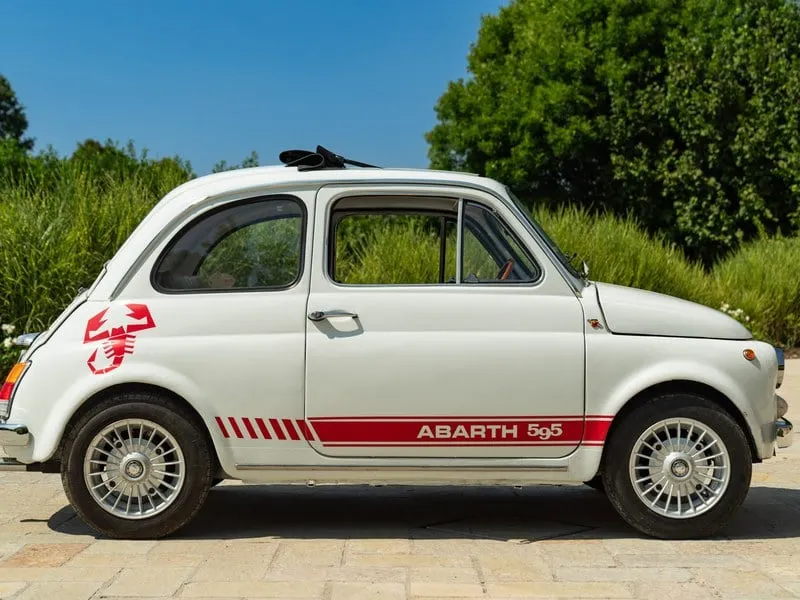
In March 1964, at Geneva, came the 595 SS (32 hp, 130 km/h), and the 695 and 695 SS with 689 cc and up to 140 km/h. The Abarths had a trademark detail — the engine cover propped open on small struts, to force more cooling air over the cylinder head. If you see a vintage photo of a 500 with the tail lid stuck up, it isn’t broken down. It’s an Abarth doing what Abarths did.
And Abarth went further. The official Fiat dealer network sold conversion kits: you could buy a standard new 500, take it to an approved workshop, and walk out with what was essentially a 595 or a 695, both mechanically and visually. Mid-1960s tuner culture, factory-blessed, decades before anyone in the UK or America thought of it as a business model.
Why the platform could absorb all that
Now the proper engineering bit. The reason a 500 could be turned into a Ferrari-shaped Vignale, a doorless beach-cart, a rally-ready Abarth, or a flat-twin Austrian alpine special, all without falling apart, is because of two cold-headed Giacosa decisions.
Rear-engine, rear-wheel drive. Same approach as the 600 and the Beetle. Put the engine where the driven wheels are. No prop shaft, no driveline tunnel, less weight, lower cost. The freed-up space at the front becomes the footwell and a token luggage area. Air cooling kills the radiator, the water pump, the hoses, all the failure points that haunted small cars in the 1950s. Fewer parts, fewer breakdowns, simpler manufacturing.
Monocoque construction. No separate chassis. The body is the structure. That’s how a three-metre car ends up weighing 499 kg. It’s also what made the Giardiniera estate possible — engine flipped on its side under a flat boot floor — and what gave Ghia enough structural integrity to cut the doors off without the whole thing folding.
The Abarth 595, in race trim, ended up with a weight distribution of 42% front / 58% rear in a car weighing roughly 520 kg dry. With a long, unsynchronised four-speed gearbox in your hand and a twin-cylinder hammering away six inches behind your ears, every roundabout became a question. Understeer didn’t exist. Oversteer was a permanent threat the moment you lifted off mid-corner. You learnt to drive properly, or you didn’t drive at all.
Those nearly four million cars came out of three plants in Italy — Turin, Desio and Termini Imerese — plus Graz, Austria (Steyr-Puch) and Ōtāhuhu, New Zealand (Torino Motors, local assembly). That’s not the trajectory of a charming little car. That’s the trajectory of an industrial necessity.
The 2007 car: nostalgia in a borrowed suit
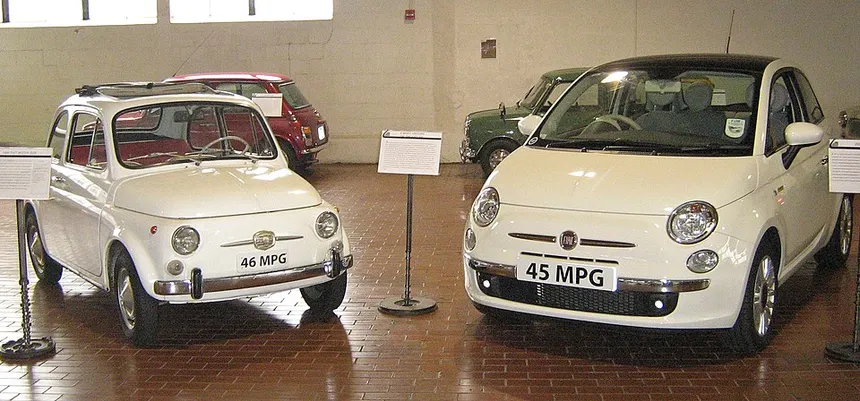
On the 4th of July 2007 — exactly fifty years after the original — Fiat unveiled the modern 500. Roberto Giolito did the concept. Frank Stephenson, formerly of MINI, did the production design. Three doors, hatchback body, front engine, front-wheel drive, Fiat Mini platform. The same platform underneath the Ford Ka and the Lancia Ypsilon.
The numbers, with no editorial filter:
| Spec | 500 N (1957) | 500 (2007) |
|---|---|---|
| Length | 2,970 mm | 3,546 mm |
| Width | 1,320 mm | 1,627 mm |
| Weight | 499 kg | 865-1,005 kg |
| Engine | Rear, 2-cyl air-cooled | Front, 2/3/4-cyl water-cooled |
| Drive | RWD | FWD |
| Platform | Bespoke | Shared with Ford Ka |
The modern 500 is twice the weight. 58 cm longer. 30 cm wider. The engine is at the wrong end, pointing at the wrong wheels, and the platform is shared with a Ford. With a Ford. The original had its own mechanical identity. The modern one is borrowed clothing.
That doesn’t make it a bad car. As a small city hatchback it’s fine. The Abarth versions (145, 160, 180 hp — the last one being the 695 Biposto, with a power-to-weight ratio of 5.2 kg/hp, which is genuinely serious) are entertaining in the way modern hot hatches are entertaining. It sells, it functions, it pays bills.
But it isn’t a 500. It’s a tribute to the 500, and there’s a difference. When Stephenson said the rear lights were “a nod to the 1965 500 F Berlina”, he was using the right word — a nod. Not continuity. This is retro engineering of the same generation as the BMW MINI and the Volkswagen New Beetle: emotional marketing wrapped around a modern, shared platform. The economics are obvious. So is the dilution.
The original was a car solved from the engineering side outwards. The modern one is a shape draped over an existing parts bin. The difference between writing a song and sampling one.
What the 500 was actually for
The classic 500 isn’t a car to love. It’s a car to understand. To understand how you design a mobility solution for fifty million people with very little money, how you draw a platform that survives four coachbuilders and one tuner without breaking, how you run a single project for eighteen years without losing its identity.
Giacosa died in 1996, after signing off on the Topolino, the 600, the 500, the 128 and the 127 — five cars that motorised Italy. Five projects any working engineer today should study the way software engineers study Knuth or Torvalds. And yet outside Italian enthusiast circles, Giacosa gets less coverage than whichever SUV designer is on the cover of Top Gear magazine this month.
The next 500 will be electric. The 500e is already on the road. It weighs around 1,300 kg. It carries a 42 kWh battery, a respectable range, a touchscreen, and a price tag that the Italian worker of 1957 would have considered an outright insult.
The problem isn’t really that we’ve lost the car. We’ve lost the question that produced the car. Valletta didn’t tell Giacosa to design an icon. He told him to solve a problem. The icon was the by-product.
Nobody asks anyone to solve problems anymore. They ask for product. And you can feel it the moment you sit in a 500 R with its 18 hp, drop down a mountain pass, listen to the twin behind your ears, fight the unsynchronised gearbox, and realise the car is actually talking to you.
The new one doesn’t talk to you. It offers you Bluetooth connectivity.
Check you’re still alive.