The best BMW M3 ever built was never sold in the United States, and the second best came over with its heart swapped out. That’s the story American enthusiasts don’t like to hear while they pay collector money for anything with the right badge. Forty years of M3 is forty years of BMW deciding what you deserved, and over here the answer was usually "less."
Let’s go through it generation by generation, with the numbers on the table.
A race car with license plates, 1986
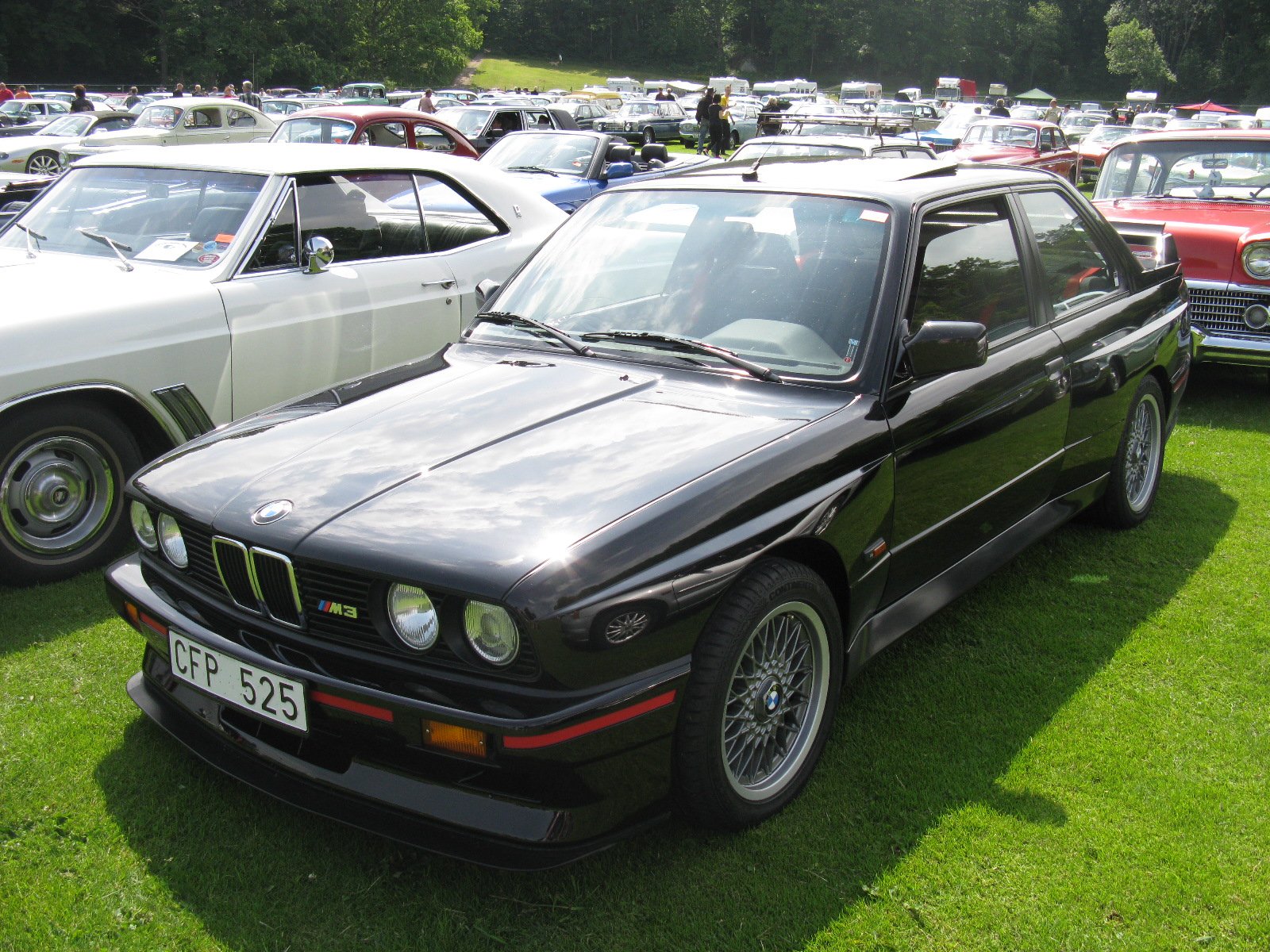
The first M3 exists because of a rulebook. For the new Group A touring car rules, a manufacturer had to build 5,000 road cars before it could race the model. Mercedes-Benz had already answered with the 190E 2.3-16, the Cosworth-headed sedan that went on sale in September 1984 with 185 hp in Europe. BMW’s reply was the E30 M3.
It looked like a regular 3 Series that had been to the gym. The box flares, the raised trunk lid, the reshaped rear window and the wing were all there for the racing version, because whatever aero you wanted on the track car had to be on the street car too. Under the hood sat the S14: a 2.3-liter four-cylinder with four valves per cylinder, built on the bottom end of BMW’s old M10 and topped with a head related to the M1‘s six. In Europe it made 200 hp without a catalytic converter. With the cat, as sold in America, it dropped to about 192.
That’s not a lot today, so put it in its own time. The 190E 2.3-16 made 185 hp in Europe and 167 in US trim. The M3 had more, revved to 7,000 rpm, weighed around 1,200 kg (about 2,650 lb), and didn’t make much of anything below 5,000 rpm. You had to work it. That was the point.
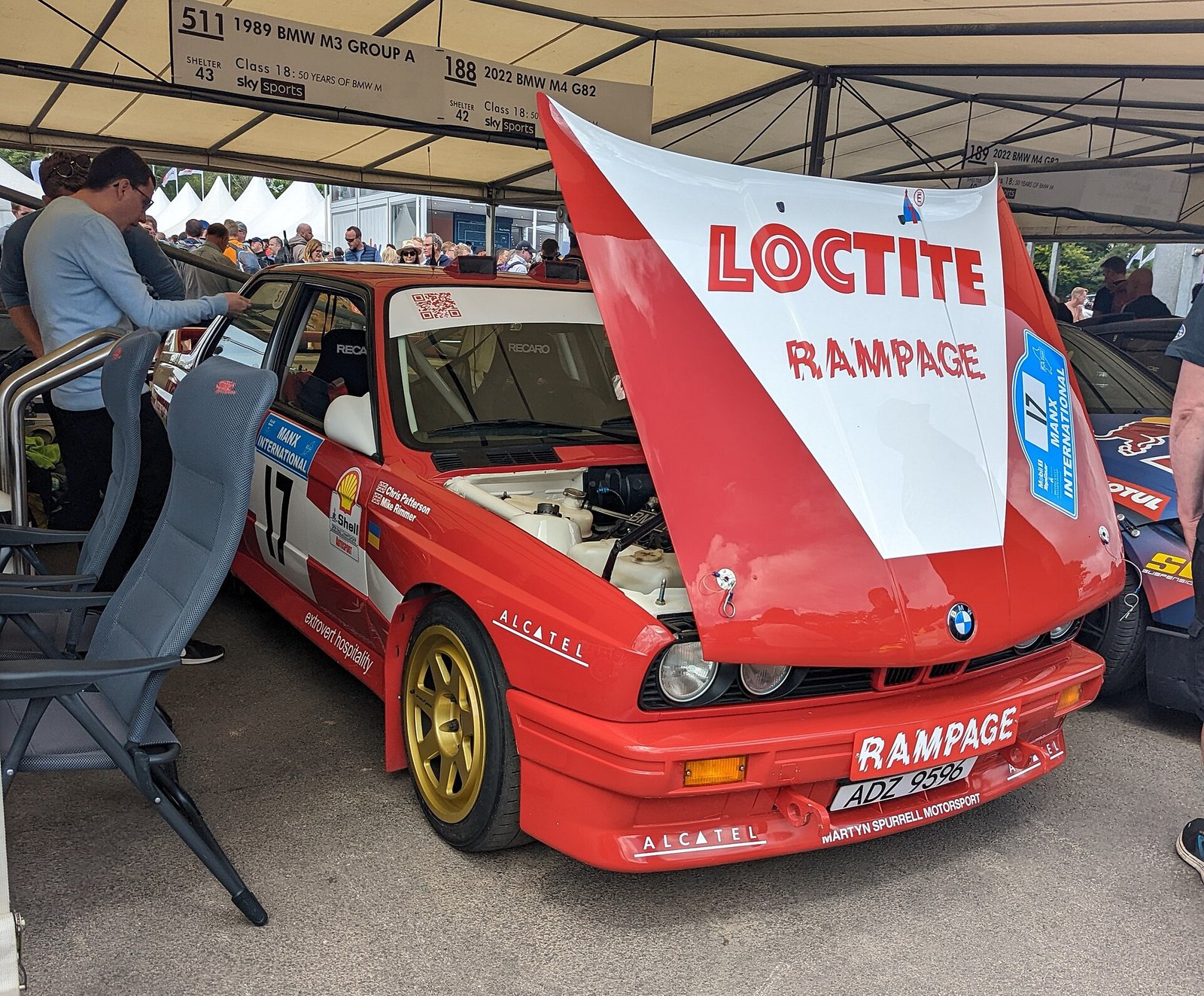
It worked on the track like nothing else. Roberto Ravaglia won the first World Touring Car Championship in 1987 in an M3. The car won the German DTM in 1987 and again in 1989 with Ravaglia, and it went rallying too: Bernard Béguin won the 1987 Tour de Corse in an M3, the only World Rally Championship win the car ever scored. Ravaglia added the 1988 European Touring Car Championship, and in Italy, where Alfa Romeo’s 75 Turbo had just won the 1988 national title with Gianfranco Brancatelli, the M3 took the crown straight back: Johnny Cecotto in 1989, Ravaglia in 1990. The M3 became the car everyone in Group A had to beat, from Germany and Britain to Australia. In Spain, Juan Ignacio Villacieros took the 1992 Spanish Touring Car Championship in an M3 run by Teo Martín Motorsport, and BMW won the manufacturers’ title that year and the next.
The evolutions, and the numbers that keep getting mangled
BMW kept sharpening the E30 to stay ahead of the racing rules. Plenty of articles get these wrong, including the Spanish version of this one, so here they are straight.
The Evolution I of 1987, 505 cars, kept the 200 hp; the changes were about homologating racing parts. The Evolution II of 1988, 501 cars, went to 220 hp at 6,750 rpm and 245 Nm. Then came the Sport Evolution in 1990: 600 cars, the S14 stroked to 2,467 cc, 238 hp at 7,000 rpm, adjustable front splitter and rear wing. It’s the one collectors hunt.
There were also driver editions. The Cecotto Edition honored Johnny Cecotto, the Venezuelan former motorcycle world champion who raced M3s in Europe. The Roberto Ravaglia Edition was a run of just 25 cars for the British market, finished in Misano Red with a plaque signed by Ravaglia, powered by the 2.3-liter engine with around 212 hp. It was not a Sport Evolution in disguise, whatever you’ve read.
What about America? BMW of North America sold the E30 M3 from 1988 to 1991, cat-equipped and short on power next to its European brother. Hagerty’s Jason Cammisa has argued that the car’s lukewarm US sales are exactly why BMW played it safe with the next one.
The E36 and the engine America didn’t get
The second-generation M3 arrived in Europe in 1992 with a straight-six: the S50B30, 3.0 liters, 286 hp at 7,000 rpm, with VANOS variable cam timing on the intake side and six individual throttle bodies, one per cylinder, like a race engine. Purists howled about a four-cylinder icon going soft. The car was faster, smoother and easier to live with, and it sold.
When the E36 M3 finally came to the US for 1995, it didn’t bring that engine. American cars got the S50B30US, a much simpler six with a single throttle body and conventional cam drive, rated at 240 hp and 225 lb-ft. Forty-six horsepower less than Europe, and far less exotic inside. The reason was money: a cheaper engine for a market BMW wasn’t sure about after the E30.
Europe moved on again in 1995 with the M3 Evolution and its S50B32: bore 86.4 mm, stroke 91 mm, 3,201 cc, 11.3:1 compression, 321 hp at 7,400 rpm and 350 Nm at 3,250 rpm, plus double VANOS and a six-speed gearbox. That’s just over 100 hp per liter without a turbo, from a road car you could buy at a dealer. The US kept a 3.2-liter version of its simpler engine.
The two specials: one for Europe, one for you
Europe got the M3 GT in 1995: 356 cars, all British Racing Green, aluminum doors, extra aero, forged 17-inch wheels and a reworked 3.0 making 295 hp. It existed to homologate parts for FIA GT and IMSA GT racing, its top speed was electronically capped at 250 km/h (155 mph), and it weighed around 1,460 kg. It was never sold in the US.
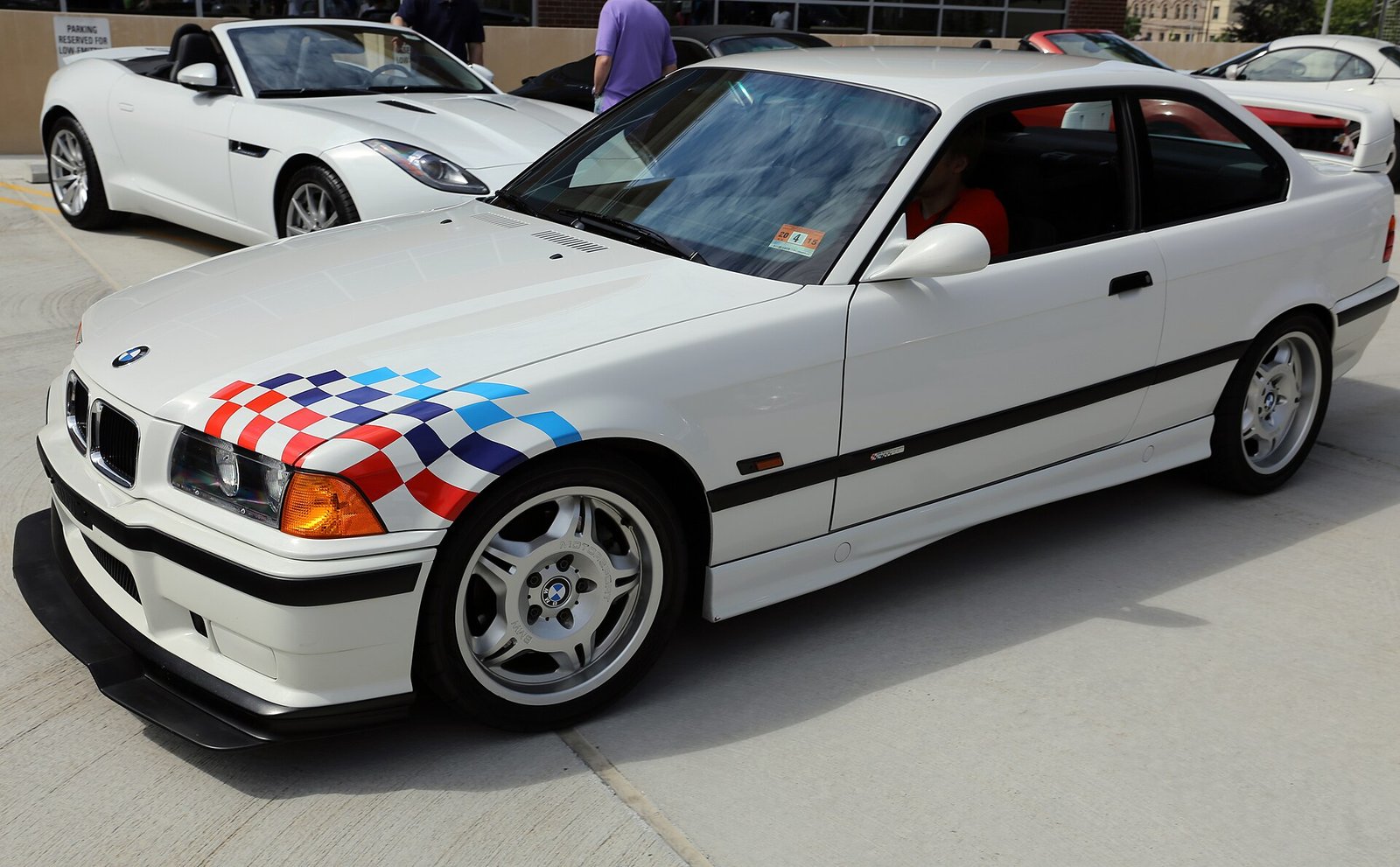
America’s consolation prize was the M3 Lightweight, and it’s the one US enthusiasts should actually be proud of. BMW built 126 of them in 1995. No air conditioning, no radio, no sunroof, much of the sound deadening gone, and roughly 200 lb (about 91 kg) gone compared with a regular US M3. They were built to put the M3 on the grid in American racing, and they still had the 240 hp engine. A light car with a modest engine beats a heavy car with a big one more often than spec sheets admit.
The E46: the high point
The third-generation M3 came out in 2000 with the S54, and this is where most people who’ve driven them all stop arguing. 3.2 liters, 343 hp at 7,900 rpm in Europe, 333 hp in US trim, an 8,000 rpm redline, double VANOS and individual throttles. This time America got the real engine, with a small emissions-related haircut.
It wasn’t perfect. Rod bearings on the S54 are a known weak point and a standard preventive job among owners today. And the differential wasn’t the mechanical limited-slip many people think it was: BMW fitted its M Variable Differential Lock, which uses a shear pump to lock up progressively only when one rear wheel starts spinning faster than the other. It works, but it’s not the same as a preloaded clutch-type LSD.
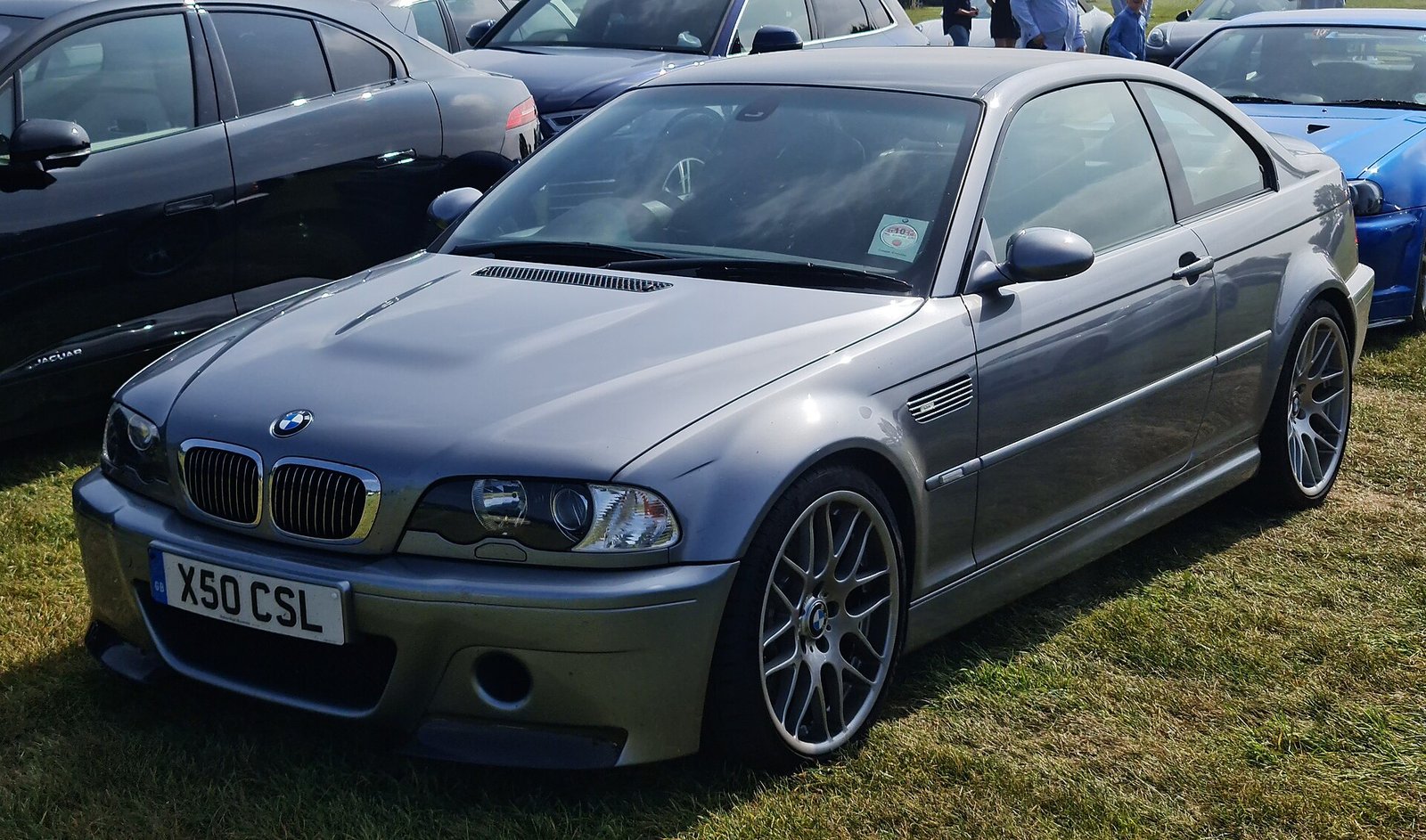
Then came the CSL in 2003, Coupé Sport Leichtbau, lightweight sports coupe, a name borrowed from the 1972 3.0 CSL. 1,383 cars, Silver Grey or Black Sapphire only, SMG automated manual only, carbon-fiber roof (a first for a production M car), carbon intake, thinner rear glass, stripped interior. 1,385 kg, which BMW put at 110 kg less than a regular M3. The S54 got sharper cams and that carbon airbox, for 360 hp at 7,900 rpm and 370 Nm. Zero to 100 km/h took 4.9 seconds, and BMW quoted a Nürburgring Nordschleife lap of 7 minutes 50 seconds on Michelin Pilot Sport Cup semi-slicks.
It never came to America. No CSL, no GT: the two most focused M3s of their eras were Europe-only.
The V8 years
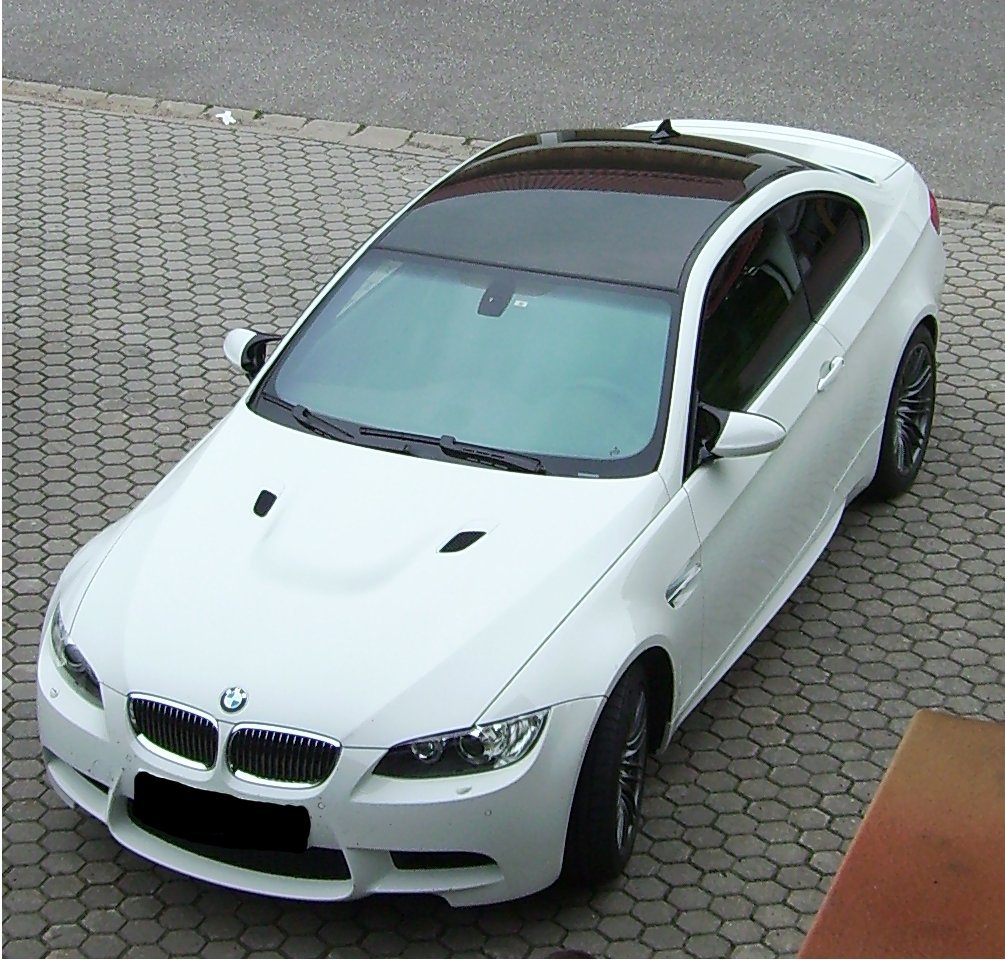
In 2008 the E90/E92 M3 dropped the straight-six for a V8. The S65 displaced 4.0 liters, made 420 hp at 8,300 rpm in Europe (414 in the US) and revved to 8,400. In fairness, it was a magnificent engine to listen to, and it had context: Audi’s RS4 had a 4.2-liter V8, Mercedes had stuffed a 6.2-liter V8 into the C63 AMG, and BMW wasn’t going to bring a six to that fight.
It also brought the rod-bearing story to the mainstream. The S65 was built with very tight bearing clearances, and some engines spun bearings, sometimes before 50,000 miles. BMW never issued a recall or admitted a defect. How many engines actually failed is argued endlessly on forums, and the more careful estimates there put it at a small share, but the fear alone made a preventive bearing swap a line item on every used S65 budget.
Turbos, and a speaker that fakes the sound
The F80 M3 of 2014 went back to six cylinders, now with two turbos. The S55 made 431 hp and 550 Nm from 1,850 rpm. On paper it beat the V8 at almost everything, including fuel economy. On the road, the big torque from low revs took away the reason to chase the redline, and the sound was so flat that BMW piped a synthesized engine note through the audio system, which it calls Active Sound Design. A car that once sold itself on what you heard at 8,000 rpm now needed speakers to sound like itself.
The current G80 uses the S58, 480 hp in the base car and 510 in the Competition, with optional all-wheel drive from 2021. One detail for American buyers: the base M3 is still offered with a six-speed manual, at a US list price of $70,100 when it launched. The Competition is automatic only.
Where the weight went
An E30 M3 weighed about 1,200 kg. A G80 is closer to 1,700 kg depending on spec and on whose scale you trust. Half a ton of crash structure, airbags, sound deadening, screens, motors for the seats and all the electronics that keep a 500 hp sedan on the road. Some of it saves lives. All of it dilutes what that first car was about: a light, nervous, four-cylinder race car you could register.
Which one to want
If you’re in the US, the E46 M3 is the sweet spot: the real S54, a manual gearbox, and the last generation that felt like the original idea grown up. If you want something rarer, the 1995 Lightweight is the most American M3 there is, built in tiny numbers for racing and stripped the way an M3 should be. The Euro-only GT and CSL will always cost more and be harder to bring in, and BMW never let you have them new.
The E30 Sport Evolution is still the purest of the lot, and most of the 600 never left Europe.
Photos: nakhon100 (CC BY 2.0); Calreyn88 (CC BY-SA 4.0); Mr.choppers (CC BY-SA 3.0); MrWalkr (CC BY-SA 4.0); Mortl (CC BY-SA 3.0). Via Wikimedia Commons.
Check you’re still alive.
17 thoughts on “BMW M3: From Homologation Special to Two-Ton Sedan, and What America Never Got”