
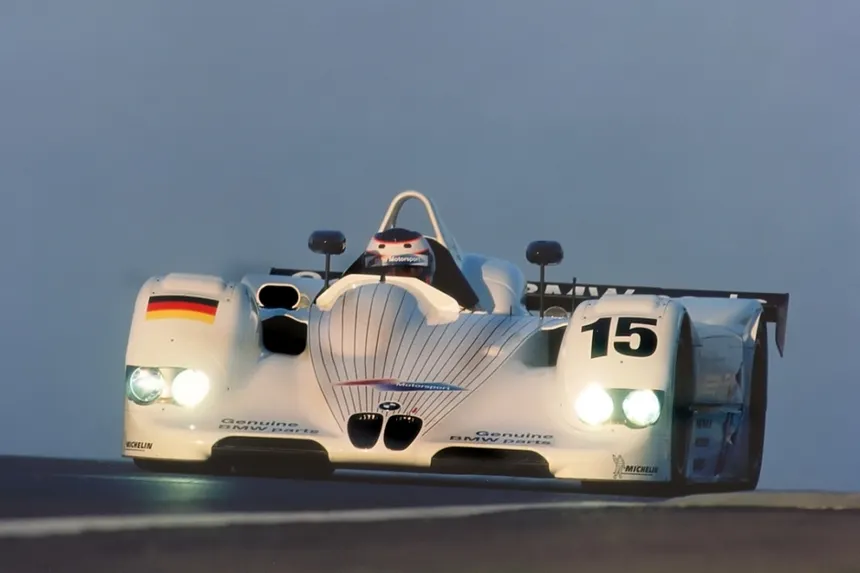
BMW Won Le Mans Once. The Wing Nearly Took It Away at 330km/h
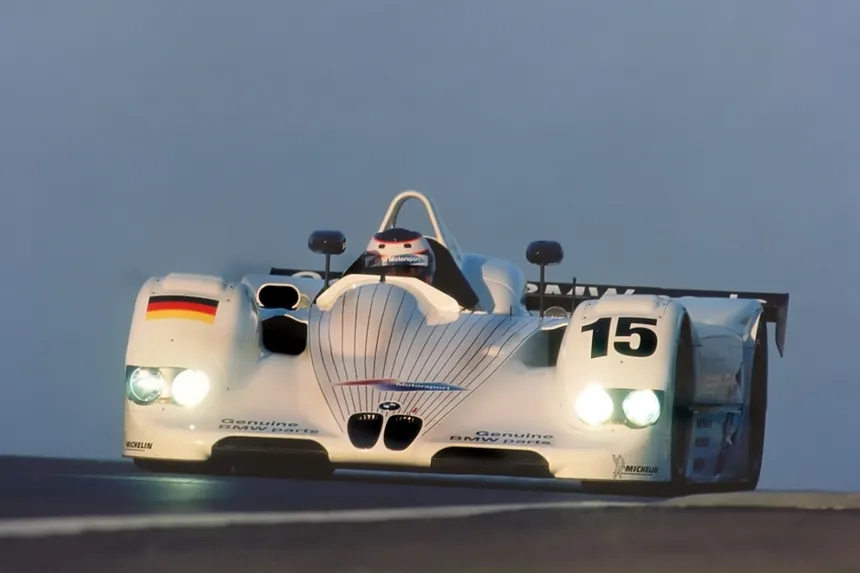
Ask any BMW enthusiast to name the company’s greatest racing achievement and watch them hesitate. The M1 Procar? The touring car dynasties? The Brabham-BMW turbo that won Piquet a title? All defensible. But the honest answer is a car most people couldn’t pick out of a lineup: a homely open-top prototype that won the 24 Hours of Le Mans in June 1999. Once. The only time in the marque’s entire history.
What nobody tells you is how close that single victory came to never happening. Not once over the weekend. Several times. This is not the story of a dominant car. It’s the story of a survivor — a machine that took the win while everything around it broke, crashed, or quite literally flew apart.
A Familiar Heart
Start where it matters most: the engine bay.
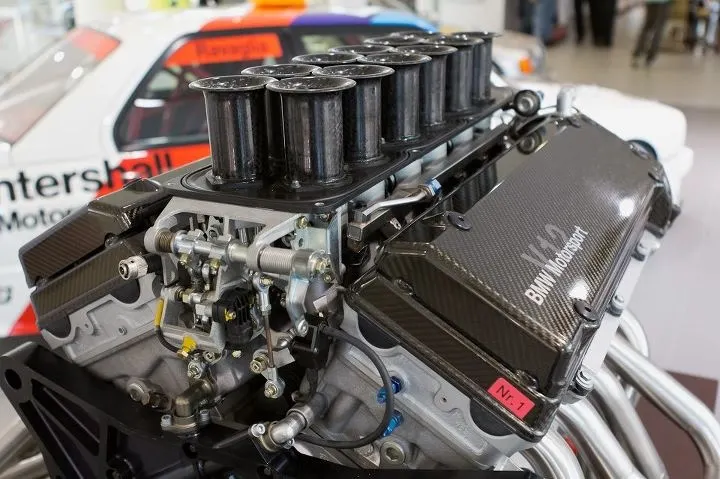
The V12 LMR ran the S70/3 — a 60-degree V12, 5,990cc, naturally aspirated. If that architecture rings a bell, it should. It shares its DNA with the powerplant that sat behind your head in the McLaren F1, the fastest road car on the planet at the time. BMW had that engine on the shelf and decided a Le Mans prototype was a fine place to put it. Hard to argue.
The numbers: around 580bhp, some sources stretching to 590. A six-speed X-Trac sequential gearbox. Roughly 340-342km/h down the Mulsanne. And here’s the first point worth nailing down, because it reframes everything that follows. Those 580 naturally aspirated horses were not exceptional for 1999. They were ordinary. The Toyota GT-One, the Mercedes CLR, the new Audi R8Rs — all in the same ballpark. The V12 LMR did not win on power. Not remotely. Dalmas said it plainly afterwards: it wasn’t necessarily the quickest car, but they’d worked hard on its reliability.
Hold that thought. It’s the whole story.
The Loophole and the Hoop
The V12 LMR was born out of embarrassment. In 1998 its predecessor, the V12 LM — no R — suffered a double retirement at Le Mans. The cooling was wrong, the aero was inefficient, heat rising off the tarmac was effectively cooking the car from below. A humiliation for a manufacturer with BMW’s resources.
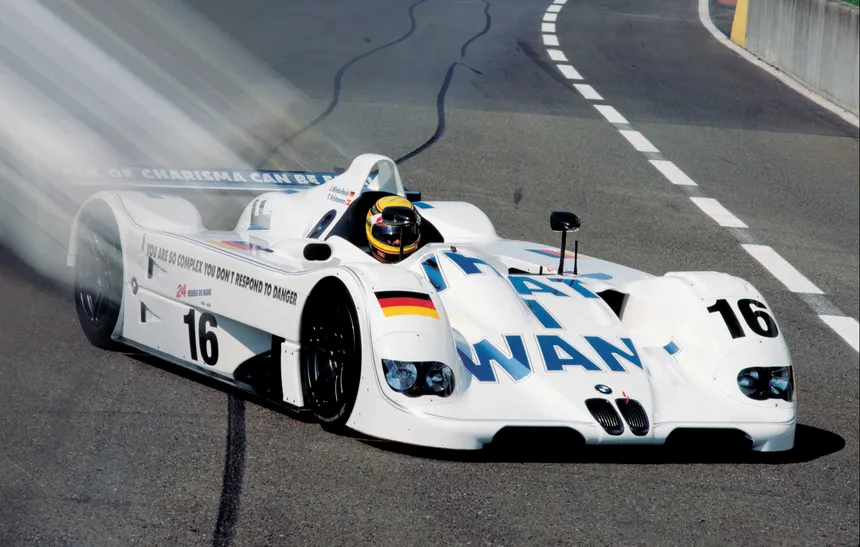
For 1999, BMW didn’t patch it. They started again. The mechanical core stayed; the entire body was binned and redrawn. Cooling intakes were lifted to the top of the car, away from the rising track heat. And then came the clever bit: instead of the wide roll structure spanning the whole cockpit, they fitted a single small hoop sitting just behind the driver’s head.
Why? Because someone in the engineering office found a gap in the ACO regulations. The narrow hoop let clean air flow uninterrupted to the rear wing — less drag, less turbulence, more downforce where it counted. Williams built the carbon-and-aluminium honeycomb chassis in the UK; Schnitzer ran the operation trackside. German Formula 1 thinking, applied to endurance racing.
On paper, immaculate. Then the air decided to collect on that cleverness.
Williams Fingerprints
One detail deserves its own paragraph, because it says a great deal about why this car went the way it did.
The monocoque was a Williams job. Not “BMW with a bit of Williams help” — Williams designed and built four carbon-and-aluminium honeycomb chassis in the UK, with their Formula 1 people embedded in the project. And it shows in the details. The car wore a distinctly asymmetrical design, with aerodynamic solutions that went on to influence later prototypes. Double-wishbone suspension front and rear, push-rod actuated, coil springs over dampers, anti-roll bars. Carbon-ceramic discs all round. Exactly what you’d expect from a car penned by people who earn their living in the top flight.
That nuance matters, because of the irony that followed. The car’s weakness at Le Mans was never the old engine or the modest power output. It was the bits that held other bits in place: the wing mast, an anti-roll bar. Mounting details. The very things you wouldn’t expect to fail on a car bearing Williams’s signature. And yet that’s exactly where the drama came from — twice, in a single weekend.
The Form Guide Said Plenty
Worth pausing here, because the V12 LMR didn’t materialise out of thin air the week of the race.
BMW handed the programme to Gerhard Berger — a recently retired Formula 1 driver running the show, with Schnitzer fielding two cars and Charly Lamm as team manager. This was no amateur outfit. It was a serious works operation with money and the right people behind it, the sort of structure that wins races when the dice fall its way.
And the form was promising. In March, at the 12 Hours of Sebring — the V12 LMR’s debut — one of the two cars won from pole. Lehto, Kristensen and Müller did the honours; the sister car of Dalmas, Martini and Winkelhock retired. But the message landed: the car was fast, and crucially, it could survive twelve hours of Florida’s bumps and heat. A solid maiden American Le Mans Series campaign followed, with wins at Sonoma, Laguna Seca and Las Vegas, and a championship lost to Panoz by a mere two points.
All of it was the warm-up act. The season’s overriding priority had a single name: the 24 Hours. In practice at La Sarthe, the car was fourth in the opening session — slower than the closed-cockpit prototypes, but easier on fuel. Qualifying put the two cars third and sixth. Only the Toyota GT-Ones were quicker. Which is to say: BMW arrived at Le Mans knowing it didn’t have the fastest car on the grid. It would have to win another way. It did.
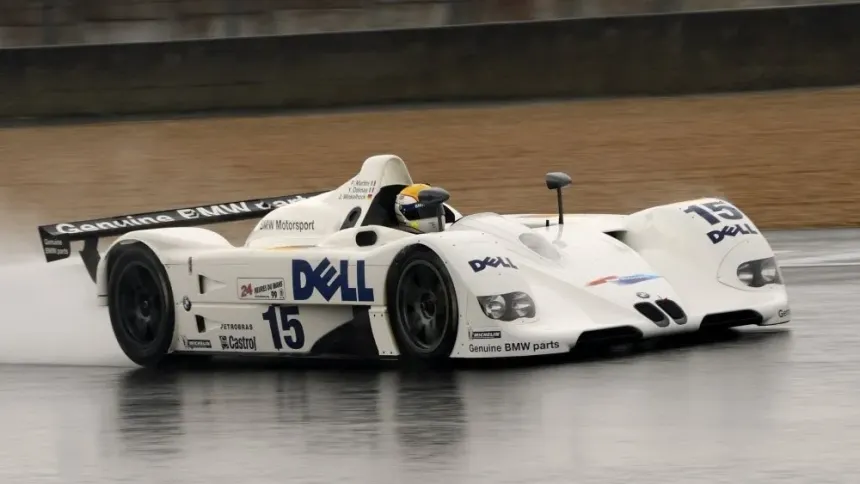
The Warning: A 360 at 330km/h, Untouched
Before the race comes pre-qualifying — not every entry makes it through to the event proper. And there, between Mulsanne Corner and Indianapolis, at the fastest point on the entire circuit, Dalmas’s V12 LMR did something nobody had scripted.
The wing mast snapped.
Let me translate what that means in plain terms. The carbon-fibre component that carried the loads from the rear wing back to the gearbox failed. The catches pulled out. And at over 330km/h, the entire wing tore off the car. Instantly. Strip the rear downforce from a Le Mans prototype at that speed and you’re left holding a paper aeroplane.
Dalmas spun. A full 360. And he tells the story himself, a quarter of a century on, the fear still audible: he completed the entire rotation without touching the guardrail on either side. Not a mark on the bodywork. “The gods were with me,” he says. He himself came off worse — a cracked rib from the violent ride over the kerbs. And one detail that turns the blood cold: it happened at almost exactly the spot where the Mercedes CLR launched into the air during that same week.
Sit with that for a second. The car that would go on to win Le Mans lost its rear wing at 330km/h days before the race. The margin between that and a fatal accident was luck. Nothing else. A spin that could have ended in the barrier ended in nothing at all.
That was the first time this victory nearly didn’t exist. It wasn’t the last.
Race Day: Everyone Else Falls Apart
June 12-13. The 1999 grid is among the most ferocious La Sarthe has ever seen: Toyota, Mercedes, a debuting Audi, Nissan, Chrysler. Manufacturers genuinely fighting for the overall win — the kind of front-running depth the race wouldn’t see again for two decades. BMW, frankly, wasn’t the favourite. It was the outsider with an ugly car and an old engine.
Then the attrition began.
Mercedes was already wounded: Dumbreck’s CLR had famously taken off and somersaulted in one of the most terrifying images in Le Mans history. Gone. The Toyotas and BMWs were left to settle it between them.
Through the night, the two V12 LMRs ran first and second. The #17 — Lehto, Kristensen, Müller — built a four-lap cushion over its sister car. It looked untouchable. Until around 10am on Sunday, with Lehto driving, a detached anti-roll bar jammed the throttle wide open. The car speared straight into the Porsche Curves. A heavy crash. The leader, gone.
Read that again: the BMW dominating the race destroyed itself over a loose component. What was left in front was the #15 — Winkelhock, Martini and Dalmas, the same Dalmas from the pre-qualifying spin — with under a lap’s margin over a Toyota GT-One breathing down its neck.
The finish was nails. Katayama set the race’s fastest lap in the Toyota, hunting the BMW down. He was coming. And with under an hour to go, his car suffered a high-speed blowout on the Mulsanne. Want to know who contributed? Another BMW. The old, failed 1998 V12 LM, privately entered and driven by amateur Thomas Bscher, forced the Toyota onto the kerbs. Puncture, bodywork damage from the flailing rubber, time lost in the pits. The eventual one-lap margin flattered a result that had been balanced on a knife edge.
BMW’s own sums suggested they’d emerge 15 seconds ahead after the final stops. But Toyota had the quicker car in that closing stint. Had the fight run its natural course, no one knows who’d have won. No one ever will.
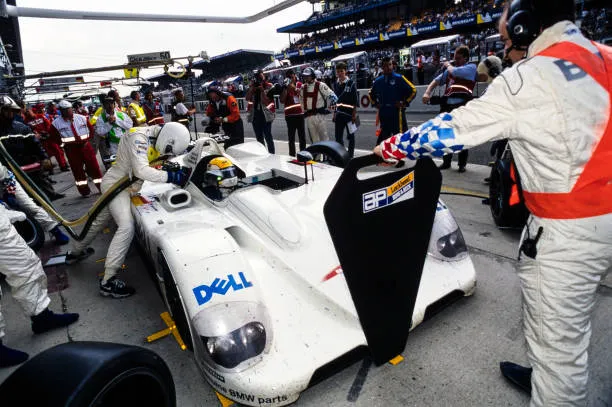
What Actually Won This Race
Here’s my reading, because I think the lesson of this car gets told badly, if at all.
The V12 LMR didn’t win on speed. It won because it was still standing when everything else broke. Mercedes flew. The Toyota punctured. Its own sister car — the one that was leading — killed itself against a wall over a loose anti-roll bar. And the #15, the very car that had lost its wing at 330km/h, was the last one running. The reliability Dalmas kept mentioning wasn’t a slogan. It was, quite literally, the only thing standing between BMW and never winning Le Mans at all.
And this is the part that fascinates me most. BMW had the McLaren F1’s engine. It had Williams building the chassis. It had Schnitzer on the pit wall, Gerhard Berger running the programme. It assembled all of that, won once — once — in 1999, and then vanished from the Le Mans conversation for a quarter of a century. It didn’t return to fight for the overall win until recently, with the M Hybrid V8. Twenty-five years without a repeat.
That’s why this car is so compelling and so misunderstood. It isn’t the icon the McLaren F1 GTR became, nor the technical villain the Porsche 911 GT1 was cast as. It’s the car that won almost by miracle and then erased itself. A victory propped up by a carbon mast that held one day after failing another, by a rival’s tyre letting go at exactly the right moment, by a spin that ended in nothing instead of the barrier.
People remember who wins. Almost no one remembers how little separated that win from oblivion. The V12 LMR is precisely that: proof that at Le Mans, the gap between legend and being forgotten fits inside a single carbon mounting.
Look at that photo of the ugly car crossing the line again. Now you know everything that had to break around it for that photo to exist.
Then check you’re still alive.