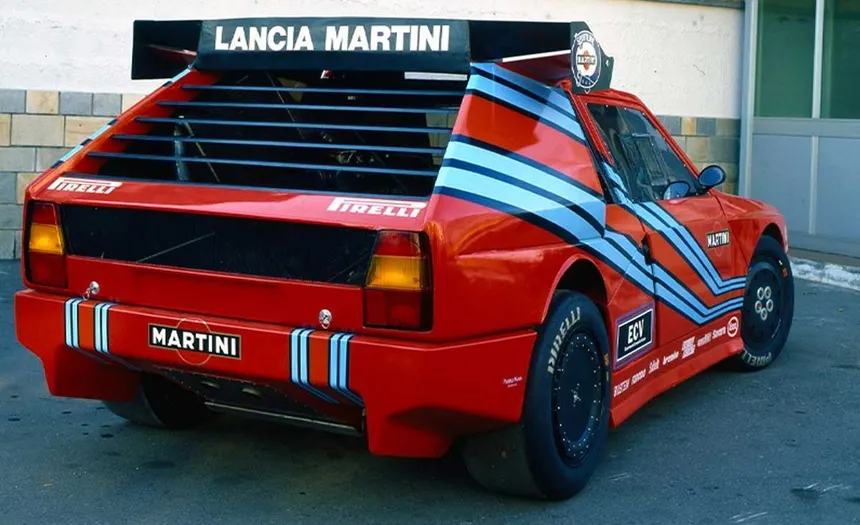
Lancia ECV: the rally car that was built to embarrass the Delta S4 and never turned a wheel
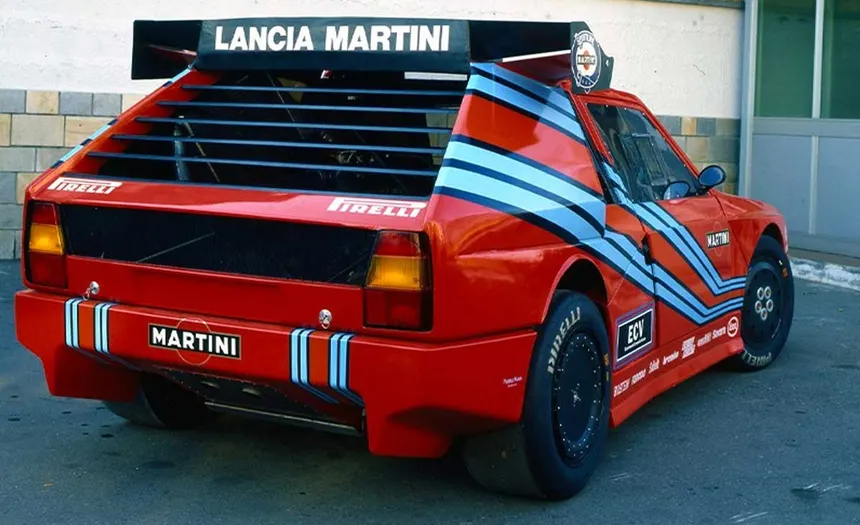
There’s a particular kind of automotive heartbreak that only true petrolheads understand. It’s not the car that died young in a famous crash. It’s not the one that lost the championship by half a point. It’s the car that was finished, ready to race, sitting in the workshop with a full tank — and then someone in a federation office signed a piece of paper and it never moved again.
That’s the Lancia ECV. Experimental Composite Vehicle. Built in Turin between 1985 and 1986 by the same Abarth engineers who’d just dominated the World Rally Championship with the 037 and the Delta S4. Designed to make every other rally car on earth look obsolete. Killed before its first stage by the same federation that asked Lancia to build it.
If you’ve ever watched a Chris Harris episode about a one-off prototype hidden in a museum basement, you’ve seen the same expression that the ECV deserves. The face of a man looking at something that should be screaming through a forest somewhere instead of sitting behind velvet rope.
What happened in 1986
You need the context first. By 1986, the Group B era of the World Rally Championship had become genuinely terrifying. Six hundred horsepower in cars that weighed nothing. Spectators standing on the road surface itself, jumping out of the way at the last second. Drivers who openly admitted, on camera, that the cars were faster than human reflexes could process.
The FIA had already decided to phase out Group B at the end of the 1986 season. The replacement was Group S — a category that would allow even more extreme engineering, but with mandatory safety features and a homologation requirement of just ten units instead of two hundred. Ten cars. That’s not a production run. That’s a prototype series with paperwork.
Manufacturers loved it. Lancia loved it especially, because Lancia had been pushing the envelope of rally engineering harder than anyone since the Stratos in 1973. They were already building their Group S contender. It was nearly finished.
Then May 1986 happened. Henri Toivonen and Sergio Cresto died at the Tour de Corse, their Delta S4 leaving the road and bursting into flames in a ravine. The FISA — the FIA’s sporting arm — panicked. They cancelled the transition to Group S before it had even begun. From the 1987 season onwards, the World Rally Championship would be run under Group A regulations: production cars with five thousand units built per year, minor modifications allowed.
The ECV, by then, was done. Tested. Ready. Lancia were left holding a prototype that would never see a competitive stage. Ever.
What Lancia had built
The ECV isn’t just a Delta S4 with extra power. It’s the car the Delta S4 should have been from day one — and the story of why it wasn’t tells you everything about how Italian motorsport politics work.
The engine is the key. Claudio Lombardi, Abarth’s technical director and one of the most underrated rally engineers of his generation, had wanted to put a properly innovative powerplant into the Delta S4 from the start. He didn’t get to. The conservative decisions made during the 1982 design phase forced him to equip the S4 with a conventional engine featuring a volumetric supercharger, the same setup already extensively tested on the Lancia Rally 037. He added a turbocharger to that proven supercharger to bridge the power gap with rivals.
In other words, the S4 that won the 1986 Argentina Rally, that Markku Alén drove to within twelve days of the world championship before the FIA stripped Peugeot’s exclusion — that car ran the safe version of Lombardi’s engine. The interesting version went into the ECV.
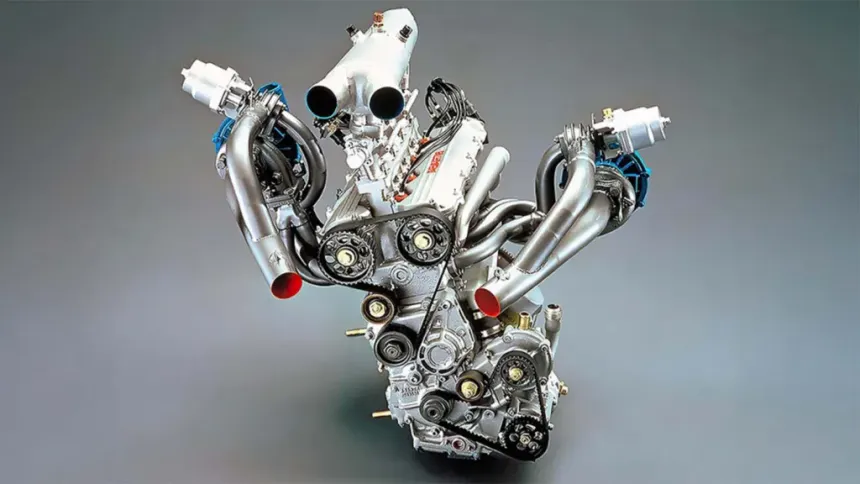
He called it the Triflux.
The Triflux: an engine that shouldn’t have worked
If you’ve been around enough engines, you eventually develop a feeling for when a designer is showing off versus when they’re solving a real problem. The Triflux does both at once.
The basic idea is heretical. Every internal combustion engine since Daimler has had intake valves on one side of the cylinder head and exhaust valves on the other. It’s the law. It’s how you build a cylinder head. Lombardi looked at this and said no.
The Triflux head has the valves crossed: on each side of each cylinder, there’s one intake valve and one exhaust valve. This let the two turbochargers be fed by two completely separate exhaust manifolds, while a single intake manifold carried the inlet air. Three air ducts in total — hence Triflux.
Why bother? Because it solved Group B’s biggest problem: turbo lag. The Group B monsters were lethal partly because the power arrived in a sudden, unpredictable lump after a long, panicked delay. The Triflux configuration meant the two turbos could be sized differently and brought online progressively, eliminating the lag while still delivering enormous top-end power. It’s effectively a sequential twin-turbo arrangement — twenty years before the production world worked out how to do it properly.
The numbers from the dyno were absurd. 600 horsepower at 8,000 rpm from a 1,759cc four-cylinder. About 100 horsepower more than the Delta S4 produced.
To put that into context using something a British or American reader can compare directly: in 1986, a Ferrari Testarossa made 390 horsepower from a 4.9-litre flat-twelve. The Lancia ECV made fifty-four percent more power from one-third the displacement, all from a four-cylinder. The metallurgy and turbocharging required to keep that engine alive at 8,000 rpm under boost wasn’t even commercial yet. Lombardi had to invent half of it.
Group S regulations would have artificially limited the car’s output to 300 horsepower to control speeds. Lombardi built six hundred anyway. Just to prove a point.
The chassis: composites in a rally car, in 1986
The engine was Lombardi. The chassis was Sergio Limone, head of design and experimentation for the Squadra Corse Lancia HF. Limone went just as far.
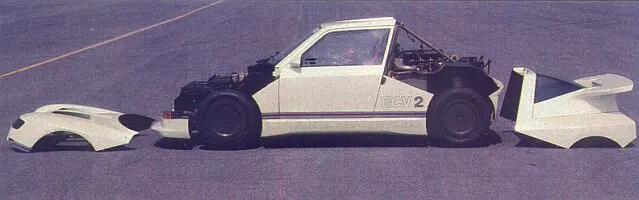
The ECV uses an extensive Kevlar and carbon fibre composite body. A special “cradle” of composite material envelops the engine. The driver sits inside a rigid composite cell formed from a series of panels. Only the front subframe is conventional steel tubing — and the reason for that is the kind of detail that tells you the designer had actually worked on race cars, not just drawn them. Steel is easier to repair and replace quickly between stages. Carbon fibre takes hours to fix. So Limone used composite where weight mattered most and kept steel where damage was most likely. Engineering with grease under the fingernails.
Even the driveshaft and wheels are composite. The whole car weighs 930 kilograms. The Delta S4 weighed around 1,200 kilograms in rally trim. The ECV is twenty percent lighter while offering greater torsional rigidity — the kind of structural improvement that you usually only get by going up several rungs on the materials science ladder.
Six hundred horsepower in a 930-kilogram car. That’s 1.55 kilograms per horsepower. A 1992 McLaren F1 — the road car that defined the decade — managed 1.90 kg/hp. A 2005 Bugatti Veyron managed 1.87. The ECV, in 1986, was already at a power-to-weight ratio that wouldn’t be reached by a production road car for another two decades. And it was being designed for gravel.
Bologna 1986: the wake before the funeral
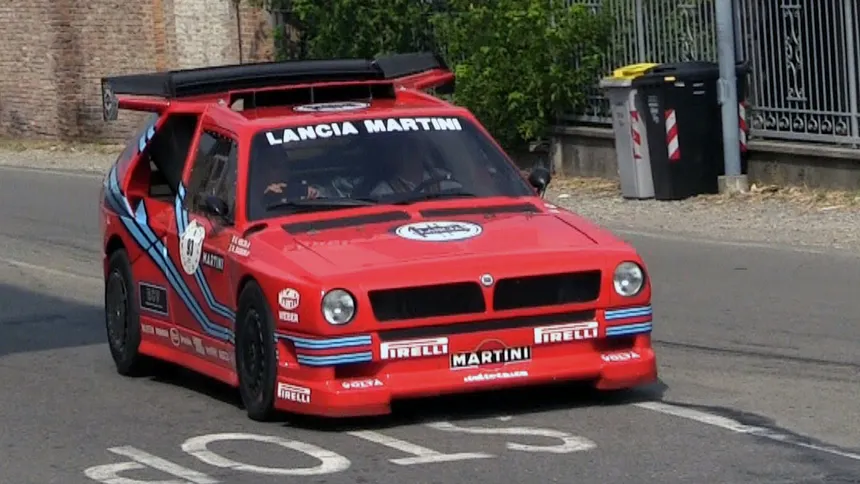
In late 1986, Lancia rolled the ECV out of the workshop and put it on a display stand at the Bologna Motor Show. By that point everyone knew. Group S was dead. The car had no future. Lancia presented it anyway, in a fresh red-based Martini livery that replaced the white scheme they’d run for years.
The reaction at the show was exactly what you’d expect. People stood and stared. Specialist press wrote breathless pieces. And then everyone went home knowing they’d just watched the unveiling of a car that would never compete.
Imagine the British equivalent. Imagine Cosworth wheeling out a finished Sierra RS500 Evolution two months after touring cars had been outlawed. That’s what Bologna 1986 felt like to anyone who understood rally engineering. A presentation of a coffin lid.
The ECV2: refusing to let go
Most manufacturers would have written off the ECV. Lancia didn’t. In 1988, two years after Group S had been formally killed, Lancia commissioned Italian designer Carlo Gaino — of his newly created Synthesis Design studio — to restyle the ECV’s bodywork on the same composite chassis. No championship to enter. No homologation to chase. Just the question: what does the perfected version of the car we never got to race look like?
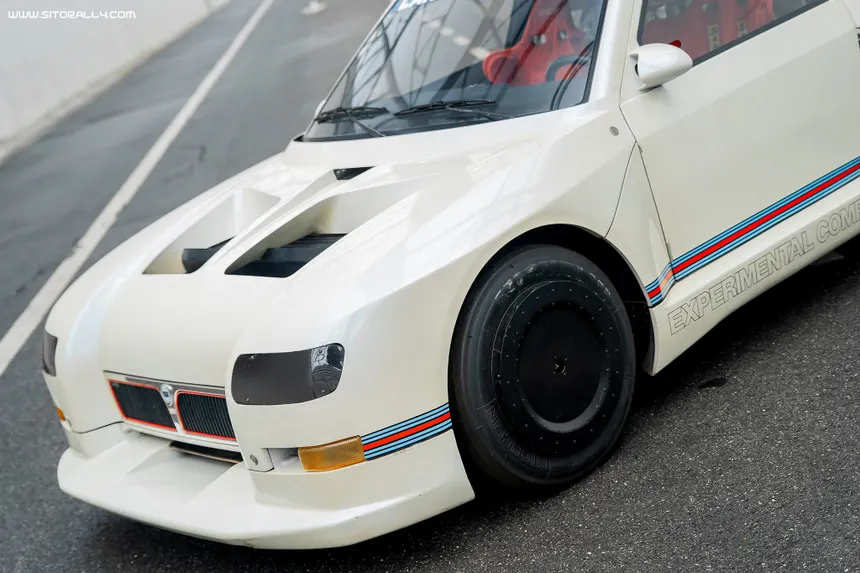
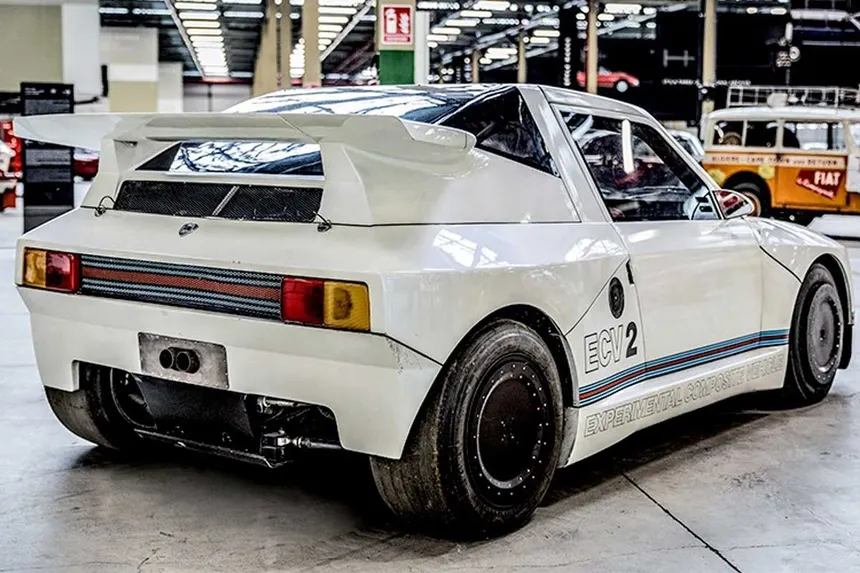
Gaino rewrote the rear completely. The rear wing detached from the roofline and dropped to mid-height on stalks, sitting in clean airflow. The tail shortened. The huge intercooler scoops on the rear pillars vanished and the front bonnet was redesigned with a twin opening to vent the radiators. Composite disc brakes appeared on the wheels themselves. Wind tunnel aerodynamics where the ECV1 still wore Delta S4 solutions.
The detail nobody mentions: the ECV2 was painted in a new colour called Bianco Perla — pearl white — with Martini stripes in light blue, blue and red. That exact shade was later used on a limited-edition Delta HF Integrale Evoluzione, also called Bianco Perla. The paint of the car that never raced ended up on the car that won everything. A quiet, almost private tribute from Lancia to the brother who died in the cot.
Where they are now
The ECV2 lives at the Stellantis Heritage HUB in Turin, the centrepiece of the rally section alongside the Delta S4. If you ever find yourself in Turin and you care about cars even slightly, go. It still looks more futuristic than half the building.
The ECV1 has a stranger and better story. The car spent nearly two decades half-forgotten until Giuseppe Volta — a preparation specialist who’d worked for Abarth through the 70s and 80s with his own outfit, Volta Racing, testing concepts in parallel to the official Martini team — bought it. Volta owns two of the only five Triflux cylinder heads ever built. He restored the car using original ECV body panels that Lancia had kept in storage, and rebuilt an original Triflux engine with help from Lombardi himself and modern turbo specialist Claudio Berri.
On 8, 9 and 10 October 2010, at the eighth running of Rally Legend in San Marino, the car finally hit a competitive special stage. The drivers were Miki Biasion — twice World Rally Champion with the Integrale — and Volta himself. Twenty-four years after Bologna, the ECV1 finally did what it had been built to do.
And it sounded like nothing else in the paddock. A 1.8-litre four-cylinder with two sequential turbochargers screaming past 8,000 rpm has a timbre that doesn’t match any Group B car. The Stratos V6 had phrasing, the 037’s supercharged unit had brass, the Audi Quattro’s five-cylinder had thunder. The Triflux is something else: sharp, metallic, with the dry rage you only get from a small-displacement four being asked to do impossible things. People who were trackside that weekend remember a sound closer to a modern touring car than a 1980s rally car. Which, technically, is what it was. Twenty years ahead of its time.
The car still belongs to Volta and lives in his workshop. It comes out occasionally for demonstrations. It remains the only ECV1 in the world with a running Triflux engine.
Why this car matters
The ECV matters because it’s the unspent ammunition of an entire era of motorsport. Group B existed because manufacturers were willing to spend stupid money on engineering experiments. Group S was supposed to channel that willingness into something safer. The ECV proved that the channelling was possible — that you could combine bonkers power with composite construction and modern turbo management and still build a car that wasn’t a death trap.
The FIA banned Group S because they had to. Toivonen, Bettega, the spectators in Portugal — there were already too many bodies. Nobody argues with the safety call. Group A saved lives.
But Group A also closed a door. The door that led to engineering for engineering’s sake. From 1987 onwards, the WRC would be a championship of road cars with rally kit. Not prototypes. Not moonshots. Lancia would win four more drivers’ titles with the Integrale, but they would never build another car as radical as the ECV. Nobody would. The rules wouldn’t let them.
Watch Top Gear’s old features on Group B and you can feel what was lost. There’s a generation of car enthusiasts — most of them now in their fifties and sixties — for whom 1986 wasn’t just a sad year. It was the year that motorsport stopped letting engineers play.
The ECV is the most painful artefact of that ending. Because it was finished. It worked. It was demonstrably better than everything that had come before it. And the world never got to see it on a special stage with Markku Alén holding the wheel.
If you’re ever in Turin, go to the Heritage HUB. Walk up to the glass. Look at the Triflux cylinder head. Look at the carbon fibre. Look at the weight figure on the placard. And then remember that this car, on a gravel stage with Toivonen at the wheel, would have left every other competitor two minutes back before the first village.
What never was. What could have been. What FISA — correctly, but without mercy — buried before its time.
Check you’re still alive.