Lancia Megagamma: Lancia invented the modern MPV in 1978 and Fiat buried it
Quick quiz. Without looking at Wikipedia. Who invented the modern MPV? The boxy family hauler with the flat floor, the five doors, the room for five people plus their luggage plus a bike inside? The category Top Gear used to mock relentlessly in the late 90s, the body shape that ferried an entire generation of British and European children to football practice?
The answer most people give is Renault. Which is fair: the 1984 Espace was the first big-selling MPV in Europe and basically named the segment. The next answer is usually Chrysler, on the back of the 1984 Dodge Caravan and Plymouth Voyager, which sold by the container-load in North America. A well-informed Japanese enthusiast will point to the Nissan Prairie of 1981, technically the first one to reach showrooms.
All three answers are wrong. Or, more precisely, all three are downstream. The concept, the original idea, the prototype that defined the entire category from scratch, was Italian. Lancia. 1978. Six years before Renault. Three before Nissan. Designed by Giorgetto Giugiaro at Italdesign. Called the Megagamma.
What happened to it after that is the kind of story anyone who has spent time inside a car company understands immediately. The big idea was finished. Sitting on four wheels. Ready for production. And the boardroom killed it.
The MoMA project: when New York asked Giugiaro for a taxi
To understand where the Megagamma came from, you have to go back two years earlier. In 1976, the Museum of Modern Art in New York organised a project called “The Taxi Project: Realistic Solutions for Today”. The premise was simple. New York taxis in the mid-1970s were a disaster. Big, thirsty, V8-powered Detroit barges with tiny boots, terrible visibility, cramped rear seats, and a fuel economy that bordered on contempt for the planet. MoMA invited a handful of manufacturers and designers to propose a better taxi.
One of those invitations went to Italdesign, run by Giorgetto Giugiaro. Giugiaro by 1976 had already signed off on the Volkswagen Golf, the Lotus Esprit, the Maserati Bora, and the Lancia Stratos HF Zero. He was, by any fair reading of the trade, the most influential car designer alive. He took the brief and built a working prototype based on the Alfa Romeo F12 commercial van platform, with a 1,280cc engine.
What came out of Giugiaro’s pencil was quietly revolutionary. A tall car. Upright seating. Flat floor. Six seats. A sliding side door. Almost 360-degree glasshouse visibility. Everything you’d recognise today as MPV vocabulary, already there, painted New York taxi yellow.
The Alfa Romeo New York Taxi got exhibited at MoMA. Specialist press took notice. But it was the industry executives drifting through the gallery who left with the strange feeling that this ugly little not-quite-van contained an idea nobody else had bothered to put on paper. A car designed as a moving compartment instead of a sports object. Interior space prioritised over exterior styling.
Giugiaro went back to Turin with the idea still in his head. He asked Italdesign to keep developing it.
Lancia steps in
By 1977 and 1978, Italdesign was working with several clients at once. The opening to turn the New York Taxi idea into something more serious came from Lancia. And it came for a very specific reason: Lancia had exactly the right platform.
The Lancia Gamma, launched in 1976, was the brand’s flagship saloon. Front-wheel drive. A water-cooled 2.5-litre flat-four boxer engine mounted longitudinally. Front transaxle. Which means: engine ahead of the wheels, gearbox bolted to it, no propshaft running to the back of the car, a completely clean floor from cabin front to boot. That mechanical layout was gold for an MPV. It allowed a properly flat floor from front to rear. The holy grail of cabin packaging.
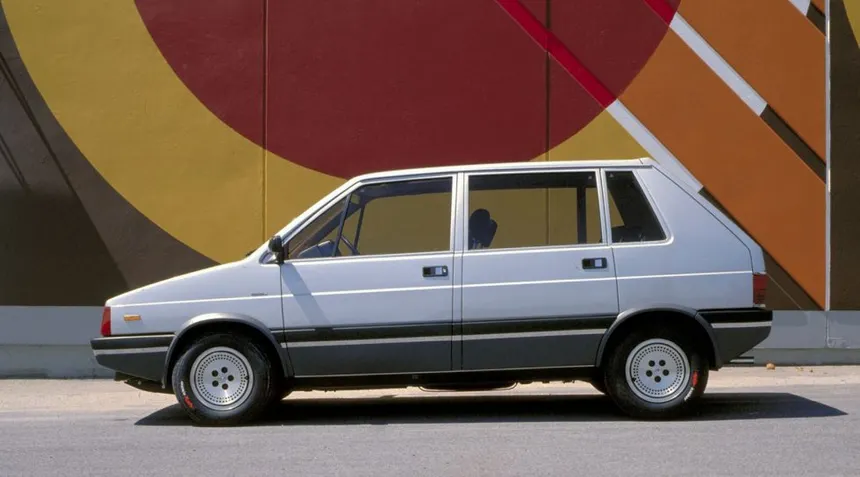
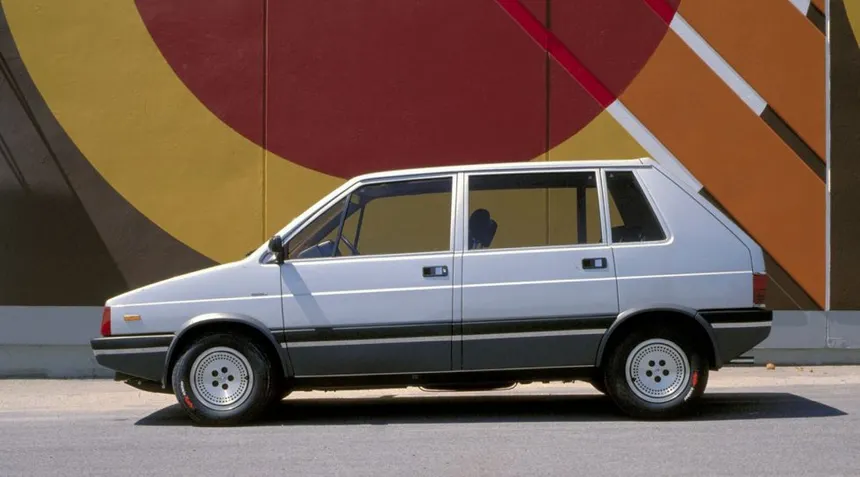
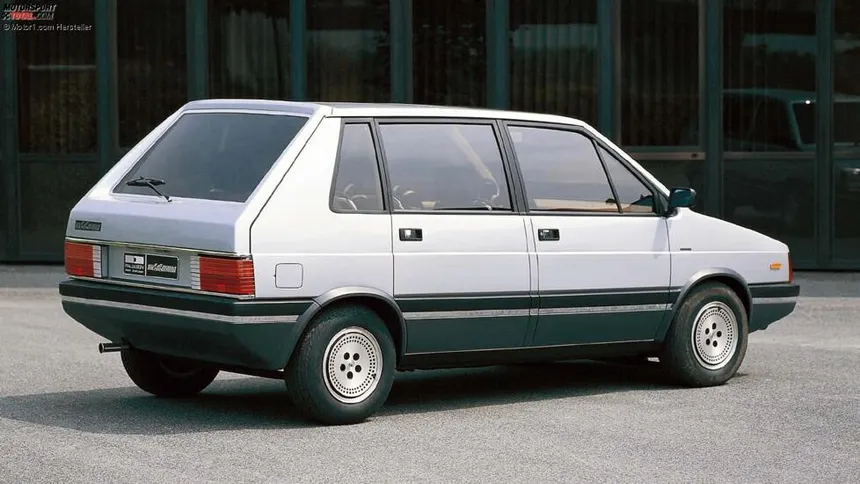
Giugiaro took the Gamma 2500 platform, shortened it by 290mm, raised the roof by 247mm, and clothed it in a five-door body with short overhangs. He used the cavity between the chassis and the flat floor to bury the fuel tank and the spare wheel, leaving the cabin completely clear. Result: a car 4,310mm long, 1,780mm wide, 1,617mm tall, 2,670mm wheelbase, 1,040kg. Translation: 290mm shorter than a stock Gamma but with 170mm more usable interior height. More car per square metre.
Under the bonnet, the Gamma’s boxer was left alone. 2,484cc, single overhead cam per bank, Bosch L-Jetronic injection, 140 horsepower at 5,400 rpm, 209 Nm at 3,000 rpm. Front-wheel drive. Five-speed manual gearbox — a Lancia trademark inherited from the 1948 Ardea.
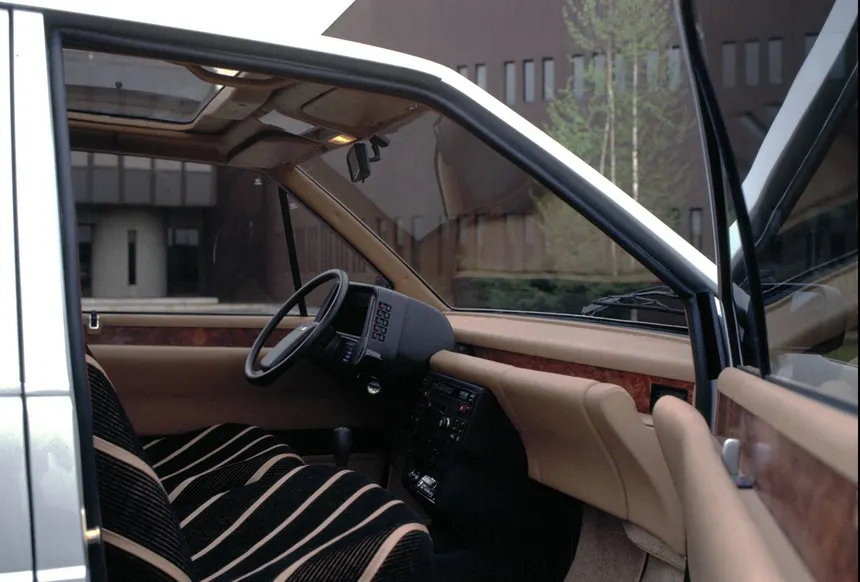
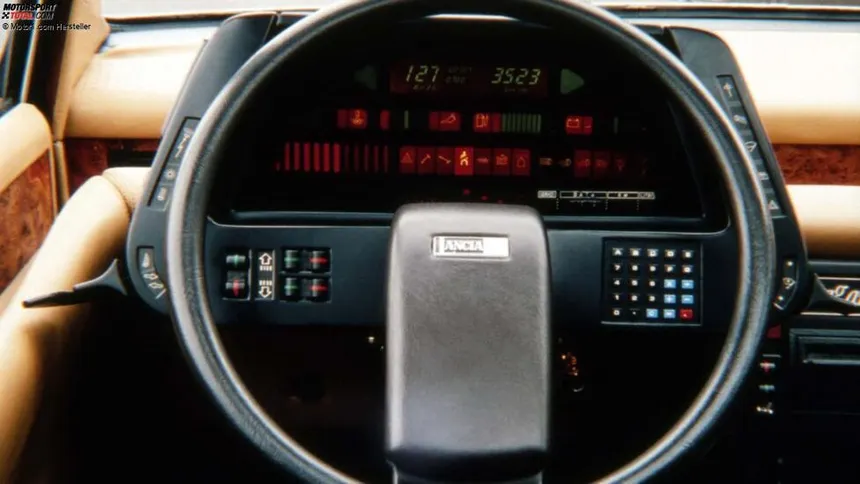
Inside, the details that separated the Megagamma from any van or estate of the period. Centrally positioned ergonomic dashboard. An electronic service-interval indicator — almost unheard of in 1978. Electric glass sunroof. Steeply raked windscreen for better aerodynamics. High seats, upright driving position, forward-mounted pedals to free up legroom. Giugiaro himself described the ergonomic recall as a return to the early-twentieth-century cars where you “sat on board” rather than down inside.
In modern language: the first tall car. The first compact MPV in the world. The grandfather of everything that followed.

Turin 1978: shock at the show
The 1978 Turin Motor Show was a big deal. Visitors crowded the Lancia stand expecting Giugiaro’s annual showpiece — some low-slung wedge, some aggressive concept, some coupé. What they got was a shortened, raised Lancia Gamma that looked like a family van with a glass roof.
The reaction is well documented. Confusion first, disappointment second, hostile reviews third. The specialist press judged the car almost entirely on its looks and gave it a hammering. Was this a Giugiaro? An Italdesign? It looked like a stunted estate. A badly drawn family wagon. A university project. The signature Italian drama, the aggression, the elegant speed — all missing.
What didn’t make the magazines was what was happening behind the stand. Executives from several manufacturers — French, Japanese, German, American — wandered up to the Megagamma, talked to Italdesign engineers, asked for technical specs, took notes. The Japanese particularly: they’d been consulting with Italdesign since the mid-1960s. They studied the car. They took photos. They went home.
Meanwhile, in Turin, in Fiat’s offices — Fiat had owned Lancia since 1969 — the decision on whether to put the Megagamma into production sat with the group’s CEO. That CEO, at the time, was Umberto Agnelli. After reviewing the car, evaluating the market, and listening to his product team, Agnelli decided no. The Megagamma was too risky. The European market wasn’t ready for a car like that yet. Lancias had to look like Lancias, not elegant family vans.
That was the end of the Megagamma. The prototype stayed as a one-off in the Italdesign archive.
The companies who did build it
Here’s where the story gets painful. Because while the Megagamma sat in a warehouse outside Turin, the next six years became a masterclass in how good ideas don’t respect borders.
Nissan, which had been working with Italdesign on various projects for over a decade, hit the Japanese market in 1981 with the Nissan Prairie. Front-wheel drive, flat floor, tall body, sliding doors, modular seats. The first modern MPV in series production. Same principles as the Megagamma, on Nissan’s own mechanicals. Mitsubishi followed with the Chariot in 1983. Honda with the Shuttle. The concept entered Japan and started winning families.
In Europe, the big play came from Renault. Working with Matra, which had been pitching a similar project to several manufacturers for years, Renault arrived in showrooms in 1984 with the Espace. Five doors, flat floor, tall roof, modular seating, front engine. Same playbook as the Megagamma. They sold them by the boatload, redefined the European family car, and gave Renault a decade of dominance in the segment. The Espace has been the default name for “the dad car” in continental Europe ever since.
In the United States, Chrysler launched the Dodge Caravan and the Plymouth Voyager the same year, 1984. Same principle: front-wheel drive minivan with a flat floor. Lee Iacocca, the executive who pushed the project through, had been defending the concept since his Ford days. Ford had said no. Chrysler said yes. They sold millions of units and saved the company from bankruptcy.
Renault saved its family-car segment. Chrysler saved itself entirely. Nissan, Mitsubishi and Honda opened up a new market in Japan. All of them, to varying degrees, following the recipe drawn in Turin in 1978.
Lancia didn’t see a penny. By extension, neither did Fiat — because when Fiat eventually decided it needed an MPV, it had to buy the technology from Peugeot through a joint venture (the 1995 Lancia Zeta, which was a rebadged Peugeot 806).
That’s the Megagamma story. The Italians invented it. Everyone else cashed it.
The Panda and Uno paradox: Giugiaro sold Fiat the idea through the back door
Here’s the twist nobody saw coming. And it closes the story with a particularly industrial sort of irony.
Giugiaro had the tall-car idea polished and stewing in his head after the Megagamma was killed. He didn’t bury it. He shrank it. He took the exact same principles — height used cleverly, low floor, maximum interior space, boxy and efficient geometry — and applied them to smaller categories. Categories where Fiat was actually willing to bet.
Result one: the 1980 Fiat Panda. A square little hatchback, almost entirely straight lines, ruthlessly simplified, with internal space well beyond its class. Megagamma philosophy compressed to A-segment. Massive success.
Result two: the 1983 Fiat Uno. A supermini taller than the average of its segment, with the floor properly used, an upright driving position, and interior space rivalling cars two classes above it. The first tall supermini in history. It became the best-selling Fiat of all time, with over six million units shipped.
So: the idea Fiat considered too risky for Lancia and for the big family segment, the same Fiat applied two years later to a cheap hatchback and sold by the million. The Megagamma philosophy worked. Just not, in Fiat’s eyes, in the place it had been designed for. Renault and Chrysler kept the family segment. The Panda and the Uno kept the supermini segment. And the Megagamma — the car in the middle, the one that connected both worlds, the one that proved the whole concept was viable — stayed in a warehouse.
Why this matters
The Megagamma matters for two reasons that don’t relate to each other and that, taken together, tell you everything.
First, because of the idea. It’s, objectively, the invention of an entire category of car. The MPV, the people-carrier, the tall car, whatever you want to call it. The best-selling body shape in Europe between 1990 and 2010, until suvs ate it. Every Espace, Scénic, Galaxy, Sharan, Touran, Picasso, Zafira, Verso, Carens, Stream — that decade and a half of European family cars all traces back, conceptually, to a single prototype shown in Turin in 1978 that nobody wanted to build. The industrial paternity belongs to Italdesign and Lancia. The commercial exploitation belongs to everybody else.
Second, because of what it says about how big companies make big decisions. Fiat had on its desk, in 1978, a finished car. Technically producible. Built on a platform they already owned. With a huge potential market that nobody had explored. The only “problem” was that it was different. It didn’t fit the existing definition of “a Lancia car”. And the boardroom said no. The same boardroom that, years later, when it became obvious the segment existed and was huge, had to pay Peugeot for the technology to build something competitive. Which is the industrial equivalent of paying for your own idea after rejecting it.
There’s a pattern in there that isn’t only Italian. It happens in every mature industry. The idea is inside. The prototype is in the warehouse. And nobody at the decision level is willing to gamble on something that breaks the catalogue. Until somebody outside gambles on it, wins, and the company of origin has to buy it back from whoever understood it first.
Where it is now
The single Megagamma prototype survived. Italdesign’s official archive still documents it as one of the studio’s milestones. It appears in books, in retrospectives on Giugiaro’s career, in thematic shows about the Turin Motor Show. It’s one of those cars that lives in the studio archive and comes out when somebody needs to remind the public where the MPV idea came from.
What it doesn’t have is the fame of the Stratos Zero, the sex appeal of the Maserati Boomerang, or the museum gravitas other concepts from the same period enjoy. Because it wasn’t a car designed to be looked at from the outside. It was designed to be sat inside, to be lived with, to be understood as a packaging exercise. And from outside, in 1978, it didn’t impress anybody.
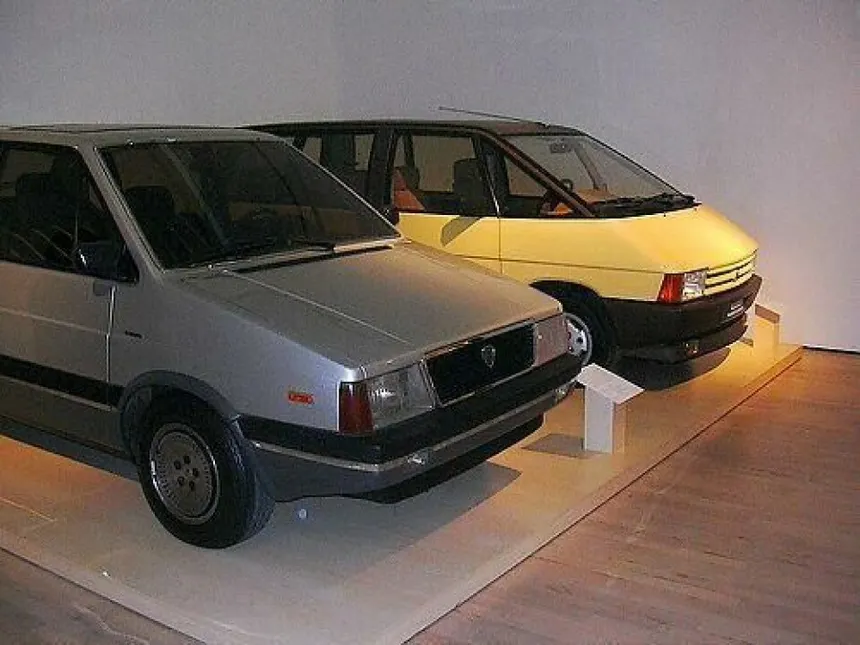
If you walked today into a collection where a Megagamma original stood next to a first-generation Renault Espace, your eyes would go to the Espace. More recognisable. More glamour. More commercial history. But technically, conceptually, historically — the Megagamma is six years ahead.
Sometimes the cars that change history aren’t the prettiest, or the fastest, or the ones that won championships. Sometimes they’re the ones that asked a question nobody else was asking. What is a car actually for? If it’s for moving a family, shouldn’t it be designed for that first? If interior space is the most important thing, why are we still making cars so low? If front-wheel drive frees up the floor, why aren’t we using that?
Giugiaro asked those questions in 1978 and built an answer. Lancia was brave enough to pay for it. Fiat was brave enough to bury it. And other people were brave enough to copy it. That’s the Megagamma story. And that’s why it matters.
The next time you see an old Espace, a Picasso, a Scénic, a Caravan, a Touran, a Sharan, a Galaxy go by, remember that behind all of them, at the origin, sits a Lancia that was never produced. Pale grey paint, glass roof, central dashboard, a 2.5-litre boxer humming quietly in the Italdesign archive while the French, the Americans and the Japanese made millions selling its recipe.
Check you’re still alive.