A Blank Cheque, and the Buyer Asked for Three Pedals
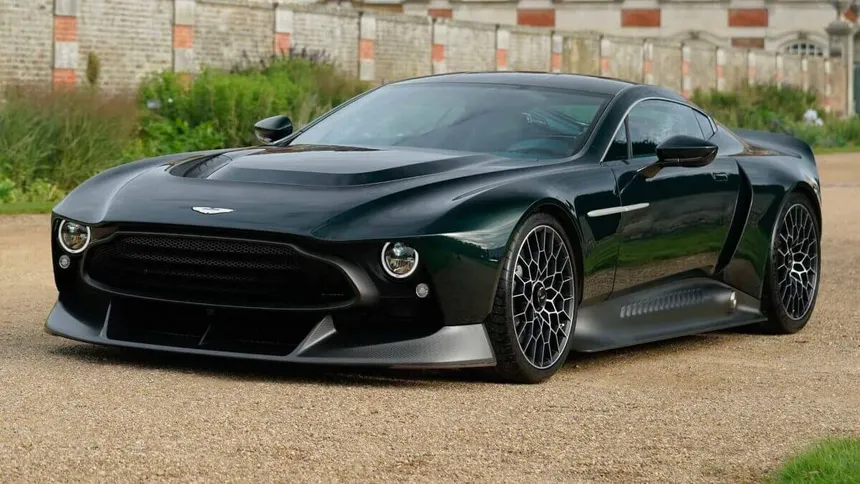
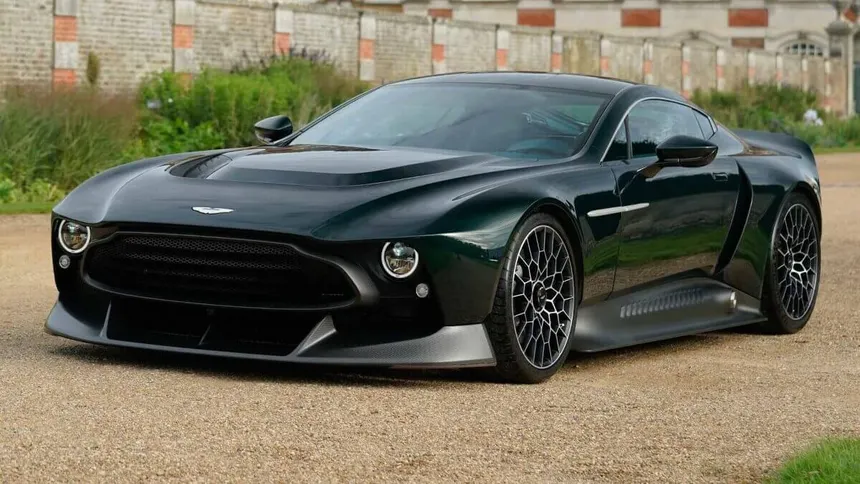
The Aston Martin Victor is what happens when a man can order any car in the world and deliberately chooses the hardest one to drive. Picture having that kind of money — not comfortable money, but the kind that gets you into Aston Martin’s “black book,” the standing list of clients ready to part with the best part of three million for a car that exists exactly once. You make the call. Q by Aston Martin asks what you’d like. The world is open: the fastest thing they can build, the most power, the biggest number to drop into conversation.
The man who commissioned it — and he’d still rather you didn’t know his name — asked for none of that. He asked for a huge naturally aspirated V12. He asked for three pedals and a gearstick carved from solid walnut. And he asked that the whole thing be made to look like a homebuilt special that a provincial Aston dealer cobbled together in a workshop nearly half a century ago to go and embarrass himself at Le Mans.
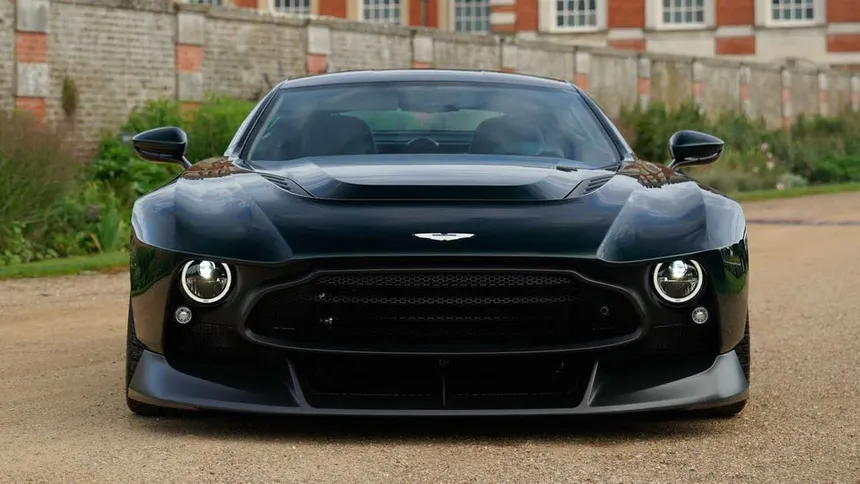
Aston built it. It’s called the Victor. There is one. And it might be the most quietly defiant car the marque has produced in years — not for what it is, but for what it deliberately refuses to be.
What’s Underneath
Get to the mechanicals first, because they explain everything else.
The Victor starts as a One-77. The carbon-fibre monocoque comes from that 2011 hypercar, with parts borrowed from the track-only Vulcan thrown into the mix. Q — Aston’s bespoke skunkworks — took the lot and rebuilt it from the ground up to one client’s specification, calling it the biggest project the division has ever taken on.
The engine is the One-77’s 7.3-litre V12. Naturally aspirated. No turbos, no hybrid assistance, nothing standing between your right foot and the throttle bodies. Cosworth, which built the thing in the first place, took it back and leaned on it: 836bhp (848PS in metric, same engine measured differently — don’t read the two figures as a contradiction) and 821Nm, up from the 760bhp of the donor One-77.
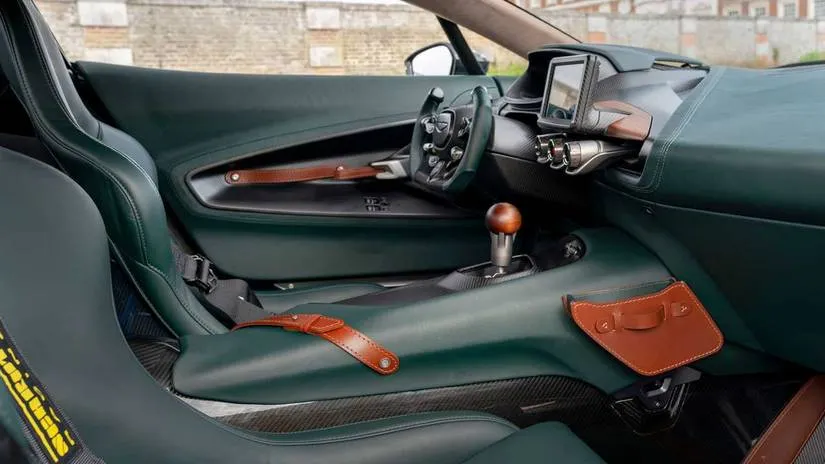
But the power isn’t the headline. The headline sits behind the engine: a six-speed manual gearbox from Graziano, with a bespoke motorsport clutch and a pair of coolers. Three pedals. In a car making 836bhp. In 2020.
That makes the Victor the most powerful manual Aston Martin ever built. It also makes it a genuine oddity in a world where even the maddest hypercars run dual-clutch boxes and paddles, because a computer shifts faster than any human wrist ever could. The Victor throws that speed away on purpose. It sacrifices the tenths. It hands the car back to your hands and feet. That’s the opening statement, and it’s a big one.
The Rest of the Spec Sheet Holds Up Too
So this doesn’t read as pure romance, understand that the Victor is a serious machine beneath the retro tailoring.
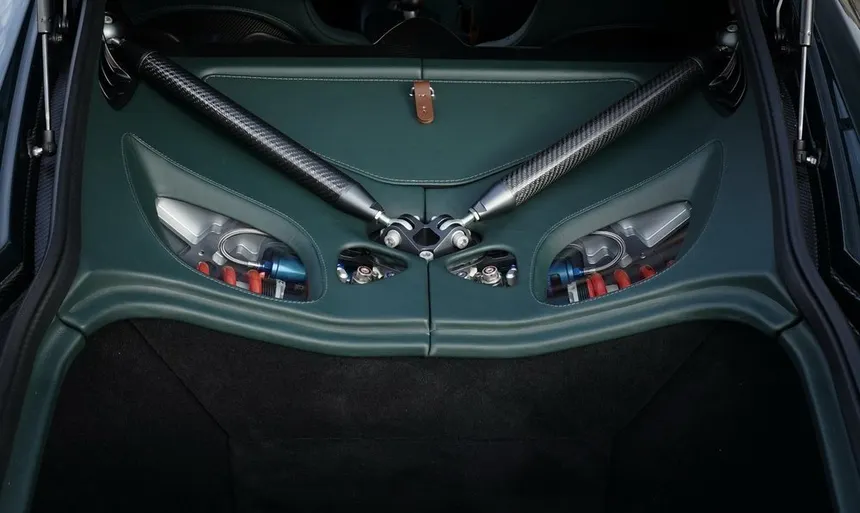
Brembo carbon-ceramic brakes, 380mm up front and 360mm at the rear, clamped by six-piston calipers. Centre-lock wheels, the real racing kind, a single nut holding each one on. The suspension uses the Vulcan’s inboard springs and dampers, but with six settings so the thing can actually cope with real, imperfect roads — because, crucially, the Victor is road-legal, at least in the UK. This is not a static museum piece. You can drive it out of the gate.
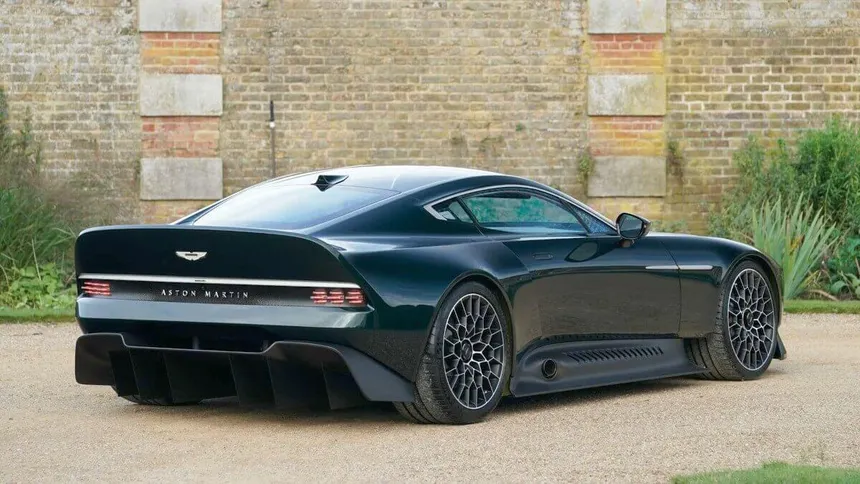
The bodywork is all carbon fibre, and Aston claims the complete chassis and body weigh less than a standard One-77’s. The colour is Pentland Green, a 1970s Aston shade Q revived solely for this commission. Inside: Forest Green leather, contrasting Conker Bridge of Weir hide, cashmere across the upper cabin, polished titanium, solid walnut. The steering wheel is lifted from the Vulcan, open at the top. The gear knob is a single machined piece of walnut. This is expensive craft, not catalogue trim.
None of which explains why the car is shaped the way it is. For that you have to go back. A long way back.
A Word on the Donor: the One-77
Before we travel to the seventies, it’s worth grasping what Q started with, because this was no ordinary car going under the knife.
The One-77 was, in its day, Aston Martin’s ultimate hypercar. Seventy-seven units, not one more — hence the name. A carbon-fibre monocoque, that 7.3-litre V12 making 760bhp as standard, and a price that hovered near $2.9 million for the handful that changed hands around 2012. It was the marque’s technical flagship, the most expensive and exclusive thing they knew how to make.
Taking one of those apart to build something else on top of it is no small indulgence. It means starting from the summit of the range and remaking it. Q didn’t tart up a car; it took the most valuable piece in Aston’s recent catalogue and reinterpreted it wholesale, folding in what they’d learned with the Vulcan, the numberplate-free track weapon that followed. The Victor is, in a sense, the two most extreme modern Aston projects distilled into a single object. And even with all that technology to hand, the destination they chose was to look half a century into the past. That’s the paradox that makes the car so compelling.
Where the Name Comes From
The Victor isn’t named on a whim. It carries the name of Victor Gauntlett, the man who chaired Aston Martin through the 1980s — one of those stretches where the company lurched from crisis to crisis and somebody had to hold the wheel. The car is a tribute to his era: hand-built Aston Martin, stubborn, British to the point of absurdity.
And within that era sits one specific car that is the Victor’s true grandfather. One almost nobody knows, and one that deserves a moment of your attention, because it’s among the best and daftest stories Le Mans has to offer.
The Grandfather: A Dealer, a Workshop, and a Caravan
In 1974, a man named Robin Hamilton — an Aston Martin dealer in Staffordshire — started racing a road-going DBS V8 in club events. An ordinary car, the sort he sold. But Hamilton had an idea that anyone sensible would have called lunacy: he wanted to take it to the 24 Hours of Le Mans.
Over three years, in his own workshop, he reworked that DBS until it was unrecognisable. He even changed its chassis number, rebadging it RHAM/1 — Robin Hamilton Aston Martin number one. Aston, mired in one of its periodic downturns, helped with little more than encouragement and a session in MIRA’s wind tunnel. The rest was Hamilton and a four-man team building the car by hand.
RHAM/1 reached Le Mans in 1977. It was the first entry to turn up in the paddock that year, because the team needed the extra time just to finish assembling it. With 520bhp, it was clocked at 322km/h down the Mulsanne in qualifying. And against every expectation, against everyone sniggering at the dealer who’d dragged a garage build to the cathedral of motorsport, RHAM/1 finished. Not just finished — 17th overall out of 55 starters, and 3rd in its GTP class, driven by Hamilton, Dave Preece and Mike Salmon.
It earned a nickname: “The Muncher.” Not for fuel, though it drank plenty, but for the rate at which it chewed through brake discs. That was its weakness, the tax on hauling a heavy car down from those speeds again and again.
Hamilton wasn’t done, either. For 1978 he reworked it further, bolting on twin Garrett AiResearch turbochargers to chase around 800bhp. The trouble was fuel consumption, which collapsed to barely a couple of miles per gallon, and the Le Mans entry that year was withdrawn a fortnight before the race. He came back in 1979 with fresh bodywork: a lowered roofline, a more steeply raked screen, a vast front airdam. Fuel injection replaced the Weber carbs and reduced boost tamed the thirst, with power dialled to roughly 650bhp. But the car, quicker than ever, no longer lasted: it retired after two hours and forty-five minutes with a holed piston. It even ran Porsche specialist Derek Bell among its drivers, who reckoned it was the only car capable of reeling in the Porsche 935s down the straight.
The story has a coda you simply have to accept as true, because it is. In 1980, retired from racing, RHAM/1 set the world speed record for towing a caravan — 152mph, roughly 245km/h, in torrential rain on a Yorkshire airfield. A car that had raced Le Mans, dragging a caravan, at 245km/h, in the wet. Only in Britain.
Why the Victor Is What It Is
Now come back to the Victor with all of that in your head, and look again.
The man who ordered it didn’t want a car to break acceleration records. He wanted a monument to that stubbornness — to the notion that a car is built by hand, with a vast naturally aspirated V12 and a manual box, because driving it that way means something even when it’s slower than pressing a button. The Victor copies the Muncher’s lines: the nose, the boat-tail rear with its upturned spoiler, the air of an elegant thug. It takes the philosophy of a bloody-minded 1977 dealer and pours three million quid of modern engineering underneath.
And here’s what genuinely fascinates me. We live in the age of the hybrid hypercar, where brochures boast acceleration figures that no longer mean anything because no human alive can feel the gap between 2.4 and 2.6 seconds to 60. Everything trends towards electric, assisted, automatic. And in the thick of 2020, with all that wind blowing the other way, someone with the means to buy literally anything chose the exact opposite: naturally aspirated when everyone’s gone turbo, manual when everyone’s gone paddle, singular when everyone builds runs.
The Victor isn’t cheap nostalgia. It’s a position. It says, with the chequebook leading the way, that driving still matters. That the act of pressing a clutch and selecting a gear by hand is worth more than the tenths you lose doing it. That a car can be a tribute to an obscure hero almost nobody remembers, rather than another number to flex in a group chat.
That’s why the Victor interests me more than most hypercars costing twice as much. Not for what it can do. For what it chose to be when it could have been anything. It’s the car that says no to nearly everything that defines the modern supercar — and says it with a naturally aspirated V12, a walnut shifter, and the spirit of a man who once took his road car to Le Mans simply because he felt like it.
There’s one in the world. Fitting, really: statements of principle don’t come off a production line. The Muncher was one bloody-minded dealer’s argument with the establishment, hammered out in a workshop and proven over twenty-four hours of La Sarthe. The Victor is the same argument, made decades later by a man who had every reason to choose the easy, faster, automatic answer — and didn’t.
Then check you’re still alive.