
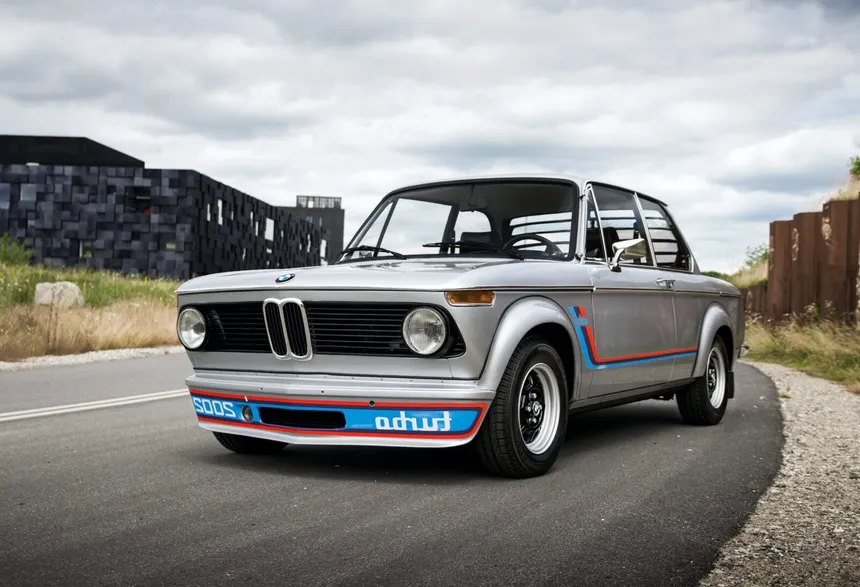
BMW 2002 turbo: The Car So Aggressive It Was Debated in the German Parliament
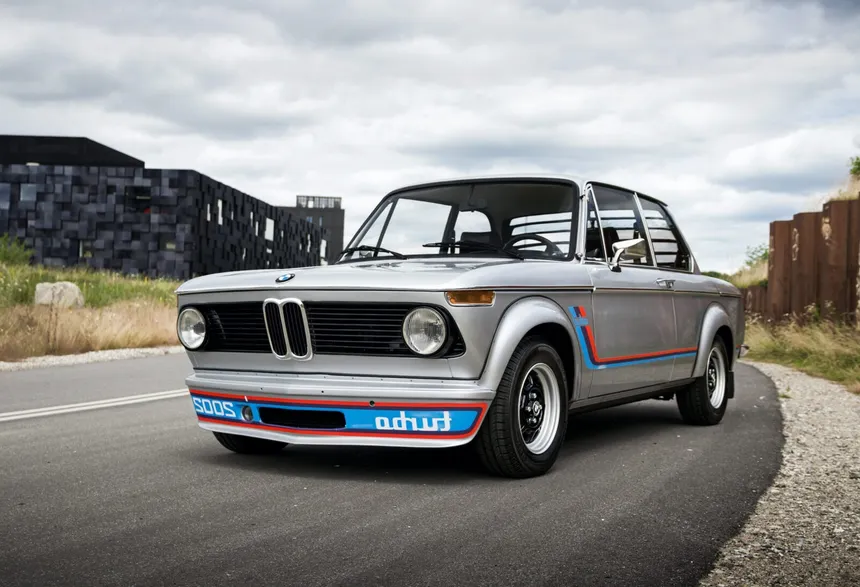
There aren’t many production cars that have ended up in a national parliament debate. A war memorial, sure. A political scandal involving a transport minister, occasionally. But an actual production sports car argued over at federal government level for the design of its decals? That’s a rare list. The BMW 2002 turbo is on it.
In September 1973, BMW unveiled what would become Europe’s first turbocharged production car at the Frankfurt Motor Show. The car wore aggressive bolt-on plastic wheel-arch flares, Motorsport blue-violet-red stripes along the body, and on its front spoiler — in oversized mirror script — the words “OBRUT 2002”. Read it in your rearview mirror and it spelled out 2002 TURBO. The message was unsubtle: get out of my way.
Two weeks later, the OPEC oil embargo hit Europe. Petrol prices quadrupled within months. Germany imposed a 100 km/h motorway speed limit and a complete ban on Sunday driving. And BMW, having just shown the most aggressive car in its history, suddenly found itself defending the decision to a press corps and a public that had moved on from worshipping performance to obsessing over fuel saving. The mirror-script lettering became a political flashpoint. A formal motion was filed in the Bundestag to ban the decal as a road safety hazard. A sticker on a road car’s spoiler reached the German federal parliament.
This is the story of how Europe’s first turbocharged production car arrived two weeks before the worst oil crisis of the twentieth century, generated a parliamentary question, and still managed to invent the entire performance turbocharged sector that Porsche would inherit two years later.
The man who built it and what he said about it
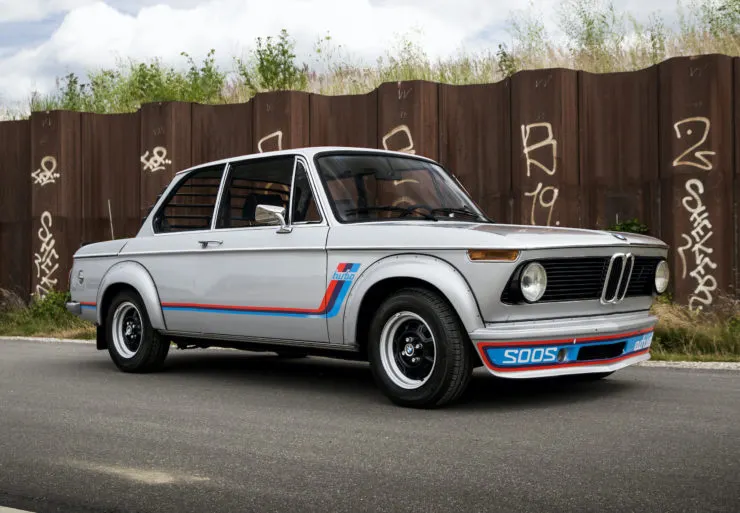
The BMW 2002 turbo was largely the work of one man: Bob Lutz, the cigar-smoking Swiss-American executive who ran BMW Motorsport in the early 1970s. Lutz would go on to lead Chrysler, Ford and General Motors, but in 1973 he was responsible for what BMW called the “second Motorsport car” — after the 3.0 CSL Batmobile that had launched the brand’s racing identity.
Lutz himself, interviewed years later in Road & Track magazine, did not mince words about the climate in which he launched the car. He described BMW in the early seventies as a culture where performance was glorified, where no Autobahn speed was considered excessive, where the brand’s identity was being built on the assumption that the road belonged to the fastest. “Into this environment,” he said, “I launched the 2002 Turbo.” He then watched, with that specific blend of corporate horror and personal amusement that defines his memoirs, as the 1973 oil crisis turned his pet project into the most controversial road car in Germany overnight.
Lutz’s quote on the project, paraphrased from the original interview: the press were quick to brand performance cars as irresponsible. Speed limits were imposed. The brand he had been building suddenly looked, in the public eye, like part of the problem rather than part of the future. He still maintains, half a century later, that the car was correct and the timing was simply impossible.
What’s under the bonnet
The base engine is the M10 — BMW’s two-litre inline four-cylinder, in production since the mid-1960s and the same block that would power BMW’s Formula 1 turbo programme of the 1980s. Single overhead camshaft, two valves per cylinder, all-aluminium head on iron block. In the production 2002 tii, fitted with Kugelfischer mechanical fuel injection, the M10 produced 130 horsepower naturally aspirated. BMW Motorsport’s brief was simple: add a turbocharger and see how far the engine could be pushed.
The turbo unit came from KKK — Kühnle, Kopp und Kausch — a Frankenthal-based engineering firm that supplied turbochargers primarily to industrial and diesel engine manufacturers. A small-frame turbo running maximum boost of 0.55 bar (8 psi) was specified, mounted on the right side of the block and integrating the exhaust manifold into its housing. Because adding boost pressure on top of mechanical compression risks detonation, BMW dropped the compression ratio from the tii’s 9.5:1 down to 6.9:1 on the turbo car. That decision matters mechanically more than most write-ups acknowledge.
A 6.9:1 compression ratio in a normally aspirated engine produces a lethargic, low-power output below the boost threshold. The driver of a 2002 turbo cruising at city speeds, off boost, is operating an engine that produces less torque than the tii equivalent. This is why most modern drivers stepping into a 2002 turbo for the first time describe a car that feels asleep until you wake it up. The compression was deliberately compromised to allow the boost margin. Below 4,000 rpm, the engine essentially behaves like a detuned tii. Above 4,000 rpm, the turbocharger reaches its working speed and everything changes.
Output with boost engaged: 170 horsepower at 5,800 rpm, 240 Nm of torque at 4,000 rpm. Specific output: 85.4 horsepower per litre. To put that into 1973 context: most naturally aspirated sports car engines of the era hovered between 70 and 75 horsepower per litre. The 2002 turbo was delivering racing-engine specific output from a compact saloon’s engine bay.
Fuel injection remained mechanical Kugelfischer, simply recalibrated to handle the boost. Ignition was conventional points-based. The wastegate was mechanically actuated by manifold pressure. There is no electronic management of any kind in the entire system. Everything is analogue, brutal and serviceable by any competent mechanic. The 2002 turbos still running today operate exactly the same way they did when they left Munich in 1974.
Why no right-hand-drive version ever existed
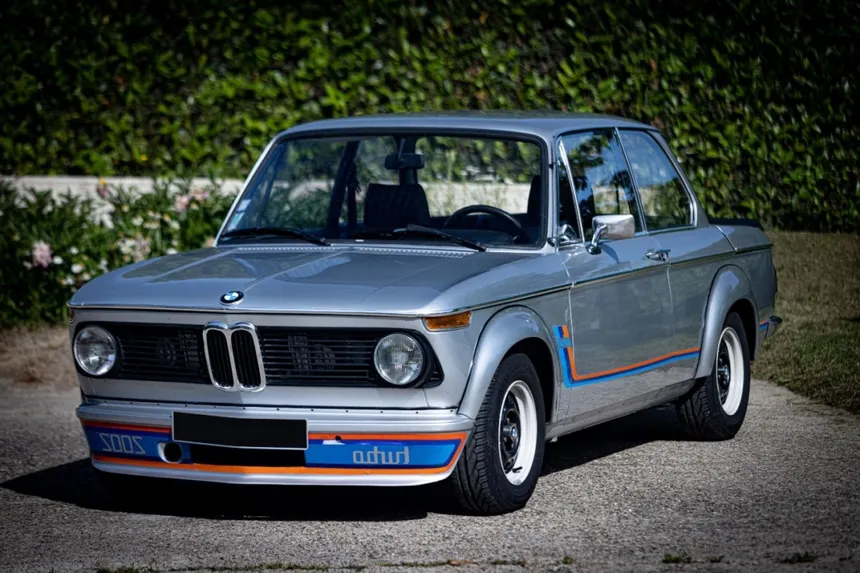
Here’s a fact almost nobody outside specialist BMW circles knows: every single 2002 turbo built was left-hand drive. There is no right-hand-drive factory variant. Not for the UK, not for Australia, not for Japan or South Africa or anywhere else. The British buyer who wanted a 2002 turbo new in 1974 had to import it from Germany as a personal grey-market purchase and live with the wrong-side steering wheel.
The reason is pure packaging engineering. The exhaust manifold and turbo on the M10 turbo install onto the right side of the engine block, with the wastegate and downpipe occupying the exact space where a right-hand-drive steering column would need to pass. BMW Motorsport calculated the cost of redesigning the manifold geometry to clear the column on a right-hand-drive variant and concluded it wasn’t worth it for the limited additional market, particularly during a fuel crisis that was already crushing demand across all markets. Left-hand drive only. Full stop.
This is why the few 2002 turbos that surface today in UK auctions are almost always grey-market German or Italian imports with all the homologation and registration history complications that implies. And it’s why the demand from right-hand-drive markets has pushed prices for those particular cars to remarkable levels in recent years.
The decal that reached the Bundestag
Now the lettering story. The press car shown at Frankfurt in September 1973 had the mirror-script “2002 turbo” painted across the front spoiler. The intent, Lutz later confirmed, was that the driver of the car ahead would read the inscription correctly in the rearview mirror as the BMW approached at speed — a kind of visual horn telling them to clear the overtaking lane.
In September 1973, this read as cheeky. By October 1973, with the embargo declared and German motoring culture pivoting overnight toward fuel saving, the same lettering read as aggressive antisocial behaviour. The press attacked the car. The decal became the symbol of everything that was wrong with the performance car industry in the eyes of a public being asked to limit their motorway driving and skip Sunday outings.
A formal motion was raised in the Bundestag — the German federal parliament — to ban the lettering as a public safety hazard. The argument: the mirror-script decal encouraged the driver of the car in front to brake suddenly when reading the message, increasing the risk of rear-end collisions. Whether this was a genuine safety concern or a politically convenient angle for legislators uncomfortable with what BMW was doing, depends on which historian you ask. The outcome was unambiguous. By the time production started in January 1974, the factory had removed the decal from all production cars. Only the Frankfurt show car and the press fleet ever carried the mirror script from the factory.
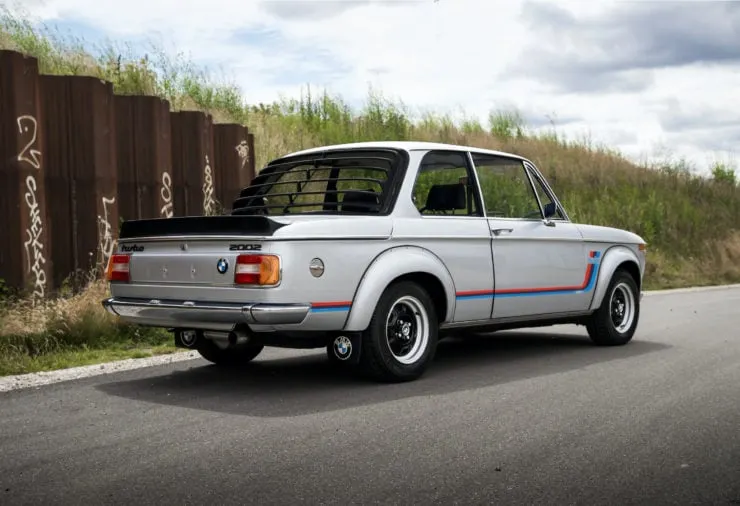
If you see a 2002 turbo today wearing the iconic “OBRUT 2002” lettering on its front spoiler, the lettering is almost certainly aftermarket restoration work. None of the 1,672 production cars left the Munich factory with that decal in place. What we now think of as the defining visual signature of the 2002 turbo survives precisely because it was never actually produced. It’s the trademark of a car that was politically silenced before its production line even started.
This may be the earliest documented case of a road car element being removed from production under direct political pressure. Fifty years before the current debates about restricting powerful engines in urban areas, BMW had already been forced to retract a design element on a production car because a member of the German parliament thought it was a threat to public safety.
What the rest of the car looks like
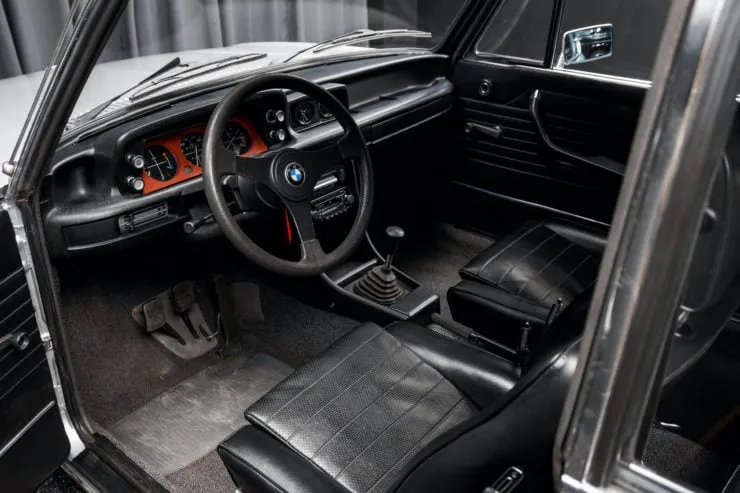
The gearbox is a four-speed manual as standard, with an optional five-speed. Fourth is direct drive; fifth, when fitted, is a relaxed overdrive for autobahn cruising. A ZF limited-slip differential is standard equipment, and this matters because the brutal mid-range hit when the turbo wakes up would produce terminal inside-wheel spin without an LSD. The car needs both rear wheels working together to put the torque down cleanly.
The fuel tank was enlarged by 52 percent over the standard 2002 to 70 litres. There’s a technical reading of this number that matters. A turbo engine, when on boost, consumes fuel at roughly three times the rate of the equivalent naturally aspirated engine. BMW’s engineers calculated that real-world range would drop dramatically compared to the base 2002, and rather than ship a sports car that needed refuelling every two hours of fast driving, they redesigned the boot floor to accept a much bigger tank. The published average consumption figure of the time was around 16 litres per 100 kilometres — roughly 18 mpg in old British money. In the middle of an oil embargo with quadrupled petrol prices, that figure was a marketing disaster waiting to happen.
The dimensions of the car remain a surprise to anyone who hasn’t stood next to one. Just over four metres long, 1,630 mm wide, 1,080 kilograms dry. By modern hot hatch standards it’s tiny. By the standards of its own era it was on the small side for a sports car carrying 170 horsepower. Power-to-weight ratio: 157 hp per tonne. For 1973, that put it in the same conversation as the contemporary Porsche 911 2.7 and a clear notch ahead of anything from Alfa Romeo, Lancia or Triumph.
What it costs to drive a turbo with 1973 lag
A modern driver getting behind the wheel of a 2002 turbo for the first time will describe the same experience anyone has described since the car was launched. The engine feels lethargic up to about 4,000 rpm. Throttle response is muted. Below the boost threshold, the compromised compression ratio is doing its work. Then somewhere around four thousand, the turbocharger reaches its operating speed, boost builds rapidly, and the entire character of the car changes. Auto Zeitung’s retrospective described the transition with one word: detonation. Not engine detonation — though that could happen with abuse — but experiential detonation. The car you were driving a moment ago has been replaced by another car, more violent, more committed, less interested in your hesitation.
This is pure 1973 turbo lag. It’s exactly the experience no modern twin-scroll variable-geometry turbo with water-to-air intercooling and electronic throttle wants to give you. Every modern turbo is engineered specifically to eliminate this transition, because the transition is widely understood to be a flaw. The 2002 turbo, lacking the technology to smooth out the transition, makes it the central feature of the driving experience instead. And that’s why current values are what they are. Collectors aren’t paying for 170 horsepower. They’re paying for the unmediated sensation of how a turbocharged car drove in 1973, before electronics civilised the experience permanently.
Why Porsche got the credit and BMW didn’t
Now the closing irony. The 2002 turbo was Europe’s first production turbocharged car. But ask any non-specialist enthusiast which car invented the road turbocharger and the answer comes back: the Porsche 911 Turbo (930), launched in 1975. Porsche took the historical credit. BMW kept the date.
Three reasons explain the asymmetry.
First, timing. The 911 Turbo arrived after the worst of the oil crisis had passed and the European luxury market had recovered. The 2002 turbo coincided exactly with the embargo’s peak. Porsche could sell freely. BMW had to halt production at 1,672 units because the market evaporated underneath them.
Second, positioning. The 911 Turbo was an expensive sports coupé aimed at a buyer for whom Sunday driving bans were irrelevant. The 2002 turbo was a relatively affordable car driven aggressively by young professionals. That made it a politically convenient target in a way the Porsche never was.
Third, and most consequentially in branding terms: Porsche kept the turbo as a permanent identity. The 911 Turbo has run from 1975 to today in an unbroken fifty-year line. BMW dropped the turbo concept from passenger cars entirely between 1975 and 1980, when it returned with the 745i. Those five years of silence let Porsche claim ownership of the turbo concept in the European consumer mind. BMW invented Europe’s first production road turbo. Porsche turned the turbo into mythology.
The 2002 turbo is, in retrospect, the car the industrial history of the automobile robbed of its credit. Not through any product fault, but through external circumstances no engineering department could control.
What you understand standing next to one
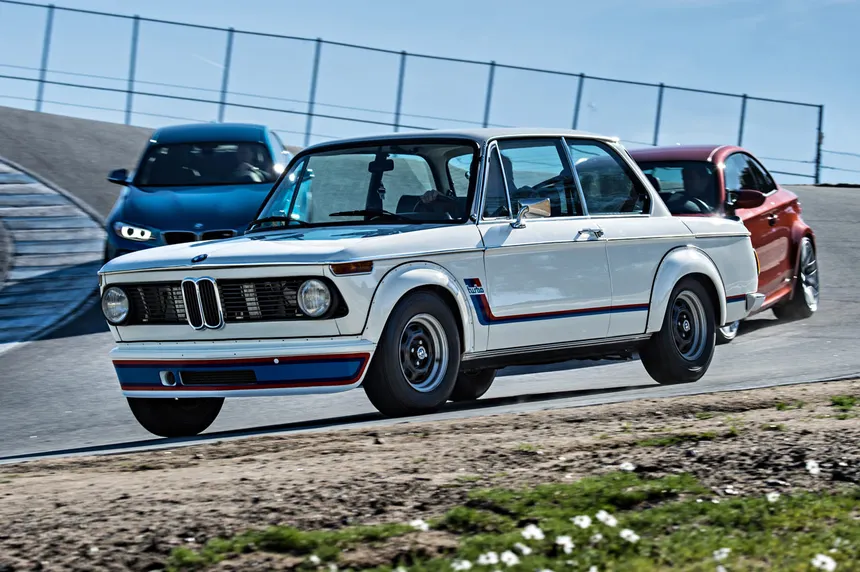
Restored 2002 turbos rarely look like much in photographs. The bolt-on flares, the steel 13-inch wheels with 185/70 tyres, the small rear lip on the boot lid, the front spoiler with its Motorsport stripes. In person, what surprises is the scale. The car is small. A two-litre four-cylinder turbocharged sports saloon weighing 1,080 kilograms with 170 horsepower has no contemporary equivalent. The closest modern parallel by spec sheet would be an entry-level Volkswagen Golf GTI weighing four hundred kilos more.
Under the bonnet, the M10 looks almost identical to the tii unit. The only visible difference is the right-side exhaust manifold terminating in a small KKK turbo, the wastegate hanging off its side, and the intake plumbing on the left running over to the Kugelfischer mechanical injection pump. Six bolts, three hoses, two pipes. Anyone trained on the M10 can service this car.
The cold-start ritual is a test of patience. A 6.9:1 compression engine with mechanical injection and points ignition does not want to idle smoothly when cold. But once it warms through, the idle settles, and in second gear past four thousand rpm with the throttle wide open, you get the full unmediated experience: turbine whistle as the wastegate cracks open, exhaust pop on lift-off, and the violent return of torque when you reapply throttle and 240 Newton metres arrive again all at once. That’s what collectors pay for. Not the horsepower number. The complete sensory texture of a turbocharged car from 1973, before the electronics arrived to smooth out the noise.
And when you walk away from the car, take one last look at the front spoiler. If the mirror script “OBRUT 2002” is painted there, somebody put it on after the fact. The factory never did. The defining visual of the 2002 turbo is, by historical accident, a feature the production line was forbidden to apply.
Sometimes the most influential car of a decade is the one that arrived two weeks before the worst crisis of the century. And what the contemporary press condemned as irresponsibility, time has rescued as the signature of the car’s character.
Why the 2002 Turbo felt dead down low and then hit all at once, and how lag differs from boost threshold, is in how a turbocharger works.
Check you’re still alive.