
Ground Effect: The Dirty Trick F1 Had to Ban (AeroNEC · 3)
In a wind tunnel in the mid-1970s, a team from Lotus watched something that shouldn’t happen. The tunnel’s moving floor — the belt meant to simulate a road rushing past — peeled up off its rollers and stuck itself to the underside of their model car. The model was sucking the laboratory floor up towards it. That was the moment Colin Chapman‘s engineers knew they’d found something that would rewrite Formula 1. They had. And it was so good the sport eventually had to legislate it away.
The trick is called ground effect, and in the last chapter I left you with the question that leads straight to it: if a wing buys grip but charges a fortune in drag, is there a cleaner way? There is. Instead of bolting a huge wing on top to push the car down, you turn the car’s own floor into a device that sucks it down. Same goal, savage grip, a fraction of the drag. It’s the difference between pushing a door and pulling it — same destination, easier route.
Welcome to chapter three of AeroNEC. Today: why this system was so superior it had to be outlawed, why it took four decades to come back, and why when it did the cars started bouncing down the straights like they were on pogo sticks.
The physics: pinch the air to speed it up, speed it up to suck
Cast back to chapter two. A wing makes grip by creating higher pressure above than below. Ground effect does the identical thing — low pressure to suck the car down — but instead of a wing hung out in the airstream, it turns the entire floor into the generator.
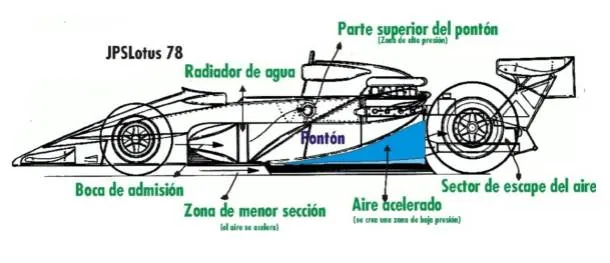
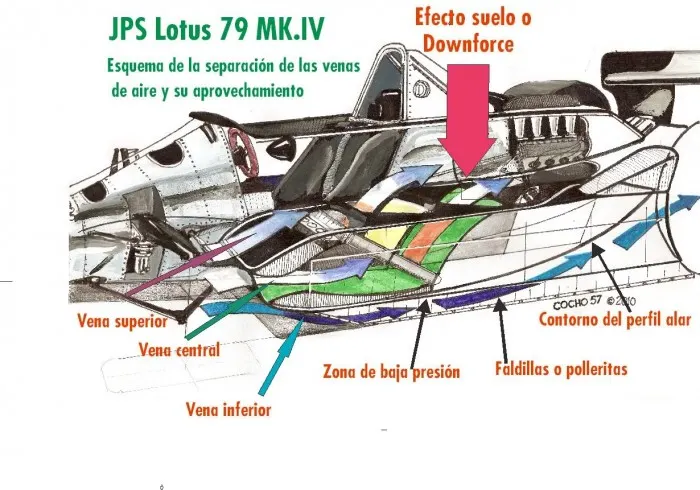
The principle is old and it’s the same one working in a carburettor: force a fluid through a narrower gap and it speeds up. When a fluid speeds up, its pressure drops. That’s the Venturi effect, straight out of a school physics lesson. Now apply it to a car. Shape the underside so the air passing beneath has to squeeze and accelerate, and you create a zone of low pressure between the car and the road. Normal pressure on top, low pressure underneath. The result: the air above presses the car into the tarmac. It sucks it down.
The piece that finishes the job is the diffuser, the tunnel that widens towards the back of the car. As it expands, it helps drag the air through from underneath and ease it back up to normal pressure behind, amplifying the suction without throwing up a wall of drag at the rear. Pinch at the front to accelerate, flare at the back to empty out. The whole floor working as a vacuum pump.
Chapman and the car that felt painted to the road
The idea didn’t appear from nowhere. As far back as 1968, engineers Tony Rudd and Peter Wright had run experiments at BRM with underbodies that used the air to press the car down, without ever reaching true ground effect. The hunch was in the air. But it took someone to see the whole picture, and that someone was Colin Chapman.
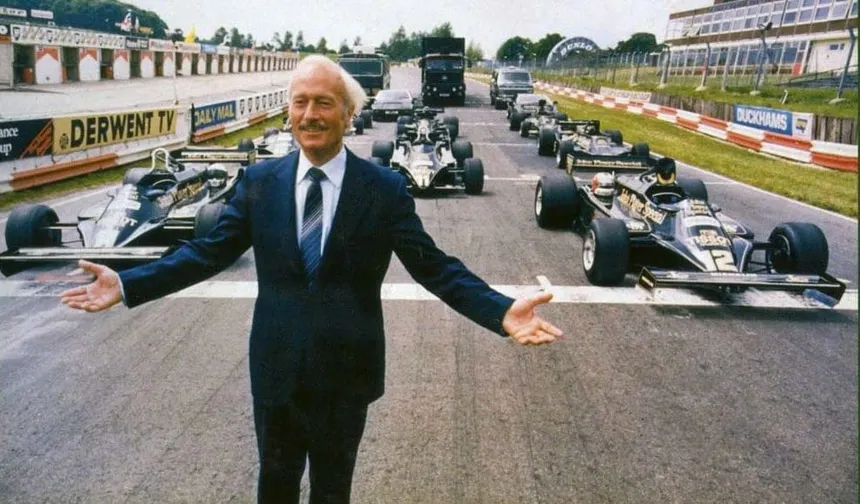
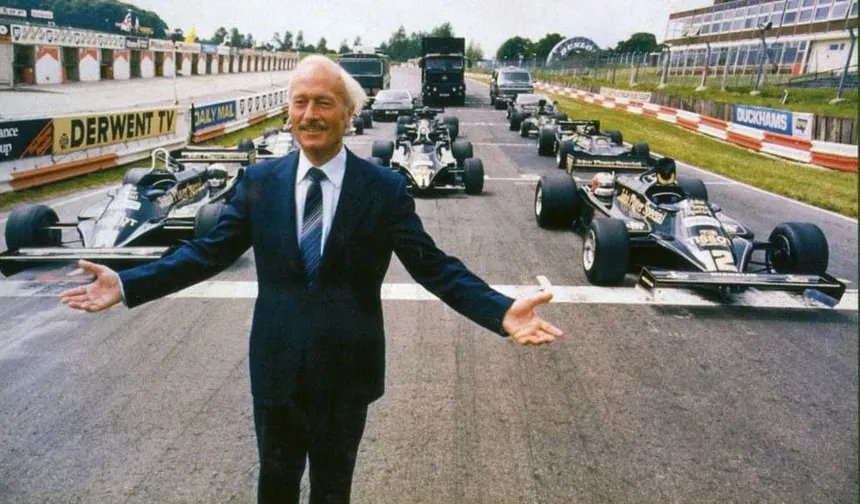
The founder of Lotus saw the potential before anyone. He reunited Wright and Rudd and put them to work shaping the floor like an upside-down wing, tucked into the sidepods. The result was the Lotus 78 of 1977 and, a year on, its perfected sibling, the Lotus 79. Rivals spent half a season just working out why that car cornered as if it were stapled to the ground. Mario Andretti, who took the 1978 title in it, summed it up in a line nobody’s improved on: the car felt painted to the road. Lotus won nine of the fifteen races that year and turned the rest of the grid into scrap in barely twelve months.
Here’s the number that proves it was a revolution, not a refinement. A technical study of the era measured the Lotus 79 at 150 mph generating roughly 700 pounds of downforce. The front wing contributed 100 of that, the rear wing 200. Ground effect, on its own, supplied the remaining 400. The floor made twice the grip of both wings combined — and at almost no drag cost. That’s why the 79 could get away with a small rear wing: it didn’t need a big one, the floor was already doing the dirty work.
Why it’s so superior: grip per gram of braking
To really see why ground effect changed everything, go back to the key idea from the last chapter: in aerodynamics, what counts isn’t how much grip you make, it’s how much grip you make for each unit of drag you pay. Engineers call it aerodynamic efficiency, and it’s the metric that actually wins races.
A wing is a poor deal on that score. It hangs out in the oncoming air, so every gram of load it makes drags a hefty chunk of resistance along with it. Ground effect, by contrast, works hidden under the car, where the air has to pass anyway. It takes a flow that was going to be there regardless and turns it into suction, almost as a freebie. The upshot is far more grip for each point of drag than any wing can manage.
That’s why ground effect isn’t merely “another way” to make downforce. It’s a radically better one. A car with good ground effect can corner as hard as one loaded with wings while being quicker down the straight because it drags less. It gets the best of the two worlds that looked irreconcilable in chapter two. Which is exactly why, the moment Lotus showed its hand, the whole grid bolted off to copy it.
Skirts: the detail that made it lethal
For the suction to hold, air from the sides mustn’t sneak underneath and spoil the low pressure. So Lotus sealed the car’s edges with sliding skirts — first bristles, later rigid blades — scraping the track and trapping the vacuum below. Without skirts, ground effect loses half its bite. With them, the car was effectively sealed against the road.
And that’s where the danger lived. All that grip depended on the seal holding. Hit a bump, break a skirt, let the car ride up for an instant, and air rushed underneath and the suction vanished — not gradually, but all at once. Picture committing to a flat-out corner trusting in enormous grip, then having that grip evaporate in a tenth of a second. The car speared off the road with no warning. Cornering speeds climbed, and the crashes climbed with them. F1 saw the problem and acted. First, in 1981, it went after the skirts by demanding a gap between car and ground; teams simply jacked the car up for inspection and ran it low on track, so for 1983 the sport attacked the root and mandated flat floors. The stated aim was to cut aerodynamic load — and with it the cornering speeds that had turned dangerous: if a skirt broke flat out through a fast bend, the car lost all its grip at once and speared off the road. It couldn’t outlaw the physics of ground effect — you can’t ban physics — but it killed the extreme sealed version, the one sucking the car down with hundreds of pounds of force. With no skirts to trap the vacuum and a floor that couldn’t be sculpted into a tunnel, the suction shrank to a shadow of what it had been. The dirty trick was switched off for nearly forty years.
When it came back, the cars wouldn’t stop bouncing
Here’s the twist. Ground effect never fully went away. Even with flat floors mandatory, engineers kept pulling grip from the underbody with ever-cleverer diffusers; in the years before 2022, more than half an F1 car’s downforce already came from the floor. The physics they’d banned was still there, working the back door.
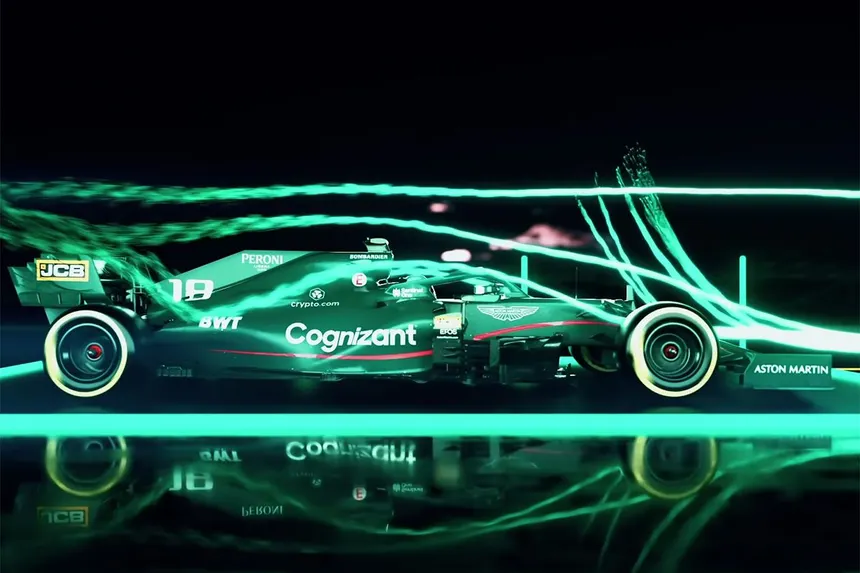
Then in 2022 F1 did something bold: it embraced proper ground effect again, Venturi tunnels back under the car. Why? A car making its grip from the floor leaves cleaner air behind it than one bristling with wings, and that lets cars follow each other closely and overtake. Ground effect returned not for nostalgia but for the show.
And it came back with its old curse wearing a new name: porpoising. The bounce. Because the suction peaks when the car runs lowest, the cars slammed down towards the tarmac at speed until the airflow through the tunnels stalled, lost the load all at once, sprang back up, regained the suction, dropped again — over and over, many times a second. Multi-million-pound cars hopping down the straights like a basketball. It was the exact same unstable physics that frightened engineers in the 1970s, dragged back to life four decades later because almost nobody was left who remembered how to tame it.
It got bad enough that drivers reported back pain and blurred vision, and midway through that first season the FIA stepped in on safety grounds, forcing teams to rein the bouncing in. The fixes were a scramble: stiffer floors, raised ride heights that bled away some of the very downforce the teams were chasing, and a frantic rethink of how low a ground-effect car could safely run. The lesson the 1970s had already taught — that this kind of grip is brilliant right up until it bites — had to be relearned the hard way, in public, on live television.
The ultimate version: suck it down by force
By this point somebody with a devious mind thought the obvious. If ground effect needs speed to work and leans on a fragile seal, why not suck the air out from underneath by force — with a fan — and have grip all the time, even standing still?
That idea existed. There were race cars with a rear fan that literally vacuumed the air from beneath the floor, gluing the car down at any speed, even zero. The grip was from another planet. And as you’d guess, they lasted exactly as long as it took the rest of the grid to lose its temper. Those sucker monsters — the Chaparral 2J in its day, the Brabham BT46B in Formula 1 — have a story of their own, and I tell it in full elsewhere in the garage. Here I’ll just leave the note that they existed, they won, and they were wiped off the map for being too good.
Ground effect is proof that in aerodynamics the best answer isn’t always the showy one. It isn’t the giant wing that wins — it’s the invisible floor nobody can see working. It’s elegant, it’s efficient, and it’s so effective it’s had to be reined in again and again to stop it breaking the sport. Next time you see a modern F1 car hunkered down, almost scraping the asphalt, you know why it sits so low: that isn’t styling. It’s hunting for the ground to suck itself against.
Next chapter we change tack and look at what happens where nobody looks: behind the car. Because it turns out the wake — the churning mess of air a car leaves in its trail — matters as much as anything we’ve covered so far.
Check you’re still alive.
1 thought on “GROUND EFFECT”