
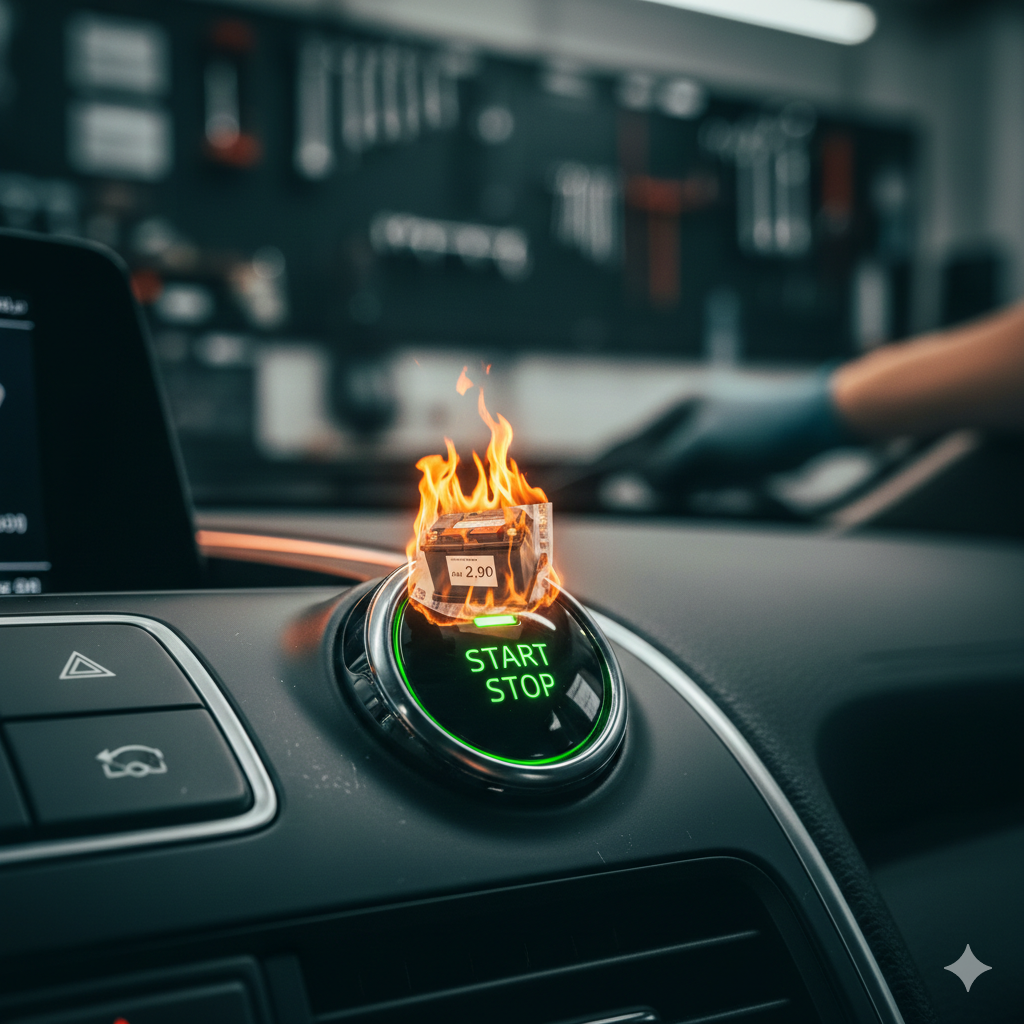
Start-Stop: The System Killing Your Engine to Save You $30 a Year

Not Enough Cylinders — Unfiltered Automotive Opinion
Sold as “Green Tech,” Built as a Compliance Trick
They’ve sold it to you as “Green Technology.” As innovation. As the future of responsible driving.
And they lied to your face.
The Auto Start-Stop system in your truck or car doesn’t exist to save you money at the pump. It exists so the manufacturer can pass the EPA’s fuel economy tests, meet CAFE (Corporate Average Fuel Economy) standards, and avoid massive government fines.
Your vehicle is the lab rat. Your wallet pays for the fallout. Your driving experience is the casualty.
I’ve spent over 30 years with my hands deep in engines. I’ve seen “revolutions” come and go, ending up in the scrapyard of history. But few things are as blatantly designed against the owner as Auto Start-Stop. Here is exactly why.
Why It Exists (Hint: It’s Not for You)
The concept is simple: when you hit a red light or get stuck in a Houston or LA gridlock, the engine dies. Lift your foot off the brake, and it fires back up.
Technically, a dead engine doesn’t burn fuel. Correct. But lab theories and the reality of a 100-degree day in Arizona have nothing to do with each other.
Manufacturers didn’t add Start-Stop to be your friend. They added it because of federal mandates. If a manufacturer’s fleet average emissions exceed the limit, they pay millions in penalties. Start-Stop can shave off just enough CO2 on paper to keep the feds happy.
They save millions in fines. You pay for the replacement parts. Great deal—for them.
The “Savings” Myth: Doing the Math
Let’s look at real numbers, not the fluff in the brochure.
What You “Save”
In heavy city driving, Start-Stop might reduce fuel consumption by maybe 0.1 to 0.3 gallons per 100 miles. If you drive 15,000 miles a year with heavy city use, you’re looking at saving maybe 20 to 30 gallons of gas annually. At $3.50 a gallon, that’s $70 to $105 a year—if you’re lucky.
What It Actually Costs You
Here is what the salesman conveniently forgets to mention:
- AGM or EFB Batteries ($250–$450): Your standard lead-acid battery can’t handle this. You need an AGM (Absorbent Glass Mat) battery. A regular high-quality battery costs $120 and lasts 6 years. An AGM costs $300+ and, due to the constant cycling, often dies in 3 to 4 years. You’re spending 4x more on batteries over the life of the car.
- Heavy-Duty Starters ($400–$700): A normal starter is designed for maybe 50,000 cycles. With Start-Stop, you hit that in two years. “Reinforced” starters cost double to replace when they inevitably burn out.
- The Hidden Killer: Engine Bearings: This is what keeps me up at night as a mechanic. When the engine is running, a film of oil keeps the crankshaft from touching the bearings. Metal never touches metal. When the engine stops, that oil film bleeds away. Every time it restarts, for a fraction of a second, you have metal-on-metal friction before oil pressure builds. Doing this 50 times a day, every day, is an execution sentence for your main bearings.
The Summer Torture Test
If the money doesn’t move you, the heat will.
Ever been stuck in traffic in July in Atlanta or Vegas? Your A/C compressor is driven by the engine belt. When the engine dies, the compressor stops. The air coming out of your vents turns humid and warm in seconds.
You’re sitting in a $60,000 truck, sweating, because some bureaucrat decided saving 0.005 gallons of gas is more important than your comfort.
Then there’s the anxiety. That split-second hesitation when the light turns green and you’re waiting for the engine to kick in while a line of cars is honking behind you. That’s not driving; that’s babysitting a computer.
Why Can’t You Just Turn It Off?
Most vehicles have a “Deactivation” button. You press it, and the system dies. Problem solved? Wrong.
Every time you cycle the ignition, the system resets to “ON.” Why? Because if the manufacturer allowed a permanent “OFF” switch, they couldn’t count the fuel savings toward their EPA fleet ratings. They sold you the car, but they still want to control how you use it. It’s not customer service; it’s a product kidnapping.
The Real Way to Save Fuel
Want to actually save money? It’s called Driving Habits, not electronics.
- Anticipation: Coast to that red light instead of staying on the gas until the last second.
- Smooth Acceleration: Don’t treat every green light like a drag strip.
- Maintenance: Keep your tires aired up and your filters clean.
A smart driver can save 15-20% on fuel without a single “Start-Stop” sensor ever firing.
My Recommendation
- If you’re buying: Look for a vehicle that allows you to disable it easily, or look into “Start-Stop Eliminators”—third-party plug-in devices that remember your last setting.
- If you have it: Hit that “Off” button every single time you put it in gear. Protect your starter. Protect your bearings.
- Ask the Dealer: “What does the replacement AGM battery cost for this specific VIN?” Watch them squirm.
Conclusion
Auto Start-Stop is the perfect example of the modern auto industry losing its way. Instead of building simpler, longer-lasting machines, they add layers of complexity that only benefit a lab test.
The owner pays for the R&D, pays for the parts, and pays for the repairs, all while being told it’s “for the environment.” It’s not for the planet; it’s for the balance sheet.
Have you had a battery die early? Has your starter left you stranded? Share your story in the comments. We don’t do brand loyalty or dealership fluff here.
— Not Enough Cylinders
4 thoughts on “START-STOP”