The first journalist to drive it was also the last
Bill Thomas didn’t know he was making history. Nobody at Bentwaters Park on August 19th, 2008 thought they were making history. They thought they were making a magazine feature. Top Gear had arranged a photo shoot with Mazda’s Furai concept at the former RAF airbase in Suffolk, a private test facility with a 1.3-mile circuit and the kind of isolation that makes car manufacturers comfortable letting prototypes stretch their legs.
Thomas, a Top Gear journalist, had just driven the Furai. He was the first member of the press to do so. The Stig had done the shakedown laps. Thomas had followed. Then Mazda’s works driver Mark Ticehurst took over for the final photographic passes. The photographer wanted a specific shot: flames from the central exhaust on a full-speed run. That orange-and-white carbon fibre body trailing fire from its tail would make the perfect cover image.
Ticehurst accelerated. The three-rotor Wankel screamed. And somewhere on that pass, the scream changed pitch.
The flames were no longer coming from the exhaust. They were coming from the engine bay.
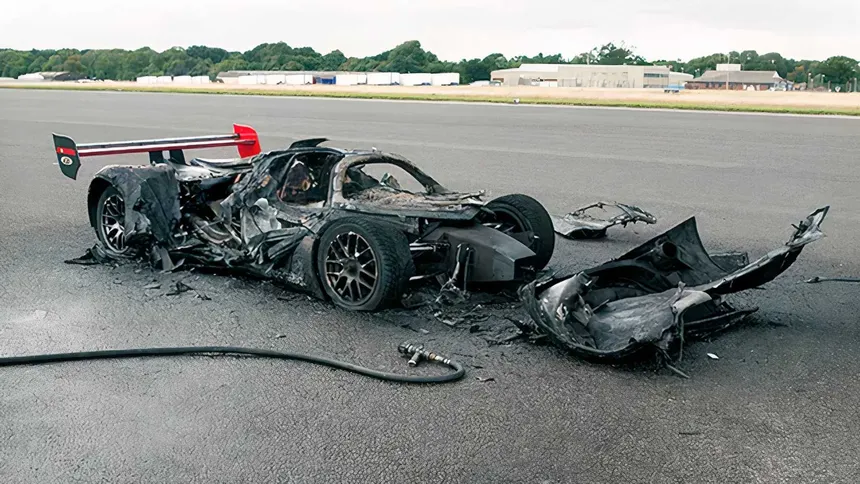
The Furai was in a remote section of the circuit. The fire crew couldn’t reach it in time. Ticehurst got out uninjured, but the car burned completely. When the fire was out, the most ambitious concept car Mazda had built in the twenty-first century had been reduced to wreckage.
Mazda said nothing. Not a word. Not a press release, not an internal memo that leaked, not a confirmation that anything had happened at all. And for five years, nobody outside the company knew the Furai was gone.
Wind made visible
Furai means “the sound of the wind” in Japanese. Mazda unveiled it at the Detroit Auto Show in January 2008 as the fifth and final chapter of the Nagare series — a sequence of experimental concepts built around the idea of “flow,” the principle that a car’s forms should follow the same patterns that wind, water and nature create when they move without obstruction.
The four previous Nagare concepts were styling exercises. The Furai was not. The Furai was a racing car.
Its mechanical basis was a Courage C65 LMP2 chassis — the same platform Mazda had campaigned in the American Le Mans Series between 2005 and 2006. That’s not a motor show prop. It’s a structure engineered to withstand the loads of real endurance racing, with harness mounting points, a homologated safety cell and suspension geometries calibrated for speeds that normal concept cars never need to contemplate.
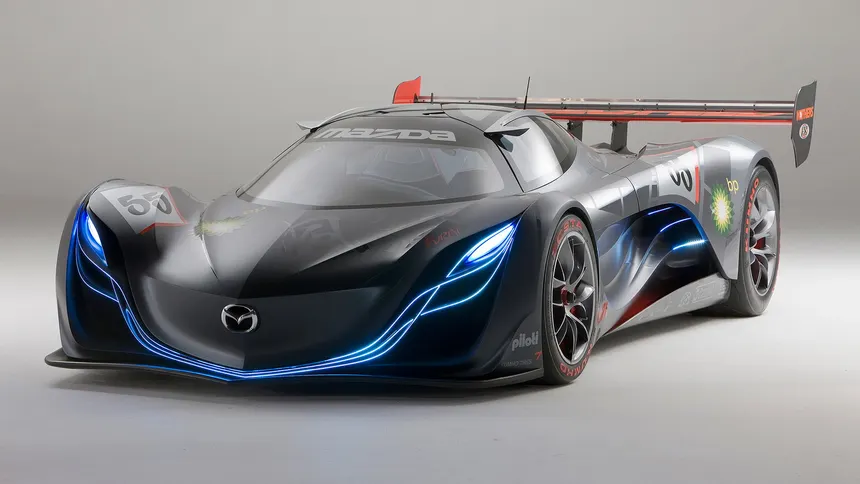
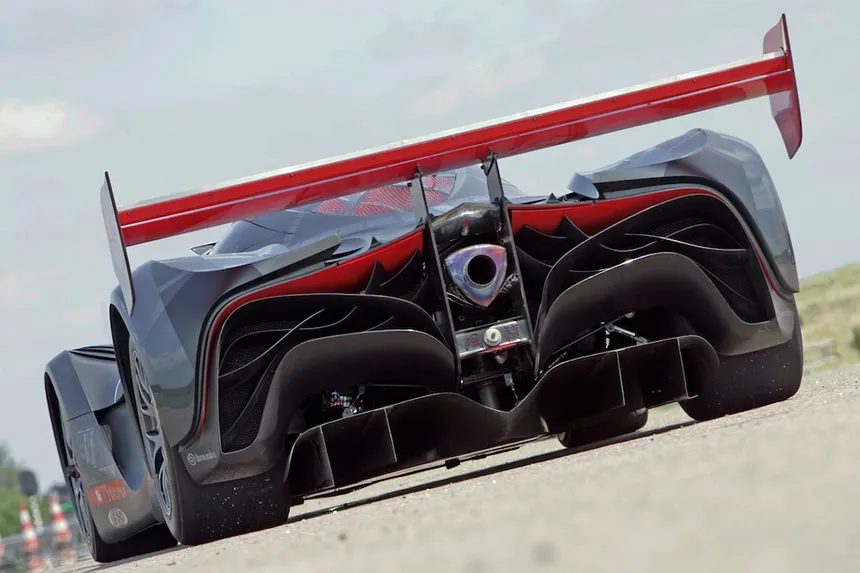
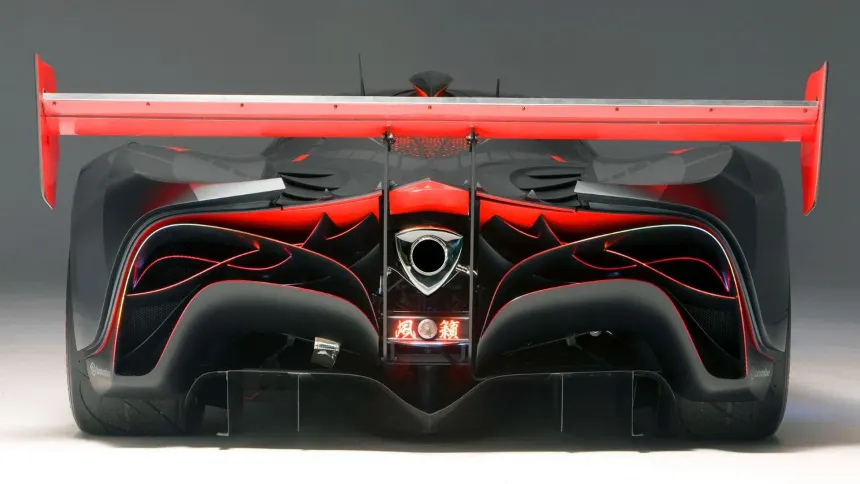
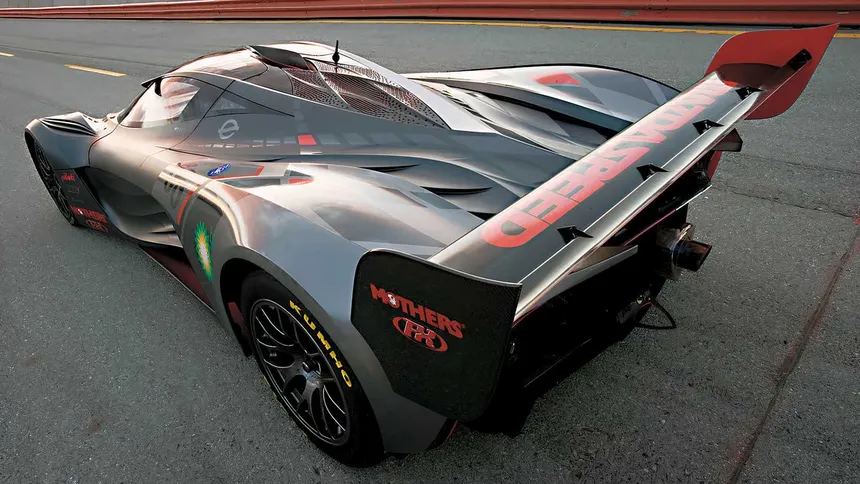
Over that chassis, Mazda built a carbon fibre body developed through computational fluid dynamics — not decorative aerodynamics but functional downforce generation. Every surface, every duct, every curve served a real aerodynamic purpose. The orange-and-white livery carried the number 55, and that number wasn’t arbitrary: it was a direct tribute to the Mazda 787B, the only Japanese car ever to win the Le Mans 24 Hours, in 1991, wearing that same number.
And at the centre of it all, the engine. A Mazda R20B RENESIS three-rotor Wankel, built by Racing Beat, running on E100 — pure ethanol. Approximately 450 horsepower extracted from an engine with no pistons, no connecting rods, no conventional crankshaft. An engine that spins instead of reciprocating. An engine that sounds like nothing else in automotive history.
What Mazda meant when it said it wasn’t going racing
This is where the Furai story becomes fascinating beyond the tragedy, because Mazda’s position in 2008 doesn’t remotely match the car they built.
In 2008, Mazda had no active rotary racing programme. The RX-8, its last production rotary car, had been on the market for years with declining sales and a reliability reputation the company couldn’t shake. The Wankel engine — Mazda’s defining technology since the Cosmo Sport of 1967, the engine that won Le Mans with the 787B — was effectively on life support. Mazda was saying, more or less officially, that it had no plans to race with the rotary.
And then it built the Furai. A functional racing prototype on an LMP2 chassis, powered by a three-rotor Wankel running on ethanol, wrapped in CFD-optimised carbon fibre and wearing the number 55 from Le Mans. If that constitutes “no intention to race,” the definition of intention needs serious revision.
What Mazda built was a declaration. Not a marketing exercise or a public relations stunt, but an engineering declaration: the rotary engine can run on renewable fuels, it can produce the power required for endurance racing, and it can do so within a structure that meets FIA demands. The Furai was Mazda’s answer to everyone who said the Wankel was dead technology. It was the company saying “we’re not racing” while building a race car.
Before Bentwaters
The Furai didn’t sit on a plinth between Detroit and Suffolk. Mazda took it to Laguna Seca, one of the most demanding circuits on the American west coast. It went to Buttonwillow, a test track in California’s Central Valley that professional racing teams use for development work. And it went to the Goodwood Festival of Speed, where it climbed the hill in front of a hundred thousand people who’d been waiting weeks to see it.
At every appearance, the Furai demonstrated something concept cars rarely demonstrate: it worked. Not at parade speed, not making pretty noises for cameras, but genuinely working. Accelerating, braking, cornering at speeds that demanded real downforce from a body designed to generate it. The drivers who handled it described a car that felt closer to a competition LMP2 than a show prototype.
That’s what makes what happened next so difficult to process.
The morning nobody reported
August 19th, 2008. The Furai arrives at Bentwaters Park for a Top Gear photo shoot. The plan is straightforward: capture the best possible images of the car in a track environment, with real-speed passes, for a feature the magazine intends to publish.
The Stig drives first, running the car through its paces on the 1.3-mile circuit. Everything works. The three-rotor Wankel sings at a frequency that vibrates through your ribcage. Then Bill Thomas takes the wheel. Thomas becomes the first external journalist to drive the Furai. Without knowing it, he also becomes the last.
After Thomas, Ticehurst takes over for the final photographic passes. The photographer wants the exhaust flame shot. Ticehurst knows. He makes several runs. On one of the last, the engine catches fire.
What follows is the worst possible combination of circumstances. The Furai is in a section of the circuit far from the emergency service points. The track’s fire crew can’t reach the car in time. Ticehurst exits under his own power, unhurt, but the Furai burns with nobody able to stop it. The flames consume the carbon fibre bodywork, the aluminium Courage C65 chassis, the R20B three-rotor engine, the interior, the instrumentation, everything. When the fire dies, the most complete concept car Mazda has built since the 787B is destroyed.
Five years of nothing
What Mazda does after the fire is, in some ways, more revealing than the fire itself. It says nothing. No press release. No internal statement that reaches the media. No explanation, no acknowledgment, not even a confirmation that the incident occurred. Mazda absorbs the destruction of the Furai and goes silent.
Top Gear goes silent too. The magazine has the photographs, Bill Thomas’s account, the video of the fire. But it can’t publish without Mazda’s permission, and Mazda won’t give it. For five years, the Bentwaters story is a secret shared between a handful of people who were there and a corporation that has decided the world doesn’t need to know.
The revelation comes in September 2013. Five years after the fire, Mazda finally allows Top Gear to publish the full story. By then, the RX-8 has been discontinued — production ended in 2012 — and Mazda’s rotary engine has officially died as a production car powerplant. The Furai, which was the proof that the Wankel could have a future in competition running renewable fuels, no longer exists. And the exact cause of the fire has never been officially published.
What remains when the car doesn’t
The charred remains of the Furai were shipped to Mazda’s Advanced Design Studio in Irvine, California. Their exact current whereabouts aren’t publicly confirmed. What survives of the most tragic concept car in recent automotive history exists in three formats: photographs, video and pixels.
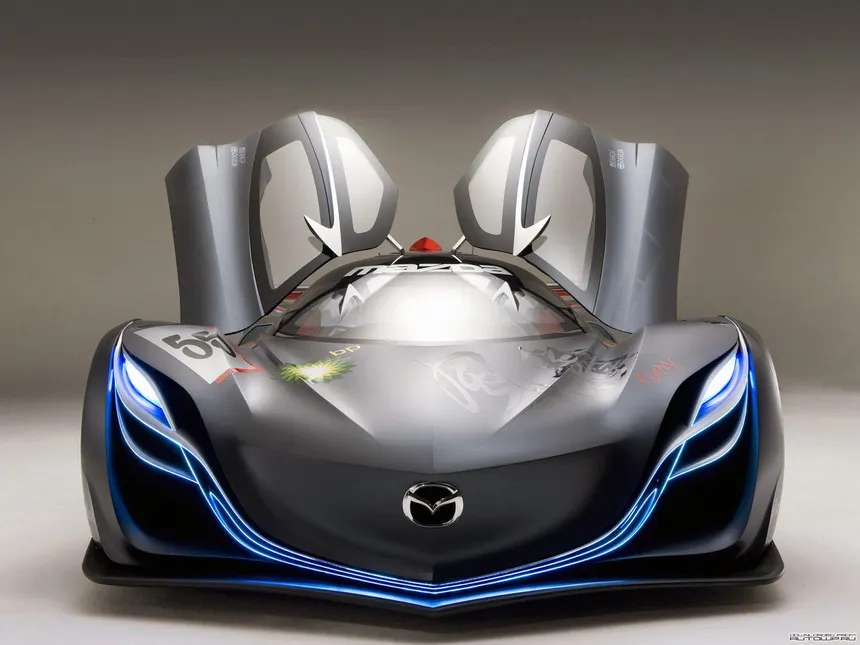
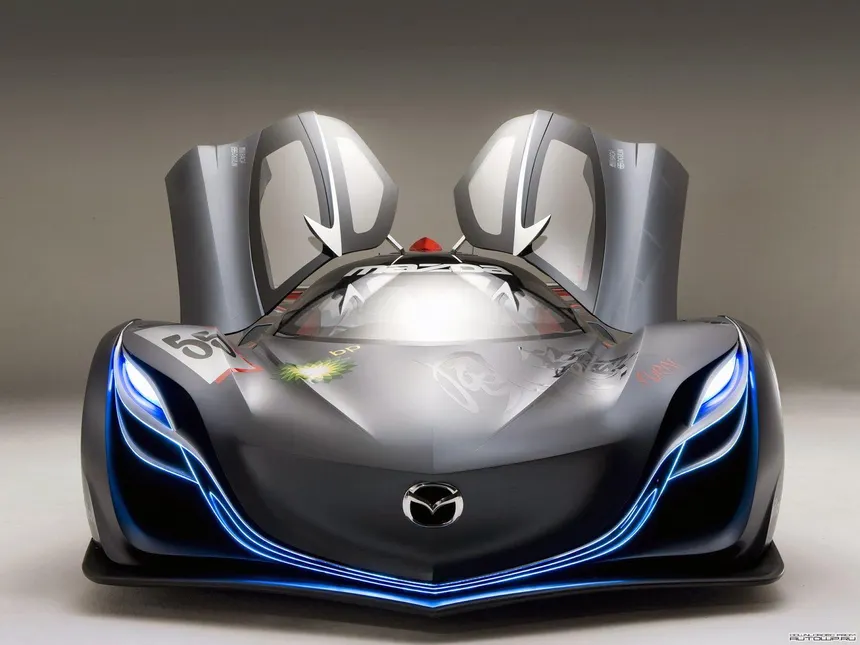
The pre-fire photographs of the Furai are among the most reproduced of any concept car this century. That orange over white with the 55 on the flanks, the LED headlights that look like insect eyes, the bodywork flowing like water around a racing chassis. They appear in every “most beautiful concept cars in history” list and every debate about cars that deserved to reach production.
The video that Top Gear eventually published includes the final footage of the Furai in motion. It’s difficult viewing if you know what comes next. The howl of the three-rotor Wankel filling a former RAF airbase in Suffolk, and somewhere in the footage, the smoke.
And then there are the video games. The Furai appears in Gran Turismo 5, Gran Turismo 6 and Gran Turismo PSP. Polyphony Digital modelled it with obsessive precision, and for millions of players the Furai exists exclusively in digital form. You can drive it on screen. You can hear the engine. You can feel a simulation of what the three-rotor did to the Courage C65 chassis. But you can’t touch it. That’s no longer possible.
There’s also a Hot Wheels Furai. A ten-centimetre piece of die-cast metal that costs less than five pounds and is, in some absurd way, the most accessible physical object connecting anyone to a car that cost millions and burned in under ten minutes.
The rotary’s last stand
The Furai was more than a concept car. It was Mazda’s last grand gesture before abandoning the rotary engine in production. When the RX-8 ceased production in 2012, the Mazda Wankel lost its final series vehicle. The Cosmo Sport of 1967, the RX-7 across all its generations, the Le Mans-winning 787B, the RX-8 — the entire lineage of cars with engines that spun instead of reciprocating came to an official end.
The Furai would have been the demonstration that the story didn’t have to finish there. A three-rotor Wankel running on pure ethanol, producing 450 horsepower, mounted in a homologated competition chassis, with Le Mans aerodynamics and the number of the car that won Le Mans. Had Mazda kept the Furai intact, it would have possessed a physical, tangible, driveable argument for the rotary engine’s future in an era of emissions regulations and alternative fuels.
Instead, it has photographs. A Hot Wheels. And the charred remains of something that might have changed the narrative of the most singular engine in automotive history, stored in a design studio somewhere in California.
The sound of the wind. That’s what Furai means. And that’s precisely what remains when the car is gone: the echo of something that passed too quickly for anyone to hold on to.
Check you’re still alive.