Pony Cars: The American War That Changed the Automobile Forever
Not Enough Cylinders — Unfiltered Automotive Opinion

There is a category of automobile that wasn’t born in an engineering lab or a high-end design studio. It was born from a gut feeling: that millions of young Americans wanted a car that was beautiful, fast, and cheap. They weren’t asking for a Corvette. They were asking to feel like they were driving one. This category is called the Pony Car, and its history is one of the most fascinating in the world of internal combustion.
A Horse Named Mustang
To understand the phenomenon, you have to look at America in the early ’60s. Baby boomers were entering the workforce, they had cash in their pockets, and they had one thing very clear: they didn’t want to drive the same boring boat their parents drove. Ford saw it before anyone else.
Lee Iacocca, then VP of Ford, pushed a project based on a simple premise: take the humble Ford Falcon chassis, dress it in a “long hood, short deck” sporty body, offer an endless list of options, and set an irresistible entry price. Just $2,368. The result was the Ford Mustang, unveiled on April 17, 1964, at the New York World’s Fair.
The numbers speak for themselves. Ford estimated 100,000 units in the first year. They hit that mark in three months. In 18 months, they had sold over a million Mustangs. It was the most successful product launch in post-war American history.
But here’s the trivia bit: the Mustang wasn’t technically the first Pony Car. That honor belongs to the Plymouth Barracuda, which hit the market on April 1, 1964—two weeks before the Mustang. Based on the Plymouth Valiant, the Barracuda featured a massive wrap-around rear window. However, with a tiny marketing budget, it was completely eclipsed by the Mustang’s media blitz. A brutal lesson in marketing vs. merit.
Anatomy of a Pony Car
Before we go further, let’s define what a Pony Car actually is. It’s not a “Muscle Car,” though the lines often blur. A Pony Car is defined by:
- Dimensions: Compact or mid-sized, with “long hood, short deck” proportions.
- Platform: Built on mass-production chassis to keep prices low.
- Capacity: Four real seats.
- Customization: A massive options list, from thrifty six-cylinders to high-performance V8s.
The main difference with Muscle Cars is that the latter were usually intermediate-sized cars with massive engines and higher price tags—think Chevelle SS or Pontiac GTO. The Pony Car was about democratizing the thrill.
The Pony Car Wars: Everyone Against the Mustang
The Mustang’s success triggered one of the most intense commercial wars in history. Every manufacturer wanted a slice of that massive cake.
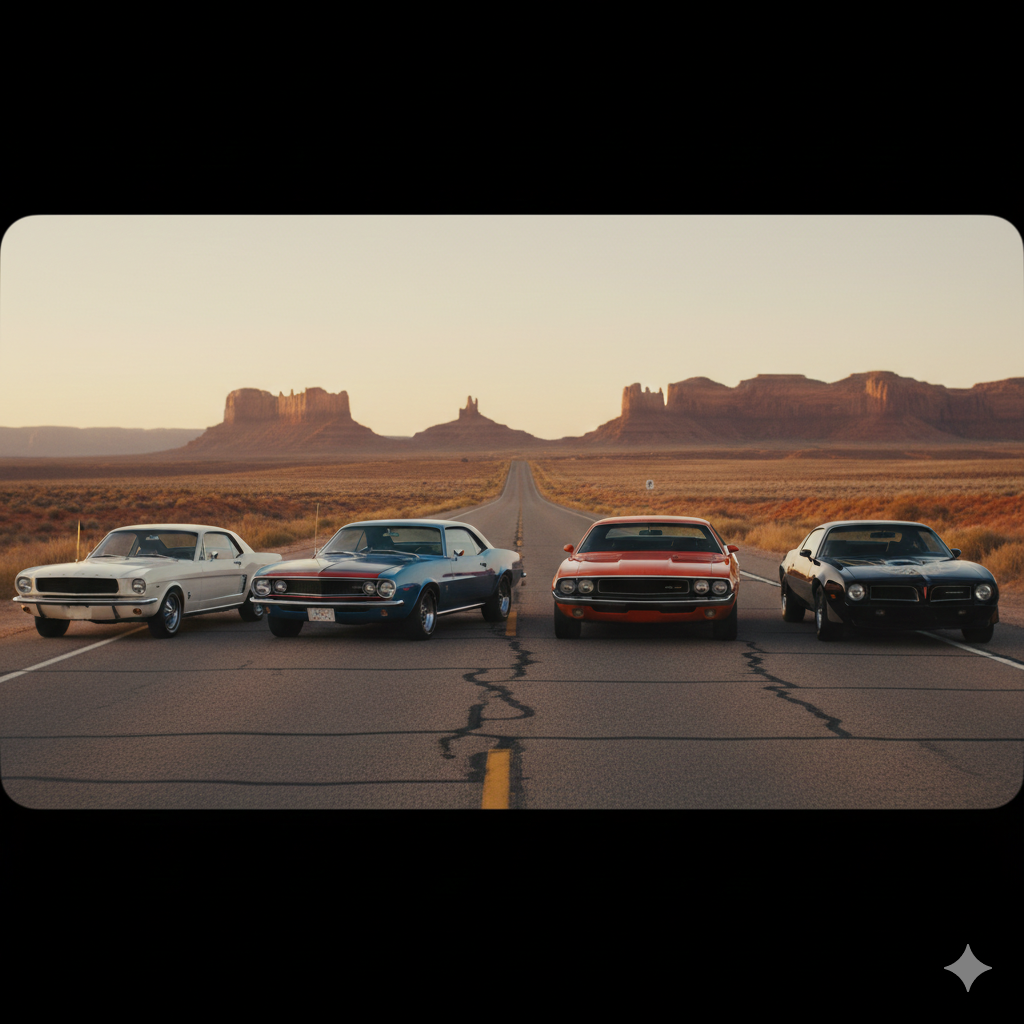
- Chevrolet Camaro (1967): GM originally thought their Corvair could compete. Big mistake. They had to rush the Camaro into production based on the Nova platform. The Z/28 version was designed specifically for SCCA Trans-Am racing, cementing its status as an icon.
- Pontiac Firebird (1967): Arriving months after the Camaro, it shared the engineering but brought its own style and legendary performance trims like the Trans Am.
- Mercury Cougar (1967): Ford’s luxury answer to its own phenomenon. Longer wheelbase, more refined, it was the “gentleman’s” Pony Car.
- AMC Javelin (1968): American Motors Corporation was the last to join, but the Javelin was widely praised for its sleek design and high-performance V8s.
- Dodge Challenger (1970): Chrysler arrived late to the party. Though it debuted when the market was saturating, its “E-body” platform (shared with the Barracuda) and the availability of the HEMI engine made it one of the most desirable cars in history.
The Perfect Storm: Crisis and Collapse
In the early ’70s, a lethal combination hit the segment. Insurance premiums for young drivers skyrocketed. Emissions regulations began to choke engine output. Then came the final blow: the 1973 Oil Crisis.
The result was devastating. The Barracuda and Challenger were canceled after 1974. The Javelin died. The Mustang was downsized into the four-cylinder Mustang II. To give you perspective: the 1973 Mustang was 8 inches longer and 600 pounds heavier than the 1965 original. The “Malaise Era” had begun.
Pop Culture & Resurrection
The Pony Car might have died there if not for Hollywood. In the late ’70s, the Pontiac Trans Am appeared in Smokey and the Bandit, and suddenly everyone wanted a black-and-gold bird on their hood. The ’80s brought the Fox Body Mustang, injecting new life into the category through accessibility and a massive aftermarket scene.
The 21st Century: Nostalgia as Fuel
After years in the wilderness, the 2005 Mustang debuted with a “retro-futuristic” design that reignited the passion. Chevy brought back the Camaro in 2010, and Dodge resurrected the Challenger in 2008 as a rolling tribute to the 1970 original.
In 2016, the Mustang went global for the first time, selling in markets like Europe and Australia. In 2017, the Challenger became the first Pony Car with AWD.
Trivia You Didn’t Know
- The Name: “Pony Car” comes directly from the galloping horse emblem on the Mustang.
- Launch Day: Ford took 22,000 orders for the Mustang on the very first day.
- The Near-Death of the V8: In the ’80s, Ford almost replaced the Mustang with a front-wheel-drive car. Fans protested so hard that Ford renamed the FWD car the “Probe” and kept the RWD Mustang alive.
- Speed Record: Ford developed the Mustang from prototype to showroom in just 18 months—a record achieved by raiding the Falcon parts bin.
An Immortal Legacy
Pony Cars represent the American Dream on four wheels: the idea that style and speed shouldn’t be for the elite. They were born for the young, for those starting out, for those who wanted the wind in their hair without draining their bank account.
More than sixty years later, the Mustang is still in production. The category has survived oil crises, emissions, the SUV craze, and now the electric revolution. Whether they burn gas or electrons, the promise of the Pony Car remains the same: that driving something special is within everyone’s reach.
Who do you represent? Team Mustang, Team Camaro, or are you a Mopar/Challenger person? Let me know in the comments.
— Not Enough Cylinders
3 thoughts on “PONY CARS”