
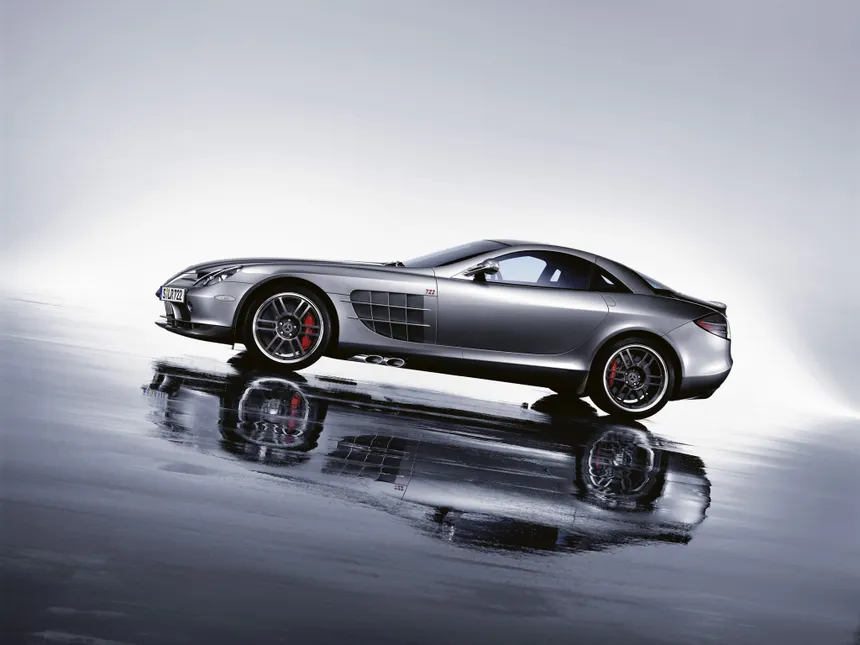
Mercedes SLR 722: The SLR That Finally Stopped Arguing With Itself
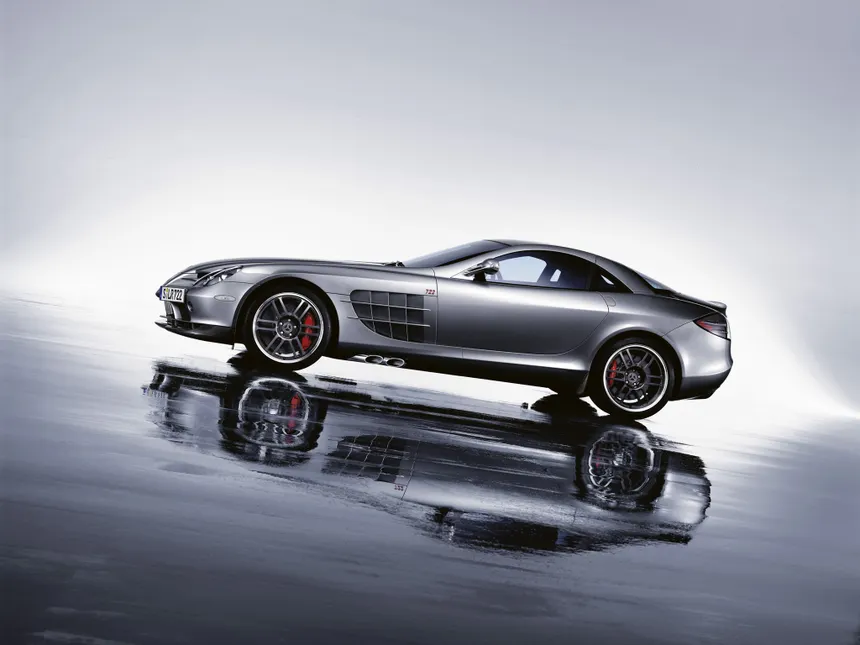
There is a clip somewhere of Chris Harris talking about the SLR McLaren, and you can see the conflict on his face. He respects the car. He just can’t quite love it. And he’s not alone. For years the SLR was the supercar nobody knew where to file. Too heavy for the wall in your bedroom, too strange for the auction-house pedestal, too clever for its own good.
Then came the 722. And suddenly the whole thing made sense.
To understand why, you have to understand that the SLR McLaren was not born from a vision. It was born from a row.
Two companies, one car, zero agreement
Mercedes owned a chunk of McLaren. The two had a rock-solid Formula 1 partnership. So when the silver Vision SLR concept landed to rapturous applause, going into production seemed obvious. Call your F1 partner, build the thing, print money.
Except the moment executives sat down to define what this car actually was, the visions collided. Mercedes wanted a grand tourer. Cross-continent comfort, two-zone climate, a proper boot, the three-pointed star and all the serenity it implies. McLaren had just built the F1, the greatest road car ever made, and wanted nothing of the sort. McLaren wanted a weapon.
What came out the other side was the standard SLR: a car pulling in two directions at once. Savagely fast, brilliantly engineered, and quietly unloved. Demand was soft for a car at that price. The people who could afford it didn’t quite know what it was for, and frankly, neither did the car.
This is where the 722 walks in and changes the conversation.
A number that carries a legend
First, the name, because the name is the whole point.
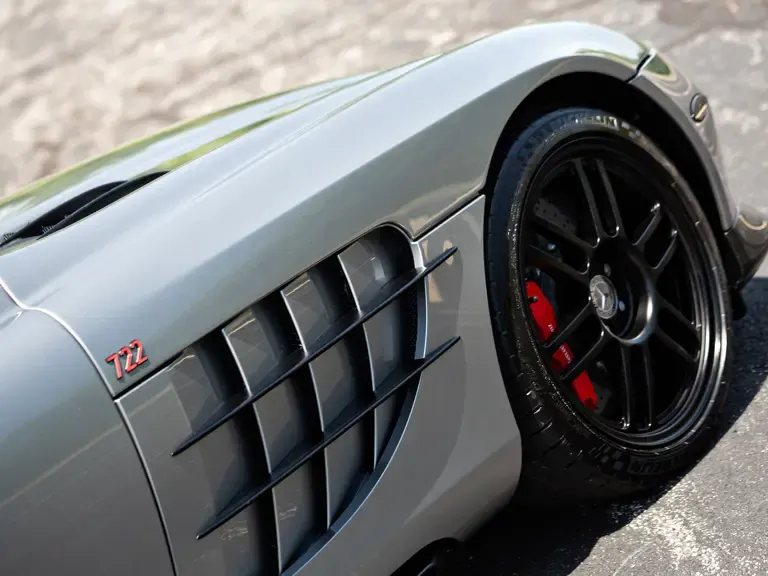
722 isn’t an engine size or a power figure or a factory code. It’s a time of day. Twenty-two minutes past seven in the morning. That was when Stirling Moss and his co-driver Denis Jenkinson set off to tear across Italy in the 1955 Mille Miglia. Every car in that race wore its exact start time as a race number, and Moss drew 722. What happened next became one of the foundational legends of the sport: nearly a thousand miles of Italian public road covered at a 98 mph average, a record smashed, a time never beaten before the race was banned two years later.
The car Moss drove was the Mercedes 300 SLR, sibling to the W196 grand prix machine that dominated 1955. A pure racing car, never sold to the public, with technology years ahead of anyone else. That same family of 300 SLR sat at the centre of one of motorsport’s darkest days that very summer, the reason Mercedes walked away from racing for decades. So when Mercedes stamped a red “722” on the wing of a 2000s supercar, it wasn’t decoration. It was the company reaching for the proudest, heaviest moment in its sporting history to sell a car its standard version had failed to sell on its own.
Cheeky? Maybe. But you have to admit it’s a beautiful piece of badge engineering.
What actually changed
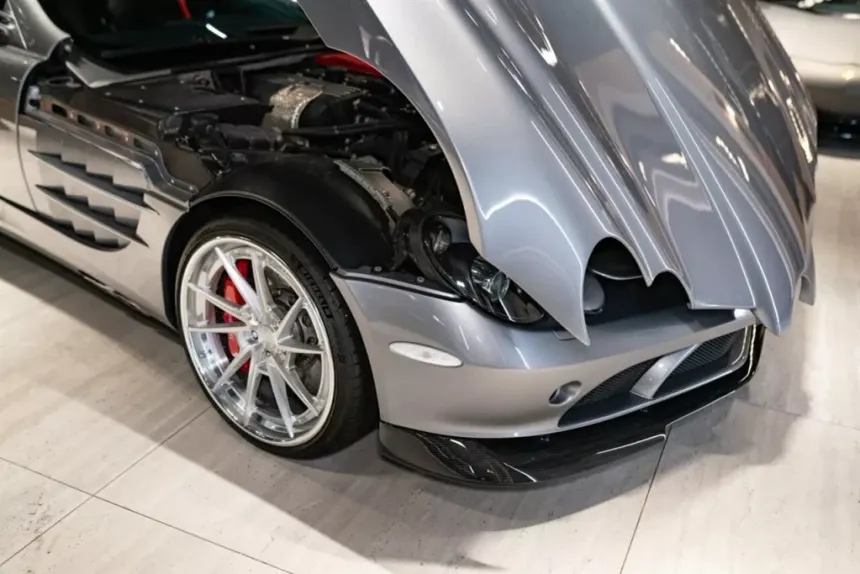
Here’s the part people get wrong. They assume the 722 was a sticker pack. A red badge, some trim, job done. It wasn’t. Over 300 components were changed from the standard SLR.
The heart stayed the same: the 5.4-litre supercharged AMG V8, hand-assembled under the “one man, one engine” creed. But Bosch remapped the engine management, the team sharpened it, and output climbed from 617 to 641 horsepower. Torque held at a colossal 605 lb-ft, available almost from idle, because a supercharger doesn’t make you wait for the revs the way a turbo does. You press, it shoves. Done.
But the engine was never the point of the 722. Everything else was.
A word on how it delivered all that grunt, because it shaped the car’s character more than the badge ever admitted. The 722 sent its power through a five-speed AMG Speedshift R automatic, which sounds antique next to the dual-clutch boxes that were about to take over the supercar world. It was not the last word in shift speed. But paired with a supercharged engine that piled on torque from almost nothing, it gave the 722 a very particular feel: not the snappy, digital, paddle-flick urgency of a modern hypercar, but a deep, immediate, almost analogue surge. You didn’t manage the powerband. You just leaned on it. For some that was the SLR’s weakness; for others it was the last honest muscle-car gesture buried inside a carbon-fibre European GT.
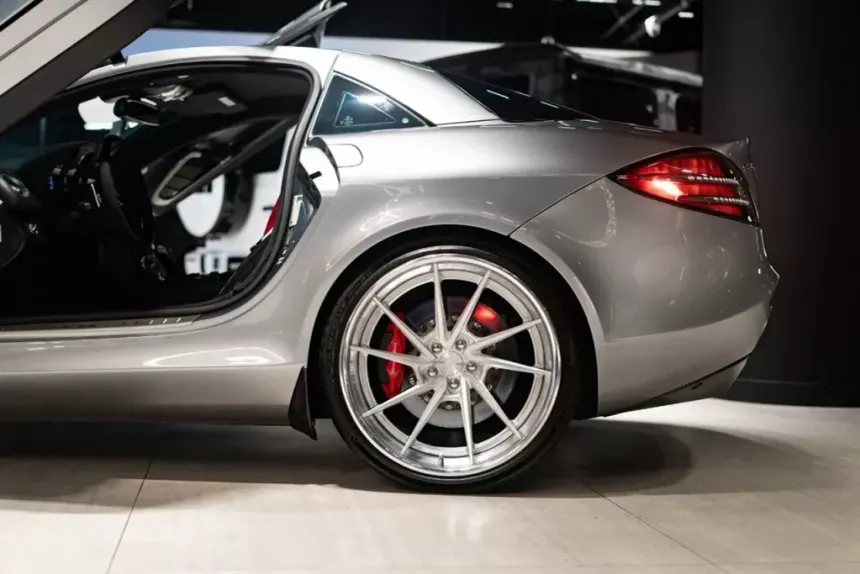
They dropped the car 10 millimetres. They stiffened the dampers. They fitted lighter 19-inch wheels to cut unsprung mass, the sort of change a driver feels without being able to explain it: less weight spinning at each corner means the suspension reads the road more finely and the car changes direction with less reluctance. Behind those wheels sat bigger carbon-ceramic brakes, 390 mm up front.
And then there’s the aero, which is where McLaren’s fingerprints are all over it. A new carbon-fibre front splitter increased front downforce by 128 percent. Read that again. Not 12, not 28. A hundred and twenty-eight percent more grip at the nose. And the genuinely clever bit: despite all that extra downforce, the 722’s drag coefficient actually went down. More grip and less drag at the same time. That isn’t a marketing line. That’s wind-tunnel work by people who know exactly what they’re doing.
The whole car shed around 44 kilos. Doesn’t sound dramatic on a car this heavy, but lose weight, drop the ride height, sharpen the aero and stiffen everything at once, and the effect doesn’t add up. It multiplies.
Why the SLR was heavy in the first place
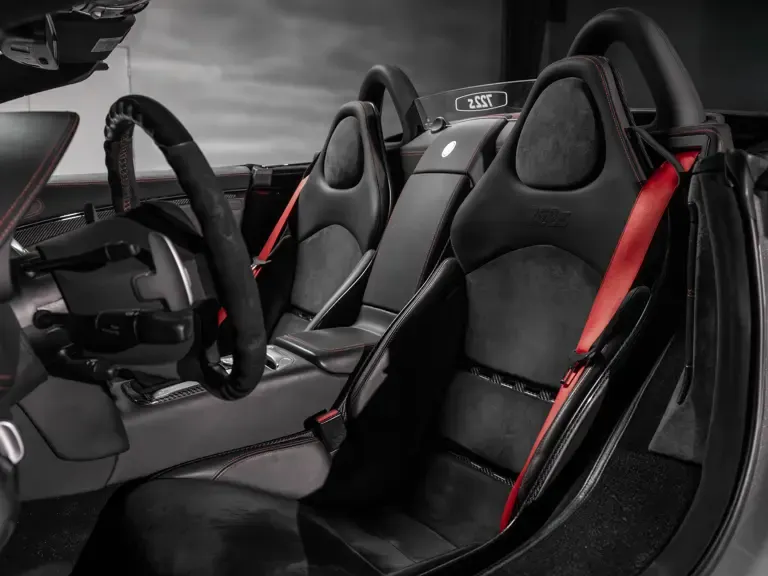
You can’t appreciate the 722 without understanding the standard car’s central flaw. The SLR was built around a carbon-fibre monocoque, the kind of structure that should make a car featherweight, like the McLaren F1. But Mercedes demanded a daily-usable, crash-tested, luxury-grade car. Air conditioning, sound deadening, safety systems, full kit. All of it weighs.
So they took a racing car’s chassis and hung an S-Class worth of equipment on it. The result had the structure of a supercar and the kerb weight of a heavy GT. That contradiction, the tension between what the chassis wanted to be and what the body was forced to carry, is exactly what the 722 set out to relieve, by stripping mass wherever it could.
The numbers, in context
Zero to 62 mph dropped to 3.6 seconds. Top speed sat north of 208 mph. Pedestrian figures by today’s standards, but this was the mid-2000s. To place the 722: the Ferrari 599 GTB Fiorano, the benchmark super-GT of the moment, claimed 3.7 seconds and just over 205 mph. The 722 looked it dead in the eye. And the Mercedes was heavier, dragging the baggage of that split-personality design, and still took the fight to Maranello on Maranello’s own turf.
That’s the whole thesis of the 722. Under that misunderstood GT, there was always a racing car waiting for permission to come out.
Three cars, one name
Quick clarification, because “722” can mean three different machines.
The one above is the 722 Edition Coupé: 150 units, launched at the 2006 Paris Motor Show. The famous one.
Then came the 722 S Roadster, the drop-top, another 150 units, all left-hand drive. A tenth slower to 62, at 3.7 seconds, and just 1 mph down on top speed. A fabric roof that folded itself away in under ten seconds. The same venom, with the sky overhead.
And then the proper animal: the 722 GT. Not a road car at all. Developed by British firm RML, Ray Mallock Ltd, at the request of SLR Club members who wanted to actually race. Just 21 built, track-only, no plates possible. Over 400 components redesigned, power up to 680 ps, everything heavy thrown out until it weighed 1,390 kg, built to run the SLR Club Trophy. Wide body, fixed wing, vast diffuser. Living proof that there was always a race car inside the SLR, hammering on the door.
The collector’s footnote that became the headline
Here’s the twist nobody saw coming at the time. The standard SLR was the hard sell. The 722, the more expensive, more focused, more uncompromising version, is the one the market eventually fell for. Of those 150 coupés, only around 25 are believed to have crossed to North America. Ten 722 Editions were reportedly commissioned by the King of Bahrain as gifts for fellow royals. The car that started life as damage control for slow sales turned into the most desirable SLR you could put on a driveway.
That’s the quiet justice of it. The version Mercedes built because the original wasn’t moving became the version everyone now chases. The market is brutally clear-eyed about these things in the long run. It rewards the car that committed to an idea over the car that hedged.
And the story didn’t end with the 722. Mercedes and McLaren had one more card to play, the most extreme of the entire line, a car with no roof and no windscreen, built in a tiny run of 75 and reserved only for existing SLR owners. They named it after the man himself: the SLR Stirling Moss. But that’s a different tale, and it deserves its own telling.
What the 722 really means
A closing thought, from a spanner-in-hand point of view rather than a press-release one.
The SLR McLaren was the first and last car Mercedes and McLaren built together. After it, they went their separate ways: Mercedes built the SLS AMG and then the AMG GT, McLaren built its own supercar factory and started writing history alone. The marriage ended. But before it did, it left the 722.
And that’s precisely why the 722 matters. It’s the moment that tense, ill-fitting partnership, that argument between two philosophies that never quite agreed, produced something whole. Because when they finally let McLaren win the argument, when they stopped trying to make the car plush and comfortable and just made it fast and brutal, out came the best SLR of all.
It wears Stirling Moss’s legend in its name, but the lesson isn’t really Moss’s. It’s older and simpler than that: a car has to know what it wants to be. The standard SLR didn’t. The 722 did. Which is why, nearly two decades on, it’s still the SLR people actually want in the garage.
Sometimes, for a car to find its soul, somebody has to win the argument. The 722 is the sound of that argument finally ending, and of the right side winning. Two decades later, the values tell the same story the chassis always did, and the badge on the wing turned out to mean exactly what it promised.