BMW M Ignite: the pre-chamber saving the S58 from Euro 7
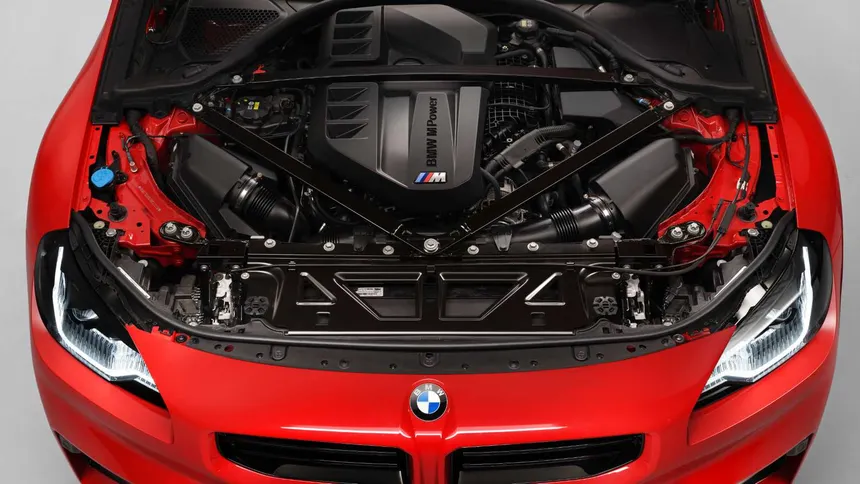
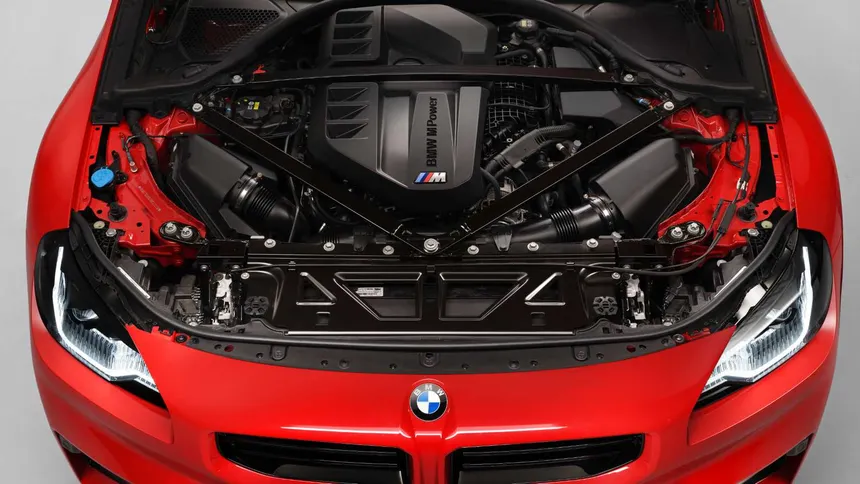
Picture a BMW M3 Competition rolling down a B-road in the Yorkshire Dales next Friday. Foot down, climbing through the curves. Under the bonnet, the S58 engine is doing exactly what it’s been doing for years: three litres, six cylinders in line, twin-turbo, 530 horsepower, that German-bruiser soundtrack that has defined the M brand for an entire generation.
Now picture the same M3 Competition built from July 2026 onwards. Same S58 engine. Same displacement. Same power. Same soundtrack. But inside the cylinder head, it now carries a part no road-going BMW has ever carried before: a combustion pre-chamber with its own spark plug and its own ignition coil. When you nail the throttle, instead of one ignition per cylinder, two ignition systems work in series, and flame jets shoot out at near sonic speed, igniting the mixture at multiple points at once.
BMW M calls it M Ignite. It’s the first time a road-going BMW M has carried this technology. And at NEC, three things deserve to be separated cleanly because almost no automotive press is doing it: what it does, why BMW is launching it now, and why BMW isn’t the first to bring this to tarmac.
What M Ignite is, in workshop language
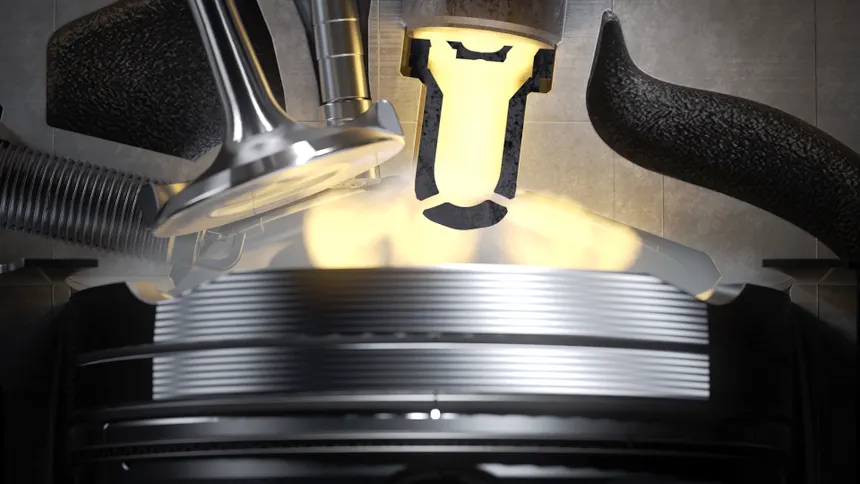
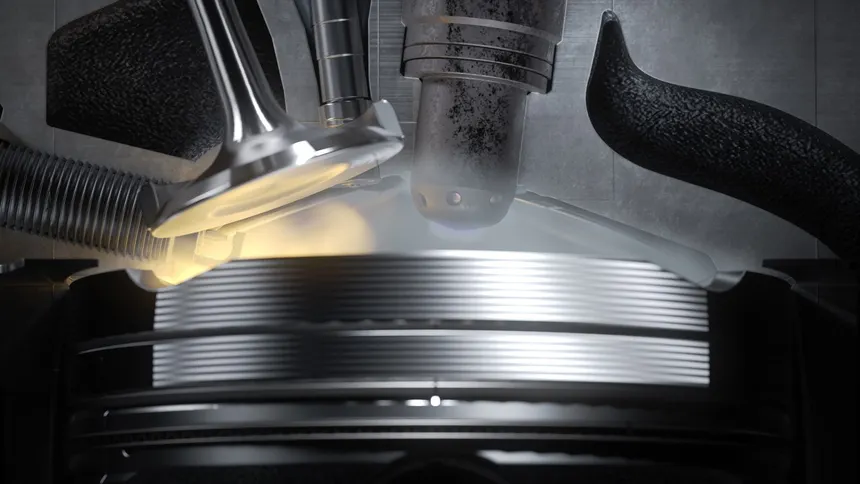
Let’s start with the hardware. M Ignite is a pre-chamber ignition system. Instead of the air-fuel mixture burning in a single space (the main combustion chamber, above the piston), it burns in two connected spaces. Above the main chamber sits a mini-chamber, separated from the larger cylinder by small openings called transfer ports. The pre-chamber has its own spark plug and its own ignition coil.
How it works in practice. At low and mid revs, BMW lets the engine work like a classic BMW: the conventional spark plug in the main chamber fires, ignites the mixture, the piston comes down, cycle complete. That matters for refinement in everyday driving, because conventional ignition is still smoother and more predictable at relaxed loads.
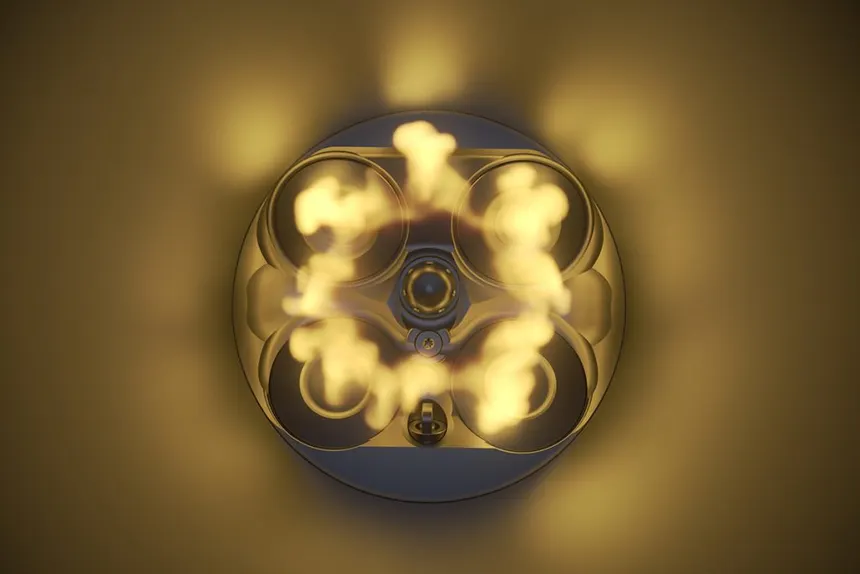
But when you climb the rev range and demand everything, the system swaps protagonists. The pre-chamber’s spark plug takes the lead. Part of the air-fuel mixture passes through the transfer ports into the pre-chamber, where it ignites first. The flames generated then shoot back into the main chamber through those same openings, but at near sonic speed, in several simultaneous jets. Those jets ignite the main mixture at multiple points at once, instead of from one single point as a conventional spark plug does.
What do you gain? Four verifiable things, all officially declared by BMW.
One. Combustion is faster and more complete. When you ignite at multiple points simultaneously, the flame front takes less time to cross the entire mixture. That means you convert more of the fuel’s energy into useful torque, and less into wasted heat.
Two. Exhaust gas temperature drops. If combustion is more efficient and faster, less heat exits through the exhaust. That matters enormously for turbocharger durability, catalytic converter life, and above all for the upcoming Euro 7 regulation that takes effect in November 2026.
Three. Knock risk (uncontrolled combustion, those metallic hammering sounds that destroy engines internally) drops dramatically. That allows you to raise the compression ratio without blowing the motor. And indeed, M Ignite comes paired with a higher compression ratio, another change BMW has declared officially.
Four. Fuel consumption under high load drops significantly. BMW says it without softening it: in track use, where the real customer of an M3 or M4 sits at full throttle for minutes at a time, the reduction is meaningful. Translated into pub English: your M3 will do more laps on the same tank at a track day.
There’s a fifth technical detail not being reported enough: M3, M4 and M2 cars with M Ignite also debut variable turbine geometry (VTG) turbochargers. It’s the first time a road-going BMW M carries VTG turbochargers on a petrol engine. The variable vanes optimise boost pressure at both low and high revs, almost completely eliminating turbo lag in the mid-rpm range. Combine pre-chamber, higher compression and VTG, and what you’re doing is redesigning the entire thermodynamics of the S58 without touching the official power figures.
Why BMW is launching it NOW and not earlier
This is the part an NEC reader has to understand properly, because without regulatory context none of it makes sense.
Euro 7 enters into force in November 2026. That isn’t opinion, it’s published EU law in the Official Journal. And Euro 7 isn’t just another tweak. Unlike previous standards, which measured emissions under standardised laboratory conditions, Euro 7 measures emissions under a much broader range of real driving conditions: cold start, aggressive driving, sustained full load. That is to say, the conditions M3s, M4s and M2s actually live in on track and on open road.
What problem does a current S58 have with Euro 7? Fuel consumption and emissions at full load. At 7,000 rpm with the throttle pinned to the floor, a conventional engine enriches the mixture to cool the combustion chamber by evaporating the fuel itself. That strategy, which protects the engine mechanically, sends unburnt hydrocarbon, CO and particulate emissions through the roof. That’s exactly what Euro 7 forbids.
M Ignite solves it. If combustion is faster, more complete, and exhaust temperature drops, you no longer need to enrich the mixture to protect mechanical components. That lets you meet Euro 7 without dropping power or shrinking displacement. Which is exactly what BMW promised years ago when it pledged the inline-six would survive whatever European regulation threw at it.
There’s another layer worth telling. In 2024, BMW patented the technology in-house. It’s not a third-party licence. It’s the intellectual property of BMW M GmbH, which means any rival wanting to implement an identical system will have to negotiate a licence or develop their own variant with enough differentiation. That’s an industrial moat several years deep.
The exact dates, no padding
For clarity, and in case you’re heading to a showroom:
M3 and M4 with M Ignite — all variants including Sedan, Touring, Competition, xDrive and CS — enter production in July 2026. This is official BMW Group Press.
M2 with M Ignite enters production in August 2026. One month later.
Displacement, power and torque stay identical to the outgoing engine. Zero changes on catalogue figures. What changes is what the customer notices when they push hard on track.
Meets Euro 7 from day one. Which is the only reason the S58 stays alive beyond November 2026.
What almost nobody is telling you: BMW isn’t the first
And here NEC puts a finger on the sore spot. Half the press coverage of M Ignite is leading with headlines saying BMW is “bringing F1 pre-chamber tech to the road”. That is half-true.
Pre-chamber combustion isn’t new. It has very concrete precedents worth knowing, especially because some are still alive.
Honda CVCC, 1970s. The first manufacturer to bring a production petrol engine with pre-chamber combustion to market was Honda. They called it CVCC: Compound Vortex Controlled Combustion. They put it in the Civic in 1972, in the Accord shortly after, and it was essentially the system that let Honda meet the US Clean Air Act standards of the time without needing a catalytic converter. It was a rich-mixture pre-chamber that ignited a lean main mixture. Same philosophy. Different purpose: cleaning emissions when catalysts weren’t yet reliable.
Formula 1, from 2014. When F1 switched to the 1.6-litre V6 turbo hybrid power units in 2014, the manufacturers (Mercedes, Ferrari, Renault, Honda) introduced pre-chamber ignition to achieve thermal efficiencies above 50%. That’s why pre-chamber is popularly associated with F1. But F1 didn’t invent it. It imported it from the lab and refined it to a brutal degree.
Maserati Nettuno, 2020. And here’s the data NEC has to put on the board. The first modern road-going engine to fit pre-chamber ignition isn’t BMW. It’s the Maserati Nettuno V6 twin-turbo, which debuted in the Maserati MC20 in September 2020 and still powers the MC20 Cielo and other GT models today. Three litres, twin-turbo, 630 horsepower, pre-chamber combustion with its own spark plug, derived directly from F1. Maserati patented it and brought it to production six years before BMW.
I’m not telling you this to wind up BMW. I’m telling you, the NEC reader, because the real industrial conversation is this: what BMW M is doing in 2026 isn’t a technical first. It’s a second generation with industrial scale. And that, in my view, is the most interesting part of the whole thing.
Maserati brought pre-chamber out first, yes, but they brought it out in a low-volume supercar. The MC20 is built in the hundreds per year. The BMW M3 is built in the tens of thousands. When BMW M decides to fit pre-chamber to its entire compact-bodied M range, it’s converting a low-volume Italian supercar technology into a German industrial-volume technology. That’s what shifts the map.
From July 2026, tens of thousands of M3s, M4s and M2s will be on European and American roads with pre-chamber combustion. That validates the technology at industrial scale. That funds the next generation of improvements. And that opens the door for every other European premium manufacturer to do the same. Mercedes-AMG, Audi RS, Porsche — they’re all watching. Not by coincidence, they all have to meet Euro 7 in November too.
The link to the NEC combustion hub
If you’ve read the six articles in the NEC combustion hub, this piece fits a very specific slot. Quick recap.
Toyota pours hydrogen motorsport R&D into its road-going GR Corolla. Philosophy: the road engine improves by racing.
BMW M, with M Ignite, does precisely the same, only in reverse. It takes a technology that’s been in F1 since 2014 and in the Maserati MC20 since 2020, patents its own variant, and drops it into your neighbour’s M3. Philosophy: what’s proven to work on track and in Italian supercars now gets democratised in a high-volume BMW.
And as we told you in the sixth pillar of the hub, this fits what Bosch, MAHLE and AVL have been doing for years: the European combustion engine is NOT dead — it’s being redirected to specific markets where regulation allows it, and optimised down to the last decimal of thermodynamics.
M Ignite is exactly that. A European petrol engine that stays alive thanks to a technology that existed years ago, brought for the first time to high-volume industrial production, just as European regulation was about to kill it.
Is it romantic engineering like Mazda‘s with the rotary? Not quite. It’s pragmatic German engineering. It’s BMW M saying: “the inline-six doesn’t die however hard regulation pushes, we’ll fit it with whatever technology it takes and here we stay.” And that, to an M3 buyer, is the only thing that matters.
The question I leave you
If BMW M Ignite isn’t a technical first, why does it matter? Because here’s what we value at NEC: what matters isn’t always who does something first, but who takes it to industrial scale and gives it real working life. Maserati opened the path. F1 polished it. But BMW M is the one putting pre-chamber into tens of thousands of private garages across Europe over the next decade.
And from here, expect Audi to announce its own variant. Expect Mercedes-AMG to release something similar for the M139 and for the next inline-six. Expect the entire European premium chain to replicate the move. Because when a high-volume German manufacturer validates a technology, the rest don’t take two years to follow.
The internal combustion engine in Europe isn’t dying in 2035. What’s happening is that it only survives if it transforms. And M Ignite is exactly the proof that the transformation is under way.
From July 2026, every time you hear an M3 Competition accelerate down a mountain road, beneath that soundtrack there are two spark plugs per cylinder working simultaneously. A small quiet revolution. And like almost every revolution in serious engineering, it arrives without headlines.
Check you’re still alive.